Decision Making: The Essence of Managers’ Job by Muhammad Iqbal Malik
Key Topics Introduction The Decision-making process Decision-making models Decision Styles A discussion on Group Decisions
Part I Introduction
Organizations Organizations are systems Involve people, structure and a common purpose Have limited resources Need to perform a series of functions to meet its objectives
Managers Managers are responsible for  effective  and  efficient  execution of these organizational functions. A typical manager performs a number of functions that are categorized as: Interpersonal Informational Decisional
Managers One of the key traits that distinguish managers from operatives is the ability to make  independent decisions .
Part II Decision-making
What is decision-making? The word decision is defined as: “ A choice between two or more alternatives ”. Thus decision-making can be defined as: “ the selection of a course of action from among alternatives   ”.
Decision-making Process Identifying a problem Identifying decision criteria Allocating weights to criteria Developing alternatives Analyzing alternatives Selecting an alternative Implementing the alternative Evaluation (of decision effectiveness)
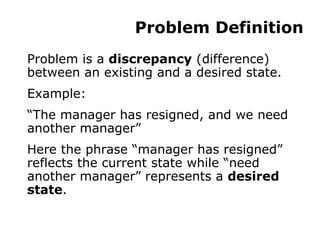
Problem Definition Problem is a  discrepancy  (difference) between an existing and a desired state.  Example: “ The manager has resigned, and we need another manager” Here the phrase “manager has resigned” reflects the current state while “need another manager” represents a  desired state .
Identifying Decision Criteria The word criteria, is defined as “ a  standard  by which something can be judged ”.  A decision criteria therefore, is the  basis  of a decision, which outlines the  relevant  and important factors for a decision. And implicitly, it also defines what is not important.
Decision Criteria: Example In the above-cited scenario, the decision criteria may include the following factors: Relevant qualifications Leadership skills Communication skills Planning and analytical skills Professional experience
Allocating Weights to Criteria The next step in the decision making process is  prioritization .  Prioritization is achieved by assigning quantitative  weights  to each criteria element.  The weightage defines the relative significance of each element.
Allocating Weights: Example
Developing Alternatives Involves defining the possible alternatives (or choices) that would resolve the problem. In our case, the alternatives would be a list of candidates or job applicants.
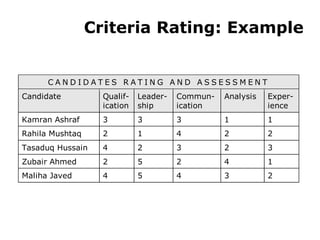
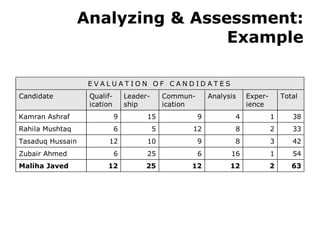
Analyzing Alternatives Alternatives are  rated  and  analyzed  on the basis of the criteria The rating can be based on a specified  scale , say 1 – 5 etc. Rating may be  subjective  in nature and thus,may depend on the judgment of the individual(s)
Criteria Rating: Example
Analyzing & Assessment: Example
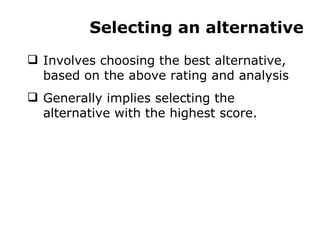
Selecting an alternative Involves choosing the best alternative, based on the above rating and analysis Generally implies selecting the alternative with the highest score.
Implementing the Alternative Putting the decision into action  Involves clear communication of the decision to all concerned and obtaining their commitment
Evaluation Evaluation forms an integral part of any process Involves evaluation of the outcome based on the desired goal and criteria Involves assessing the effectiveness and efficiency of the outcome (or the entire process) In case of any undesired results, each step of the process is carefully reviewed to trace the root causes
Decision-making Models Model “ A simplified representation or description of a system or complex entity ” Examples A model of a building A globe (Earth model)
Rational/Bounded Rational So Rational and Bounded Rational Models are  cognitive  models that describe how managers make rational decisions
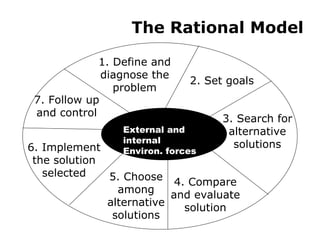
The Rational Model 2. Set goals External and internal  Environ. forces 1. Define and diagnose the problem 3. Search for alternative solutions 4. Compare and evaluate solution 5. Choose among alternative solutions 6. Implement the solution selected 7. Follow up and control
Rational Model: Assumptions Clear and unambiguous problem Single, well-defined goal All alternatives are known Clear  preferences  (ranking criteria) Constant/stable preferences No  time or cost constraints Decision will  maximize  payoff
Rational Model: Criticism Not all decisions made on  rational  basis Most problems, goals and preferences are not clear or well defined Not practical to know  all possible  alternatives Time and cost constraints exist in all practical problems Result  not maximized  in most cases
Bounded Rational: Assumptions Limited set of criteria Self-interest  influences ratings Limited no. of alternatives Alternatives are assessed  one at a time  till a  satisficing  (or good enough) alternative is found Politics  influences acceptance and commitment of decision
Intuition An unconscious process of making decisions on the basis of  experience  and  judgment
Intuition Involves  gut feeling May also have rational basis The “feeling” arises from  past  experience and knowledge Involves quicker response Does not involve  systematic  analysis
Decision Types Effective managers make various kinds of decisions. In general, these decisions are either Programmed decisions Non-programmed decisions
Programmed Decisions A decision that is repetitive and routine A definite method for its solution can be established Does not have to be treated a new each time it occurs Procedures are often already laid out Examples:  pricing standard customer orders, determining billing dates, recording office supplies etc.
Non-programmed Decisions A decision that is novel (new or unique) or Ill structured No established methods exist, because it has never occurred before or because It is too complex
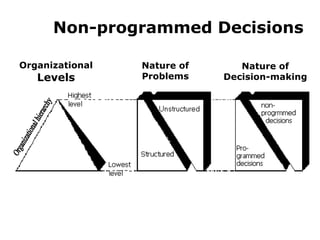
Non-programmed Decisions Organizational  Levels Nature of Problems Nature of Decision-making Organizational hierarchy
Non-programmed Decisions Are  “tough”  decisions that involve risk and uncertainty and  call for  entrepreneurial  abilities Such decisions draw heavily on the analytical abilities of the manager Examples:  Moving into a new market, investing in a new unproven technology, changing strategic direction
Decision Styles Decision-making, though a rational process does include some  subjective  elements Thus in real organizational settings, the quality of decision does depend on the ability,  style  and approach of the manager
Decision Styles: Directive Directive Represents  low tolerance  for ambiguity and uncertainty Reflects rational thinking of the manager Such decision styles are more suitable for routine procedural tasks
Decision Styles: Analytic Analytic Analytical style is also a rational style of thinking Involves a very  high tolerance  for ambiguity and uncertainty Such managers generally seek detailed information before making a decision
Decision Styles: Behavioural Behavioural Represents a  creative  way of thinking Involves a  low tolerance  for ambiguity or uncertainty Managers with a behavioural style introduce  “new”  ways of doing things
Decision Styles: Conceptual Conceptual Conceptual style also reflects a  creative  and intuitive way of thinking Conceptual style managers have a very  broad vision  and generally look at numerous alternatives for decision-making Focused on the long run and often result in creative outcomes or alternatives
Vroom and Yetton Model Vroom and Yetton have identified five decision styles for managers, and are classified as follows: Autocratic AI The decision is made  individually , using the information available to the individual only
Vroom and Yetton Model AII The manager obtains information from subordinates and  himself  makes the decision May or may not share with subordinates, the purpose of questions or the nature of problem  Subordinates  do not  play any role in problem definition or selection of alternatives
Vroom and Yetton Model Consultative CI The manager  shares  the problem with relevant subordinates individually Getting their input  individually  and not as a group. The manager then makes the decision  independently , and may or may not be influenced by the subordinates’ suggestions
Vroom and Yetton Model CII The problem is  shared  to subordinates in a group Their ideas and suggestions are sought in a  group  meeting The decision is then made by the manager which May or  may not  reflect the subordinates’ influence
Vroom and Yetton Model Group Consensus GI The problem is  shared  to subordinates as a  group Alternatives are generated and evaluated  collectively Effort is made to reach a  consensus
Vroom and Yetton Model GI (Contd.) The decision is made  collectively  and the manager functions as a coordinator Does not “press” the group in adopting the manager’s “solution” The manager is willing to  accept  and implement the decision of the group
Group Decision-making The factors requiring group decisions include: Involving  sensitive  issues High cost alternatives Involving very high risk factor Strategic impact
Group Decisions: Advantages Acceptance of group members Coordination is easier Communication is easier Existence of large alternatives More information can be processed Diversity of experience and perspectives
Group Decisions: Disadvantages Take longer time Group can be indecisive Groups can compromise Groups can be  dominated Groups can “ play games ” Victim to  Groupthink
Situational Factors for Individual Decision-making Short time Unimportant to group Manager can take decision Dominate the decision Destructive conflict Members hesitant
Situational Factors for Individual Decision-making Confidential data Incapability of members Manager’s dominance Indirect effect on group members
Situational Factors for  Group Decision-making Need for innovation and creativity Data collection Importance of acceptance Importance of solution Complex problem Democratic process
Situational Factors for  Group Decision-making Risk taking solution needed Better understanding Whole responsibility Feedback required
Improving Group  Decision-making Brainstorming Nominal group techniques Electronic meeting

Decision making

  • 1.
    Decision Making: TheEssence of Managers’ Job by Muhammad Iqbal Malik
  • 2.
    Key Topics IntroductionThe Decision-making process Decision-making models Decision Styles A discussion on Group Decisions
  • 3.
  • 4.
    Organizations Organizations aresystems Involve people, structure and a common purpose Have limited resources Need to perform a series of functions to meet its objectives
  • 5.
    Managers Managers areresponsible for effective and efficient execution of these organizational functions. A typical manager performs a number of functions that are categorized as: Interpersonal Informational Decisional
  • 6.
    Managers One ofthe key traits that distinguish managers from operatives is the ability to make independent decisions .
  • 7.
  • 8.
    What is decision-making?The word decision is defined as: “ A choice between two or more alternatives ”. Thus decision-making can be defined as: “ the selection of a course of action from among alternatives ”.
  • 9.
    Decision-making Process Identifyinga problem Identifying decision criteria Allocating weights to criteria Developing alternatives Analyzing alternatives Selecting an alternative Implementing the alternative Evaluation (of decision effectiveness)
  • 10.
    Problem Definition Problemis a discrepancy (difference) between an existing and a desired state. Example: “ The manager has resigned, and we need another manager” Here the phrase “manager has resigned” reflects the current state while “need another manager” represents a desired state .
  • 11.
    Identifying Decision CriteriaThe word criteria, is defined as “ a standard by which something can be judged ”. A decision criteria therefore, is the basis of a decision, which outlines the relevant and important factors for a decision. And implicitly, it also defines what is not important.
  • 12.
    Decision Criteria: ExampleIn the above-cited scenario, the decision criteria may include the following factors: Relevant qualifications Leadership skills Communication skills Planning and analytical skills Professional experience
  • 13.
    Allocating Weights toCriteria The next step in the decision making process is prioritization . Prioritization is achieved by assigning quantitative weights to each criteria element. The weightage defines the relative significance of each element.
  • 14.
  • 15.
    Developing Alternatives Involvesdefining the possible alternatives (or choices) that would resolve the problem. In our case, the alternatives would be a list of candidates or job applicants.
  • 16.
    Analyzing Alternatives Alternativesare rated and analyzed on the basis of the criteria The rating can be based on a specified scale , say 1 – 5 etc. Rating may be subjective in nature and thus,may depend on the judgment of the individual(s)
  • 17.
  • 18.
  • 19.
    Selecting an alternativeInvolves choosing the best alternative, based on the above rating and analysis Generally implies selecting the alternative with the highest score.
  • 20.
    Implementing the AlternativePutting the decision into action Involves clear communication of the decision to all concerned and obtaining their commitment
  • 21.
    Evaluation Evaluation formsan integral part of any process Involves evaluation of the outcome based on the desired goal and criteria Involves assessing the effectiveness and efficiency of the outcome (or the entire process) In case of any undesired results, each step of the process is carefully reviewed to trace the root causes
  • 22.
    Decision-making Models Model“ A simplified representation or description of a system or complex entity ” Examples A model of a building A globe (Earth model)
  • 23.
    Rational/Bounded Rational SoRational and Bounded Rational Models are cognitive models that describe how managers make rational decisions
  • 24.
    The Rational Model2. Set goals External and internal Environ. forces 1. Define and diagnose the problem 3. Search for alternative solutions 4. Compare and evaluate solution 5. Choose among alternative solutions 6. Implement the solution selected 7. Follow up and control
  • 25.
    Rational Model: AssumptionsClear and unambiguous problem Single, well-defined goal All alternatives are known Clear preferences (ranking criteria) Constant/stable preferences No time or cost constraints Decision will maximize payoff
  • 26.
    Rational Model: CriticismNot all decisions made on rational basis Most problems, goals and preferences are not clear or well defined Not practical to know all possible alternatives Time and cost constraints exist in all practical problems Result not maximized in most cases
  • 27.
    Bounded Rational: AssumptionsLimited set of criteria Self-interest influences ratings Limited no. of alternatives Alternatives are assessed one at a time till a satisficing (or good enough) alternative is found Politics influences acceptance and commitment of decision
  • 28.
    Intuition An unconsciousprocess of making decisions on the basis of experience and judgment
  • 29.
    Intuition Involves gut feeling May also have rational basis The “feeling” arises from past experience and knowledge Involves quicker response Does not involve systematic analysis
  • 30.
    Decision Types Effectivemanagers make various kinds of decisions. In general, these decisions are either Programmed decisions Non-programmed decisions
  • 31.
    Programmed Decisions Adecision that is repetitive and routine A definite method for its solution can be established Does not have to be treated a new each time it occurs Procedures are often already laid out Examples: pricing standard customer orders, determining billing dates, recording office supplies etc.
  • 32.
    Non-programmed Decisions Adecision that is novel (new or unique) or Ill structured No established methods exist, because it has never occurred before or because It is too complex
  • 33.
    Non-programmed Decisions Organizational Levels Nature of Problems Nature of Decision-making Organizational hierarchy
  • 34.
    Non-programmed Decisions Are “tough” decisions that involve risk and uncertainty and call for entrepreneurial abilities Such decisions draw heavily on the analytical abilities of the manager Examples: Moving into a new market, investing in a new unproven technology, changing strategic direction
  • 35.
    Decision Styles Decision-making,though a rational process does include some subjective elements Thus in real organizational settings, the quality of decision does depend on the ability, style and approach of the manager
  • 36.
    Decision Styles: DirectiveDirective Represents low tolerance for ambiguity and uncertainty Reflects rational thinking of the manager Such decision styles are more suitable for routine procedural tasks
  • 37.
    Decision Styles: AnalyticAnalytic Analytical style is also a rational style of thinking Involves a very high tolerance for ambiguity and uncertainty Such managers generally seek detailed information before making a decision
  • 38.
    Decision Styles: BehaviouralBehavioural Represents a creative way of thinking Involves a low tolerance for ambiguity or uncertainty Managers with a behavioural style introduce “new” ways of doing things
  • 39.
    Decision Styles: ConceptualConceptual Conceptual style also reflects a creative and intuitive way of thinking Conceptual style managers have a very broad vision and generally look at numerous alternatives for decision-making Focused on the long run and often result in creative outcomes or alternatives
  • 40.
    Vroom and YettonModel Vroom and Yetton have identified five decision styles for managers, and are classified as follows: Autocratic AI The decision is made individually , using the information available to the individual only
  • 41.
    Vroom and YettonModel AII The manager obtains information from subordinates and himself makes the decision May or may not share with subordinates, the purpose of questions or the nature of problem Subordinates do not play any role in problem definition or selection of alternatives
  • 42.
    Vroom and YettonModel Consultative CI The manager shares the problem with relevant subordinates individually Getting their input individually and not as a group. The manager then makes the decision independently , and may or may not be influenced by the subordinates’ suggestions
  • 43.
    Vroom and YettonModel CII The problem is shared to subordinates in a group Their ideas and suggestions are sought in a group meeting The decision is then made by the manager which May or may not reflect the subordinates’ influence
  • 44.
    Vroom and YettonModel Group Consensus GI The problem is shared to subordinates as a group Alternatives are generated and evaluated collectively Effort is made to reach a consensus
  • 45.
    Vroom and YettonModel GI (Contd.) The decision is made collectively and the manager functions as a coordinator Does not “press” the group in adopting the manager’s “solution” The manager is willing to accept and implement the decision of the group
  • 46.
    Group Decision-making Thefactors requiring group decisions include: Involving sensitive issues High cost alternatives Involving very high risk factor Strategic impact
  • 47.
    Group Decisions: AdvantagesAcceptance of group members Coordination is easier Communication is easier Existence of large alternatives More information can be processed Diversity of experience and perspectives
  • 48.
    Group Decisions: DisadvantagesTake longer time Group can be indecisive Groups can compromise Groups can be dominated Groups can “ play games ” Victim to Groupthink
  • 49.
    Situational Factors forIndividual Decision-making Short time Unimportant to group Manager can take decision Dominate the decision Destructive conflict Members hesitant
  • 50.
    Situational Factors forIndividual Decision-making Confidential data Incapability of members Manager’s dominance Indirect effect on group members
  • 51.
    Situational Factors for Group Decision-making Need for innovation and creativity Data collection Importance of acceptance Importance of solution Complex problem Democratic process
  • 52.
    Situational Factors for Group Decision-making Risk taking solution needed Better understanding Whole responsibility Feedback required
  • 53.
    Improving Group Decision-making Brainstorming Nominal group techniques Electronic meeting