




Decision Making
• Decision
  – Making a choice from two or more alternatives.
• The Decision-Making Process
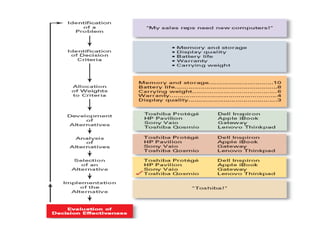
  – Identifying a problem and decision criteria and
    allocating weights to the criteria.
  – Developing, analyzing, and selecting an alternative
    that can resolve the problem.
  – Implementing the selected alternative.
  – Evaluating the decision’s effectiveness.
Step 1: Identifying the Problem
• Problem
  – A discrepancy between an existing and desired state
    of affairs.
• Characteristics of Problems
  – A problem becomes a problem when a manager
    becomes aware of it.
  – There is pressure to solve the problem.
  – The manager must have the authority, information, or
    resources needed to solve the problem.
Step 2: Identifying Decision Criteria
• Decision criteria are factors that are
  important (relevant) to resolving the
  problem.
  – Costs that will be incurred (investments
    required)
  – Risks likely to be encountered (chance of
    failure)
  – Outcomes that are desired (growth of the firm)
Step 3: Allocating Weights to the
               Criteria
• Decision criteria are not of equal
  importance:
  – Assigning a weight to each item places the
    items in the correct priority order of their
    importance in the decision making process.
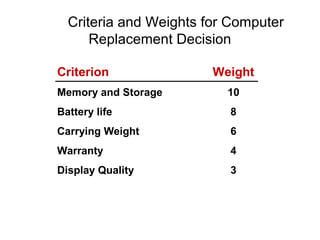
Criteria and Weights for Computer
      Replacement Decision

Criterion               Weight
Memory and Storage        10
Battery life              8
Carrying Weight           6
Warranty                  4
Display Quality           3
Step 4: Developing Alternatives
• Identifying viable alternatives
  – Alternatives are listed (without evaluation) that
    can resolve the problem.
Step 5: Analyzing Alternatives
• Appraising each alternative’s strengths
  and weaknesses
  – An alternative’s appraisal is based on its
    ability to resolve the issues identified in steps
    2 and 3.
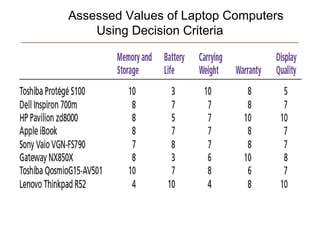
Assessed Values of Laptop Computers
    Using Decision Criteria
Step 6: Selecting an Alternative
• Choosing the best alternative
  – The alternative with the highest total weight is
    chosen.
Step 7: Implementing the
             Alternative
• Putting the chosen alternative into action.
  – Conveying the decision to and gaining
    commitment from those who will carry out the
    decision.
Step 8: Evaluating the Decision’s
          Effectiveness
• The soundness of the decision is judged
  by its outcomes.
  – How effectively was the problem resolved by
    outcomes resulting from the chosen
    alternatives?
  – If the problem was not resolved, what went
    wrong?
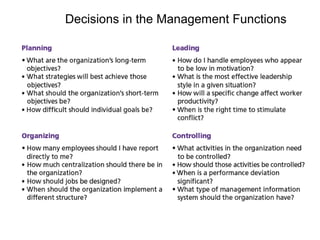
Decisions in the Management Functions
Types of Problems and Decisions
• Structured Problems
  – Involve goals that clear.
  – Are familiar (have occurred before).
  – Are easily and completely defined—information about
    the problem is available and complete.

• Programmed Decision
  – A repetitive decision that can be handled by a routine
    approach.
Types of Programmed Decisions
• Policy
  – A general guideline for making a decision about a
    structured problem.
• Procedure
  – A series of interrelated steps that a manager can use
    to respond (applying a policy) to a structured problem.
• Rule
  – An explicit statement that limits what a manager or
    employee can or cannot do.
Policy, Procedure, and Rule
              Examples
• Policy
  – Accept all customer-returned merchandise.

• Procedure
  – Follow all steps for completing merchandise return
    documentation.

• Rules
  – Managers must approve all refunds over $50.00.
  – No credit purchases are refunded for cash.
Problems and Decisions (cont’d)
• Unstructured Problems
  – Problems that are new or unusual and for which
    information is ambiguous or incomplete.
  – Problems that will require custom-made solutions.

• Nonprogrammed Decisions
  – Decisions that are unique and nonrecurring.
  – Decisions that generate unique responses.
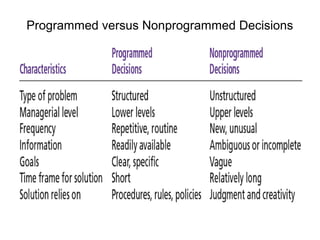
Programmed versus Nonprogrammed Decisions
Models of decision making
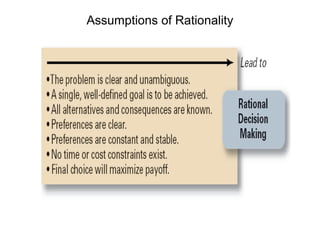
• Rationality
  – Managers make consistent, value-maximizing
    choices with specified constraints.
  – Assumptions are that decision makers:
     • Are perfectly rational, fully objective, and logical.
     • Have carefully defined the problem and identified
       all viable alternatives.
     • Have a clear and specific goal
     • Will select the alternative that maximizes outcomes
       in the organization’s interests rather than in their
       personal interests.
Assumptions of Rationality
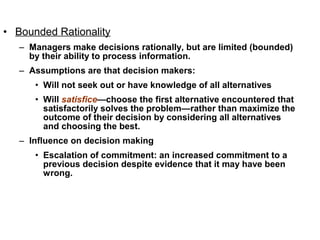
• Bounded Rationality
   – Managers make decisions rationally, but are limited (bounded)
     by their ability to process information.
   – Assumptions are that decision makers:
      • Will not seek out or have knowledge of all alternatives
      • Will satisfice—choose the first alternative encountered that
        satisfactorily solves the problem—rather than maximize the
        outcome of their decision by considering all alternatives
        and choosing the best.
   – Influence on decision making
      • Escalation of commitment: an increased commitment to a
        previous decision despite evidence that it may have been
        wrong.
The Role of Intuition
• Intuitive decision making
  – Making decisions on the basis of experience,
    feelings, and accumulated judgment.
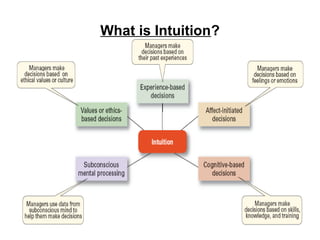
What is Intuition?
Decision-Making Styles

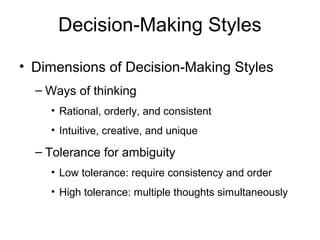
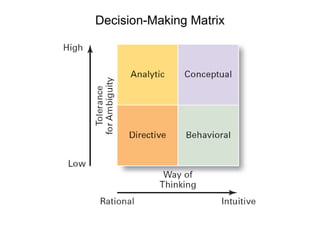
• Dimensions of Decision-Making Styles
  – Ways of thinking
    • Rational, orderly, and consistent
    • Intuitive, creative, and unique

  – Tolerance for ambiguity
    • Low tolerance: require consistency and order
    • High tolerance: multiple thoughts simultaneously
Decision-Making Styles (cont’d)

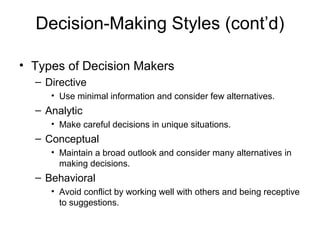
• Types of Decision Makers
  – Directive
     • Use minimal information and consider few alternatives.
  – Analytic
     • Make careful decisions in unique situations.
  – Conceptual
     • Maintain a broad outlook and consider many alternatives in
       making decisions.
  – Behavioral
     • Avoid conflict by working well with others and being receptive
       to suggestions.
Decision-Making Matrix
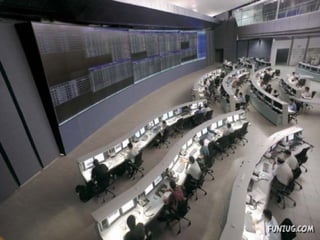
GUESS, WHICH COMPANY THIS COULD BE???
AMAZING .......................................
        .....................
Still thinking...................... .............
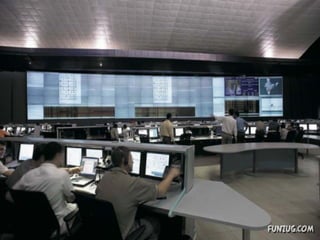
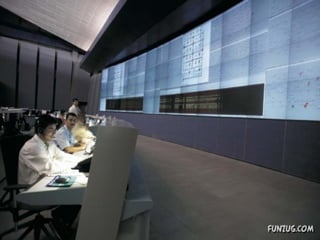
RELIANCE COMMUNICATIONS (NOC
          ) MUMBAI

  Biggest Group of India and World
          Wide Rank 87.... 

 Fact File: Situated in Metgalli City
Mysore its Worlds 2nd Biggest Screen
           just after NASA.

Mainly Built to have look into Fiber
Optic Cable laid down all over India .

It mainly used By Fault Detection and
        Quick Response Cell .

The facility has some of World's finest
  Technologies attached within it .

 It has fully functional Helipad too...

Decision making class

  • 1.
    Decision Making • Decision – Making a choice from two or more alternatives. • The Decision-Making Process – Identifying a problem and decision criteria and allocating weights to the criteria. – Developing, analyzing, and selecting an alternative that can resolve the problem. – Implementing the selected alternative. – Evaluating the decision’s effectiveness.
  • 3.
    Step 1: Identifyingthe Problem • Problem – A discrepancy between an existing and desired state of affairs. • Characteristics of Problems – A problem becomes a problem when a manager becomes aware of it. – There is pressure to solve the problem. – The manager must have the authority, information, or resources needed to solve the problem.
  • 4.
    Step 2: IdentifyingDecision Criteria • Decision criteria are factors that are important (relevant) to resolving the problem. – Costs that will be incurred (investments required) – Risks likely to be encountered (chance of failure) – Outcomes that are desired (growth of the firm)
  • 5.
    Step 3: AllocatingWeights to the Criteria • Decision criteria are not of equal importance: – Assigning a weight to each item places the items in the correct priority order of their importance in the decision making process.
  • 6.
    Criteria and Weightsfor Computer Replacement Decision Criterion Weight Memory and Storage 10 Battery life 8 Carrying Weight 6 Warranty 4 Display Quality 3
  • 7.
    Step 4: DevelopingAlternatives • Identifying viable alternatives – Alternatives are listed (without evaluation) that can resolve the problem.
  • 8.
    Step 5: AnalyzingAlternatives • Appraising each alternative’s strengths and weaknesses – An alternative’s appraisal is based on its ability to resolve the issues identified in steps 2 and 3.
  • 9.
    Assessed Values ofLaptop Computers Using Decision Criteria
  • 10.
    Step 6: Selectingan Alternative • Choosing the best alternative – The alternative with the highest total weight is chosen.
  • 11.
    Step 7: Implementingthe Alternative • Putting the chosen alternative into action. – Conveying the decision to and gaining commitment from those who will carry out the decision.
  • 12.
    Step 8: Evaluatingthe Decision’s Effectiveness • The soundness of the decision is judged by its outcomes. – How effectively was the problem resolved by outcomes resulting from the chosen alternatives? – If the problem was not resolved, what went wrong?
  • 13.
    Decisions in theManagement Functions
  • 14.
    Types of Problemsand Decisions • Structured Problems – Involve goals that clear. – Are familiar (have occurred before). – Are easily and completely defined—information about the problem is available and complete. • Programmed Decision – A repetitive decision that can be handled by a routine approach.
  • 15.
    Types of ProgrammedDecisions • Policy – A general guideline for making a decision about a structured problem. • Procedure – A series of interrelated steps that a manager can use to respond (applying a policy) to a structured problem. • Rule – An explicit statement that limits what a manager or employee can or cannot do.
  • 16.
    Policy, Procedure, andRule Examples • Policy – Accept all customer-returned merchandise. • Procedure – Follow all steps for completing merchandise return documentation. • Rules – Managers must approve all refunds over $50.00. – No credit purchases are refunded for cash.
  • 17.
    Problems and Decisions(cont’d) • Unstructured Problems – Problems that are new or unusual and for which information is ambiguous or incomplete. – Problems that will require custom-made solutions. • Nonprogrammed Decisions – Decisions that are unique and nonrecurring. – Decisions that generate unique responses.
  • 18.
  • 19.
    Models of decisionmaking • Rationality – Managers make consistent, value-maximizing choices with specified constraints. – Assumptions are that decision makers: • Are perfectly rational, fully objective, and logical. • Have carefully defined the problem and identified all viable alternatives. • Have a clear and specific goal • Will select the alternative that maximizes outcomes in the organization’s interests rather than in their personal interests.
  • 20.
  • 21.
    • Bounded Rationality – Managers make decisions rationally, but are limited (bounded) by their ability to process information. – Assumptions are that decision makers: • Will not seek out or have knowledge of all alternatives • Will satisfice—choose the first alternative encountered that satisfactorily solves the problem—rather than maximize the outcome of their decision by considering all alternatives and choosing the best. – Influence on decision making • Escalation of commitment: an increased commitment to a previous decision despite evidence that it may have been wrong.
  • 22.
    The Role ofIntuition • Intuitive decision making – Making decisions on the basis of experience, feelings, and accumulated judgment.
  • 23.
  • 24.
    Decision-Making Styles • Dimensionsof Decision-Making Styles – Ways of thinking • Rational, orderly, and consistent • Intuitive, creative, and unique – Tolerance for ambiguity • Low tolerance: require consistency and order • High tolerance: multiple thoughts simultaneously
  • 25.
    Decision-Making Styles (cont’d) •Types of Decision Makers – Directive • Use minimal information and consider few alternatives. – Analytic • Make careful decisions in unique situations. – Conceptual • Maintain a broad outlook and consider many alternatives in making decisions. – Behavioral • Avoid conflict by working well with others and being receptive to suggestions.
  • 26.
  • 27.
    GUESS, WHICH COMPANYTHIS COULD BE???
  • 29.
  • 31.
  • 36.
    RELIANCE COMMUNICATIONS (NOC ) MUMBAI Biggest Group of India and World Wide Rank 87....  Fact File: Situated in Metgalli City Mysore its Worlds 2nd Biggest Screen just after NASA. Mainly Built to have look into Fiber Optic Cable laid down all over India . It mainly used By Fault Detection and Quick Response Cell . The facility has some of World's finest Technologies attached within it . It has fully functional Helipad too...