Mgt 101

Planning
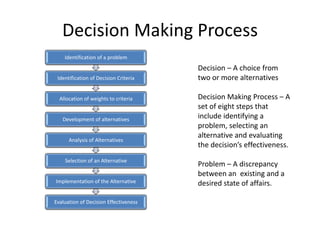
Decision Making Process
    Identification of a problem
                                       Decision – A choice from
 Identification of Decision Criteria   two or more alternatives

  Allocation of weights to criteria    Decision Making Process – A
                                       set of eight steps that
   Development of alternatives         include identifying a
                                       problem, selecting an
                                       alternative and evaluating
      Analysis of Alternatives
                                       the decision’s effectiveness.
    Selection of an Alternative
                                       Problem – A discrepancy
                                       between an existing and a
Implementation of the Alternative      desired state of affairs.

Evaluation of Decision Effectiveness
Making Decisions
Rational Decision Making – Decision-making
  behaviour where choices are consistent and
  value-maximizing within specified constraints.

Intuitive decision making – Making decisions on
  the basis of experience, feelings and accumulated
  judgment.

Programmed Decision – A repetitive decision that
  can be handled by a routing approach.
Decide?
Structured Problems – Straightforward, familiar, and
   easily defined problems.

Procedure – A series of interrelated sequential steps that
  can be used to respond to a well-structured problem.

Rule – An explicit statement that tells managers what
  they can or cannot do.

Policy – A guideline for making decisions.
Decision Making Conditions
Certainty – A situation in which a manager can
  make accurate decisions because all outcomes
  are known.

Risk – A situation in which the decision maker is
  able to estimate the likelihood of certain
  outcomes.

Uncertainty –A situation in which a decision maker
 has neither certainty nor reasonable probability
 estimates available.
Common Decision-Making Errors
Anchoring Effect – Describes when decision makers
  fixate on initial information as a starting point
  and then, once set, fail to adequately adjust for
  subsequent information.
Selective Perception Bias – Decision makers
  selectively organize and interpret events based
  on their biased perceptions.
Availability Bias – Decision makers tend to
  remember events that are the most recent and
  vivid in their memory.
Common Decision-Making Errors
           • Self serving

         • Overconfidence

      • Immediate Gratification

           • Randomness
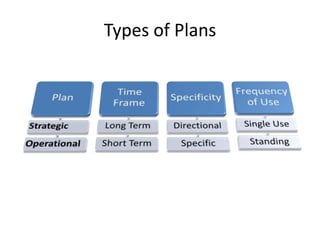
Types of Plans
Plans
Strategic Plans – Plans that apply to the entire
   organization, establish the organization’s overall goals
   and seek to position the organization in terms of its
   environment.

Operational Plans – Plans that specify the details of how
  the overall goals are to be achieved.
=============================================
Long-term – Plans with a time frame beyond 3 years.

Short-term – Plans covering 1 year or less.
What is Planning?
Defining organization’s goals, establishing overall
  strategy and developing plans.

Reasons:
  1. Provides Direction
  2. Reduces Uncertainty
  3. Minimizes waste and redundancy
  4. Establishes goals and objectives
  5. Is associated with positive financial results.

Mgt 101 planning

  • 1.
  • 2.
    Decision Making Process Identification of a problem Decision – A choice from Identification of Decision Criteria two or more alternatives Allocation of weights to criteria Decision Making Process – A set of eight steps that Development of alternatives include identifying a problem, selecting an alternative and evaluating Analysis of Alternatives the decision’s effectiveness. Selection of an Alternative Problem – A discrepancy between an existing and a Implementation of the Alternative desired state of affairs. Evaluation of Decision Effectiveness
  • 3.
    Making Decisions Rational DecisionMaking – Decision-making behaviour where choices are consistent and value-maximizing within specified constraints. Intuitive decision making – Making decisions on the basis of experience, feelings and accumulated judgment. Programmed Decision – A repetitive decision that can be handled by a routing approach.
  • 4.
    Decide? Structured Problems –Straightforward, familiar, and easily defined problems. Procedure – A series of interrelated sequential steps that can be used to respond to a well-structured problem. Rule – An explicit statement that tells managers what they can or cannot do. Policy – A guideline for making decisions.
  • 5.
    Decision Making Conditions Certainty– A situation in which a manager can make accurate decisions because all outcomes are known. Risk – A situation in which the decision maker is able to estimate the likelihood of certain outcomes. Uncertainty –A situation in which a decision maker has neither certainty nor reasonable probability estimates available.
  • 6.
    Common Decision-Making Errors AnchoringEffect – Describes when decision makers fixate on initial information as a starting point and then, once set, fail to adequately adjust for subsequent information. Selective Perception Bias – Decision makers selectively organize and interpret events based on their biased perceptions. Availability Bias – Decision makers tend to remember events that are the most recent and vivid in their memory.
  • 7.
    Common Decision-Making Errors • Self serving • Overconfidence • Immediate Gratification • Randomness
  • 8.
  • 9.
    Plans Strategic Plans –Plans that apply to the entire organization, establish the organization’s overall goals and seek to position the organization in terms of its environment. Operational Plans – Plans that specify the details of how the overall goals are to be achieved. ============================================= Long-term – Plans with a time frame beyond 3 years. Short-term – Plans covering 1 year or less.
  • 10.
    What is Planning? Definingorganization’s goals, establishing overall strategy and developing plans. Reasons: 1. Provides Direction 2. Reduces Uncertainty 3. Minimizes waste and redundancy 4. Establishes goals and objectives 5. Is associated with positive financial results.