Organic Pedagogical Electronic
Network
Deciphering Reaction Mechanism
with Intermediate Trapping
Shuangyu Ma & Yiling Bi
University of Utah
Identifying mechanism with intermediate trapping
Overview:
A reactive intermediate is a short-lived, high-energy, highly
reactive molecule. When generated in a chemical reaction, it
will quickly convert into a more stable molecule. When their
existence is indicated, reactive intermediates can help explain
how a chemical reaction takes place.
Wiki Page: http://en.wikipedia.org/wiki/Reactive_intermediate
Other References: Young, P. R.; Jencks, W. P. J. Am. Chem. Soc. 1977, 8238; Cordes, E.; Bull, H. Chem. Rev. 1974, 74,
581; Fife, T. Acc. Chem. Res. 1972, 78, 264.
Wiki Page: http://en.wikipedia.org/wiki/Reactive_intermediate
Other References: Young, P. R.; Jencks, W. P. J. Am. Chem. Soc. 1977, 8238; Cordes, E.; Bull, H. Chem. Rev. 1974, 74,
581; Fife, T. Acc. Chem. Res. 1972, 78, 264.
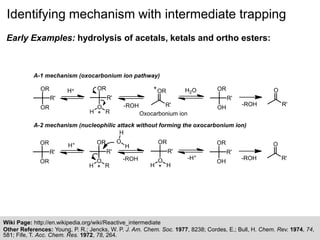
Early Examples: hydrolysis of acetals, ketals and ortho esters:
Identifying mechanism with intermediate trapping
Wiki Page: http://en.wikipedia.org/wiki/Reactive_intermediate
Other References: Young, P. R.; Jencks, W. P. J. Am. Chem. Soc. 1977, 8238; Cordes, E.; Bull, H. Chem. Rev. 1974, 74,
581; Fife, T. Acc. Chem. Res. 1972, 78, 264.
Trapping of the oxocarbonium ion intermediate by sulfite dianion:
Identifying mechanism with intermediate trapping
• Results: achieved up to 97% trapping; rate constants for
acid-catalyzed cleavage of ketals are independent of
[SO3
2-] (Table 1).
• Conclusion: [SO3
2-] is not present in the TS of the RLS.
Reaction proceeds through the oxocarbonium ion
pathway.
H2O
R'
OR
Oxocarbonium ion
OH
OR
R'
R'
O
SO3
2-
SO3
-
OR
R'
Disulfide buffer
OR
OR
R'
Monitor absorbance change at 262 nm
Identifying mechanism with intermediate trapping
References: Haberfield, P. J. Am. Chem. Soc. 1995, 3314; Bank, S.; Noyd, D. A. J. Am. Chem. Soc. 1973, 95,
8203.
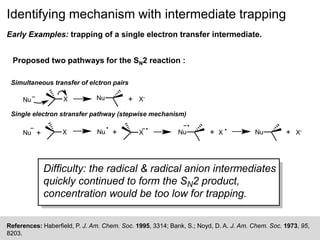
Proposed two pathways for the SN2 reaction :
Nu X-X Nu +
Simultaneous transfer of elctron pairs
Single electron stransfer pathway (stepwise mechanism)
XNu +Nu X Nu+ X+ X-Nu +
Difficulty: the radical & radical anion intermediates
quickly continued to form the SN2 product,
concentration would be too low for trapping.
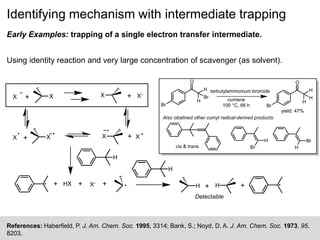
Early Examples: trapping of a single electron transfer intermediate.
Identifying mechanism with intermediate trapping
References: Haberfield, P. J. Am. Chem. Soc. 1995, 3314; Bank, S.; Noyd, D. A. J. Am. Chem. Soc. 1973, 95,
8203.
Early Examples: trapping of a single electron transfer intermediate.
Using identity reaction and very large concentration of scavenger (as solvent).
Br
H
O
Br
H
Br
H
O
Br
H
H
Hterbutylammonium bromide
cumene
100 °C, 66 h
H
Br
Also obatined other cumyl radical-derived products:
yield: 47%
cis & trans
Detectable
X+ X-X +X
X+X XX +
H
HX+ + X- +
H
H H ++
Application of intermediate trapping in understanding enzyme catalyzed
complex reaction mechanism
References: Mehta, A. P.; Abdelwahed, S. H.; Xu, H.; Begley, T. P. J. Am. Chem. Soc. 2014, 136, 10609;
Mehta, A. P.; Abdelwahed, S. H.; Begley, T. P. J. Am. Chem. Soc. 2013, 135, 10883.
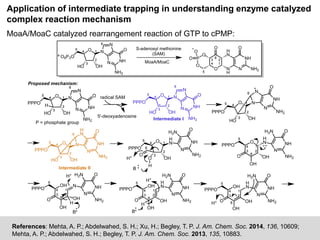
MoaA/MoaC catalyzed rearrangement reaction of GTP to cPMP:
MoaA/MoaC
44
33
22
11O N
N66
N NH
NH2
O
HO OH
55
4-O9P3O
N
NH
NH2
O
H
N
22
11
N
H
66
33
44
O
O
O
P
O
55
O
O
S-adenosyl methionine
(SAM)
B
Proposed mechanism:
44
33
22
11O N
N
66
N NH
NH2
O
HO OH
55
PPPO
44
33
22
11O N
N
66
N NH
NH2
O
HO OH
55
PPPO
H
P = phosphate group
radical SAM
5'-deoxyadenosine
44
33
22
11O N
N66
N
NH
NH2
O
HO OH
55
PPPO
44
33
22
11O N
H
N66
N
NH
NH2
O
HO OH
55
PPPO
44
33
22
11O H
N
H2N
N
NH
NH2
O
O OH
55
PPPO
Intermediate II
66
O
H
44
33 22
11
O
H
N
H2N
N
NH
NH2
O
O OH
55
PPPO
66
OH
H+
44
33 22
11
OH N
H2N
N
NH
NH2
O
O OH
55
PPPO
66
OH
H
B
H+
44
33 22
11
OH
H
N
H2N
N
NH
NH2
O
O OH
55
PPPO
66
OH
H
B
H+
44
33 22
11
OH
H
N
H2N
N
NH
NH2
O
O OH
55
PPPO
66
OH
H+
Intermediate I
Application of intermediate trapping in understanding enzyme catalyzed
complex reaction mechanism
References: Mehta, A. P.; Abdelwahed, S. H.; Xu, H.; Begley, T. P. J. Am. Chem. Soc. 2014, 136, 10609;
Mehta, A. P.; Abdelwahed, S. H.; Begley, T. P. J. Am. Chem. Soc. 2013, 135, 10883.
44
33
22
11
OH
NH
HN
N
NH
NH2
O
HO
HO
55
PPPO
66
HO
Intermediate III
44
33
22
11
OH
NH
HN
N
NH
NH2
O
HO
H2O
55
PPPO
66
O
44
33 22
11
OH N
H
N
N
NH
NH2
O
HO
55
PPPO
66
O
44
33 22
11
OH N
H
N
N
NH
NH2
O
HO
55
PPPO
66
O
H+
44
33 22
11
O N
H
H
N
N
NH
NH2
O
HO
55
PPPO
66
O
44
33 22
11
O N
H
H
N
N
NH
NH2
O
O
55
O
66
O
P
O
O
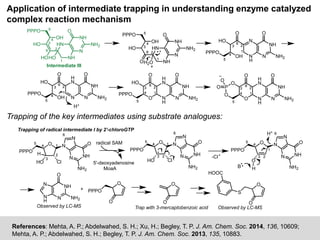
Trapping of the key intermediates using substrate analogues:
Trapping of radical intermediate I by 2'-chloroGTP
44
33
22
11O N
N
66
N NH
NH2
O
HO Cl
55
PPPO H
44
33 22
11O N
N
66
N NH
NH2
O
HO Cl
55
PPPO
radical SAM
5'-deoxyadenosine
MoaA
44
33 22
11
O N
N
66
N NH
NH2
O
O
55
PPPO
H
-Cl
B
H+
N
H
N
N
NH
NH2
O
O
PPPO
O
Observed by LC-MS
O
O
Observed by LC-MS
HOOC
S
O
O
Trap with 3-mercaptobenzoic acid
Application of intermediate trapping in understanding enzyme catalyzed
complex reaction mechanism
References: Mehta, A. P.; Abdelwahed, S. H.; Xu, H.; Begley, T. P. J. Am. Chem. Soc. 2014, 136, 10609;
Mehta, A. P.; Abdelwahed, S. H.; Begley, T. P. J. Am. Chem. Soc. 2013, 135, 10883.
44
33
22
11
OH
NH
HN
N
NH
NH2
O
HO
H
55
PPPO
66
O
44
33
22
11
OH N
H
N
N
NH
NH2
O
HO
55
PPPO
66
HO
44
33
22
11
OH
NH
HN
N
NH
NH2
O
HO
H
55
PPPO
66
HO
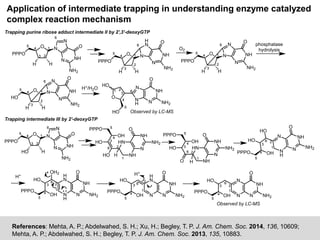
Trapping purine ribose adduct intermediate II by 2',3'-deoxyGTP
44
33
22
11O N
H
N66
N
NH
NH2
O
H H
55
PPPO
44
33 22
11O N
N
66
N NH
NH2
O
H H
55
PPPO
O2
44
33
22
11O N
N66
N
NH
NH2
O
H H
55
PPPO
phosphatase
hydrolysis
44
33
22
11O N
N66
N
NH
NH2
O
H H
55
HO
H+/H2O
44
33
2211
O
N
H
N
66
N
NH
NH2
O
55
HO
HO
Observed by LC-MS
Trapping intermediate III by 2'-deoxyGTP
44
33 22
11O N
N66
N NH
NH2
O
HO H
55
PPPO
44
33 22
11
OH N
H
H
N
N
NH
NH2
O
HO
55
PPPO
66
OH2
H+
44
33
22
11
OH N
H
N
N
NH
NH2
O
HO
55
PPPO
66
H+
44
33 22
11
OH N
N
N
NH
NH2
O
HO
55
PPPO
66
Observed by LC-MS
Problems:
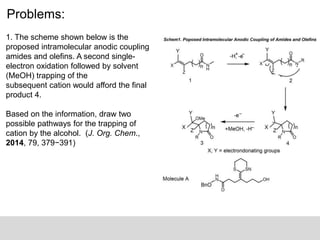
1. The scheme shown below is the
proposed intramolecular anodic coupling
amides and olefins. A second single-
electron oxidation followed by solvent
(MeOH) trapping of the
subsequent cation would afford the final
product 4.
Based on the information, draw two
possible pathways for the trapping of
cation by the alcohol. (J. Org. Chem.,
2014, 79, 379−391)
Problems:
2. Thymidylate synthases (TSases)
catalyze the last step in the de novo
biosynthesis of the DNA nucleotide
dUMP to dTMP, using CH2H4 folate as a
methylene donor. (J. Am. Chem. Soc.,
2012, 134, 4442−4448)
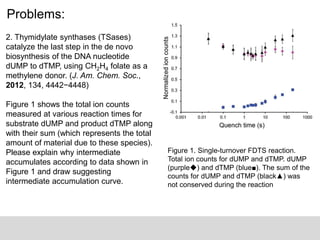
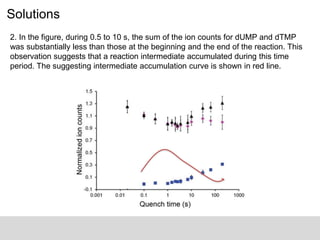
Figure 1 shows the total ion counts
measured at various reaction times for
substrate dUMP and product dTMP along
with their sum (which represents the total
amount of material due to these species).
Please explain why intermediate
accumulates according to data shown in
Figure 1 and draw suggesting
intermediate accumulation curve.
Figure 1. Single-turnover FDTS reaction.
Total ion counts for dUMP and dTMP. dUMP
(purple◆) and dTMP (blue■). The sum of the
counts for dUMP and dTMP (black▲) was
not conserved during the reaction
Problems:
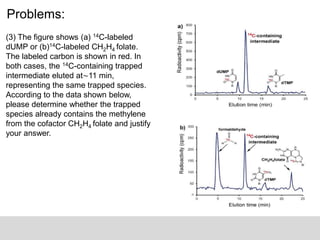
(3) The figure shows (a) 14C-labeled
dUMP or (b)14C-labeled CH2H4 folate.
The labeled carbon is shown in red. In
both cases, the 14C-containing trapped
intermediate eluted at∼11 min,
representing the same trapped species.
According to the data shown below,
please determine whether the trapped
species already contains the methylene
from the cofactor CH2H4 folate and justify
your answer.
Solutions
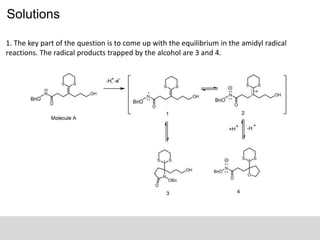
1. The key part of the question is to come up with the equilibrium in the amidyl radical
reactions. The radical products trapped by the alcohol are 3 and 4.
Solutions
2. In the figure, during 0.5 to 10 s, the sum of the ion counts for dUMP and dTMP
was substantially less than those at the beginning and the end of the reaction. This
observation suggests that a reaction intermediate accumulated during this time
period. The suggesting intermediate accumulation curve is shown in red line.
Solutions
3. [11-14C] CH2H4 folate radiolabeled, a new radioactive peak had developed that
had the same retention time as the peak observed when starting with [2-14C]
dUMP. It means it is the same reactive intermediate. So it shows that the
intermediate nucleotide being chemically trapped during the acid quenching
had already undergone the condensation and that the carbon−carbon bond
between the C5 of dUMP and the methylene had been formed prior to the formation
of that intermediate.
This work is licensed under a
Creative Commons Attribution-
ShareAlike 4.0 International
License.
Contributed by:
Shuangyu Ma & Yiling Bi (Undergraduate Students)
University of Utah
2014

Deciphering reaction mechanism with intermediate trapping

  • 1.
    Organic Pedagogical Electronic Network DecipheringReaction Mechanism with Intermediate Trapping Shuangyu Ma & Yiling Bi University of Utah
  • 2.
    Identifying mechanism withintermediate trapping Overview: A reactive intermediate is a short-lived, high-energy, highly reactive molecule. When generated in a chemical reaction, it will quickly convert into a more stable molecule. When their existence is indicated, reactive intermediates can help explain how a chemical reaction takes place. Wiki Page: http://en.wikipedia.org/wiki/Reactive_intermediate Other References: Young, P. R.; Jencks, W. P. J. Am. Chem. Soc. 1977, 8238; Cordes, E.; Bull, H. Chem. Rev. 1974, 74, 581; Fife, T. Acc. Chem. Res. 1972, 78, 264.
  • 3.
    Wiki Page: http://en.wikipedia.org/wiki/Reactive_intermediate OtherReferences: Young, P. R.; Jencks, W. P. J. Am. Chem. Soc. 1977, 8238; Cordes, E.; Bull, H. Chem. Rev. 1974, 74, 581; Fife, T. Acc. Chem. Res. 1972, 78, 264. Early Examples: hydrolysis of acetals, ketals and ortho esters: Identifying mechanism with intermediate trapping
  • 4.
    Wiki Page: http://en.wikipedia.org/wiki/Reactive_intermediate OtherReferences: Young, P. R.; Jencks, W. P. J. Am. Chem. Soc. 1977, 8238; Cordes, E.; Bull, H. Chem. Rev. 1974, 74, 581; Fife, T. Acc. Chem. Res. 1972, 78, 264. Trapping of the oxocarbonium ion intermediate by sulfite dianion: Identifying mechanism with intermediate trapping • Results: achieved up to 97% trapping; rate constants for acid-catalyzed cleavage of ketals are independent of [SO3 2-] (Table 1). • Conclusion: [SO3 2-] is not present in the TS of the RLS. Reaction proceeds through the oxocarbonium ion pathway. H2O R' OR Oxocarbonium ion OH OR R' R' O SO3 2- SO3 - OR R' Disulfide buffer OR OR R' Monitor absorbance change at 262 nm
  • 5.
    Identifying mechanism withintermediate trapping References: Haberfield, P. J. Am. Chem. Soc. 1995, 3314; Bank, S.; Noyd, D. A. J. Am. Chem. Soc. 1973, 95, 8203. Proposed two pathways for the SN2 reaction : Nu X-X Nu + Simultaneous transfer of elctron pairs Single electron stransfer pathway (stepwise mechanism) XNu +Nu X Nu+ X+ X-Nu + Difficulty: the radical & radical anion intermediates quickly continued to form the SN2 product, concentration would be too low for trapping. Early Examples: trapping of a single electron transfer intermediate.
  • 6.
    Identifying mechanism withintermediate trapping References: Haberfield, P. J. Am. Chem. Soc. 1995, 3314; Bank, S.; Noyd, D. A. J. Am. Chem. Soc. 1973, 95, 8203. Early Examples: trapping of a single electron transfer intermediate. Using identity reaction and very large concentration of scavenger (as solvent). Br H O Br H Br H O Br H H Hterbutylammonium bromide cumene 100 °C, 66 h H Br Also obatined other cumyl radical-derived products: yield: 47% cis & trans Detectable X+ X-X +X X+X XX + H HX+ + X- + H H H ++
  • 7.
    Application of intermediatetrapping in understanding enzyme catalyzed complex reaction mechanism References: Mehta, A. P.; Abdelwahed, S. H.; Xu, H.; Begley, T. P. J. Am. Chem. Soc. 2014, 136, 10609; Mehta, A. P.; Abdelwahed, S. H.; Begley, T. P. J. Am. Chem. Soc. 2013, 135, 10883. MoaA/MoaC catalyzed rearrangement reaction of GTP to cPMP: MoaA/MoaC 44 33 22 11O N N66 N NH NH2 O HO OH 55 4-O9P3O N NH NH2 O H N 22 11 N H 66 33 44 O O O P O 55 O O S-adenosyl methionine (SAM) B Proposed mechanism: 44 33 22 11O N N 66 N NH NH2 O HO OH 55 PPPO 44 33 22 11O N N 66 N NH NH2 O HO OH 55 PPPO H P = phosphate group radical SAM 5'-deoxyadenosine 44 33 22 11O N N66 N NH NH2 O HO OH 55 PPPO 44 33 22 11O N H N66 N NH NH2 O HO OH 55 PPPO 44 33 22 11O H N H2N N NH NH2 O O OH 55 PPPO Intermediate II 66 O H 44 33 22 11 O H N H2N N NH NH2 O O OH 55 PPPO 66 OH H+ 44 33 22 11 OH N H2N N NH NH2 O O OH 55 PPPO 66 OH H B H+ 44 33 22 11 OH H N H2N N NH NH2 O O OH 55 PPPO 66 OH H B H+ 44 33 22 11 OH H N H2N N NH NH2 O O OH 55 PPPO 66 OH H+ Intermediate I
  • 8.
    Application of intermediatetrapping in understanding enzyme catalyzed complex reaction mechanism References: Mehta, A. P.; Abdelwahed, S. H.; Xu, H.; Begley, T. P. J. Am. Chem. Soc. 2014, 136, 10609; Mehta, A. P.; Abdelwahed, S. H.; Begley, T. P. J. Am. Chem. Soc. 2013, 135, 10883. 44 33 22 11 OH NH HN N NH NH2 O HO HO 55 PPPO 66 HO Intermediate III 44 33 22 11 OH NH HN N NH NH2 O HO H2O 55 PPPO 66 O 44 33 22 11 OH N H N N NH NH2 O HO 55 PPPO 66 O 44 33 22 11 OH N H N N NH NH2 O HO 55 PPPO 66 O H+ 44 33 22 11 O N H H N N NH NH2 O HO 55 PPPO 66 O 44 33 22 11 O N H H N N NH NH2 O O 55 O 66 O P O O Trapping of the key intermediates using substrate analogues: Trapping of radical intermediate I by 2'-chloroGTP 44 33 22 11O N N 66 N NH NH2 O HO Cl 55 PPPO H 44 33 22 11O N N 66 N NH NH2 O HO Cl 55 PPPO radical SAM 5'-deoxyadenosine MoaA 44 33 22 11 O N N 66 N NH NH2 O O 55 PPPO H -Cl B H+ N H N N NH NH2 O O PPPO O Observed by LC-MS O O Observed by LC-MS HOOC S O O Trap with 3-mercaptobenzoic acid
  • 9.
    Application of intermediatetrapping in understanding enzyme catalyzed complex reaction mechanism References: Mehta, A. P.; Abdelwahed, S. H.; Xu, H.; Begley, T. P. J. Am. Chem. Soc. 2014, 136, 10609; Mehta, A. P.; Abdelwahed, S. H.; Begley, T. P. J. Am. Chem. Soc. 2013, 135, 10883. 44 33 22 11 OH NH HN N NH NH2 O HO H 55 PPPO 66 O 44 33 22 11 OH N H N N NH NH2 O HO 55 PPPO 66 HO 44 33 22 11 OH NH HN N NH NH2 O HO H 55 PPPO 66 HO Trapping purine ribose adduct intermediate II by 2',3'-deoxyGTP 44 33 22 11O N H N66 N NH NH2 O H H 55 PPPO 44 33 22 11O N N 66 N NH NH2 O H H 55 PPPO O2 44 33 22 11O N N66 N NH NH2 O H H 55 PPPO phosphatase hydrolysis 44 33 22 11O N N66 N NH NH2 O H H 55 HO H+/H2O 44 33 2211 O N H N 66 N NH NH2 O 55 HO HO Observed by LC-MS Trapping intermediate III by 2'-deoxyGTP 44 33 22 11O N N66 N NH NH2 O HO H 55 PPPO 44 33 22 11 OH N H H N N NH NH2 O HO 55 PPPO 66 OH2 H+ 44 33 22 11 OH N H N N NH NH2 O HO 55 PPPO 66 H+ 44 33 22 11 OH N N N NH NH2 O HO 55 PPPO 66 Observed by LC-MS
  • 10.
    Problems: 1. The schemeshown below is the proposed intramolecular anodic coupling amides and olefins. A second single- electron oxidation followed by solvent (MeOH) trapping of the subsequent cation would afford the final product 4. Based on the information, draw two possible pathways for the trapping of cation by the alcohol. (J. Org. Chem., 2014, 79, 379−391)
  • 11.
    Problems: 2. Thymidylate synthases(TSases) catalyze the last step in the de novo biosynthesis of the DNA nucleotide dUMP to dTMP, using CH2H4 folate as a methylene donor. (J. Am. Chem. Soc., 2012, 134, 4442−4448) Figure 1 shows the total ion counts measured at various reaction times for substrate dUMP and product dTMP along with their sum (which represents the total amount of material due to these species). Please explain why intermediate accumulates according to data shown in Figure 1 and draw suggesting intermediate accumulation curve. Figure 1. Single-turnover FDTS reaction. Total ion counts for dUMP and dTMP. dUMP (purple◆) and dTMP (blue■). The sum of the counts for dUMP and dTMP (black▲) was not conserved during the reaction
  • 12.
    Problems: (3) The figureshows (a) 14C-labeled dUMP or (b)14C-labeled CH2H4 folate. The labeled carbon is shown in red. In both cases, the 14C-containing trapped intermediate eluted at∼11 min, representing the same trapped species. According to the data shown below, please determine whether the trapped species already contains the methylene from the cofactor CH2H4 folate and justify your answer.
  • 13.
    Solutions 1. The keypart of the question is to come up with the equilibrium in the amidyl radical reactions. The radical products trapped by the alcohol are 3 and 4.
  • 14.
    Solutions 2. In thefigure, during 0.5 to 10 s, the sum of the ion counts for dUMP and dTMP was substantially less than those at the beginning and the end of the reaction. This observation suggests that a reaction intermediate accumulated during this time period. The suggesting intermediate accumulation curve is shown in red line.
  • 15.
    Solutions 3. [11-14C] CH2H4folate radiolabeled, a new radioactive peak had developed that had the same retention time as the peak observed when starting with [2-14C] dUMP. It means it is the same reactive intermediate. So it shows that the intermediate nucleotide being chemically trapped during the acid quenching had already undergone the condensation and that the carbon−carbon bond between the C5 of dUMP and the methylene had been formed prior to the formation of that intermediate.
  • 16.
    This work islicensed under a Creative Commons Attribution- ShareAlike 4.0 International License. Contributed by: Shuangyu Ma & Yiling Bi (Undergraduate Students) University of Utah 2014