DCCN (Dr. Nadia Nawaz) 10-1
Part 3 Data Link Layer
Chapter 10 Error Detection and Correction
Chapter 11 Data Link Control
Chapter 12 Multiple Access
Chapter 13 Wired LANs: Ethernet
Chapter 14 Wireless LANs
Chapter 15 Connecting LANs, Backbone Networks, and Virtual LANs
DCCN (Dr. Nadia Nawaz) 10-2
Chapter 10 Error Detection and Correction
1. Introduction
2. Block Coding
3. Linear Block Codes
4. Cyclic Codes
5. Checksum
DCCN (Dr. Nadia Nawaz) 10-3
Type of Errors
• An electromagnetic signal is subject to interference from
heat, magnetism, and other forms of electricity
• Single-bit error: 0 → 1 or 1 → 0
• Burst error: 2 or more bits have changed
DCCN (Dr. Nadia Nawaz) 10-4
Single-Bit Error
• Only one bit of a given data unit is changed
• The least likely type of error in serial transmission
• Single-bit error can happen in parallel transmission
DCCN (Dr. Nadia Nawaz) 10-5
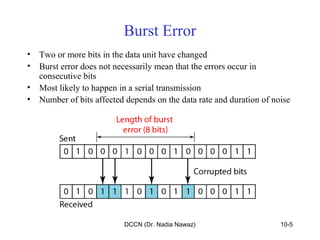
Burst Error
• Two or more bits in the data unit have changed
• Burst error does not necessarily mean that the errors occur in
consecutive bits
• Most likely to happen in a serial transmission
• Number of bits affected depends on the data rate and duration of noise
DCCN (Dr. Nadia Nawaz) 10-6
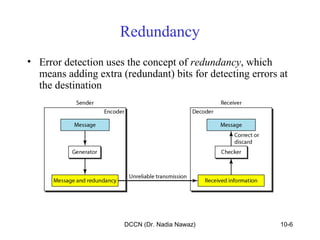
Redundancy
• Error detection uses the concept of redundancy, which
means adding extra (redundant) bits for detecting errors at
the destination
DCCN (Dr. Nadia Nawaz) 10-7
Error Control
• Detection Versus Correction
– Detection: error ? yes or no
– Correction: Need to know the exact number of bits that
are corrupted, and their location in the message
• Forward Error Correction Versus Retransmission
– Retransmission (resending) : Backward error correction
• Coding for redundancy
– Block coding: discussed in our textbook
– Convolution coding
DCCN (Dr. Nadia Nawaz) 10-8
Modular Arithmetic
• In modulo-N arithmetic, we use only the integers in the range 0 to N-
1, inclusive.
• Adding: 0 + 0 = 0 0 + 1 = 1 1 + 0 = 1 1 + 1 = 0
• Subtracting: 0 – 0 = 0 0 – 1 = 1 1 – 0 = 1 1 – 1 = 0
• XORing of two single bits or two words
DCCN (Dr. Nadia Nawaz) 10-9
Block Coding
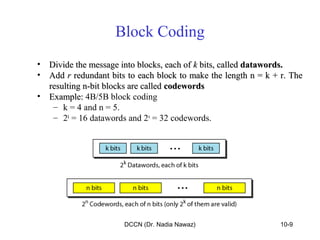
• Divide the message into blocks, each ofDivide the message into blocks, each of kk bits, calledbits, called datawords.datawords.
• AddAdd rr redundant bits to each block to make the length n = k + r. Theredundant bits to each block to make the length n = k + r. The
resulting n-bit blocks are calledresulting n-bit blocks are called codewordscodewords
• Example:Example: 4B/5B block coding
– k = 4 and n = 5.
– 2k
= 16 datawords and 2n
= 32 codewords.
DCCN (Dr. Nadia Nawaz) 10-10
Error Detection in Block Coding
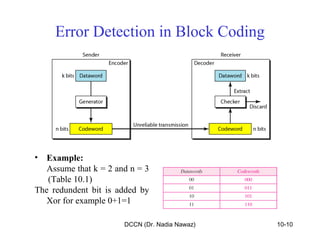
• Example:
Assume that k = 2 and n = 3
(Table 10.1)
The redundent bit is added by
Xor for example 0+1=1
DCCN (Dr. Nadia Nawaz) 10-11
Error Detection: Example
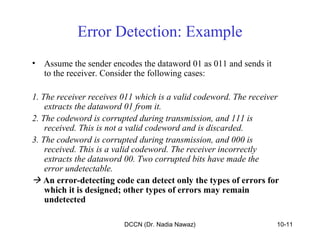
• Assume the sender encodes the dataword 01 as 011 and sends it
to the receiver. Consider the following cases:
1. The receiver receives 011 which is a valid codeword. The receiver
extracts the dataword 01 from it.
2. The codeword is corrupted during transmission, and 111 is
received. This is not a valid codeword and is discarded.
3. The codeword is corrupted during transmission, and 000 is
received. This is a valid codeword. The receiver incorrectly
extracts the dataword 00. Two corrupted bits have made the
error undetectable.
 An error-detecting code can detect only the types of errors for
which it is designed; other types of errors may remain
undetected
DCCN (Dr. Nadia Nawaz) 10-12
Error Correction in Block Coding
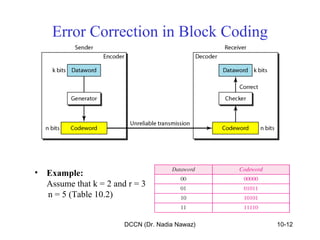
• Example:
Assume that k = 2 and r = 3
n = 5 (Table 10.2)
DCCN (Dr. Nadia Nawaz) 10-13
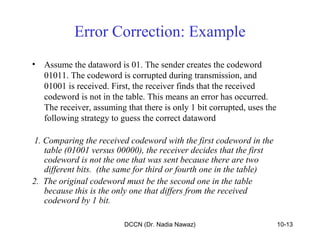
Error Correction: Example
• Assume the dataword is 01. The sender creates the codeword
01011. The codeword is corrupted during transmission, and
01001 is received. First, the receiver finds that the received
codeword is not in the table. This means an error has occurred.
The receiver, assuming that there is only 1 bit corrupted, uses the
following strategy to guess the correct dataword
1. Comparing the received codeword with the first codeword in the
table (01001 versus 00000), the receiver decides that the first
codeword is not the one that was sent because there are two
different bits. (the same for third or fourth one in the table)
2.. The original codeword must be the second one in the table
because this is the only one that differs from the received
codeword by 1 bit.
DCCN (Dr. Nadia Nawaz) 10-14
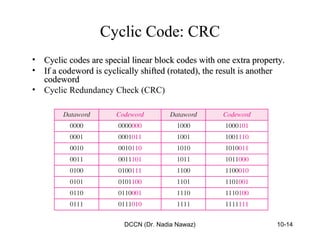
Cyclic Code: CRC
• Cyclic codes are special linear block codes with one extra property.Cyclic codes are special linear block codes with one extra property.
• If a codeword is cyclically shifted (rotated), the result is anotherIf a codeword is cyclically shifted (rotated), the result is another
codewordcodeword
• Cyclic Redundancy Check (CRC)
DCCN (Dr. Nadia Nawaz) 10-15
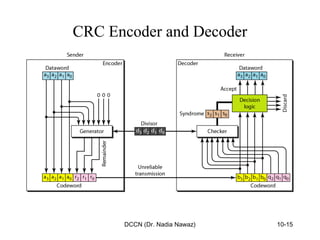
CRC Encoder and Decoder
DCCN (Dr. Nadia Nawaz) 10-16
Division in CRC Encoder
DCCN (Dr. Nadia Nawaz) 10-17
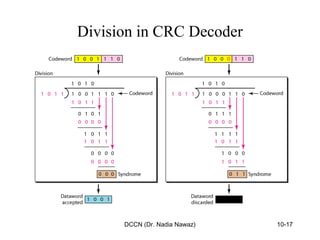
Division in CRC Decoder
DCCN (Dr. Nadia Nawaz) 10-18
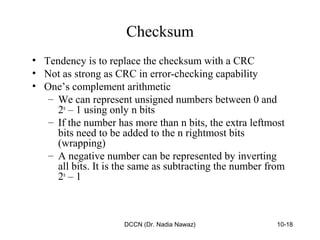
Checksum
• Tendency is to replace the checksum with a CRC
• Not as strong as CRC in error-checking capability
• One’s complement arithmetic
– We can represent unsigned numbers between 0 and
2n
– 1 using only n bits
– If the number has more than n bits, the extra leftmost
bits need to be added to the n rightmost bits
(wrapping)
– A negative number can be represented by inverting
all bits. It is the same as subtracting the number from
2n
– 1
DCCN (Dr. Nadia Nawaz) 10-19
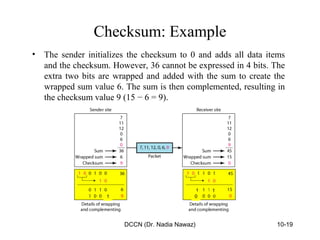
Checksum: Example
• The sender initializes the checksum to 0 and adds all data items
and the checksum. However, 36 cannot be expressed in 4 bits. The
extra two bits are wrapped and added with the sum to create the
wrapped sum value 6. The sum is then complemented, resulting in
the checksum value 9 (15 − 6 = 9).
1
1 1
0
DCCN (Dr. Nadia Nawaz) 10-20
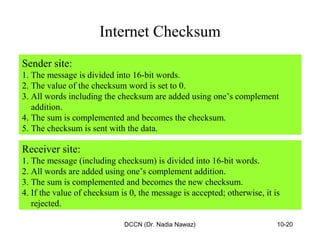
Internet Checksum
Sender site:
1. The message is divided into 16-bit words.
2. The value of the checksum word is set to 0.
3. All words including the checksum are added using one’s complement
addition.
4. The sum is complemented and becomes the checksum.
5. The checksum is sent with the data.
Receiver site:
1. The message (including checksum) is divided into 16-bit words.
2. All words are added using one’s complement addition.
3. The sum is complemented and becomes the new checksum.
4. If the value of checksum is 0, the message is accepted; otherwise, it is
rejected.
DCCN (Dr. Nadia Nawaz) 10-21
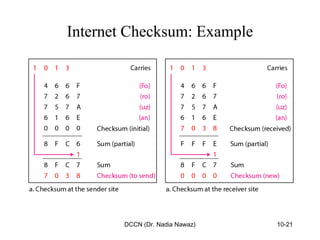
Internet Checksum: Example

Data Link Layer| Error Detection

  • 1.
    DCCN (Dr. NadiaNawaz) 10-1 Part 3 Data Link Layer Chapter 10 Error Detection and Correction Chapter 11 Data Link Control Chapter 12 Multiple Access Chapter 13 Wired LANs: Ethernet Chapter 14 Wireless LANs Chapter 15 Connecting LANs, Backbone Networks, and Virtual LANs
  • 2.
    DCCN (Dr. NadiaNawaz) 10-2 Chapter 10 Error Detection and Correction 1. Introduction 2. Block Coding 3. Linear Block Codes 4. Cyclic Codes 5. Checksum
  • 3.
    DCCN (Dr. NadiaNawaz) 10-3 Type of Errors • An electromagnetic signal is subject to interference from heat, magnetism, and other forms of electricity • Single-bit error: 0 → 1 or 1 → 0 • Burst error: 2 or more bits have changed
  • 4.
    DCCN (Dr. NadiaNawaz) 10-4 Single-Bit Error • Only one bit of a given data unit is changed • The least likely type of error in serial transmission • Single-bit error can happen in parallel transmission
  • 5.
    DCCN (Dr. NadiaNawaz) 10-5 Burst Error • Two or more bits in the data unit have changed • Burst error does not necessarily mean that the errors occur in consecutive bits • Most likely to happen in a serial transmission • Number of bits affected depends on the data rate and duration of noise
  • 6.
    DCCN (Dr. NadiaNawaz) 10-6 Redundancy • Error detection uses the concept of redundancy, which means adding extra (redundant) bits for detecting errors at the destination
  • 7.
    DCCN (Dr. NadiaNawaz) 10-7 Error Control • Detection Versus Correction – Detection: error ? yes or no – Correction: Need to know the exact number of bits that are corrupted, and their location in the message • Forward Error Correction Versus Retransmission – Retransmission (resending) : Backward error correction • Coding for redundancy – Block coding: discussed in our textbook – Convolution coding
  • 8.
    DCCN (Dr. NadiaNawaz) 10-8 Modular Arithmetic • In modulo-N arithmetic, we use only the integers in the range 0 to N- 1, inclusive. • Adding: 0 + 0 = 0 0 + 1 = 1 1 + 0 = 1 1 + 1 = 0 • Subtracting: 0 – 0 = 0 0 – 1 = 1 1 – 0 = 1 1 – 1 = 0 • XORing of two single bits or two words
  • 9.
    DCCN (Dr. NadiaNawaz) 10-9 Block Coding • Divide the message into blocks, each ofDivide the message into blocks, each of kk bits, calledbits, called datawords.datawords. • AddAdd rr redundant bits to each block to make the length n = k + r. Theredundant bits to each block to make the length n = k + r. The resulting n-bit blocks are calledresulting n-bit blocks are called codewordscodewords • Example:Example: 4B/5B block coding – k = 4 and n = 5. – 2k = 16 datawords and 2n = 32 codewords.
  • 10.
    DCCN (Dr. NadiaNawaz) 10-10 Error Detection in Block Coding • Example: Assume that k = 2 and n = 3 (Table 10.1) The redundent bit is added by Xor for example 0+1=1
  • 11.
    DCCN (Dr. NadiaNawaz) 10-11 Error Detection: Example • Assume the sender encodes the dataword 01 as 011 and sends it to the receiver. Consider the following cases: 1. The receiver receives 011 which is a valid codeword. The receiver extracts the dataword 01 from it. 2. The codeword is corrupted during transmission, and 111 is received. This is not a valid codeword and is discarded. 3. The codeword is corrupted during transmission, and 000 is received. This is a valid codeword. The receiver incorrectly extracts the dataword 00. Two corrupted bits have made the error undetectable.  An error-detecting code can detect only the types of errors for which it is designed; other types of errors may remain undetected
  • 12.
    DCCN (Dr. NadiaNawaz) 10-12 Error Correction in Block Coding • Example: Assume that k = 2 and r = 3 n = 5 (Table 10.2)
  • 13.
    DCCN (Dr. NadiaNawaz) 10-13 Error Correction: Example • Assume the dataword is 01. The sender creates the codeword 01011. The codeword is corrupted during transmission, and 01001 is received. First, the receiver finds that the received codeword is not in the table. This means an error has occurred. The receiver, assuming that there is only 1 bit corrupted, uses the following strategy to guess the correct dataword 1. Comparing the received codeword with the first codeword in the table (01001 versus 00000), the receiver decides that the first codeword is not the one that was sent because there are two different bits. (the same for third or fourth one in the table) 2.. The original codeword must be the second one in the table because this is the only one that differs from the received codeword by 1 bit.
  • 14.
    DCCN (Dr. NadiaNawaz) 10-14 Cyclic Code: CRC • Cyclic codes are special linear block codes with one extra property.Cyclic codes are special linear block codes with one extra property. • If a codeword is cyclically shifted (rotated), the result is anotherIf a codeword is cyclically shifted (rotated), the result is another codewordcodeword • Cyclic Redundancy Check (CRC)
  • 15.
    DCCN (Dr. NadiaNawaz) 10-15 CRC Encoder and Decoder
  • 16.
    DCCN (Dr. NadiaNawaz) 10-16 Division in CRC Encoder
  • 17.
    DCCN (Dr. NadiaNawaz) 10-17 Division in CRC Decoder
  • 18.
    DCCN (Dr. NadiaNawaz) 10-18 Checksum • Tendency is to replace the checksum with a CRC • Not as strong as CRC in error-checking capability • One’s complement arithmetic – We can represent unsigned numbers between 0 and 2n – 1 using only n bits – If the number has more than n bits, the extra leftmost bits need to be added to the n rightmost bits (wrapping) – A negative number can be represented by inverting all bits. It is the same as subtracting the number from 2n – 1
  • 19.
    DCCN (Dr. NadiaNawaz) 10-19 Checksum: Example • The sender initializes the checksum to 0 and adds all data items and the checksum. However, 36 cannot be expressed in 4 bits. The extra two bits are wrapped and added with the sum to create the wrapped sum value 6. The sum is then complemented, resulting in the checksum value 9 (15 − 6 = 9). 1 1 1 0
  • 20.
    DCCN (Dr. NadiaNawaz) 10-20 Internet Checksum Sender site: 1. The message is divided into 16-bit words. 2. The value of the checksum word is set to 0. 3. All words including the checksum are added using one’s complement addition. 4. The sum is complemented and becomes the checksum. 5. The checksum is sent with the data. Receiver site: 1. The message (including checksum) is divided into 16-bit words. 2. All words are added using one’s complement addition. 3. The sum is complemented and becomes the new checksum. 4. If the value of checksum is 0, the message is accepted; otherwise, it is rejected.
  • 21.
    DCCN (Dr. NadiaNawaz) 10-21 Internet Checksum: Example