Data Link Layer:
Error Detection and Correction
Data Communication and
Computer Networks
Adapted from lecture slides by Behrouz A. Forouzan
© The McGraw-Hill Companies, Inc. All rights reserved
2
Outline
 Overview of Data Link Layer
 Types of errors
 Redundancy
 Correction vs. detection
 Coding
3
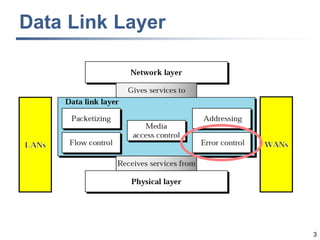
Data Link Layer
4
Error Control
 Detecting errors
 Correcting errors
 Forward error correction
 Automatic repeat request
5
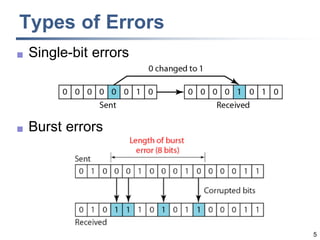
Types of Errors
 Single-bit errors
 Burst errors
6
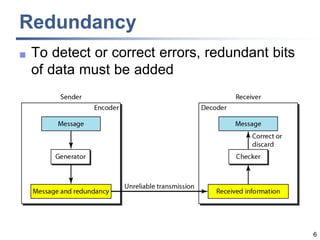
Redundancy
 To detect or correct errors, redundant bits
of data must be added
7
Coding
 Process of adding redundancy for error
detection or correction
 Two types:
 Block codes
 Divides the data to be sent into a set of blocks
 Extra information attached to each block
 Memoryless
 Convolutional codes
 Treats data as a series of bits, and computes a code over a
continuous series
 The code computed for a set of bits depends on the current
and previous input
8
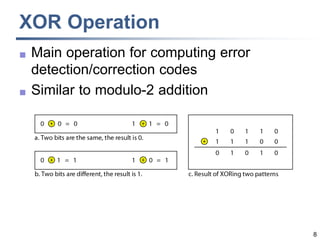
XOR Operation
 Main operation for computing error
detection/correction codes
 Similar to modulo-2 addition
9
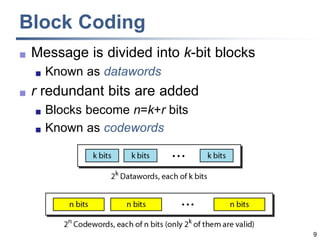
Block Coding
 Message is divided into k-bit blocks
 Known as datawords
 r redundant bits are added
 Blocks become n=k+r bits
 Known as codewords
10
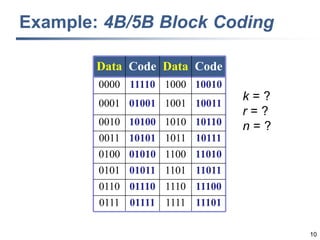
Example: 4B/5B Block Coding
Data Code Data Code
0000 11110 1000 10010
0001 01001 1001 10011
0010 10100 1010 10110
0011 10101 1011 10111
0100 01010 1100 11010
0101 01011 1101 11011
0110 01110 1110 11100
0111 01111 1111 11101
k = ?
r = ?
n = ?
11
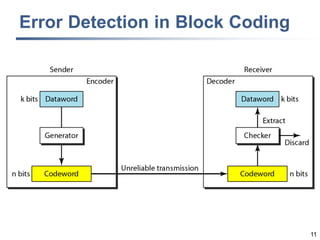
Error Detection in Block Coding
12
Notes
 An error-detecting code can detect
only the types of errors for which it is
designed
 Other types of errors may remain undetected.
 There is no way to detect every possible
error
13
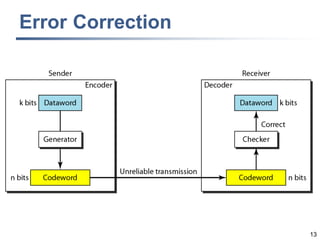
Error Correction
14
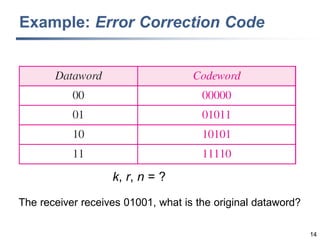
Example: Error Correction Code
The receiver receives 01001, what is the original dataword?
k, r, n = ?
15
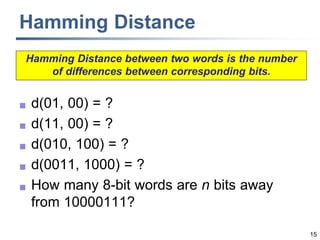
Hamming Distance
 d(01, 00) = ?
 d(11, 00) = ?
 d(010, 100) = ?
 d(0011, 1000) = ?
 How many 8-bit words are n bits away
from 10000111?
Hamming Distance between two words is the number
of differences between corresponding bits.
16
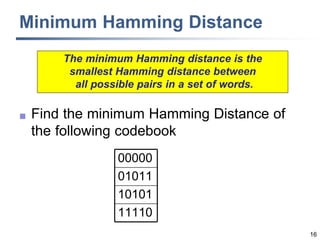
Minimum Hamming Distance
 Find the minimum Hamming Distance of
the following codebook
The minimum Hamming distance is the
smallest Hamming distance between
all possible pairs in a set of words.
00000
01011
10101
11110
17
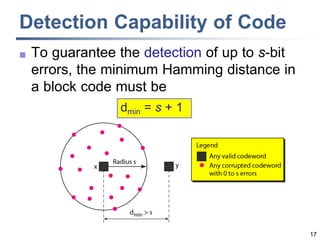
Detection Capability of Code
 To guarantee the detection of up to s-bit
errors, the minimum Hamming distance in
a block code must be
dmin = s + 1
18
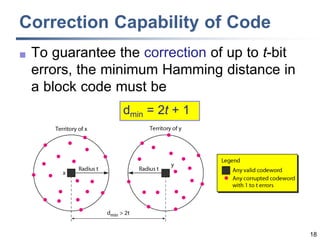
Correction Capability of Code
 To guarantee the correction of up to t-bit
errors, the minimum Hamming distance in
a block code must be
dmin = 2t + 1
19
Example: Hamming Distance
 A code scheme has a Hamming distance
dmin = 4. What is the error detection and
correction capability of this scheme?
20
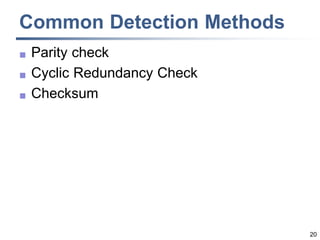
Common Detection Methods
 Parity check
 Cyclic Redundancy Check
 Checksum
21
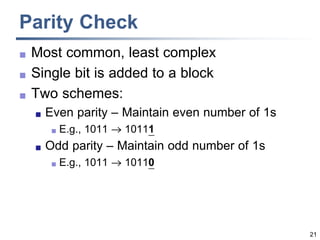
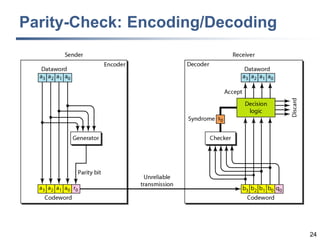
Parity Check
 Most common, least complex
 Single bit is added to a block
 Two schemes:
 Even parity – Maintain even number of 1s
 E.g., 1011  10111
 Odd parity – Maintain odd number of 1s
 E.g., 1011  10110
22
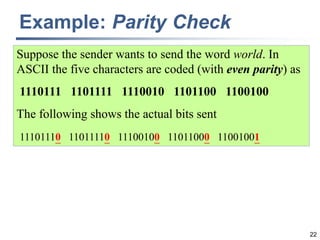
Example: Parity Check
Suppose the sender wants to send the word world. In
ASCII the five characters are coded (with even parity) as
1110111 1101111 1110010 1101100 1100100
The following shows the actual bits sent
11101110 11011110 11100100 11011000 11001001
23
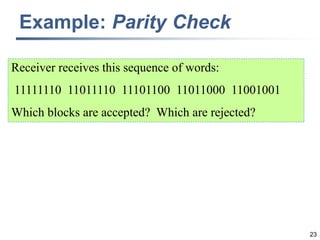
Example: Parity Check
Receiver receives this sequence of words:
11111110 11011110 11101100 11011000 11001001
Which blocks are accepted? Which are rejected?
24
Parity-Check: Encoding/Decoding
25
Performance of Parity Check
 Can 1-bit errors be detected?
 Can 2-bit errors be detected?
 :
26
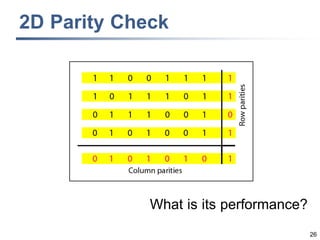
2D Parity Check
What is its performance?
27
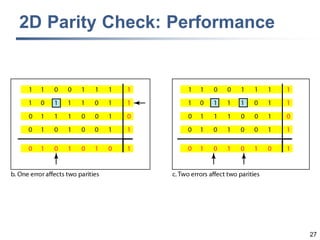
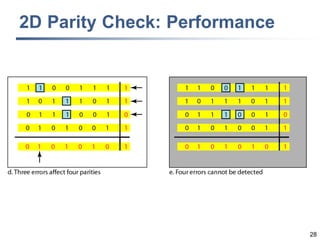
2D Parity Check: Performance
28
2D Parity Check: Performance
29
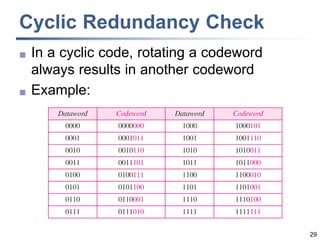
Cyclic Redundancy Check
 In a cyclic code, rotating a codeword
always results in another codeword
 Example:
30
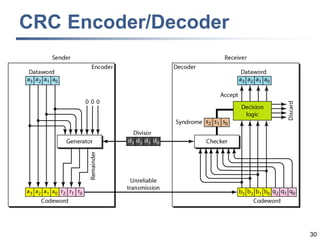
CRC Encoder/Decoder
31
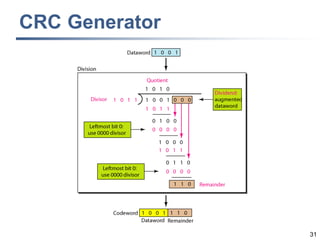
CRC Generator
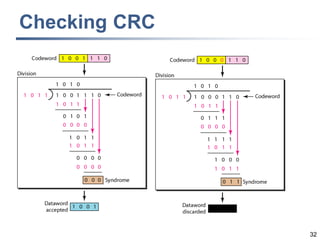
32
Checking CRC
33
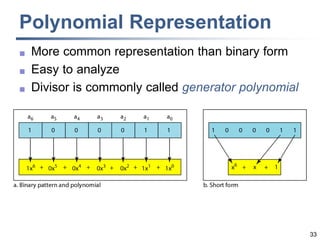
Polynomial Representation
 More common representation than binary form
 Easy to analyze
 Divisor is commonly called generator polynomial
34
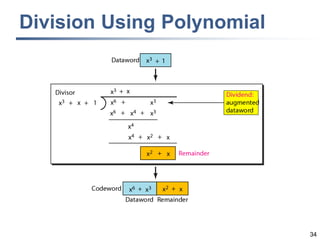
Division Using Polynomial
35
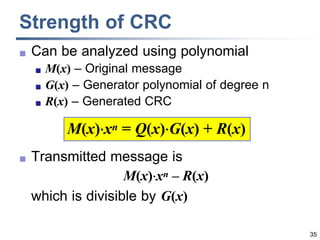
Strength of CRC
 Can be analyzed using polynomial
 M(x) – Original message
 G(x) – Generator polynomial of degree n
 R(x) – Generated CRC
 Transmitted message is
M(x)

xn – R(x)
which is divisible by G(x)
M(x)

xn = Q(x)

G(x) + R(x)
36
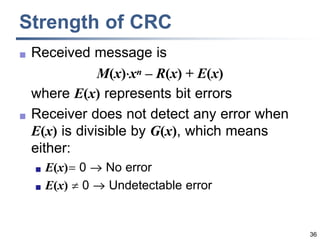
Strength of CRC
 Received message is
M(x)

xn – R(x) + E(x)
where E(x) represents bit errors
 Receiver does not detect any error when
E(x) is divisible by G(x), which means
either:
 E(x) 0  No error
 E(x)  0  Undetectable error
37
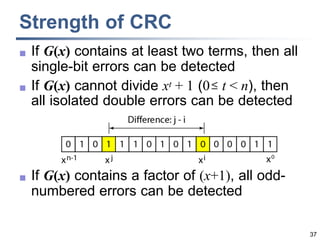
Strength of CRC
 If G(x) contains at least two terms, then all
single-bit errors can be detected
 If G(x) cannot divide xt + 1 (0 t < n), then
all isolated double errors can be detected
 If G(x) contains a factor of (x+1), all odd-
numbered errors can be detected
38
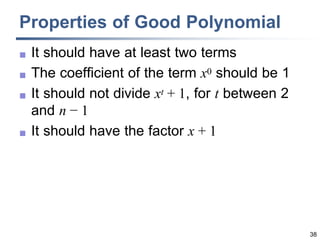
Properties of Good Polynomial
 It should have at least two terms
 The coefficient of the term x0 should be 1
 It should not divide xt + 1, for t between 2
and n − 1
 It should have the factor x + 1
39
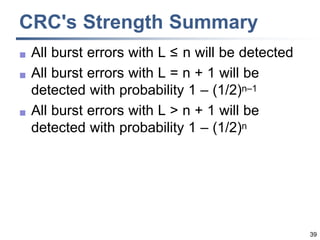
CRC's Strength Summary
 All burst errors with L ≤ n will be detected
 All burst errors with L = n + 1 will be
detected with probability 1 – (1/2)n–1
 All burst errors with L > n + 1 will be
detected with probability 1 – (1/2)n
40
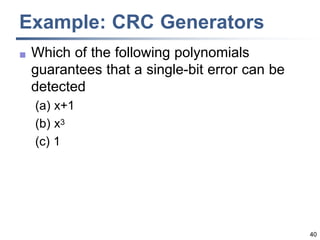
Example: CRC Generators
 Which of the following polynomials
guarantees that a single-bit error can be
detected
(a) x+1
(b) x3
(c) 1
41
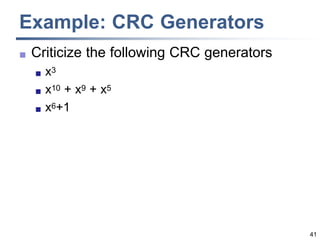
Example: CRC Generators
 Criticize the following CRC generators
 x3
 x10 + x9 + x5
 x6+1
42
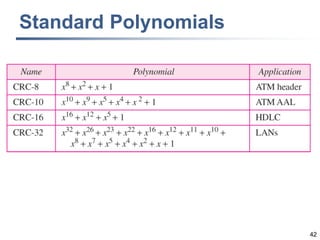
Standard Polynomials
43
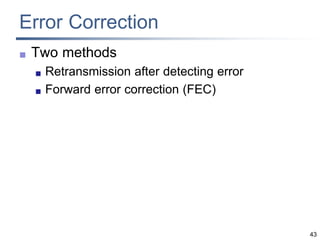
Error Correction
 Two methods
 Retransmission after detecting error
 Forward error correction (FEC)
44
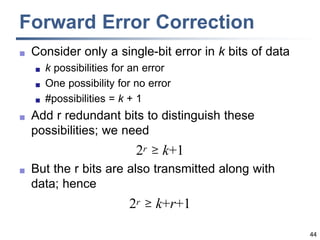
Forward Error Correction
 Consider only a single-bit error in k bits of data
 k possibilities for an error
 One possibility for no error
 #possibilities = k + 1
 Add r redundant bits to distinguish these
possibilities; we need
2r  k+1
 But the r bits are also transmitted along with
data; hence
2r  k+r+1
45
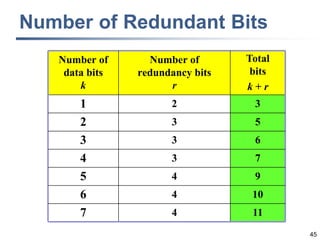
Number of Redundant Bits
Number of
data bits
k
Number of
redundancy bits
r
Total
bits
k + r
1 2 3
2 3 5
3 3 6
4 3 7
5 4 9
6 4 10
7 4 11
46
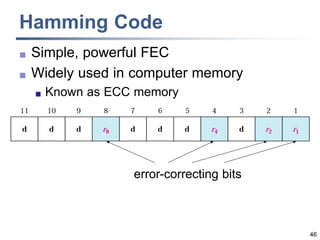
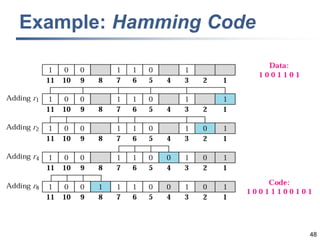
Hamming Code
 Simple, powerful FEC
 Widely used in computer memory
 Known as ECC memory
error-correcting bits
47
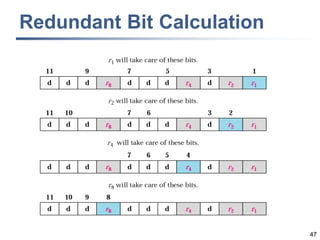
Redundant Bit Calculation
48
Example: Hamming Code
49
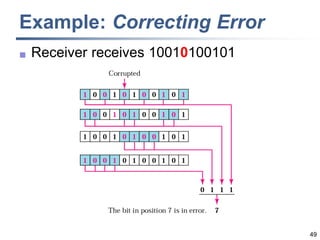
Example: Correcting Error
 Receiver receives 10010100101
50
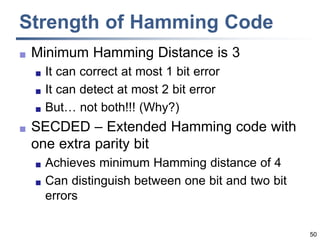
Strength of Hamming Code
 Minimum Hamming Distance is 3
 It can correct at most 1 bit error
 It can detect at most 2 bit error
 But… not both!!! (Why?)
 SECDED – Extended Hamming code with
one extra parity bit
 Achieves minimum Hamming distance of 4
 Can distinguish between one bit and two bit
errors
51
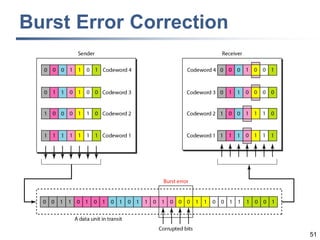
Burst Error Correction
Assignment 4
52
Problem Set:
P10-3, P10-7, P10-9, P10-15
Due on Next Lecture 10-09-2016
Assignment 5
53
Try hamming code given in Chapter 10
Due on Next Lecture 10-06-2015

Data links

  • 1.
    Data Link Layer: ErrorDetection and Correction Data Communication and Computer Networks Adapted from lecture slides by Behrouz A. Forouzan © The McGraw-Hill Companies, Inc. All rights reserved
  • 2.
    2 Outline  Overview ofData Link Layer  Types of errors  Redundancy  Correction vs. detection  Coding
  • 3.
  • 4.
    4 Error Control  Detectingerrors  Correcting errors  Forward error correction  Automatic repeat request
  • 5.
    5 Types of Errors Single-bit errors  Burst errors
  • 6.
    6 Redundancy  To detector correct errors, redundant bits of data must be added
  • 7.
    7 Coding  Process ofadding redundancy for error detection or correction  Two types:  Block codes  Divides the data to be sent into a set of blocks  Extra information attached to each block  Memoryless  Convolutional codes  Treats data as a series of bits, and computes a code over a continuous series  The code computed for a set of bits depends on the current and previous input
  • 8.
    8 XOR Operation  Mainoperation for computing error detection/correction codes  Similar to modulo-2 addition
  • 9.
    9 Block Coding  Messageis divided into k-bit blocks  Known as datawords  r redundant bits are added  Blocks become n=k+r bits  Known as codewords
  • 10.
    10 Example: 4B/5B BlockCoding Data Code Data Code 0000 11110 1000 10010 0001 01001 1001 10011 0010 10100 1010 10110 0011 10101 1011 10111 0100 01010 1100 11010 0101 01011 1101 11011 0110 01110 1110 11100 0111 01111 1111 11101 k = ? r = ? n = ?
  • 11.
  • 12.
    12 Notes  An error-detectingcode can detect only the types of errors for which it is designed  Other types of errors may remain undetected.  There is no way to detect every possible error
  • 13.
  • 14.
    14 Example: Error CorrectionCode The receiver receives 01001, what is the original dataword? k, r, n = ?
  • 15.
    15 Hamming Distance  d(01,00) = ?  d(11, 00) = ?  d(010, 100) = ?  d(0011, 1000) = ?  How many 8-bit words are n bits away from 10000111? Hamming Distance between two words is the number of differences between corresponding bits.
  • 16.
    16 Minimum Hamming Distance Find the minimum Hamming Distance of the following codebook The minimum Hamming distance is the smallest Hamming distance between all possible pairs in a set of words. 00000 01011 10101 11110
  • 17.
    17 Detection Capability ofCode  To guarantee the detection of up to s-bit errors, the minimum Hamming distance in a block code must be dmin = s + 1
  • 18.
    18 Correction Capability ofCode  To guarantee the correction of up to t-bit errors, the minimum Hamming distance in a block code must be dmin = 2t + 1
  • 19.
    19 Example: Hamming Distance A code scheme has a Hamming distance dmin = 4. What is the error detection and correction capability of this scheme?
  • 20.
    20 Common Detection Methods Parity check  Cyclic Redundancy Check  Checksum
  • 21.
    21 Parity Check  Mostcommon, least complex  Single bit is added to a block  Two schemes:  Even parity – Maintain even number of 1s  E.g., 1011  10111  Odd parity – Maintain odd number of 1s  E.g., 1011  10110
  • 22.
    22 Example: Parity Check Supposethe sender wants to send the word world. In ASCII the five characters are coded (with even parity) as 1110111 1101111 1110010 1101100 1100100 The following shows the actual bits sent 11101110 11011110 11100100 11011000 11001001
  • 23.
    23 Example: Parity Check Receiverreceives this sequence of words: 11111110 11011110 11101100 11011000 11001001 Which blocks are accepted? Which are rejected?
  • 24.
  • 25.
    25 Performance of ParityCheck  Can 1-bit errors be detected?  Can 2-bit errors be detected?  :
  • 26.
    26 2D Parity Check Whatis its performance?
  • 27.
  • 28.
  • 29.
    29 Cyclic Redundancy Check In a cyclic code, rotating a codeword always results in another codeword  Example:
  • 30.
  • 31.
  • 32.
  • 33.
    33 Polynomial Representation  Morecommon representation than binary form  Easy to analyze  Divisor is commonly called generator polynomial
  • 34.
  • 35.
    35 Strength of CRC Can be analyzed using polynomial  M(x) – Original message  G(x) – Generator polynomial of degree n  R(x) – Generated CRC  Transmitted message is M(x)  xn – R(x) which is divisible by G(x) M(x)  xn = Q(x)  G(x) + R(x)
  • 36.
    36 Strength of CRC Received message is M(x)  xn – R(x) + E(x) where E(x) represents bit errors  Receiver does not detect any error when E(x) is divisible by G(x), which means either:  E(x) 0  No error  E(x)  0  Undetectable error
  • 37.
    37 Strength of CRC If G(x) contains at least two terms, then all single-bit errors can be detected  If G(x) cannot divide xt + 1 (0 t < n), then all isolated double errors can be detected  If G(x) contains a factor of (x+1), all odd- numbered errors can be detected
  • 38.
    38 Properties of GoodPolynomial  It should have at least two terms  The coefficient of the term x0 should be 1  It should not divide xt + 1, for t between 2 and n − 1  It should have the factor x + 1
  • 39.
    39 CRC's Strength Summary All burst errors with L ≤ n will be detected  All burst errors with L = n + 1 will be detected with probability 1 – (1/2)n–1  All burst errors with L > n + 1 will be detected with probability 1 – (1/2)n
  • 40.
    40 Example: CRC Generators Which of the following polynomials guarantees that a single-bit error can be detected (a) x+1 (b) x3 (c) 1
  • 41.
    41 Example: CRC Generators Criticize the following CRC generators  x3  x10 + x9 + x5  x6+1
  • 42.
  • 43.
    43 Error Correction  Twomethods  Retransmission after detecting error  Forward error correction (FEC)
  • 44.
    44 Forward Error Correction Consider only a single-bit error in k bits of data  k possibilities for an error  One possibility for no error  #possibilities = k + 1  Add r redundant bits to distinguish these possibilities; we need 2r  k+1  But the r bits are also transmitted along with data; hence 2r  k+r+1
  • 45.
    45 Number of RedundantBits Number of data bits k Number of redundancy bits r Total bits k + r 1 2 3 2 3 5 3 3 6 4 3 7 5 4 9 6 4 10 7 4 11
  • 46.
    46 Hamming Code  Simple,powerful FEC  Widely used in computer memory  Known as ECC memory error-correcting bits
  • 47.
  • 48.
  • 49.
    49 Example: Correcting Error Receiver receives 10010100101
  • 50.
    50 Strength of HammingCode  Minimum Hamming Distance is 3  It can correct at most 1 bit error  It can detect at most 2 bit error  But… not both!!! (Why?)  SECDED – Extended Hamming code with one extra parity bit  Achieves minimum Hamming distance of 4  Can distinguish between one bit and two bit errors
  • 51.
  • 52.
    Assignment 4 52 Problem Set: P10-3,P10-7, P10-9, P10-15 Due on Next Lecture 10-09-2016
  • 53.
    Assignment 5 53 Try hammingcode given in Chapter 10 Due on Next Lecture 10-06-2015