10.1
Chapter 10
Error Detection
and
Correction
Copyright © The McGraw-Hill Companies, Inc. Permission required for reproduction or display.
10.2
Data can be corrupted
during transmission.
Some applications require that
errors be detected and corrected.
Note
10.3
10-1 INTRODUCTION10-1 INTRODUCTION
Let us first discuss some issues related, directly orLet us first discuss some issues related, directly or
indirectly, to error detection and correction.indirectly, to error detection and correction.
Types of Errors
Redundancy
Detection Versus Correction
Forward Error Correction Versus Retransmission
Coding
Modular Arithmetic
Topics discussed in this section:Topics discussed in this section:
10.4
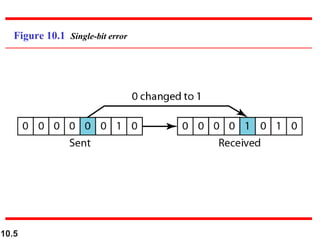
In a single-bit error, only 1 bit in the data
unit has changed.
Note
10.5
Figure 10.1 Single-bit error
10.6
A burst error means that 2 or more bits
in the data unit have changed.
Note
10.7
Figure 10.2 Burst error of length 8
10.8
To detect or correct errors, we need to
send extra (redundant) bits with data.
Note
10.9
Figure 10.3 The structure of encoder and decoder
10.10
In this book, we concentrate on block
codes; we leave convolution codes
to advanced texts.
Note
10.11
In modulo-N arithmetic, we use only the
integers in the range 0 to N −1,
inclusive.
Note
10.12
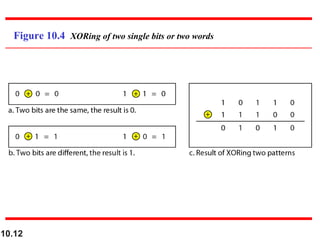
Figure 10.4 XORing of two single bits or two words
10.13
10-2 BLOCK CODING10-2 BLOCK CODING
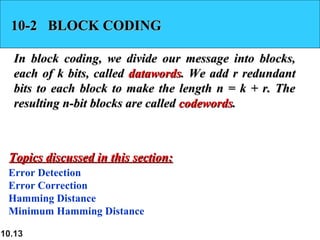
In block coding, we divide our message into blocks,In block coding, we divide our message into blocks,
each of k bits, calledeach of k bits, called datawordsdatawords. We add r redundant. We add r redundant
bits to each block to make the length n = k + r. Thebits to each block to make the length n = k + r. The
resulting n-bit blocks are calledresulting n-bit blocks are called codewordscodewords..
Error Detection
Error Correction
Hamming Distance
Minimum Hamming Distance
Topics discussed in this section:Topics discussed in this section:
10.14
Figure 10.5 Datawords and codewords in block coding ( n = k+r), r:
extra bits
10.15
Figure 10.6 Process of error detection in block coding
10.16
Let us assume that k = 2 and n = 3. Table 10.1 shows the
list of datawords and codewords. Later, we will see
how to derive a codeword from a dataword.
Assume the sender encodes the dataword 01 as 011 and
sends it to the receiver. Consider the following cases:
1. The receiver receives 011. It is a valid codeword. The
receiver extracts the dataword 01 from it.
Example 10.2
10.17
2. The codeword is corrupted during transmission, and
111 is received. This is not a valid codeword and is
discarded.
3. The codeword is corrupted during transmission, and
000 is received. This is a valid codeword. The receiver
incorrectly extracts the dataword 00. Two corrupted
bits have made the error undetectable.
Example 10.2 (continued)
10.18
Table 10.1 A code for error detection (Example 10.2)
10.19
An error-detecting code can detect
only the types of errors for which it is
designed; other types of errors may
remain undetected.
Note
10.20
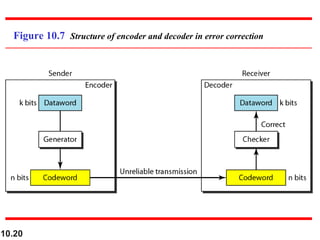
Figure 10.7 Structure of encoder and decoder in error correction
10.21
Let us add more redundant bits to Example 10.2 to see if
the receiver can correct an error without knowing what
was actually sent. We add 3 redundant bits to the 2-bit
dataword to make 5-bit codewords. Table 10.2 shows the
datawords and codewords. Assume the dataword is 01.
The sender creates the codeword 01011. The codeword is
corrupted during transmission, and 01001 is received.
First, the receiver finds that the received codeword is not
in the table. This means an error has occurred. The
receiver, assuming that there is only 1 bit corrupted, uses
the following strategy to guess the correct dataword.
Example 10.3
10.22
1. Comparing the received codeword with the first
codeword in the table (01001 versus 00000), the
receiver decides that the first codeword is not the one
that was sent because there are two different bits.
2. By the same reasoning, the original codeword cannot
be the third or fourth one in the table.
3. The original codeword must be the second one in the
table because this is the only one that differs from the
received codeword by 1 bit. The receiver replaces
01001 with 01011 and consults the table to find the
dataword 01.
Example 10.3 (continued)
10.23
Table 10.2 A code for error correction (Example 10.3)
10.24
The Hamming distance between two
words is the number of differences
between corresponding bits.
Note
10.25
Let us find the Hamming distance between two pairs of
words (number of differences betrween 2 words)
1. The Hamming distance d(000, 011) is 2 because
Example 10.4
2. The Hamming distance d(10101, 11110) is 3 because
10.26
The minimum Hamming distance is the
smallest Hamming distance between
all possible pairs in a set of words.
Note
10.27
Find the minimum Hamming distance of the coding
scheme in Table 10.1.
Solution
We first find all Hamming distances.
Example 10.5
The dmin in this case is 2.
10.28
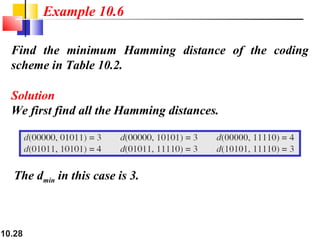
Find the minimum Hamming distance of the coding
scheme in Table 10.2.
Solution
We first find all the Hamming distances.
The dmin in this case is 3.
Example 10.6
10.29
10-3 LINEAR BLOCK CODES10-3 LINEAR BLOCK CODES
Almost all block codes used today belong to a subsetAlmost all block codes used today belong to a subset
calledcalled linear block codeslinear block codes. A linear block code is a code. A linear block code is a code
in which the exclusive OR (addition modulo-2) of twoin which the exclusive OR (addition modulo-2) of two
valid codewords creates another valid codeword.valid codewords creates another valid codeword.
Minimum Distance for Linear Block Codes
Some Linear Block Codes
Topics discussed in this section:Topics discussed in this section:
10.30
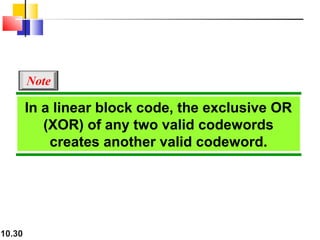
In a linear block code, the exclusive OR
(XOR) of any two valid codewords
creates another valid codeword.
Note
10.31
Let us see if the two codes we defined in Table 10.1 and
Table 10.2 belong to the class of linear block codes.
1. The scheme in Table 10.1 is a linear block code
because the result of XORing any codeword with any
other codeword is a valid codeword. For example, the
XORing of the second and third codewords creates the
fourth one.
2. The scheme in Table 10.2 is also a linear block code.
We can create all four codewords by XORing two
other codewords.
Example 10.10
10.32
A simple parity-check code is a
single-bit error-detecting
code in which
n = k + 1 with dmin = 2.
The extra-bit: parity bits is selected to
make the total number of 1s in the
codeword even ( even parity) or odd (for
odd parity)
10.33
Table 10.3 Simple parity-check code C(5, 4)
10.34
Figure 10.10 Encoder and decoder for simple parity-check code
10.35
A simple parity-check code can detect
an odd number of errors.
Note
10.36
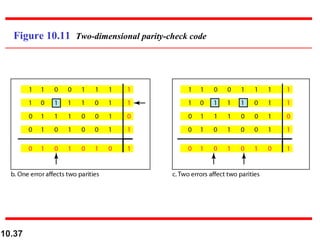
Figure 10.11 Two-dimensional parity-check code
10.37
Figure 10.11 Two-dimensional parity-check code
10.38
Figure 10.11 Two-dimensional parity-check code
10.39
Table 10.4 Hamming code C(7, 4)
10.40
Figure 10.12 The structure of the encoder and decoder for a Hamming code
10.41
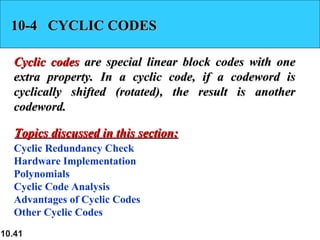
10-4 CYCLIC CODES10-4 CYCLIC CODES
Cyclic codesCyclic codes are special linear block codes with oneare special linear block codes with one
extra property. In a cyclic code, if a codeword isextra property. In a cyclic code, if a codeword is
cyclically shifted (rotated), the result is anothercyclically shifted (rotated), the result is another
codeword.codeword.
Cyclic Redundancy Check
Hardware Implementation
Polynomials
Cyclic Code Analysis
Advantages of Cyclic Codes
Other Cyclic Codes
Topics discussed in this section:Topics discussed in this section:
10.42
Table 10.6 A CRC code with C(7, 4)
10.43
Figure 10.14 CRC encoder and decoder
10.44
Figure 10.15 Division in CRC encoder
The division is done
to have the most left
bit 0, and is done
from left to right like a
regular division. The
division is done until
the quotient has as
many bits as the
dividend. The new
codeword is the
dataword extended by
the remainder.
The divisor
(generator) is agreed
upon.
10.45
To recover the dataword, we divide the
same way. In the following slide, we show
an example where the codeword was
changed (1 bit error) from 1001110 to
1000110. We see that there will be a
remainder (syndrome)
10.46
Figure 10.16 Division in the CRC decoder for two cases
10.47
The divisor in a cyclic code is normally
called the generator polynomial
or simply the generator.
Note
10.48
Advantages:
Very good performance in detecting single-
bit errors, double errors, an odd number of
errors and burst errors.
Easy to implement
10.49
10-5 CHECKSUM10-5 CHECKSUM
The last error detection method we discuss here isThe last error detection method we discuss here is
called the checksum. The checksum is used in thecalled the checksum. The checksum is used in the
Internet by several protocols although not at the dataInternet by several protocols although not at the data
link layer. However, we briefly discuss it here.link layer. However, we briefly discuss it here.
The idea is to simply send an additional data ( forThe idea is to simply send an additional data ( for
example the sum) along with the data. At theexample the sum) along with the data. At the
destination, the sum is calculated and compared to thedestination, the sum is calculated and compared to the
one sent.one sent.
One’s Complement
Internet Checksum
Topics discussed in this section:Topics discussed in this section:
10.50
Suppose our data is a list of five 4-bit numbers that we
want to send to a destination. In addition to sending these
numbers, we send the sum of the numbers. For example,
if the set of numbers is (7, 11, 12, 0, 6), we send (7, 11, 12,
0, 6, 36), where 36 is the sum of the original numbers.
The receiver adds the five numbers and compares the
result with the sum. If the two are the same, the receiver
assumes no error, accepts the five numbers, and discards
the sum. Otherwise, there is an error somewhere and the
data are not accepted.
Example 10.18
10.51
We can make the job of the receiver easier if we send the
negative (complement) of the sum, called the checksum.
In this case, we send (7, 11, 12, 0, 6, −36). The receiver
can add all the numbers received (including the
checksum). If the result is 0, it assumes no error;
otherwise, there is an error.
Example 10.19
10.52
Figure 10.24 Example 10.22
Cyclic RedundancyCyclic Redundancy
CheckCheck Given a k-bit frame or message, the
transmitter generates an n-bit
sequence, known as a frame check
sequence (FCS), so that the resulting
frame, consisting of (k+n) bits, is exactly
divisible by some predetermined
number.
 The receiver then divides the incoming
frame by the same number and, if there
is no remainder, assumes that there
was no error.
Binary Division
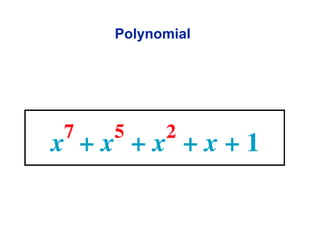
Polynomial
Polynomial and Divisor
Standard Polynomials

error detection correction

  • 1.
    10.1 Chapter 10 Error Detection and Correction Copyright© The McGraw-Hill Companies, Inc. Permission required for reproduction or display.
  • 2.
    10.2 Data can becorrupted during transmission. Some applications require that errors be detected and corrected. Note
  • 3.
    10.3 10-1 INTRODUCTION10-1 INTRODUCTION Letus first discuss some issues related, directly orLet us first discuss some issues related, directly or indirectly, to error detection and correction.indirectly, to error detection and correction. Types of Errors Redundancy Detection Versus Correction Forward Error Correction Versus Retransmission Coding Modular Arithmetic Topics discussed in this section:Topics discussed in this section:
  • 4.
    10.4 In a single-biterror, only 1 bit in the data unit has changed. Note
  • 5.
  • 6.
    10.6 A burst errormeans that 2 or more bits in the data unit have changed. Note
  • 7.
    10.7 Figure 10.2 Bursterror of length 8
  • 8.
    10.8 To detect orcorrect errors, we need to send extra (redundant) bits with data. Note
  • 9.
    10.9 Figure 10.3 Thestructure of encoder and decoder
  • 10.
    10.10 In this book,we concentrate on block codes; we leave convolution codes to advanced texts. Note
  • 11.
    10.11 In modulo-N arithmetic,we use only the integers in the range 0 to N −1, inclusive. Note
  • 12.
    10.12 Figure 10.4 XORingof two single bits or two words
  • 13.
    10.13 10-2 BLOCK CODING10-2BLOCK CODING In block coding, we divide our message into blocks,In block coding, we divide our message into blocks, each of k bits, calledeach of k bits, called datawordsdatawords. We add r redundant. We add r redundant bits to each block to make the length n = k + r. Thebits to each block to make the length n = k + r. The resulting n-bit blocks are calledresulting n-bit blocks are called codewordscodewords.. Error Detection Error Correction Hamming Distance Minimum Hamming Distance Topics discussed in this section:Topics discussed in this section:
  • 14.
    10.14 Figure 10.5 Datawordsand codewords in block coding ( n = k+r), r: extra bits
  • 15.
    10.15 Figure 10.6 Processof error detection in block coding
  • 16.
    10.16 Let us assumethat k = 2 and n = 3. Table 10.1 shows the list of datawords and codewords. Later, we will see how to derive a codeword from a dataword. Assume the sender encodes the dataword 01 as 011 and sends it to the receiver. Consider the following cases: 1. The receiver receives 011. It is a valid codeword. The receiver extracts the dataword 01 from it. Example 10.2
  • 17.
    10.17 2. The codewordis corrupted during transmission, and 111 is received. This is not a valid codeword and is discarded. 3. The codeword is corrupted during transmission, and 000 is received. This is a valid codeword. The receiver incorrectly extracts the dataword 00. Two corrupted bits have made the error undetectable. Example 10.2 (continued)
  • 18.
    10.18 Table 10.1 Acode for error detection (Example 10.2)
  • 19.
    10.19 An error-detecting codecan detect only the types of errors for which it is designed; other types of errors may remain undetected. Note
  • 20.
    10.20 Figure 10.7 Structureof encoder and decoder in error correction
  • 21.
    10.21 Let us addmore redundant bits to Example 10.2 to see if the receiver can correct an error without knowing what was actually sent. We add 3 redundant bits to the 2-bit dataword to make 5-bit codewords. Table 10.2 shows the datawords and codewords. Assume the dataword is 01. The sender creates the codeword 01011. The codeword is corrupted during transmission, and 01001 is received. First, the receiver finds that the received codeword is not in the table. This means an error has occurred. The receiver, assuming that there is only 1 bit corrupted, uses the following strategy to guess the correct dataword. Example 10.3
  • 22.
    10.22 1. Comparing thereceived codeword with the first codeword in the table (01001 versus 00000), the receiver decides that the first codeword is not the one that was sent because there are two different bits. 2. By the same reasoning, the original codeword cannot be the third or fourth one in the table. 3. The original codeword must be the second one in the table because this is the only one that differs from the received codeword by 1 bit. The receiver replaces 01001 with 01011 and consults the table to find the dataword 01. Example 10.3 (continued)
  • 23.
    10.23 Table 10.2 Acode for error correction (Example 10.3)
  • 24.
    10.24 The Hamming distancebetween two words is the number of differences between corresponding bits. Note
  • 25.
    10.25 Let us findthe Hamming distance between two pairs of words (number of differences betrween 2 words) 1. The Hamming distance d(000, 011) is 2 because Example 10.4 2. The Hamming distance d(10101, 11110) is 3 because
  • 26.
    10.26 The minimum Hammingdistance is the smallest Hamming distance between all possible pairs in a set of words. Note
  • 27.
    10.27 Find the minimumHamming distance of the coding scheme in Table 10.1. Solution We first find all Hamming distances. Example 10.5 The dmin in this case is 2.
  • 28.
    10.28 Find the minimumHamming distance of the coding scheme in Table 10.2. Solution We first find all the Hamming distances. The dmin in this case is 3. Example 10.6
  • 29.
    10.29 10-3 LINEAR BLOCKCODES10-3 LINEAR BLOCK CODES Almost all block codes used today belong to a subsetAlmost all block codes used today belong to a subset calledcalled linear block codeslinear block codes. A linear block code is a code. A linear block code is a code in which the exclusive OR (addition modulo-2) of twoin which the exclusive OR (addition modulo-2) of two valid codewords creates another valid codeword.valid codewords creates another valid codeword. Minimum Distance for Linear Block Codes Some Linear Block Codes Topics discussed in this section:Topics discussed in this section:
  • 30.
    10.30 In a linearblock code, the exclusive OR (XOR) of any two valid codewords creates another valid codeword. Note
  • 31.
    10.31 Let us seeif the two codes we defined in Table 10.1 and Table 10.2 belong to the class of linear block codes. 1. The scheme in Table 10.1 is a linear block code because the result of XORing any codeword with any other codeword is a valid codeword. For example, the XORing of the second and third codewords creates the fourth one. 2. The scheme in Table 10.2 is also a linear block code. We can create all four codewords by XORing two other codewords. Example 10.10
  • 32.
    10.32 A simple parity-checkcode is a single-bit error-detecting code in which n = k + 1 with dmin = 2. The extra-bit: parity bits is selected to make the total number of 1s in the codeword even ( even parity) or odd (for odd parity)
  • 33.
    10.33 Table 10.3 Simpleparity-check code C(5, 4)
  • 34.
    10.34 Figure 10.10 Encoderand decoder for simple parity-check code
  • 35.
    10.35 A simple parity-checkcode can detect an odd number of errors. Note
  • 36.
  • 37.
  • 38.
  • 39.
  • 40.
    10.40 Figure 10.12 Thestructure of the encoder and decoder for a Hamming code
  • 41.
    10.41 10-4 CYCLIC CODES10-4CYCLIC CODES Cyclic codesCyclic codes are special linear block codes with oneare special linear block codes with one extra property. In a cyclic code, if a codeword isextra property. In a cyclic code, if a codeword is cyclically shifted (rotated), the result is anothercyclically shifted (rotated), the result is another codeword.codeword. Cyclic Redundancy Check Hardware Implementation Polynomials Cyclic Code Analysis Advantages of Cyclic Codes Other Cyclic Codes Topics discussed in this section:Topics discussed in this section:
  • 42.
    10.42 Table 10.6 ACRC code with C(7, 4)
  • 43.
    10.43 Figure 10.14 CRCencoder and decoder
  • 44.
    10.44 Figure 10.15 Divisionin CRC encoder The division is done to have the most left bit 0, and is done from left to right like a regular division. The division is done until the quotient has as many bits as the dividend. The new codeword is the dataword extended by the remainder. The divisor (generator) is agreed upon.
  • 45.
    10.45 To recover thedataword, we divide the same way. In the following slide, we show an example where the codeword was changed (1 bit error) from 1001110 to 1000110. We see that there will be a remainder (syndrome)
  • 46.
    10.46 Figure 10.16 Divisionin the CRC decoder for two cases
  • 47.
    10.47 The divisor ina cyclic code is normally called the generator polynomial or simply the generator. Note
  • 48.
    10.48 Advantages: Very good performancein detecting single- bit errors, double errors, an odd number of errors and burst errors. Easy to implement
  • 49.
    10.49 10-5 CHECKSUM10-5 CHECKSUM Thelast error detection method we discuss here isThe last error detection method we discuss here is called the checksum. The checksum is used in thecalled the checksum. The checksum is used in the Internet by several protocols although not at the dataInternet by several protocols although not at the data link layer. However, we briefly discuss it here.link layer. However, we briefly discuss it here. The idea is to simply send an additional data ( forThe idea is to simply send an additional data ( for example the sum) along with the data. At theexample the sum) along with the data. At the destination, the sum is calculated and compared to thedestination, the sum is calculated and compared to the one sent.one sent. One’s Complement Internet Checksum Topics discussed in this section:Topics discussed in this section:
  • 50.
    10.50 Suppose our datais a list of five 4-bit numbers that we want to send to a destination. In addition to sending these numbers, we send the sum of the numbers. For example, if the set of numbers is (7, 11, 12, 0, 6), we send (7, 11, 12, 0, 6, 36), where 36 is the sum of the original numbers. The receiver adds the five numbers and compares the result with the sum. If the two are the same, the receiver assumes no error, accepts the five numbers, and discards the sum. Otherwise, there is an error somewhere and the data are not accepted. Example 10.18
  • 51.
    10.51 We can makethe job of the receiver easier if we send the negative (complement) of the sum, called the checksum. In this case, we send (7, 11, 12, 0, 6, −36). The receiver can add all the numbers received (including the checksum). If the result is 0, it assumes no error; otherwise, there is an error. Example 10.19
  • 52.
  • 53.
    Cyclic RedundancyCyclic Redundancy CheckCheckGiven a k-bit frame or message, the transmitter generates an n-bit sequence, known as a frame check sequence (FCS), so that the resulting frame, consisting of (k+n) bits, is exactly divisible by some predetermined number.  The receiver then divides the incoming frame by the same number and, if there is no remainder, assumes that there was no error.
  • 54.
  • 55.
  • 56.
  • 57.