This presentation is compiled by “ Drug Regulations” a
non profit organization which provides free online
resource to the Pharmaceutical Professional.
Visit http://www.drugregulations.org for latest
information from the world of Pharmaceuticals.
5/15/2014 1
This presentation is compiled from resources
available on the world wide web.
“Drug Regulations” is a non profit organization
which provides free online resource to the
Pharmaceutical Professional.
Visit http://www.drugregulations.org for latest
information from the world of
Pharmaceuticals.
5/15/2014 2
Drug Regulations : Online
Resource for Latest Information
 Data Integrity is assuming greater importance in cGMP’s
 Quality of raw materials, in process materials and finished
goods can not be assured with out data integrity.
 Data integrity issues are 21 CFR Part 11 and severe CGMP
violations
 If the integrity of laboratory data is compromised
◦ Products may not comply with regulatory authorization terms
◦ Products can not be released for sale
5/15/2014 3Drug Regulations : Online Resource for Latest Information
 In recent past FDA has increased its focus on data integrity and
reliability
 Similarly MHRA and Other regulatory bodies have increased
focus on data integrity
 Inspectors are examining data based on multiple regulations and
standards :
◦ CGMP
◦ Good Laboratory Practices (GLP),
◦ Good Clinical Practices (GCP) and
◦ The Application Integrity Policy (AIP)
5/15/2014 4Drug Regulations : Online Resource for Latest Information
 “Guilty until proven innocent” approach
 Historical approaches based on technical
justification and scientific rationale not
adequate
 Emphasis on providing evidence that the
analytical results are not fraudulent
5/15/2014 5Drug Regulations : Online Resource for Latest Information
 Data integrity is the assurance that data records
are accurate, complete, intact and maintained
within their original context, including their
relationship to other data records.
 This definition applies to data recorded in
electronic and paper formats or a hybrid of both.
5/15/2014 6Drug Regulations : Online Resource for Latest Information
 Protecting original data from
◦ Accidental modification
◦ Intentional Modification
◦ Falsification
◦ Deletion
5/15/2014 7Drug Regulations : Online Resource for Latest Information
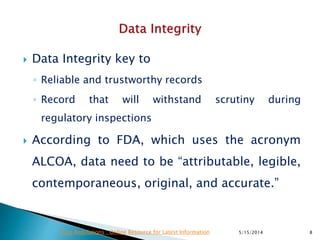
 Data Integrity key to
◦ Reliable and trustworthy records
◦ Record that will withstand scrutiny during
regulatory inspections
 According to FDA, which uses the acronym
ALCOA, data need to be “attributable, legible,
contemporaneous, original, and accurate.”
5/15/2014 8Drug Regulations : Online Resource for Latest Information
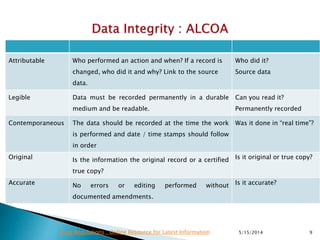
Attributable Who performed an action and when? If a record is
changed, who did it and why? Link to the source
data.
Who did it?
Source data
Legible Data must be recorded permanently in a durable
medium and be readable.
Can you read it?
Permanently recorded
Contemporaneous The data should be recorded at the time the work
is performed and date / time stamps should follow
in order
Was it done in “real time”?
Original Is the information the original record or a certified
true copy?
Is it original or true copy?
Accurate No errors or editing performed without
documented amendments.
Is it accurate?
5/15/2014 9Drug Regulations : Online Resource for Latest Information
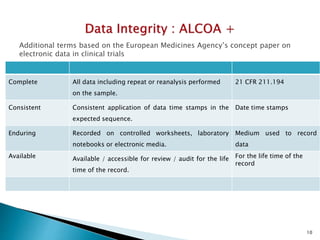
Complete All data including repeat or reanalysis performed
on the sample.
21 CFR 211.194
Consistent Consistent application of data time stamps in the
expected sequence.
Date time stamps
Enduring Recorded on controlled worksheets, laboratory
notebooks or electronic media.
Medium used to record
data
Available Available / accessible for review / audit for the life
time of the record.
For the life time of the
record
10
Additional terms based on the European Medicines Agency’s concept paper on
electronic data in clinical trials
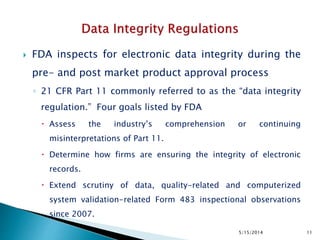
 FDA inspects for electronic data integrity during the
pre- and post market product approval process
◦ 21 CFR Part 11 commonly referred to as the “data integrity
regulation.” Four goals listed by FDA
 Assess the industry’s comprehension or continuing
misinterpretations of Part 11.
 Determine how firms are ensuring the integrity of electronic
records.
 Extend scrutiny of data, quality-related and computerized
system validation-related Form 483 inspectional observations
since 2007.
5/15/2014 11
 Comparisons between secure electronic data and data in
paper format.
◦ For software compliant to 21 CFR Part 11 (9) & with
appropriate technical controls
 Electronic data are more secure, more difficult to
manipulate or change, and any changes are easier to
detect
◦ Changes to paper data, such as a printed chromatogram,
are simpler to make, but much harder to detect.
5/15/2014 12Drug Regulations : Online Resource for Latest Information
 Comparisons between secure electronic data and data
in paper format.
◦ Defining paper records as “raw data” (the so-called
typewriter rule) does not satisfy the predicate rules
◦ Printed paper copy of the chromatogram will not be
considered a true copy
◦ Although this comment was made about
chromatographic data, the principles have much wider
implications.
5/15/2014 13Drug Regulations : Online Resource for Latest Information
 Able Labs ( 2005)
◦ Paper copies of records differed, sometimes
radically, from the electronic records contained
within a chromatography data system.
◦ Massive record falsification
◦ Efforts to avoid detection of several defective
medicines
5/15/2014 14Drug Regulations : Online Resource for Latest Information
 Leiner Health Products ( 2007)
 Serious deviations,
 Data manipulation
 Inadequate testing procedures
 Allowed the nonconforming drugs to be shipped to a
customer
5/15/2014 15Drug Regulations : Online Resource for Latest Information
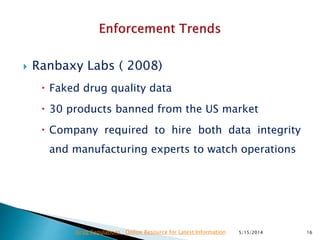
 Ranbaxy Labs ( 2008)
 Faked drug quality data
 30 products banned from the US market
 Company required to hire both data integrity
and manufacturing experts to watch operations
5/15/2014 16Drug Regulations : Online Resource for Latest Information
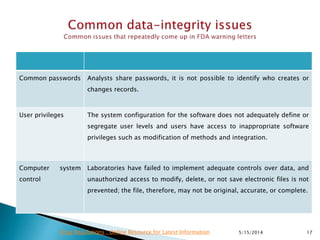
Common passwords Analysts share passwords, it is not possible to identify who creates or
changes records.
User privileges The system configuration for the software does not adequately define or
segregate user levels and users have access to inappropriate software
privileges such as modification of methods and integration.
Computer system
control
Laboratories have failed to implement adequate controls over data, and
unauthorized access to modify, delete, or not save electronic files is not
prevented; the file, therefore, may not be original, accurate, or complete.
5/15/2014 17Drug Regulations : Online Resource for Latest Information
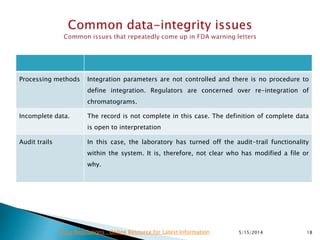
Processing methods Integration parameters are not controlled and there is no procedure to
define integration. Regulators are concerned over re-integration of
chromatograms.
Incomplete data. The record is not complete in this case. The definition of complete data
is open to interpretation
Audit trails In this case, the laboratory has turned off the audit-trail functionality
within the system. It is, therefore, not clear who has modified a file or
why.
5/15/2014 18Drug Regulations : Online Resource for Latest Information
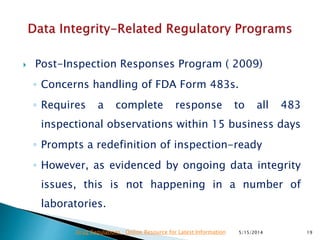
 Post-Inspection Responses Program ( 2009)
◦ Concerns handling of FDA Form 483s.
◦ Requires a complete response to all 483
inspectional observations within 15 business days
◦ Prompts a redefinition of inspection-ready
◦ However, as evidenced by ongoing data integrity
issues, this is not happening in a number of
laboratories.
5/15/2014 19Drug Regulations : Online Resource for Latest Information
 Part 11 audits alongside normal CGMP inspections
(2010)
 FDA’s Pre-Approval Inspection Program 7346.832,
◦ Audit the raw data, hard copy or electronic, to authenticate
the data submitted in the CMC section of the application,
and
◦ Verify that all relevant data (e.g., stability, biobatch data)
submitted can rely on the submitted data as complete and
accurate.”
5/15/2014 20Drug Regulations : Online Resource for Latest Information
 EU has published similar regulations relating to data
integrity.
 Released in January 2011
 Effective on 30 June 2011
 Increased requirements for computerized systems
regulation in Annex 11.
 Requires raw data for batch release is defined for both
homogeneous and hybrid systems.
5/15/2014 21Drug Regulations : Online Resource for Latest Information
 The new records retention requirements state that
if the records are supporting a Marketing
Authorisation (MA), then the records have to be
maintained, including the data integrity for as long
as the MA is in force.
 The recently published EU GMP Annex for
computerized systems 11, effective 30 June 2011,
has several sections dealing with data integrity.
5/15/2014 22Drug Regulations : Online Resource for Latest Information
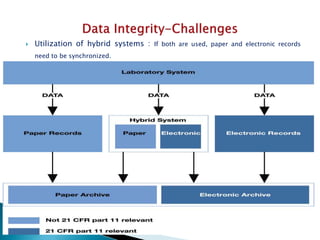
 Utilization of hybrid systems : If both are used, paper and electronic records
need to be synchronized.
5/15/2014 23
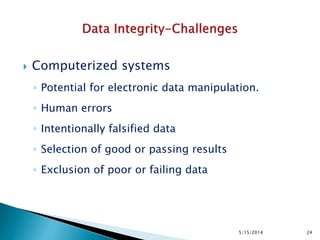
 Computerized systems
◦ Potential for electronic data manipulation.
◦ Human errors
◦ Intentionally falsified data
◦ Selection of good or passing results
◦ Exclusion of poor or failing data
5/15/2014 24
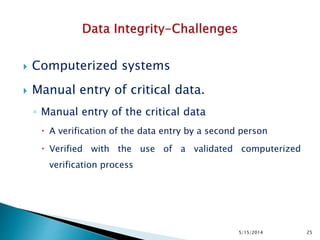
 Computerized systems
 Manual entry of critical data.
◦ Manual entry of the critical data
 A verification of the data entry by a second person
 Verified with the use of a validated computerized
verification process
5/15/2014 25
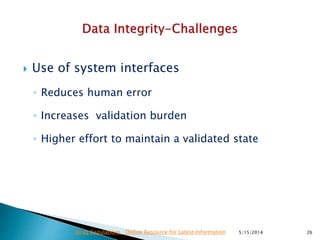
 Use of system interfaces
◦ Reduces human error
◦ Increases validation burden
◦ Higher effort to maintain a validated state
5/15/2014 26Drug Regulations : Online Resource for Latest Information
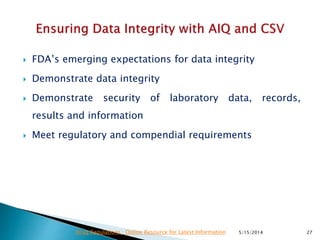
 FDA’s emerging expectations for data integrity
 Demonstrate data integrity
 Demonstrate security of laboratory data, records,
results and information
 Meet regulatory and compendial requirements
5/15/2014 27Drug Regulations : Online Resource for Latest Information
 Analytical instrumentation is computerized either
via firmware inside the instrument or via software
installed on a workstation situated next to the
instrument.
 All analytical instruments must be qualified
 All computerized systems must be validated
5/15/2014 28Drug Regulations : Online Resource for Latest Information
 The current regulatory guidance regarding the qualification of
analytical instrumentation and validation of computerized
systems is conflicting;
 qualification and validation are typically considered separate
activities with little, if any, interaction between the two
disciplines.
 The American Association of Pharmaceutical Scientists (AAPS)
produced guidance on analytical instrument qualification (AIQ) in
the form of a white paper,
 This has been incorporated as General Chapter <1058> within
the United States Pharmacopoeia (USP).
5/15/2014 29Drug Regulations : Online Resource for Latest Information
 The current regulatory guidance regarding the qualification of analytical
instrumentation and validation focuses on the instrument with little
emphasis on computerized system validation.
 In contrast, the Good Automated Manufacturing Practice (GAMP) Good
Practice Guide for Validation of Laboratory Computerized Systems from
the International Society for Pharmaceutical Engineering (ISPE) looks
exclusively at the computerized system
 This guidance ignores instrument qualification.
 The major problem and practical reality are that a computerized system
cannot be validated without qualifying the analytical instrument, and vice
versa.
5/15/2014 30Drug Regulations : Online Resource for Latest Information
 FDA and other global regulatory agencies now oversee the
pharmaceutical product lifecycle from early development to
final product release more thoroughly
 Therefore R & D labs have come under increased scrutiny
within recent years
 Regulations have been in place since the 1970s,
 However historically, FDA has concentrated its review process
on the manufacturing aspect of pharmaceutical products
 This has changed with the added scrutiny on data integrity
5/15/2014 31Drug Regulations : Online Resource for Latest Information
 Focus on resources : Personnel, Equipment and Facilities.
 Qualify all testing equipment to ensure its suitability for the
testing
 Implement a regular maintenance and calibration schedule
 Document all activities and record in logbooks or electronic
systems dedicated to each instrument and activity.
 Implement traceability for laboratory samples, test samples,
reagents
 Document the life of the laboratory sample until final
disposal, including all test samples and test portions
5/15/2014 32Drug Regulations : Online Resource for Latest Information
 Characterization Testing
 Keep detailed records
◦ Any raw materials used in development and
◦ Any intermediate process steps.
 Records should include as much information as
possible
◦ Raw material manufacturer
◦ Lot numbers
◦ Descriptions of the testing performed
◦ Any equipment used
5/15/2014 33Drug Regulations : Online Resource for Latest Information
 Protocols
 Protocols facilitate reproducibility of test methods and data to
strengthen the validity of generated data
 Establish protocols for both the studies and the testing
 Follow protocols consistently
 Establish procedures for handling non-trending data and
deviations from the approved procedures
5/15/2014 34Drug Regulations : Online Resource for Latest Information
 Results and Record Retention
 Data should be recorded
◦ In a timely manner
◦ Ideally in real time
◦ In bound notebooks
◦ Electronic systems.
 These data should be reviewed by personnel who are
knowledgeable about the test performed and the results
generated.
5/15/2014 35Drug Regulations : Online Resource for Latest Information
 Document in final study report
◦ Research testing outcome
◦ Interpretation of results
◦ Include specific commentary on any deviations that may have occurred
during the course of the study
 Archive all records safely yet be accessible
 Implement policies and procedures to ensure records are
retained and protected in a manner that ensures activities are
legally defensible
5/15/2014 36Drug Regulations : Online Resource for Latest Information
 Data integrity Challenges by
◦ sources of variation inherent in the use of computerized systems
◦ intentional falsification
◦ by accidental data loss or corruption.
 Several laboratories have a working LIMS
 Few laboratories are truly “paperless.”
5/15/2014 37Drug Regulations : Online Resource for Latest Information
 Common practices and tools for any laboratory computerized
system to control data integrity challenges
◦ User rights administration
◦ Security tools
◦ User access records
◦ Audit trails
◦ Records management
 Monitor these properly and
 Control to ensure data integrity
5/15/2014 38Drug Regulations : Online Resource for Latest Information
 Use Revision control for reanalysed data
 Enforce operational checks to verify user permissions
 Enforce a certain sequence of permitted steps according
to a defined workflow
 Use pre-defined workflows so that data cannot be
entered out of context
5/15/2014 39Drug Regulations : Online Resource for Latest Information
 Define “built-in” validation checkpoints within systems
◦ Input pattern/mask that forces the user to enter data into a
defined format
◦ Checks for valid data entered by the user to avoid data type issues
(classification identifying various types of data, such as real,
integer or Boolean)
◦ Drop-down lists for data selection wherever possible, instead of
data entry by the user
◦ Double entry checks to ensure key fields are not duplicated
◦ Pop-up calendars for date input to avoid entering the incorrect
date format
5/15/2014 40Drug Regulations : Online Resource for Latest Information
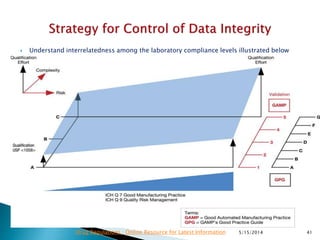
 Understand interrelatedness among the laboratory compliance levels illustrated below
5/15/2014 41Drug Regulations : Online Resource for Latest Information
 All levels are fundamental parts of the laboratory quality
system.
 Qualify Analytical instruments to show they are working
properly before any analytical methods are developed or
validated using them.
 Qualify analytical instruments before the computerized
systems managing the resulting data are validated.
5/15/2014 42Drug Regulations : Online Resource for Latest Information
 Guidance for Industry Part 11, Electronic Records;
Electronic Signatures
◦ Identify all raw data associated with making CGMP
decisions
◦ Determine the format (paper/electronic) in which the data
will be maintained.
◦ If the raw data are to be maintained in electronic format,
the integrity of the record must be assured.
5/15/2014 43Drug Regulations : Online Resource for Latest Information
 Accreditation to the International Standard ISO/IEC 17025:
2005
 Implementation is an advantage to maintaining data
integrity.
 Good analytical laboratory uses qualified analysts, checks the
performance of equipment used for testing and validates
analytical methods, many times, the outcome of the tests is
not fully documented.
 ISO/IEC 17025 accreditation requires formal documentation
for nearly everything in the laboratory workflow.
5/15/2014 44Drug Regulations : Online Resource for Latest Information
 Ensure data validity and integrity by
◦ Review raw data produced by the laboratory equipment or
computerized system periodically
◦ Define the raw data to be reviewed
◦ Define the related review task
◦ Link raw data and corresponding records clearly and
immutably
◦ Provide a date and time stamp with the data
◦ Link clearly and immutably to the original condition
5/15/2014 45Drug Regulations : Online Resource for Latest Information
 Document
◦ Periodic review results,
◦ Any gaps identified
◦ Corresponding remediation activities
 An annual assessment of laboratory procedural controls
is best to ensure:
◦ Compliance of laboratory personnel
◦ Proper coverage and implementation of SOPs
◦ “Real life” implementation of SOPs (verified through sample
checks of system documentation)
5/15/2014 46Drug Regulations : Online Resource for Latest Information
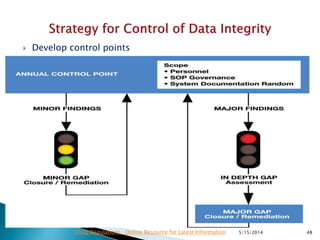
 Develop control points from
◦ System validation deliverables,
◦ System backup
◦ Restore
◦ Audit trail
◦ Electronic records
◦ Electronic signature
◦ Infrastructure requirements
5/15/2014 47Drug Regulations : Online Resource for Latest Information
 Develop control points
5/15/2014 48Drug Regulations : Online Resource for Latest Information
 Include control points in an annual
assessment tool
◦ Enable compliance with control points to be
determined through reporting major and minor
findings
◦ Implement remediation of major & minor gaps
◦ Describe whether the system is fit for use
5/15/2014 49Drug Regulations : Online Resource for Latest Information
 FDA-regulated laboratories are under intense scrutiny
 Data integrity enforcement actions are increasing due to violations
in recent years
 Ensuring data integrity is critical in both pre- and post marketing
approval activities
 Laboratories should document an overall data integrity approach by
outlining informatics based on workflow
 This approach can be set forth in a laboratory data integrity strategy
 Operational and procedural control points should be monitored
routinely
◦ Audited to identify any need for remediation
◦ Put the laboratory in the most defensible position
5/15/2014 50Drug Regulations : Online Resource for Latest Information
This presentation was compiled from resources
available on the world wide web.
“Drug Regulations” is a non profit organization
which provides free online resource to the
Pharmaceutical Professional.
Visit http://www.drugregulations.org for latest
information from the world of
Pharmaceuticals.
5/15/2014 51
Drug Regulations : Online
Resource for Latest Information

Data Integrity in FDA Regulated Labs

  • 1.
    This presentation iscompiled by “ Drug Regulations” a non profit organization which provides free online resource to the Pharmaceutical Professional. Visit http://www.drugregulations.org for latest information from the world of Pharmaceuticals. 5/15/2014 1
  • 2.
    This presentation iscompiled from resources available on the world wide web. “Drug Regulations” is a non profit organization which provides free online resource to the Pharmaceutical Professional. Visit http://www.drugregulations.org for latest information from the world of Pharmaceuticals. 5/15/2014 2 Drug Regulations : Online Resource for Latest Information
  • 3.
     Data Integrityis assuming greater importance in cGMP’s  Quality of raw materials, in process materials and finished goods can not be assured with out data integrity.  Data integrity issues are 21 CFR Part 11 and severe CGMP violations  If the integrity of laboratory data is compromised ◦ Products may not comply with regulatory authorization terms ◦ Products can not be released for sale 5/15/2014 3Drug Regulations : Online Resource for Latest Information
  • 4.
     In recentpast FDA has increased its focus on data integrity and reliability  Similarly MHRA and Other regulatory bodies have increased focus on data integrity  Inspectors are examining data based on multiple regulations and standards : ◦ CGMP ◦ Good Laboratory Practices (GLP), ◦ Good Clinical Practices (GCP) and ◦ The Application Integrity Policy (AIP) 5/15/2014 4Drug Regulations : Online Resource for Latest Information
  • 5.
     “Guilty untilproven innocent” approach  Historical approaches based on technical justification and scientific rationale not adequate  Emphasis on providing evidence that the analytical results are not fraudulent 5/15/2014 5Drug Regulations : Online Resource for Latest Information
  • 6.
     Data integrityis the assurance that data records are accurate, complete, intact and maintained within their original context, including their relationship to other data records.  This definition applies to data recorded in electronic and paper formats or a hybrid of both. 5/15/2014 6Drug Regulations : Online Resource for Latest Information
  • 7.
     Protecting originaldata from ◦ Accidental modification ◦ Intentional Modification ◦ Falsification ◦ Deletion 5/15/2014 7Drug Regulations : Online Resource for Latest Information
  • 8.
     Data Integritykey to ◦ Reliable and trustworthy records ◦ Record that will withstand scrutiny during regulatory inspections  According to FDA, which uses the acronym ALCOA, data need to be “attributable, legible, contemporaneous, original, and accurate.” 5/15/2014 8Drug Regulations : Online Resource for Latest Information
  • 9.
    Attributable Who performedan action and when? If a record is changed, who did it and why? Link to the source data. Who did it? Source data Legible Data must be recorded permanently in a durable medium and be readable. Can you read it? Permanently recorded Contemporaneous The data should be recorded at the time the work is performed and date / time stamps should follow in order Was it done in “real time”? Original Is the information the original record or a certified true copy? Is it original or true copy? Accurate No errors or editing performed without documented amendments. Is it accurate? 5/15/2014 9Drug Regulations : Online Resource for Latest Information
  • 10.
    Complete All dataincluding repeat or reanalysis performed on the sample. 21 CFR 211.194 Consistent Consistent application of data time stamps in the expected sequence. Date time stamps Enduring Recorded on controlled worksheets, laboratory notebooks or electronic media. Medium used to record data Available Available / accessible for review / audit for the life time of the record. For the life time of the record 10 Additional terms based on the European Medicines Agency’s concept paper on electronic data in clinical trials
  • 11.
     FDA inspectsfor electronic data integrity during the pre- and post market product approval process ◦ 21 CFR Part 11 commonly referred to as the “data integrity regulation.” Four goals listed by FDA  Assess the industry’s comprehension or continuing misinterpretations of Part 11.  Determine how firms are ensuring the integrity of electronic records.  Extend scrutiny of data, quality-related and computerized system validation-related Form 483 inspectional observations since 2007. 5/15/2014 11
  • 12.
     Comparisons betweensecure electronic data and data in paper format. ◦ For software compliant to 21 CFR Part 11 (9) & with appropriate technical controls  Electronic data are more secure, more difficult to manipulate or change, and any changes are easier to detect ◦ Changes to paper data, such as a printed chromatogram, are simpler to make, but much harder to detect. 5/15/2014 12Drug Regulations : Online Resource for Latest Information
  • 13.
     Comparisons betweensecure electronic data and data in paper format. ◦ Defining paper records as “raw data” (the so-called typewriter rule) does not satisfy the predicate rules ◦ Printed paper copy of the chromatogram will not be considered a true copy ◦ Although this comment was made about chromatographic data, the principles have much wider implications. 5/15/2014 13Drug Regulations : Online Resource for Latest Information
  • 14.
     Able Labs( 2005) ◦ Paper copies of records differed, sometimes radically, from the electronic records contained within a chromatography data system. ◦ Massive record falsification ◦ Efforts to avoid detection of several defective medicines 5/15/2014 14Drug Regulations : Online Resource for Latest Information
  • 15.
     Leiner HealthProducts ( 2007)  Serious deviations,  Data manipulation  Inadequate testing procedures  Allowed the nonconforming drugs to be shipped to a customer 5/15/2014 15Drug Regulations : Online Resource for Latest Information
  • 16.
     Ranbaxy Labs( 2008)  Faked drug quality data  30 products banned from the US market  Company required to hire both data integrity and manufacturing experts to watch operations 5/15/2014 16Drug Regulations : Online Resource for Latest Information
  • 17.
    Common passwords Analystsshare passwords, it is not possible to identify who creates or changes records. User privileges The system configuration for the software does not adequately define or segregate user levels and users have access to inappropriate software privileges such as modification of methods and integration. Computer system control Laboratories have failed to implement adequate controls over data, and unauthorized access to modify, delete, or not save electronic files is not prevented; the file, therefore, may not be original, accurate, or complete. 5/15/2014 17Drug Regulations : Online Resource for Latest Information
  • 18.
    Processing methods Integrationparameters are not controlled and there is no procedure to define integration. Regulators are concerned over re-integration of chromatograms. Incomplete data. The record is not complete in this case. The definition of complete data is open to interpretation Audit trails In this case, the laboratory has turned off the audit-trail functionality within the system. It is, therefore, not clear who has modified a file or why. 5/15/2014 18Drug Regulations : Online Resource for Latest Information
  • 19.
     Post-Inspection ResponsesProgram ( 2009) ◦ Concerns handling of FDA Form 483s. ◦ Requires a complete response to all 483 inspectional observations within 15 business days ◦ Prompts a redefinition of inspection-ready ◦ However, as evidenced by ongoing data integrity issues, this is not happening in a number of laboratories. 5/15/2014 19Drug Regulations : Online Resource for Latest Information
  • 20.
     Part 11audits alongside normal CGMP inspections (2010)  FDA’s Pre-Approval Inspection Program 7346.832, ◦ Audit the raw data, hard copy or electronic, to authenticate the data submitted in the CMC section of the application, and ◦ Verify that all relevant data (e.g., stability, biobatch data) submitted can rely on the submitted data as complete and accurate.” 5/15/2014 20Drug Regulations : Online Resource for Latest Information
  • 21.
     EU haspublished similar regulations relating to data integrity.  Released in January 2011  Effective on 30 June 2011  Increased requirements for computerized systems regulation in Annex 11.  Requires raw data for batch release is defined for both homogeneous and hybrid systems. 5/15/2014 21Drug Regulations : Online Resource for Latest Information
  • 22.
     The newrecords retention requirements state that if the records are supporting a Marketing Authorisation (MA), then the records have to be maintained, including the data integrity for as long as the MA is in force.  The recently published EU GMP Annex for computerized systems 11, effective 30 June 2011, has several sections dealing with data integrity. 5/15/2014 22Drug Regulations : Online Resource for Latest Information
  • 23.
     Utilization ofhybrid systems : If both are used, paper and electronic records need to be synchronized. 5/15/2014 23
  • 24.
     Computerized systems ◦Potential for electronic data manipulation. ◦ Human errors ◦ Intentionally falsified data ◦ Selection of good or passing results ◦ Exclusion of poor or failing data 5/15/2014 24
  • 25.
     Computerized systems Manual entry of critical data. ◦ Manual entry of the critical data  A verification of the data entry by a second person  Verified with the use of a validated computerized verification process 5/15/2014 25
  • 26.
     Use ofsystem interfaces ◦ Reduces human error ◦ Increases validation burden ◦ Higher effort to maintain a validated state 5/15/2014 26Drug Regulations : Online Resource for Latest Information
  • 27.
     FDA’s emergingexpectations for data integrity  Demonstrate data integrity  Demonstrate security of laboratory data, records, results and information  Meet regulatory and compendial requirements 5/15/2014 27Drug Regulations : Online Resource for Latest Information
  • 28.
     Analytical instrumentationis computerized either via firmware inside the instrument or via software installed on a workstation situated next to the instrument.  All analytical instruments must be qualified  All computerized systems must be validated 5/15/2014 28Drug Regulations : Online Resource for Latest Information
  • 29.
     The currentregulatory guidance regarding the qualification of analytical instrumentation and validation of computerized systems is conflicting;  qualification and validation are typically considered separate activities with little, if any, interaction between the two disciplines.  The American Association of Pharmaceutical Scientists (AAPS) produced guidance on analytical instrument qualification (AIQ) in the form of a white paper,  This has been incorporated as General Chapter <1058> within the United States Pharmacopoeia (USP). 5/15/2014 29Drug Regulations : Online Resource for Latest Information
  • 30.
     The currentregulatory guidance regarding the qualification of analytical instrumentation and validation focuses on the instrument with little emphasis on computerized system validation.  In contrast, the Good Automated Manufacturing Practice (GAMP) Good Practice Guide for Validation of Laboratory Computerized Systems from the International Society for Pharmaceutical Engineering (ISPE) looks exclusively at the computerized system  This guidance ignores instrument qualification.  The major problem and practical reality are that a computerized system cannot be validated without qualifying the analytical instrument, and vice versa. 5/15/2014 30Drug Regulations : Online Resource for Latest Information
  • 31.
     FDA andother global regulatory agencies now oversee the pharmaceutical product lifecycle from early development to final product release more thoroughly  Therefore R & D labs have come under increased scrutiny within recent years  Regulations have been in place since the 1970s,  However historically, FDA has concentrated its review process on the manufacturing aspect of pharmaceutical products  This has changed with the added scrutiny on data integrity 5/15/2014 31Drug Regulations : Online Resource for Latest Information
  • 32.
     Focus onresources : Personnel, Equipment and Facilities.  Qualify all testing equipment to ensure its suitability for the testing  Implement a regular maintenance and calibration schedule  Document all activities and record in logbooks or electronic systems dedicated to each instrument and activity.  Implement traceability for laboratory samples, test samples, reagents  Document the life of the laboratory sample until final disposal, including all test samples and test portions 5/15/2014 32Drug Regulations : Online Resource for Latest Information
  • 33.
     Characterization Testing Keep detailed records ◦ Any raw materials used in development and ◦ Any intermediate process steps.  Records should include as much information as possible ◦ Raw material manufacturer ◦ Lot numbers ◦ Descriptions of the testing performed ◦ Any equipment used 5/15/2014 33Drug Regulations : Online Resource for Latest Information
  • 34.
     Protocols  Protocolsfacilitate reproducibility of test methods and data to strengthen the validity of generated data  Establish protocols for both the studies and the testing  Follow protocols consistently  Establish procedures for handling non-trending data and deviations from the approved procedures 5/15/2014 34Drug Regulations : Online Resource for Latest Information
  • 35.
     Results andRecord Retention  Data should be recorded ◦ In a timely manner ◦ Ideally in real time ◦ In bound notebooks ◦ Electronic systems.  These data should be reviewed by personnel who are knowledgeable about the test performed and the results generated. 5/15/2014 35Drug Regulations : Online Resource for Latest Information
  • 36.
     Document infinal study report ◦ Research testing outcome ◦ Interpretation of results ◦ Include specific commentary on any deviations that may have occurred during the course of the study  Archive all records safely yet be accessible  Implement policies and procedures to ensure records are retained and protected in a manner that ensures activities are legally defensible 5/15/2014 36Drug Regulations : Online Resource for Latest Information
  • 37.
     Data integrityChallenges by ◦ sources of variation inherent in the use of computerized systems ◦ intentional falsification ◦ by accidental data loss or corruption.  Several laboratories have a working LIMS  Few laboratories are truly “paperless.” 5/15/2014 37Drug Regulations : Online Resource for Latest Information
  • 38.
     Common practicesand tools for any laboratory computerized system to control data integrity challenges ◦ User rights administration ◦ Security tools ◦ User access records ◦ Audit trails ◦ Records management  Monitor these properly and  Control to ensure data integrity 5/15/2014 38Drug Regulations : Online Resource for Latest Information
  • 39.
     Use Revisioncontrol for reanalysed data  Enforce operational checks to verify user permissions  Enforce a certain sequence of permitted steps according to a defined workflow  Use pre-defined workflows so that data cannot be entered out of context 5/15/2014 39Drug Regulations : Online Resource for Latest Information
  • 40.
     Define “built-in”validation checkpoints within systems ◦ Input pattern/mask that forces the user to enter data into a defined format ◦ Checks for valid data entered by the user to avoid data type issues (classification identifying various types of data, such as real, integer or Boolean) ◦ Drop-down lists for data selection wherever possible, instead of data entry by the user ◦ Double entry checks to ensure key fields are not duplicated ◦ Pop-up calendars for date input to avoid entering the incorrect date format 5/15/2014 40Drug Regulations : Online Resource for Latest Information
  • 41.
     Understand interrelatednessamong the laboratory compliance levels illustrated below 5/15/2014 41Drug Regulations : Online Resource for Latest Information
  • 42.
     All levelsare fundamental parts of the laboratory quality system.  Qualify Analytical instruments to show they are working properly before any analytical methods are developed or validated using them.  Qualify analytical instruments before the computerized systems managing the resulting data are validated. 5/15/2014 42Drug Regulations : Online Resource for Latest Information
  • 43.
     Guidance forIndustry Part 11, Electronic Records; Electronic Signatures ◦ Identify all raw data associated with making CGMP decisions ◦ Determine the format (paper/electronic) in which the data will be maintained. ◦ If the raw data are to be maintained in electronic format, the integrity of the record must be assured. 5/15/2014 43Drug Regulations : Online Resource for Latest Information
  • 44.
     Accreditation tothe International Standard ISO/IEC 17025: 2005  Implementation is an advantage to maintaining data integrity.  Good analytical laboratory uses qualified analysts, checks the performance of equipment used for testing and validates analytical methods, many times, the outcome of the tests is not fully documented.  ISO/IEC 17025 accreditation requires formal documentation for nearly everything in the laboratory workflow. 5/15/2014 44Drug Regulations : Online Resource for Latest Information
  • 45.
     Ensure datavalidity and integrity by ◦ Review raw data produced by the laboratory equipment or computerized system periodically ◦ Define the raw data to be reviewed ◦ Define the related review task ◦ Link raw data and corresponding records clearly and immutably ◦ Provide a date and time stamp with the data ◦ Link clearly and immutably to the original condition 5/15/2014 45Drug Regulations : Online Resource for Latest Information
  • 46.
     Document ◦ Periodicreview results, ◦ Any gaps identified ◦ Corresponding remediation activities  An annual assessment of laboratory procedural controls is best to ensure: ◦ Compliance of laboratory personnel ◦ Proper coverage and implementation of SOPs ◦ “Real life” implementation of SOPs (verified through sample checks of system documentation) 5/15/2014 46Drug Regulations : Online Resource for Latest Information
  • 47.
     Develop controlpoints from ◦ System validation deliverables, ◦ System backup ◦ Restore ◦ Audit trail ◦ Electronic records ◦ Electronic signature ◦ Infrastructure requirements 5/15/2014 47Drug Regulations : Online Resource for Latest Information
  • 48.
     Develop controlpoints 5/15/2014 48Drug Regulations : Online Resource for Latest Information
  • 49.
     Include controlpoints in an annual assessment tool ◦ Enable compliance with control points to be determined through reporting major and minor findings ◦ Implement remediation of major & minor gaps ◦ Describe whether the system is fit for use 5/15/2014 49Drug Regulations : Online Resource for Latest Information
  • 50.
     FDA-regulated laboratoriesare under intense scrutiny  Data integrity enforcement actions are increasing due to violations in recent years  Ensuring data integrity is critical in both pre- and post marketing approval activities  Laboratories should document an overall data integrity approach by outlining informatics based on workflow  This approach can be set forth in a laboratory data integrity strategy  Operational and procedural control points should be monitored routinely ◦ Audited to identify any need for remediation ◦ Put the laboratory in the most defensible position 5/15/2014 50Drug Regulations : Online Resource for Latest Information
  • 51.
    This presentation wascompiled from resources available on the world wide web. “Drug Regulations” is a non profit organization which provides free online resource to the Pharmaceutical Professional. Visit http://www.drugregulations.org for latest information from the world of Pharmaceuticals. 5/15/2014 51 Drug Regulations : Online Resource for Latest Information