nd rd
22 - 23 April 2016 th th
25 - 26 April 2016 th th
29 - 30 April 2016
Hyderabad Mumbai Chandigarh
www.marcepinc.com Tel: 022- 30210100 Fax: 022- 30210103 info@marcepinc.com
Workshop on :
Data Integrity Compliance = Achieving Quality & Compliance Excellence
To Meet US FDA, EU & International Regulatory Audit
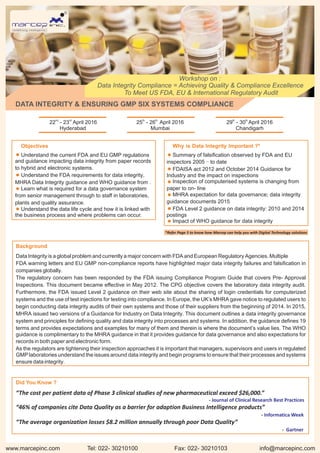
DATA INTEGRITY & ENSURING GMP SIX SYSTEMS COMPLIANCE
Objectives
Understand the current FDA and EU GMP regulations
and guidance impacting data integrity from paper records
to hybrid and electronic systems.
Understand the FDA requirements for data integrity,
MHRA Data Integrity guidance and WHO guidance from .
Learn what is required for a data governance system
from senior management through to staff in laboratories,
plants and quality assurance.
Understand the data life cycle and how it is linked with
the business process and where problems can occur.
Why is Data Integrity Important ?*
Summary of falsification observed by FDA and EU
inspectors 2005 – to date
FDAISA act 2012 and October 2014 Guidance for
Industry and the impact on inspections
Inspection of computerised systems is changing from
paper to on- line
MHRA expectation for data governance; data integrity
guidance documents 2015
FDA Level 2 guidance on data integrity: 2010 and 2014
postings
Impact of WHO guidance for data integrity
Background
Data Integrity is a global problem and currently a major concern with FDA and European Regulatory Agencies. Multiple
FDA warning letters and EU GMP non-compliance reports have highlighted major data integrity failures and falsification in
companies globally.
The regulatory concern has been responded by the FDA issuing Compliance Program Guide that covers Pre- Approval
Inspections. This document became effective in May 2012. The CPG objective covers the laboratory data integrity audit.
Furthermore, the FDA issued Level 2 guidance on their web site about the sharing of login credentials for computerized
systems and the use of test injections for testing into compliance. In Europe, the UK’s MHRA gave notice to regulated users to
begin conducting data integrity audits of their own systems and those of their suppliers from the beginning of 2014. In 2015,
MHRA issued two versions of a Guidance for Industry on Data Integrity. This document outlines a data integrity governance
system and principles for defining quality and data integrity into processes and systems. In addition, the guidance defines 19
terms and provides expectations and examples for many of them and therein is where the document’s value lies. The WHO
guidance is complimentary to the MHRA guidance in that it provides guidance for data governance and also expectations for
records in both paper and electronic form.
As the regulators are tightening their inspection approaches it is important that managers, supervisors and users in regulated
GMP laboratories understand the issues around data integrity and begin programs to ensure that their processes and systems
ensure data integrity.
R
Did You Know ?
“The cost per patient data of Phase 3 clinical studies of new pharmaceutical exceed $26,000.”
-
“46% of companies cite Data Quality as a barrier for adaption Business Intelligence products”
-
“The average organization losses $8.2 million annually through poor Data Quality”
-
Journal of Clinical Research Best Practices
Informatica Week
Gartner
*Refer Page 5 to know how Marcep can help you with Digital Technology solutions
www.marcepinc.com Tel: 022- 30210100 Fax: 022- 30210103 info@marcepinc.com
REGISTRATION
Welcome address and introduction of participants
What is Data Integrity
Definitions of Data integrity
Regulatory citing on Data integrity issues
This session will discuss the basics and elements of data
integrity and provide basic key example of how to ensure its
effectiveness
Regulatory Requirements on Data integrity
Key regulatory requirements
Data Integrity – Issues : Understanding and Resolution-
Dealing with Mistakes before they become falsification
and fraud
Current data integrity Issues
What is its impact?
How can we assure data integrity
Resolution Mechanism of data Integrity
Networking Luncheon
EU and FDA GMP Regulations Impacting Laboratory
Data and Results
EU GMP/MHRA requirements on data integrity
FDA GMP requirements on data integrity
FDA Guidance documents OOS, Inspection of QC labs
Inspection findings 483 and warning letters
Defining data integrity, “complete data” and “raw data”
Generation of Data
What are the requirements for raw data integrity?
Three scenarios covering
Ÿa paper system
Ÿa hybrid system
Ÿa client server electronic system
Principle for the Generation of Data
Observational tests and instruments tests
Training of staff
Qualified analytical instruments and validated software
Intergrity issues with practice
Security issues
Recording of Data
Paper based systems
Hybrid systems with paper printouts and electronic records
Stand alone systems containing only electronic records
Networked systems containing only electronic records
Q & A Sessions
Closing Remarks for Day One.
How to Overcome Data integrity issues
Data integrity compliance team
Strengthening internal Audits
Strengthening Review procedures
GMP six systems specific data Integrity check points:
Discussion about how to check laboratory data integrity
Check and its Compliance
Discussion about how to check Production records and its
systems control data integrity compliance
Discussion about Quality systems data integrity (QA data
integrity checks) compliance
Discussion about Material systems (stores and ware house
and finished good storage) data integrity checks and its
control.
Discussion about Facilities ;Equipments and engineering
systems (HVAC and Water systems) data integrity checks
and its control.
Discussion about Packaging; labelling and its control data
integrity checks and its control.
These discussion will be explained with individual check
list and also helps the people during their regular internal
audits.
Work shop case study:
Participant's splitter into 6 groups and in all six systems each
one data integrity observation will be given and participants
have to work out investigation; root cause and propose CAPA.
Transforming Data and Data Transformation and
Collation and Reporting Results-How to identify
transcription errors and how to handle and correct them
Converting laboratory data to information
Identifying and handling errors on paper as well as electronic
systems
Calculations performed manually and by computer programs
Issues with truncation and rounding of numbers
Integrity and security issues of the records generated during
transformation
Using Excel correctly
Data from printout transcription, rounding, truncation
Calculating the reportable value and comparison with the
specification
Paper processes versus electronic processes
Linkage with out of specification investigations (OOS)
Archiving
Risk assessment
How to conduct Risk assessment covering Data integrity
some Model risk assessment discussion
Discussion about quality culture
Improvements for quality culture
How to monitor through Quality metrics.
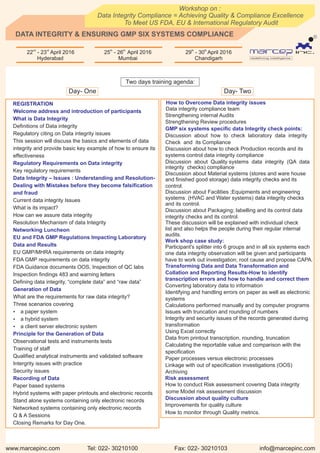
Day- One Day- Two
Two days training agenda:
nd rd
22 - 23 April 2016 th th
25 - 26 April 2016 th th
29 - 30 April 2016
Hyderabad Mumbai Chandigarh
Workshop on :
Data Integrity Compliance = Achieving Quality & Compliance Excellence
To Meet US FDA, EU & International Regulatory Audit
DATA INTEGRITY & ENSURING GMP SIX SYSTEMS COMPLIANCE R

Data Integrity; Ensuring GMP Six Systems Compliance Pharma Training

  • 1.
    nd rd 22 -23 April 2016 th th 25 - 26 April 2016 th th 29 - 30 April 2016 Hyderabad Mumbai Chandigarh www.marcepinc.com Tel: 022- 30210100 Fax: 022- 30210103 info@marcepinc.com Workshop on : Data Integrity Compliance = Achieving Quality & Compliance Excellence To Meet US FDA, EU & International Regulatory Audit DATA INTEGRITY & ENSURING GMP SIX SYSTEMS COMPLIANCE Objectives Understand the current FDA and EU GMP regulations and guidance impacting data integrity from paper records to hybrid and electronic systems. Understand the FDA requirements for data integrity, MHRA Data Integrity guidance and WHO guidance from . Learn what is required for a data governance system from senior management through to staff in laboratories, plants and quality assurance. Understand the data life cycle and how it is linked with the business process and where problems can occur. Why is Data Integrity Important ?* Summary of falsification observed by FDA and EU inspectors 2005 – to date FDAISA act 2012 and October 2014 Guidance for Industry and the impact on inspections Inspection of computerised systems is changing from paper to on- line MHRA expectation for data governance; data integrity guidance documents 2015 FDA Level 2 guidance on data integrity: 2010 and 2014 postings Impact of WHO guidance for data integrity Background Data Integrity is a global problem and currently a major concern with FDA and European Regulatory Agencies. Multiple FDA warning letters and EU GMP non-compliance reports have highlighted major data integrity failures and falsification in companies globally. The regulatory concern has been responded by the FDA issuing Compliance Program Guide that covers Pre- Approval Inspections. This document became effective in May 2012. The CPG objective covers the laboratory data integrity audit. Furthermore, the FDA issued Level 2 guidance on their web site about the sharing of login credentials for computerized systems and the use of test injections for testing into compliance. In Europe, the UK’s MHRA gave notice to regulated users to begin conducting data integrity audits of their own systems and those of their suppliers from the beginning of 2014. In 2015, MHRA issued two versions of a Guidance for Industry on Data Integrity. This document outlines a data integrity governance system and principles for defining quality and data integrity into processes and systems. In addition, the guidance defines 19 terms and provides expectations and examples for many of them and therein is where the document’s value lies. The WHO guidance is complimentary to the MHRA guidance in that it provides guidance for data governance and also expectations for records in both paper and electronic form. As the regulators are tightening their inspection approaches it is important that managers, supervisors and users in regulated GMP laboratories understand the issues around data integrity and begin programs to ensure that their processes and systems ensure data integrity. R Did You Know ? “The cost per patient data of Phase 3 clinical studies of new pharmaceutical exceed $26,000.” - “46% of companies cite Data Quality as a barrier for adaption Business Intelligence products” - “The average organization losses $8.2 million annually through poor Data Quality” - Journal of Clinical Research Best Practices Informatica Week Gartner *Refer Page 5 to know how Marcep can help you with Digital Technology solutions
  • 2.
    www.marcepinc.com Tel: 022-30210100 Fax: 022- 30210103 info@marcepinc.com REGISTRATION Welcome address and introduction of participants What is Data Integrity Definitions of Data integrity Regulatory citing on Data integrity issues This session will discuss the basics and elements of data integrity and provide basic key example of how to ensure its effectiveness Regulatory Requirements on Data integrity Key regulatory requirements Data Integrity – Issues : Understanding and Resolution- Dealing with Mistakes before they become falsification and fraud Current data integrity Issues What is its impact? How can we assure data integrity Resolution Mechanism of data Integrity Networking Luncheon EU and FDA GMP Regulations Impacting Laboratory Data and Results EU GMP/MHRA requirements on data integrity FDA GMP requirements on data integrity FDA Guidance documents OOS, Inspection of QC labs Inspection findings 483 and warning letters Defining data integrity, “complete data” and “raw data” Generation of Data What are the requirements for raw data integrity? Three scenarios covering Ÿa paper system Ÿa hybrid system Ÿa client server electronic system Principle for the Generation of Data Observational tests and instruments tests Training of staff Qualified analytical instruments and validated software Intergrity issues with practice Security issues Recording of Data Paper based systems Hybrid systems with paper printouts and electronic records Stand alone systems containing only electronic records Networked systems containing only electronic records Q & A Sessions Closing Remarks for Day One. How to Overcome Data integrity issues Data integrity compliance team Strengthening internal Audits Strengthening Review procedures GMP six systems specific data Integrity check points: Discussion about how to check laboratory data integrity Check and its Compliance Discussion about how to check Production records and its systems control data integrity compliance Discussion about Quality systems data integrity (QA data integrity checks) compliance Discussion about Material systems (stores and ware house and finished good storage) data integrity checks and its control. Discussion about Facilities ;Equipments and engineering systems (HVAC and Water systems) data integrity checks and its control. Discussion about Packaging; labelling and its control data integrity checks and its control. These discussion will be explained with individual check list and also helps the people during their regular internal audits. Work shop case study: Participant's splitter into 6 groups and in all six systems each one data integrity observation will be given and participants have to work out investigation; root cause and propose CAPA. Transforming Data and Data Transformation and Collation and Reporting Results-How to identify transcription errors and how to handle and correct them Converting laboratory data to information Identifying and handling errors on paper as well as electronic systems Calculations performed manually and by computer programs Issues with truncation and rounding of numbers Integrity and security issues of the records generated during transformation Using Excel correctly Data from printout transcription, rounding, truncation Calculating the reportable value and comparison with the specification Paper processes versus electronic processes Linkage with out of specification investigations (OOS) Archiving Risk assessment How to conduct Risk assessment covering Data integrity some Model risk assessment discussion Discussion about quality culture Improvements for quality culture How to monitor through Quality metrics. Day- One Day- Two Two days training agenda: nd rd 22 - 23 April 2016 th th 25 - 26 April 2016 th th 29 - 30 April 2016 Hyderabad Mumbai Chandigarh Workshop on : Data Integrity Compliance = Achieving Quality & Compliance Excellence To Meet US FDA, EU & International Regulatory Audit DATA INTEGRITY & ENSURING GMP SIX SYSTEMS COMPLIANCE R