Data
Independence
Presented by-
Pragya Srivastava
B.Tech(3rd year)
1336710013
SCHEMA
The word schema comes from the Greek word
skhēma, which means shape and overall
structure, or more generally, plan. The
plural is skhēmata. In English, both schemas
and schemata are used as plural forms.
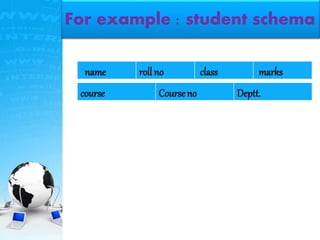
Overall structure or design of database is called schema.
name roll no class marks
course Courseno Deptt.
For example : student schema
SUB SCHEMA
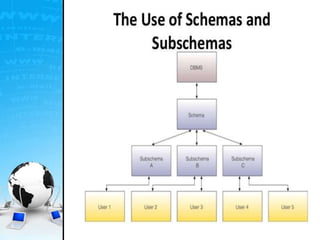
A subschema is a subset or proper subset of the schema and inherits the
same property that a schema has.
The plan (or scheme) for a view is often called subschema.
 It gives the users a window through which he or she can view only that part
of the database, which is of interest to him/her.
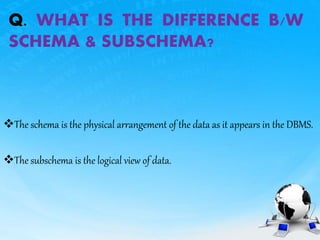
Q. WHAT IS THE DIFFERENCE B/W
SCHEMA & SUBSCHEMA?
The schema is the physical arrangement of the data as it appears in the DBMS.
The subschema is the logical view of data.
3-SCHEMA ARCHITECTURE
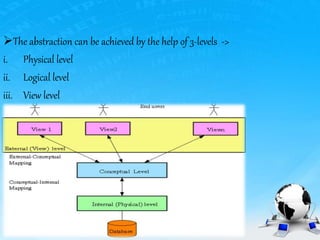
The three-schema model consisting conceptual level, an external level, and an
internal or physical level was first introduced by Charles Bachman in 1975.
The motive of studying data base architecture is to provide an abstract view.
Abstract view means that the system hides 2nd detail on how the data is stored
& maintained in data base.
The abstraction can be achieved by the help of 3-levels ->
i. Physical level
ii. Logical level
iii. View level
PHYSICAL LEVEL
It deals with how data is stored in storage
medium.
Physical level has physical/internal schema.
LOGICAL LEVEL
it describe what data is store in database and what relationship exist among
those data?
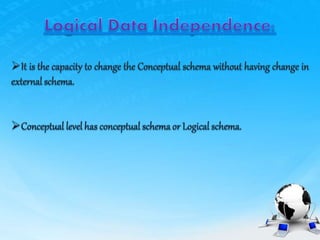
Logical level has logical/conceptual schema.
Logical level hides the details of physical storage.
VIEW LEVEL
This level is closest to the user.
It has external schema.
External schema describe the part of the database that perticular user group
is interacting in and hides rest of the database from user group.
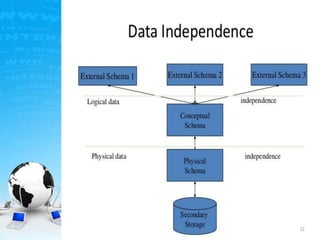
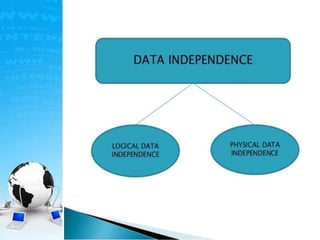
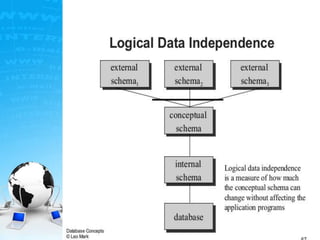
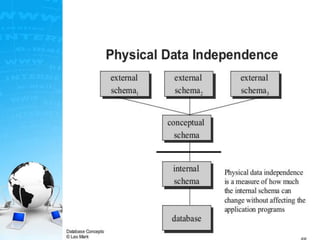
Data Independence
 The capacity to change schema at one level without having change in next
higher level.
 We have to changes because the size of database increases day by day.
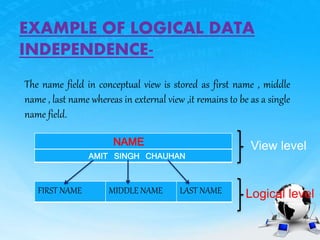
EXAMPLE OF LOGICAL DATA
INDEPENDENCE-
The name field in conceptual view is stored as first name , middle
name , last name whereas in external view ,it remains to be as a single
name field.
FIRST NAME MIDDLE NAME LAST NAME
NAME
AMIT SINGH CHAUHAN
View level
Logical level
EXAMPLE OF PHYSICAL DATA
INDEPENDENCE-
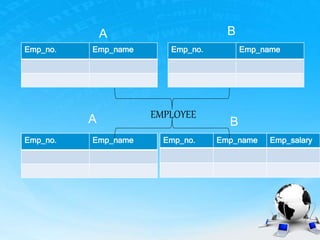
consider two users ‘A’ & ‘B’. Both are selecting the fields "Employee
Number" and "Employee Name". If user ‘B’ adds a new column (e.g. salary)
to his table, it will not effect the external view for user ‘A’, through the
internal schema of the database has been changed for both users ‘A’ & ‘B’.
Emp_no. Emp_nameEmp_no. Emp_name
BA
EMPLOYEE
Emp_no. Emp_name Emp_no. Emp_name Emp_salary
A B
Schema

Schema

  • 1.
  • 3.
    SCHEMA The word schemacomes from the Greek word skhēma, which means shape and overall structure, or more generally, plan. The plural is skhēmata. In English, both schemas and schemata are used as plural forms. Overall structure or design of database is called schema.
  • 4.
    name roll noclass marks course Courseno Deptt. For example : student schema
  • 5.
    SUB SCHEMA A subschemais a subset or proper subset of the schema and inherits the same property that a schema has. The plan (or scheme) for a view is often called subschema.  It gives the users a window through which he or she can view only that part of the database, which is of interest to him/her.
  • 7.
    Q. WHAT ISTHE DIFFERENCE B/W SCHEMA & SUBSCHEMA? The schema is the physical arrangement of the data as it appears in the DBMS. The subschema is the logical view of data.
  • 8.
    3-SCHEMA ARCHITECTURE The three-schemamodel consisting conceptual level, an external level, and an internal or physical level was first introduced by Charles Bachman in 1975. The motive of studying data base architecture is to provide an abstract view. Abstract view means that the system hides 2nd detail on how the data is stored & maintained in data base.
  • 9.
    The abstraction canbe achieved by the help of 3-levels -> i. Physical level ii. Logical level iii. View level
  • 10.
    PHYSICAL LEVEL It dealswith how data is stored in storage medium. Physical level has physical/internal schema.
  • 11.
    LOGICAL LEVEL it describewhat data is store in database and what relationship exist among those data? Logical level has logical/conceptual schema. Logical level hides the details of physical storage.
  • 12.
    VIEW LEVEL This levelis closest to the user. It has external schema. External schema describe the part of the database that perticular user group is interacting in and hides rest of the database from user group.
  • 13.
    Data Independence  Thecapacity to change schema at one level without having change in next higher level.  We have to changes because the size of database increases day by day.
  • 18.
    EXAMPLE OF LOGICALDATA INDEPENDENCE- The name field in conceptual view is stored as first name , middle name , last name whereas in external view ,it remains to be as a single name field. FIRST NAME MIDDLE NAME LAST NAME NAME AMIT SINGH CHAUHAN View level Logical level
  • 21.
    EXAMPLE OF PHYSICALDATA INDEPENDENCE- consider two users ‘A’ & ‘B’. Both are selecting the fields "Employee Number" and "Employee Name". If user ‘B’ adds a new column (e.g. salary) to his table, it will not effect the external view for user ‘A’, through the internal schema of the database has been changed for both users ‘A’ & ‘B’.
  • 22.
    Emp_no. Emp_nameEmp_no. Emp_name BA EMPLOYEE Emp_no.Emp_name Emp_no. Emp_name Emp_salary A B