DFD 
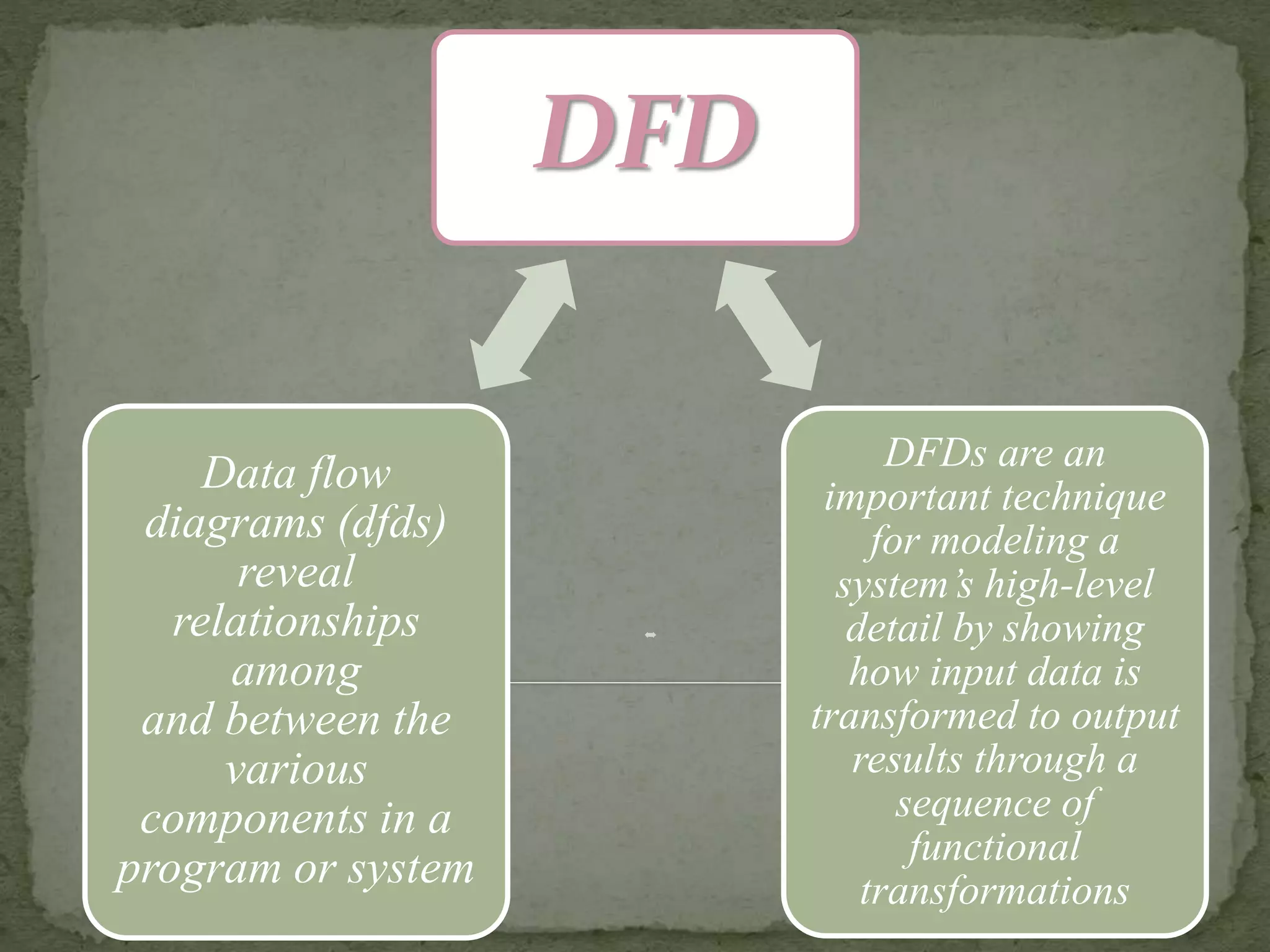
DFDs are an 
important technique 
for modeling a 
system’s high-level 
detail by showing 
how input data is 
transformed to output 
results through a 
sequence of 
functional 
transformations 
Data flow 
diagrams (dfds) 
reveal 
relationships 
among 
and between the 
various 
components in a 
program or system
WHAT ARE DATA FLOW DIAGRAMS?
DATA FLOW DIAGRAMS
DATA FLOW DIAGRAMS
DFD 
Four major components 
Entities Processes 
Data 
stores 
Data 
flows
Entity 
•An entity is the source or destination of data. 
•The source in a DFD represents these entities that 
are outside the context of the system. 
• Entities either provide data to the System or 
receive data from it. 
• Entities are often represented as rectangles.
Process
Data Store 
•A data store is where a process stores data between 
processes for later retrieval by that same process or 
another one. Files and tables are considered data stores. 
•Data store names are simple but meaningful, 
such as “customers,” “orders,” and “products.” 
•Data stores are usually drawn as a rectangle with the right 
hand side missing and labeled by the name of the data 
storage area it represents, though different notations do exist.
Data Flow
Symbols used to depict how these components 
interact in a system are simple and easy to understand; 
however, there are several DFD models to work from, 
each having its own symbology
CONCLUSION
Dfd by Jimmy Rakesh
Dfd by Jimmy Rakesh

Dfd by Jimmy Rakesh

  • 3.
    DFD DFDs arean important technique for modeling a system’s high-level detail by showing how input data is transformed to output results through a sequence of functional transformations Data flow diagrams (dfds) reveal relationships among and between the various components in a program or system
  • 4.
    WHAT ARE DATAFLOW DIAGRAMS?
  • 6.
  • 7.
  • 8.
    DFD Four majorcomponents Entities Processes Data stores Data flows
  • 9.
    Entity •An entityis the source or destination of data. •The source in a DFD represents these entities that are outside the context of the system. • Entities either provide data to the System or receive data from it. • Entities are often represented as rectangles.
  • 10.
  • 11.
    Data Store •Adata store is where a process stores data between processes for later retrieval by that same process or another one. Files and tables are considered data stores. •Data store names are simple but meaningful, such as “customers,” “orders,” and “products.” •Data stores are usually drawn as a rectangle with the right hand side missing and labeled by the name of the data storage area it represents, though different notations do exist.
  • 12.
  • 13.
    Symbols used todepict how these components interact in a system are simple and easy to understand; however, there are several DFD models to work from, each having its own symbology
  • 14.