8.1 Silberschatz, Galvin and Gagne ©2013
Operating System Concepts – 9th Edition
Paging
 Physical address space of a process can be noncontiguous;
process is allocated physical memory whenever the latter is
available
 Avoids external fragmentation
 Avoids problem of varying sized memory chunks
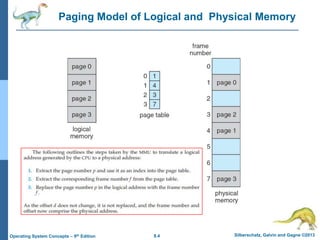
 Divide physical memory into fixed-sized blocks called frames
 Size is power of 2, between 512 bytes and 16 Mbytes
 Divide logical memory into blocks of same size called pages
 Keep track of all free frames
 To run a program of size N pages, need to find N free frames and
load program
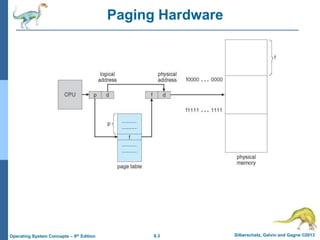
 Set up a page table to translate logical to physical addresses
 Backing store likewise split into pages
 Still have Internal fragmentation
8.2 Silberschatz, Galvin and Gagne ©2013
Operating System Concepts – 9th Edition
Address Translation Scheme
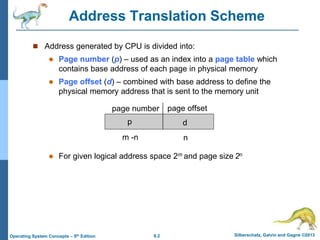
 Address generated by CPU is divided into:
 Page number (p) – used as an index into a page table which
contains base address of each page in physical memory
 Page offset (d) – combined with base address to define the
physical memory address that is sent to the memory unit
 For given logical address space 2m and page size 2n
page number page offset
p d
m -n n
8.3 Silberschatz, Galvin and Gagne ©2013
Operating System Concepts – 9th Edition
Paging Hardware
8.4 Silberschatz, Galvin and Gagne ©2013
Operating System Concepts – 9th Edition
Paging Model of Logical and Physical Memory
8.5 Silberschatz, Galvin and Gagne ©2013
Operating System Concepts – 9th Edition
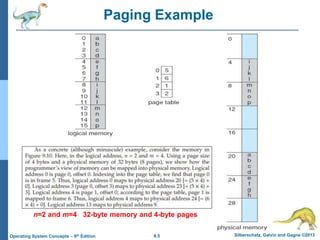
Paging Example
n=2 and m=4 32-byte memory and 4-byte pages
8.6 Silberschatz, Galvin and Gagne ©2013
Operating System Concepts – 9th Edition
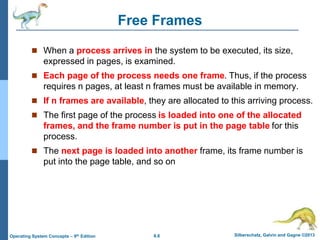
Free Frames
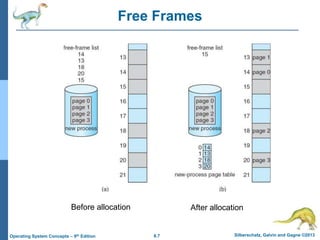
 When a process arrives in the system to be executed, its size,
expressed in pages, is examined.
 Each page of the process needs one frame. Thus, if the process
requires n pages, at least n frames must be available in memory.
 If n frames are available, they are allocated to this arriving process.
 The first page of the process is loaded into one of the allocated
frames, and the frame number is put in the page table for this
process.
 The next page is loaded into another frame, its frame number is
put into the page table, and so on
8.7 Silberschatz, Galvin and Gagne ©2013
Operating System Concepts – 9th Edition
Free Frames
Before allocation After allocation
8.8 Silberschatz, Galvin and Gagne ©2013
Operating System Concepts – 9th Edition
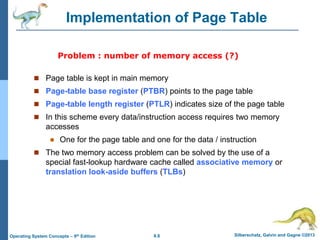
Implementation of Page Table
 Page table is kept in main memory
 Page-table base register (PTBR) points to the page table
 Page-table length register (PTLR) indicates size of the page table
 In this scheme every data/instruction access requires two memory
accesses
 One for the page table and one for the data / instruction
 The two memory access problem can be solved by the use of a
special fast-lookup hardware cache called associative memory or
translation look-aside buffers (TLBs)
Problem : number of memory access (?)
8.9 Silberschatz, Galvin and Gagne ©2013
Operating System Concepts – 9th Edition
Implementation of Page Table (Cont.)
 Some TLBs store address-space identifiers (ASIDs) in each
TLB entry – uniquely identifies each process to provide
address-space protection for that process
 Otherwise need to flush at every context switch
 TLBs typically small (64 to 1,024 entries)
 On a TLB miss, value is loaded into the TLB for faster access
next time
 Replacement policies must be considered
 Some entries can be wired down for permanent fast
access
8.10 Silberschatz, Galvin and Gagne ©2013
Operating System Concepts – 9th Edition
Associative Memory
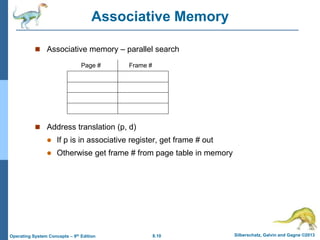
 Associative memory – parallel search
 Address translation (p, d)
 If p is in associative register, get frame # out
 Otherwise get frame # from page table in memory
Page # Frame #
8.11 Silberschatz, Galvin and Gagne ©2013
Operating System Concepts – 9th Edition
Paging Hardware With TLB
8.12 Silberschatz, Galvin and Gagne ©2013
Operating System Concepts – 9th Edition
Memory Protection
 Memory protection implemented by associating protection bit
with each frame to indicate if read-only or read-write access is
allowed
 Can also add more bits to indicate page execute-only, and
so on
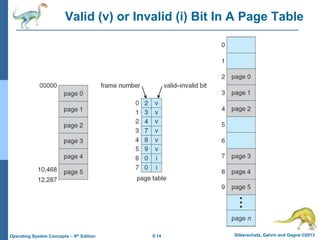
 Valid-invalid bit attached to each entry in the page table:
 “valid” indicates that the associated page is in the
process’ logical address space, and is thus a legal page
 “invalid” indicates that the page is not in the process’
logical address space
 Or use page-table length register (PTLR)
 Any violations result in a trap to the kernel
8.13 Silberschatz, Galvin and Gagne ©2013
Operating System Concepts – 9th Edition
 Suppose, for example, that in a system with a 14-bit address space (0 to
16383), we have a program that should use only addresses 0 to 10468.
 Given a page size of 2 KB, we have the situation shown in Figure 9.13.
 Addresses in pages 0, 1, 2, 3, 4, and 5 are mapped normally through the
page table.
 Any attempt to generate an address in pages 6 or 7, however, will find that
the valid –invalid bit is set to invalid, and the computer will trap to the
operating system (invalid page reference).
 Notice that this scheme has created a problem. Because the program
extends only to address 10468, any reference beyond that address is
illegal.
 However, references to page 5 are classified as valid, so accesses to
addresses up to 12287 are valid.
 Only the addresses from 12288 to 16383 are invalid.
 This problem is a result of the 2-KB page size and reflects the internal
fragmentation of paging
8.14 Silberschatz, Galvin and Gagne ©2013
Operating System Concepts – 9th Edition
Valid (v) or Invalid (i) Bit In A Page Table
8.15 Silberschatz, Galvin and Gagne ©2013
Operating System Concepts – 9th Edition
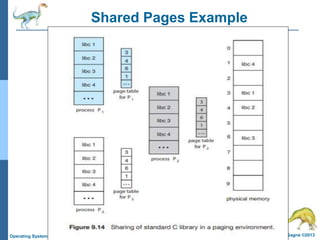
Shared Pages
 Shared code
 One copy of read-only (reentrant) code shared among
processes (i.e., text editors, compilers, window systems)
 Similar to multiple threads sharing the same process space
 Also useful for interprocess communication if sharing of
read-write pages is allowed
 Private code and data
 Each process keeps a separate copy of the code and data
 The pages for the private code and data can appear
anywhere in the logical address space
8.16 Silberschatz, Galvin and Gagne ©2013
Operating System Concepts – 9th Edition
Shared Pages Example
8.17 Silberschatz, Galvin and Gagne ©2013
Operating System Concepts – 9th Edition
Explanation
8.18 Silberschatz, Galvin and Gagne ©2013
Operating System Concepts – 9th Edition
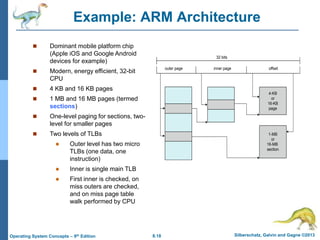
Example: ARM Architecture
 Dominant mobile platform chip
(Apple iOS and Google Android
devices for example)
 Modern, energy efficient, 32-bit
CPU
 4 KB and 16 KB pages
 1 MB and 16 MB pages (termed
sections)
 One-level paging for sections, two-
level for smaller pages
 Two levels of TLBs
 Outer level has two micro
TLBs (one data, one
instruction)
 Inner is single main TLB
 First inner is checked, on
miss outers are checked,
and on miss page table
walk performed by CPU
outer page inner page offset
4-KB
or
16-KB
page
1-MB
or
16-MB
section
32 bits

Paging.ppt

  • 1.
    8.1 Silberschatz, Galvinand Gagne ©2013 Operating System Concepts – 9th Edition Paging  Physical address space of a process can be noncontiguous; process is allocated physical memory whenever the latter is available  Avoids external fragmentation  Avoids problem of varying sized memory chunks  Divide physical memory into fixed-sized blocks called frames  Size is power of 2, between 512 bytes and 16 Mbytes  Divide logical memory into blocks of same size called pages  Keep track of all free frames  To run a program of size N pages, need to find N free frames and load program  Set up a page table to translate logical to physical addresses  Backing store likewise split into pages  Still have Internal fragmentation
  • 2.
    8.2 Silberschatz, Galvinand Gagne ©2013 Operating System Concepts – 9th Edition Address Translation Scheme  Address generated by CPU is divided into:  Page number (p) – used as an index into a page table which contains base address of each page in physical memory  Page offset (d) – combined with base address to define the physical memory address that is sent to the memory unit  For given logical address space 2m and page size 2n page number page offset p d m -n n
  • 3.
    8.3 Silberschatz, Galvinand Gagne ©2013 Operating System Concepts – 9th Edition Paging Hardware
  • 4.
    8.4 Silberschatz, Galvinand Gagne ©2013 Operating System Concepts – 9th Edition Paging Model of Logical and Physical Memory
  • 5.
    8.5 Silberschatz, Galvinand Gagne ©2013 Operating System Concepts – 9th Edition Paging Example n=2 and m=4 32-byte memory and 4-byte pages
  • 6.
    8.6 Silberschatz, Galvinand Gagne ©2013 Operating System Concepts – 9th Edition Free Frames  When a process arrives in the system to be executed, its size, expressed in pages, is examined.  Each page of the process needs one frame. Thus, if the process requires n pages, at least n frames must be available in memory.  If n frames are available, they are allocated to this arriving process.  The first page of the process is loaded into one of the allocated frames, and the frame number is put in the page table for this process.  The next page is loaded into another frame, its frame number is put into the page table, and so on
  • 7.
    8.7 Silberschatz, Galvinand Gagne ©2013 Operating System Concepts – 9th Edition Free Frames Before allocation After allocation
  • 8.
    8.8 Silberschatz, Galvinand Gagne ©2013 Operating System Concepts – 9th Edition Implementation of Page Table  Page table is kept in main memory  Page-table base register (PTBR) points to the page table  Page-table length register (PTLR) indicates size of the page table  In this scheme every data/instruction access requires two memory accesses  One for the page table and one for the data / instruction  The two memory access problem can be solved by the use of a special fast-lookup hardware cache called associative memory or translation look-aside buffers (TLBs) Problem : number of memory access (?)
  • 9.
    8.9 Silberschatz, Galvinand Gagne ©2013 Operating System Concepts – 9th Edition Implementation of Page Table (Cont.)  Some TLBs store address-space identifiers (ASIDs) in each TLB entry – uniquely identifies each process to provide address-space protection for that process  Otherwise need to flush at every context switch  TLBs typically small (64 to 1,024 entries)  On a TLB miss, value is loaded into the TLB for faster access next time  Replacement policies must be considered  Some entries can be wired down for permanent fast access
  • 10.
    8.10 Silberschatz, Galvinand Gagne ©2013 Operating System Concepts – 9th Edition Associative Memory  Associative memory – parallel search  Address translation (p, d)  If p is in associative register, get frame # out  Otherwise get frame # from page table in memory Page # Frame #
  • 11.
    8.11 Silberschatz, Galvinand Gagne ©2013 Operating System Concepts – 9th Edition Paging Hardware With TLB
  • 12.
    8.12 Silberschatz, Galvinand Gagne ©2013 Operating System Concepts – 9th Edition Memory Protection  Memory protection implemented by associating protection bit with each frame to indicate if read-only or read-write access is allowed  Can also add more bits to indicate page execute-only, and so on  Valid-invalid bit attached to each entry in the page table:  “valid” indicates that the associated page is in the process’ logical address space, and is thus a legal page  “invalid” indicates that the page is not in the process’ logical address space  Or use page-table length register (PTLR)  Any violations result in a trap to the kernel
  • 13.
    8.13 Silberschatz, Galvinand Gagne ©2013 Operating System Concepts – 9th Edition  Suppose, for example, that in a system with a 14-bit address space (0 to 16383), we have a program that should use only addresses 0 to 10468.  Given a page size of 2 KB, we have the situation shown in Figure 9.13.  Addresses in pages 0, 1, 2, 3, 4, and 5 are mapped normally through the page table.  Any attempt to generate an address in pages 6 or 7, however, will find that the valid –invalid bit is set to invalid, and the computer will trap to the operating system (invalid page reference).  Notice that this scheme has created a problem. Because the program extends only to address 10468, any reference beyond that address is illegal.  However, references to page 5 are classified as valid, so accesses to addresses up to 12287 are valid.  Only the addresses from 12288 to 16383 are invalid.  This problem is a result of the 2-KB page size and reflects the internal fragmentation of paging
  • 14.
    8.14 Silberschatz, Galvinand Gagne ©2013 Operating System Concepts – 9th Edition Valid (v) or Invalid (i) Bit In A Page Table
  • 15.
    8.15 Silberschatz, Galvinand Gagne ©2013 Operating System Concepts – 9th Edition Shared Pages  Shared code  One copy of read-only (reentrant) code shared among processes (i.e., text editors, compilers, window systems)  Similar to multiple threads sharing the same process space  Also useful for interprocess communication if sharing of read-write pages is allowed  Private code and data  Each process keeps a separate copy of the code and data  The pages for the private code and data can appear anywhere in the logical address space
  • 16.
    8.16 Silberschatz, Galvinand Gagne ©2013 Operating System Concepts – 9th Edition Shared Pages Example
  • 17.
    8.17 Silberschatz, Galvinand Gagne ©2013 Operating System Concepts – 9th Edition Explanation
  • 18.
    8.18 Silberschatz, Galvinand Gagne ©2013 Operating System Concepts – 9th Edition Example: ARM Architecture  Dominant mobile platform chip (Apple iOS and Google Android devices for example)  Modern, energy efficient, 32-bit CPU  4 KB and 16 KB pages  1 MB and 16 MB pages (termed sections)  One-level paging for sections, two- level for smaller pages  Two levels of TLBs  Outer level has two micro TLBs (one data, one instruction)  Inner is single main TLB  First inner is checked, on miss outers are checked, and on miss page table walk performed by CPU outer page inner page offset 4-KB or 16-KB page 1-MB or 16-MB section 32 bits