FUNCTION DEPENDENCY
AND
TYPES & EXAMPLE
NAME-VRAJ PATEL
BATCH-A
ENROLL NO : 150410107082
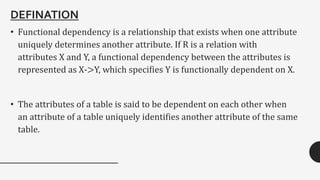
DEFINATION
• Functional dependency is a relationship that exists when one attribute
uniquely determines another attribute. If R is a relation with
attributes X and Y, a functional dependency between the attributes is
represented as X->Y, which specifies Y is functionally dependent on X.
• The attributes of a table is said to be dependent on each other when
an attribute of a table uniquely identifies another attribute of the same
table.
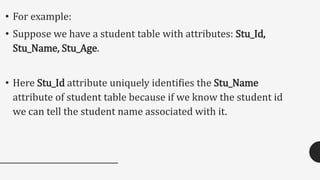
• For example:
• Suppose we have a student table with attributes: Stu_Id,
Stu_Name, Stu_Age.
• Here Stu_Id attribute uniquely identifies the Stu_Name
attribute of student table because if we know the student id
we can tell the student name associated with it.
Functional dependency and can be written as :
Stu_Id->Stu_Name .
we can say Stu_Name is functionally dependent on Stu_Id.
Formally:
If column A of a table uniquely identifies the column B of same table
then it can represented as A->B (Attribute B is functionally dependent
on attribute A)
Types of Functional Dependencies
• Trivial functional dependency
• Non-trivial functional dependency
• Multivalued dependency
• Transitive dependency
Trivial functional dependency
• The dependency of an attribute on a set of attributes is known as
trivial functional dependency if the set of attributes includes that
attribute.
Symbolically:
• A ->B is trivial functional dependency if B is a subset of A.
• The following dependencies are also trivial: A->A & B->B
• For example:
Consider a table with two columns Student_id and Student_Name.
{Student_Id, Student_Name} -> Student_Id is a trivial functional
dependency as Student_Id is a subset of {Student_Id,
Student_Name}.
• Also, Student_Id -> Student_Id & Student_Name -> Student_Name
are trivial dependencies too.
Non-trivial functional dependency
• If a functional dependency X->Y holds true where
Y is not a subset of X then this dependency is called
non trivial Functional dependency.
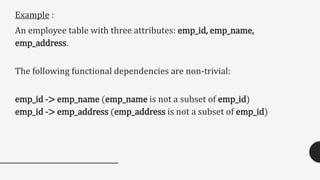
Example :
An employee table with three attributes: emp_id, emp_name,
emp_address.
The following functional dependencies are non-trivial:
emp_id -> emp_name (emp_name is not a subset of emp_id)
emp_id -> emp_address (emp_address is not a subset of emp_id)
• On the other hand, the following dependencies are trivial:
{emp_id, emp_name} -> emp_name [emp_name is a subset of {emp_id, emp_name}]
Completely non trivial FD:
If a Functional dependency X->Y holds true where X intersection Y is Null then this
dependency is said to be completely non trivial function dependency.
Multivalued dependency
• Multivalued dependency occurs when there are more than one
independent multivalued attributes in a table.
• a multivalued dependency is a full constraint between two sets of
attributes in a relation. In contrast to the functional dependency,
the multivalued dependency requires that certain tuples be
present in a relation.
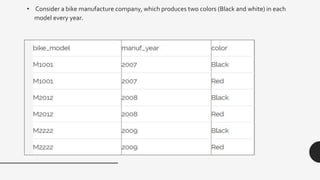
• Consider a bike manufacture company, which produces two colors (Black and white) in each
model every year.
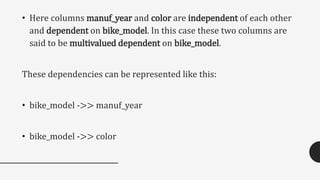
• Here columns manuf_year and color are independent of each other
and dependent on bike_model. In this case these two columns are
said to be multivalued dependent on bike_model.
These dependencies can be represented like this:
• bike_model ->> manuf_year
• bike_model ->> color
Transitive dependency
A functional dependency is said to be transitive if it is indirectly
formed by two functional dependencies.
X -> Z is a transitive dependency if the following three functional
dependencies hold true:
X->Y
Y does not ->X
Y->Z
A transitive dependency can only occur in a relation of three of
more attributes. This dependency helps us normalizing the
database in 3NF (3rd Normal Form).
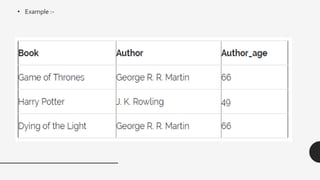
• Example :-
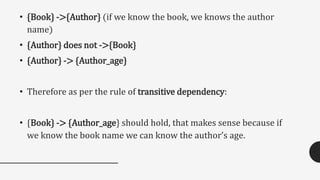
• {Book} ->{Author} (if we know the book, we knows the author
name)
• {Author} does not ->{Book}
• {Author} -> {Author_age}
• Therefore as per the rule of transitive dependency:
• {Book} -> {Author_age} should hold, that makes sense because if
we know the book name we can know the author’s age.
THANK YOU

FUNCTION DEPENDENCY AND TYPES & EXAMPLE

  • 1.
    FUNCTION DEPENDENCY AND TYPES &EXAMPLE NAME-VRAJ PATEL BATCH-A ENROLL NO : 150410107082
  • 2.
    DEFINATION • Functional dependencyis a relationship that exists when one attribute uniquely determines another attribute. If R is a relation with attributes X and Y, a functional dependency between the attributes is represented as X->Y, which specifies Y is functionally dependent on X. • The attributes of a table is said to be dependent on each other when an attribute of a table uniquely identifies another attribute of the same table.
  • 3.
    • For example: •Suppose we have a student table with attributes: Stu_Id, Stu_Name, Stu_Age. • Here Stu_Id attribute uniquely identifies the Stu_Name attribute of student table because if we know the student id we can tell the student name associated with it.
  • 4.
    Functional dependency andcan be written as : Stu_Id->Stu_Name . we can say Stu_Name is functionally dependent on Stu_Id. Formally: If column A of a table uniquely identifies the column B of same table then it can represented as A->B (Attribute B is functionally dependent on attribute A)
  • 5.
    Types of FunctionalDependencies • Trivial functional dependency • Non-trivial functional dependency • Multivalued dependency • Transitive dependency
  • 6.
    Trivial functional dependency •The dependency of an attribute on a set of attributes is known as trivial functional dependency if the set of attributes includes that attribute. Symbolically: • A ->B is trivial functional dependency if B is a subset of A. • The following dependencies are also trivial: A->A & B->B
  • 7.
    • For example: Considera table with two columns Student_id and Student_Name. {Student_Id, Student_Name} -> Student_Id is a trivial functional dependency as Student_Id is a subset of {Student_Id, Student_Name}. • Also, Student_Id -> Student_Id & Student_Name -> Student_Name are trivial dependencies too.
  • 8.
    Non-trivial functional dependency •If a functional dependency X->Y holds true where Y is not a subset of X then this dependency is called non trivial Functional dependency.
  • 9.
    Example : An employeetable with three attributes: emp_id, emp_name, emp_address. The following functional dependencies are non-trivial: emp_id -> emp_name (emp_name is not a subset of emp_id) emp_id -> emp_address (emp_address is not a subset of emp_id)
  • 10.
    • On theother hand, the following dependencies are trivial: {emp_id, emp_name} -> emp_name [emp_name is a subset of {emp_id, emp_name}] Completely non trivial FD: If a Functional dependency X->Y holds true where X intersection Y is Null then this dependency is said to be completely non trivial function dependency.
  • 11.
    Multivalued dependency • Multivalueddependency occurs when there are more than one independent multivalued attributes in a table. • a multivalued dependency is a full constraint between two sets of attributes in a relation. In contrast to the functional dependency, the multivalued dependency requires that certain tuples be present in a relation.
  • 12.
    • Consider abike manufacture company, which produces two colors (Black and white) in each model every year.
  • 13.
    • Here columnsmanuf_year and color are independent of each other and dependent on bike_model. In this case these two columns are said to be multivalued dependent on bike_model. These dependencies can be represented like this: • bike_model ->> manuf_year • bike_model ->> color
  • 14.
    Transitive dependency A functionaldependency is said to be transitive if it is indirectly formed by two functional dependencies. X -> Z is a transitive dependency if the following three functional dependencies hold true: X->Y Y does not ->X Y->Z A transitive dependency can only occur in a relation of three of more attributes. This dependency helps us normalizing the database in 3NF (3rd Normal Form).
  • 15.
  • 16.
    • {Book} ->{Author}(if we know the book, we knows the author name) • {Author} does not ->{Book} • {Author} -> {Author_age} • Therefore as per the rule of transitive dependency: • {Book} -> {Author_age} should hold, that makes sense because if we know the book name we can know the author’s age.
  • 17.