CONTENTS
 DEFINITION OF DATA STRUCTURES.
 DATA STRUCTURE OPERATIONS.
 TYPES OF DATA STRUCTURE.
 LINEAR DATA STRUCTURE.
 NON-LINEAR DATA STRUCTURE
DEFINITION:
DATA STRUCTURES
A data structure is a scheme for organizing data in the memory of computer.
It is a logical way of storing data and it also define mechanism of retrieve data.
The way in which the data is organized affects the performance of a program
for different tasks.
Computer programmers decide which data structures to use based on the
nature of the data and the processes that need to be performed on that data.
The way in which the data is organized affects the
performance of a program for different tasks.
Computer programmers decide which data
structures to use based on the nature of the data
and the processes that need to be performed on
that data.
OPERATIONS

Searching:
Finding the location of the record with a given key value .
Insertion:
Adding a new record to the structure
Deletion:
Removing a record from the structure
Types of Data Structure:
 Primitive:
Primitive data structures are those which are
predefined way of storing data by the system. ...
Primitive data structures are char, int, float, double.
Characters are internally considered as int and floats
also falls under double and the predefined operations
are addition, subtraction, etc.
Non Primitive
Non-primitive data types are not defined
by the programming language, but are
instead created by the programmer.
They are sometimes called "reference
variables," or "object references," since
they reference a memory location,
which stores the data
Non Primitive
 LINEAR DATA STRUCTURE
 NON LINEAR DATA STRUCTURE
LINEAR DATA STRUCTURE
ARRAY
LINKED LIST
STACK
QUEUE
ARRAY
An array is a collection of
homogeneous type of data elements.
An array is consisting of a collection
of elements . REPRESENTATION OF
ARRAY IN MEMORY
LINKED LIST
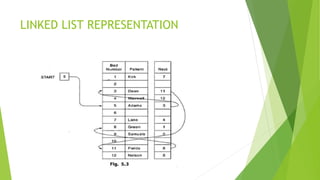
A Linked list is a linear collection of
data elements .It has two part one is
info and other is link part.info part
gives information and link part is
address of next node.
LINKED LIST REPRESENTATION
Stack:
A Stack also called last in first out
(LIFO) system.
A Stack is a list of elements in which
an element may be inserted or deleted
at one end which is known as TOP of
the stack.
Operations performed on stack
Push: add an element in stack.
Pop: remove an element in stack.
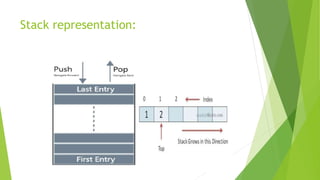
Stack representation:
Queue (FIFO)
 A Queue also called first in first out (FIFO)
system.
 A queue is a linear list of element in which
insertion can be done at one end which is
known as front and deletion can be done
which is known as rear.
Operations performed on queue
Insertion : add a new element in
queue.
Deletion: Removing an element in
queue.
Queue representation
Non-linear data structure
 Tree:
 Graph:
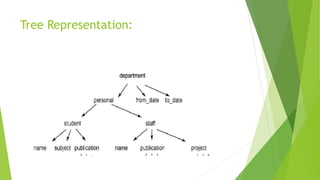
Tree:
Data frequently contain a hierarchical
relationship between various elements. The data
structure which reflects this relationship is
called tree.
Operations performed on tree
Insertion
Deletion
Searching
Tree Representation:
Graph:
Data sometimes contain a relationship
between pairs of elements which is not
necessarily hierarchical in nature.
For example, an airline flies only
between cities connected by lines.
Graph Respresentation:
Thank You

Data structure and its types.

  • 1.
    CONTENTS  DEFINITION OFDATA STRUCTURES.  DATA STRUCTURE OPERATIONS.  TYPES OF DATA STRUCTURE.  LINEAR DATA STRUCTURE.  NON-LINEAR DATA STRUCTURE
  • 2.
    DEFINITION: DATA STRUCTURES A datastructure is a scheme for organizing data in the memory of computer. It is a logical way of storing data and it also define mechanism of retrieve data. The way in which the data is organized affects the performance of a program for different tasks. Computer programmers decide which data structures to use based on the nature of the data and the processes that need to be performed on that data.
  • 3.
    The way inwhich the data is organized affects the performance of a program for different tasks. Computer programmers decide which data structures to use based on the nature of the data and the processes that need to be performed on that data.
  • 4.
    OPERATIONS  Searching: Finding the locationof the record with a given key value . Insertion: Adding a new record to the structure Deletion: Removing a record from the structure
  • 5.
    Types of DataStructure:  Primitive: Primitive data structures are those which are predefined way of storing data by the system. ... Primitive data structures are char, int, float, double. Characters are internally considered as int and floats also falls under double and the predefined operations are addition, subtraction, etc.
  • 6.
    Non Primitive Non-primitive datatypes are not defined by the programming language, but are instead created by the programmer. They are sometimes called "reference variables," or "object references," since they reference a memory location, which stores the data
  • 7.
    Non Primitive  LINEARDATA STRUCTURE  NON LINEAR DATA STRUCTURE
  • 8.
  • 9.
    ARRAY An array isa collection of homogeneous type of data elements. An array is consisting of a collection of elements . REPRESENTATION OF ARRAY IN MEMORY
  • 10.
    LINKED LIST A Linkedlist is a linear collection of data elements .It has two part one is info and other is link part.info part gives information and link part is address of next node.
  • 11.
  • 12.
    Stack: A Stack alsocalled last in first out (LIFO) system. A Stack is a list of elements in which an element may be inserted or deleted at one end which is known as TOP of the stack.
  • 13.
    Operations performed onstack Push: add an element in stack. Pop: remove an element in stack.
  • 14.
  • 15.
    Queue (FIFO)  AQueue also called first in first out (FIFO) system.  A queue is a linear list of element in which insertion can be done at one end which is known as front and deletion can be done which is known as rear.
  • 16.
    Operations performed onqueue Insertion : add a new element in queue. Deletion: Removing an element in queue.
  • 17.
  • 18.
  • 19.
    Tree: Data frequently containa hierarchical relationship between various elements. The data structure which reflects this relationship is called tree. Operations performed on tree Insertion Deletion Searching
  • 20.
  • 21.
    Graph: Data sometimes containa relationship between pairs of elements which is not necessarily hierarchical in nature. For example, an airline flies only between cities connected by lines.
  • 22.
  • 23.