
Data Encryption Standard
Adri Jovin J J, M.Tech., Ph.D.
UITC203 CRYPTOGRAPHY AND NETWORK SECURITY
Data Encryption Standard
• Issued in 1977 by National Institute of Standards and Technology
• Initially referred to as Data Encryption Algorithm
• Data encrypted in 64-bit blocks using 56-bit key
• Most dominant symmetric encryption algorithm, especially in financial applications till the introduction of AES
UITC203 CRYPTOGRAPHY AND NETWORK SECURITY 2
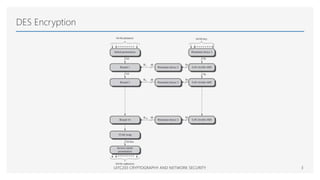
DES Encryption
UITC203 CRYPTOGRAPHY AND NETWORK SECURITY 3
Single Round of DES Algorithm
UITC203 CRYPTOGRAPHY AND NETWORK SECURITY 4
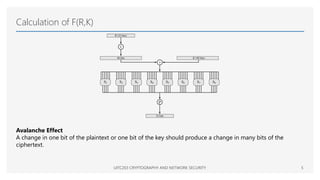
Calculation of F(R,K)
UITC203 CRYPTOGRAPHY AND NETWORK SECURITY 5
Avalanche Effect
A change in one bit of the plaintext or one bit of the key should produce a change in many bits of the
ciphertext.
Strength of DES
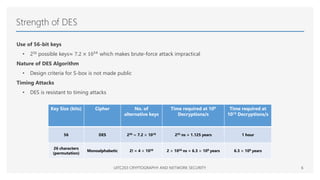
Use of 56-bit keys
• 256 possible keys≈ 7.2 × 10¹⁶
which makes brute-force attack impractical
Nature of DES Algorithm
• Design criteria for S-box is not made public
Timing Attacks
• DES is resistant to timing attacks
UITC203 CRYPTOGRAPHY AND NETWORK SECURITY 6
Key Size (bits) Cipher No. of
alternative keys
Time required at 109
Decryptions/s
Time required at
1013 Decryptions/s
56 DES 256 ≈ 7.2 × 10¹⁶ 255 ns = 1.125 years 1 hour
26 characters
(permutation)
Monoalphabetic 2! = 4 × 1026 2 × 1026 ns = 6.3 × 10⁹ years 6.3 × 10⁶ years
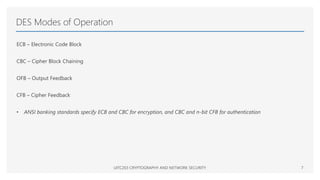
DES Modes of Operation
ECB – Electronic Code Block
CBC – Cipher Block Chaining
OFB – Output Feedback
CFB – Cipher Feedback
• ANSI banking standards specify ECB and CBC for encryption, and CBC and n-bit CFB for authentication
UITC203 CRYPTOGRAPHY AND NETWORK SECURITY 7
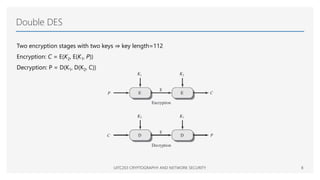
Double DES
UITC203 CRYPTOGRAPHY AND NETWORK SECURITY 8
Two encryption stages with two keys ⇒ key length=112
Encryption: C = E(K2, E(K1, P))
Decryption: P = D(K1, D(K2, C))
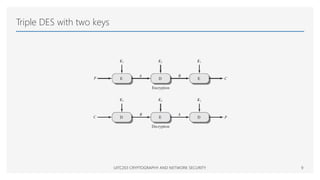
Triple DES with two keys
UITC203 CRYPTOGRAPHY AND NETWORK SECURITY 9
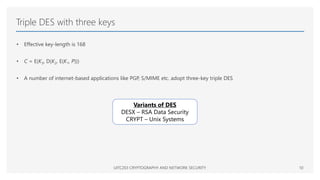
Triple DES with three keys
• Effective key-length is 168
• C = E(K3, D(K2, E(K1, P)))
• A number of internet-based applications like PGP, S/MIME etc. adopt three-key triple DES
UITC203 CRYPTOGRAPHY AND NETWORK SECURITY 10
Variants of DES
DESX – RSA Data Security
CRYPT – Unix Systems
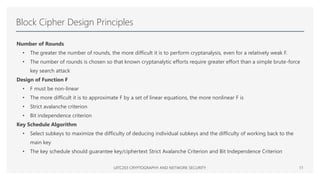
Block Cipher Design Principles
Number of Rounds
• The greater the number of rounds, the more difficult it is to perform cryptanalysis, even for a relatively weak F.
• The number of rounds is chosen so that known cryptanalytic efforts require greater effort than a simple brute-force
key search attack
Design of Function F
• F must be non-linear
• The more difficult it is to approximate F by a set of linear equations, the more nonlinear F is
• Strict avalanche criterion
• Bit independence criterion
Key Schedule Algorithm
• Select subkeys to maximize the difficulty of deducing individual subkeys and the difficulty of working back to the
main key
• The key schedule should guarantee key/ciphertext Strict Avalanche Criterion and Bit Independence Criterion
UITC203 CRYPTOGRAPHY AND NETWORK SECURITY 11
References
Schneier, B. (2007). Applied cryptography: protocols, algorithms, and source code in C. John Wiley & Sons.
Stallings, W. (2014). Cryptography and network security, 6/E. Pearson Education India.
Katz, J., & Lindell, Y. (2014). Introduction to modern cryptography. CRC press.
UITC203 CRYPTOGRAPHY AND NETWORK SECURITY 12

Data Encryption Standard

  • 1.
    Data Encryption Standard AdriJovin J J, M.Tech., Ph.D. UITC203 CRYPTOGRAPHY AND NETWORK SECURITY
  • 2.
    Data Encryption Standard •Issued in 1977 by National Institute of Standards and Technology • Initially referred to as Data Encryption Algorithm • Data encrypted in 64-bit blocks using 56-bit key • Most dominant symmetric encryption algorithm, especially in financial applications till the introduction of AES UITC203 CRYPTOGRAPHY AND NETWORK SECURITY 2
  • 3.
  • 4.
    Single Round ofDES Algorithm UITC203 CRYPTOGRAPHY AND NETWORK SECURITY 4
  • 5.
    Calculation of F(R,K) UITC203CRYPTOGRAPHY AND NETWORK SECURITY 5 Avalanche Effect A change in one bit of the plaintext or one bit of the key should produce a change in many bits of the ciphertext.
  • 6.
    Strength of DES Useof 56-bit keys • 256 possible keys≈ 7.2 × 10¹⁶ which makes brute-force attack impractical Nature of DES Algorithm • Design criteria for S-box is not made public Timing Attacks • DES is resistant to timing attacks UITC203 CRYPTOGRAPHY AND NETWORK SECURITY 6 Key Size (bits) Cipher No. of alternative keys Time required at 109 Decryptions/s Time required at 1013 Decryptions/s 56 DES 256 ≈ 7.2 × 10¹⁶ 255 ns = 1.125 years 1 hour 26 characters (permutation) Monoalphabetic 2! = 4 × 1026 2 × 1026 ns = 6.3 × 10⁹ years 6.3 × 10⁶ years
  • 7.
    DES Modes ofOperation ECB – Electronic Code Block CBC – Cipher Block Chaining OFB – Output Feedback CFB – Cipher Feedback • ANSI banking standards specify ECB and CBC for encryption, and CBC and n-bit CFB for authentication UITC203 CRYPTOGRAPHY AND NETWORK SECURITY 7
  • 8.
    Double DES UITC203 CRYPTOGRAPHYAND NETWORK SECURITY 8 Two encryption stages with two keys ⇒ key length=112 Encryption: C = E(K2, E(K1, P)) Decryption: P = D(K1, D(K2, C))
  • 9.
    Triple DES withtwo keys UITC203 CRYPTOGRAPHY AND NETWORK SECURITY 9
  • 10.
    Triple DES withthree keys • Effective key-length is 168 • C = E(K3, D(K2, E(K1, P))) • A number of internet-based applications like PGP, S/MIME etc. adopt three-key triple DES UITC203 CRYPTOGRAPHY AND NETWORK SECURITY 10 Variants of DES DESX – RSA Data Security CRYPT – Unix Systems
  • 11.
    Block Cipher DesignPrinciples Number of Rounds • The greater the number of rounds, the more difficult it is to perform cryptanalysis, even for a relatively weak F. • The number of rounds is chosen so that known cryptanalytic efforts require greater effort than a simple brute-force key search attack Design of Function F • F must be non-linear • The more difficult it is to approximate F by a set of linear equations, the more nonlinear F is • Strict avalanche criterion • Bit independence criterion Key Schedule Algorithm • Select subkeys to maximize the difficulty of deducing individual subkeys and the difficulty of working back to the main key • The key schedule should guarantee key/ciphertext Strict Avalanche Criterion and Bit Independence Criterion UITC203 CRYPTOGRAPHY AND NETWORK SECURITY 11
  • 12.
    References Schneier, B. (2007).Applied cryptography: protocols, algorithms, and source code in C. John Wiley & Sons. Stallings, W. (2014). Cryptography and network security, 6/E. Pearson Education India. Katz, J., & Lindell, Y. (2014). Introduction to modern cryptography. CRC press. UITC203 CRYPTOGRAPHY AND NETWORK SECURITY 12