A webinar on Network
Security
By Krishna Kumari
• Network security is the security provided to a network from
unauthorized access and risks. It is the duty of network
administrators to adopt preventive measures to protect
their networks from potential security threats.
What is Network Security?
• Computer networks that are involved in regular transactions
and communication within the government, individuals, or
business require security. The most common and simple
way of protecting a network resource is by assigning it a
unique name and a corresponding password.
Simplest form of security
Active Devices
• These security devices block the surplus traffic. Firewalls, antivirus scanning
devices, and content filtering devices are the examples of such devices.
Passive Devices
• These devices identify and report on unwanted traffic, for example, intrusion
detection appliances.
Preventative Devices
• These devices scan the networks and identify potential security problems. For
example, penetration testing devices and vulnerability assessment appliances.
Types of Network Security Devices
• Security threats are actions or events that can compromise
the confidentiality, integrity, or availability of data and
systems.
• These threats can originate from various sources, such as
individuals, groups, or natural events.
• Security threats can be many like Software attacks, theft of
intellectual property, etc.
Network threats
• Cryptography
• Firewalls
• VPNs
• Intrusion detection systems
Solutions to threats
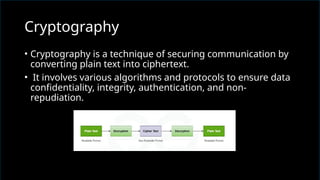
• Cryptography is a technique of securing communication by
converting plain text into ciphertext.
• It involves various algorithms and protocols to ensure data
confidentiality, integrity, authentication, and non-
repudiation.
Cryptography
Symmetric Key cryptography
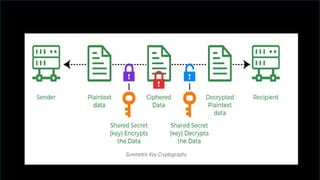
• It is an encryption system where the sender and receiver of a
message use a single common key to encrypt and decrypt
messages.
• Symmetric Key cryptography is faster and simpler but the
problem is that the sender and receiver have to somehow
exchange keys securely.
• The most popular symmetric key cryptography systems are
Data Encryption Systems (DES) and Advanced Encryption
Systems (AES) .
Types of Cryptography
• The Advanced Encryption Standard (AES) is a method that
uses the same key to both encrypt and decrypt data. It
doesn’t just encrypt the data once; instead, it applies
multiple rounds of changes, like swapping, mixing, and
rearranging data, to make it much more secure and harder
to break.
• The key size can be 128/192/256 bits.
• Encrypts data in blocks of 128 bits each.
What is the AES Advanced Encryption
Standard?
• AES considers each block as a 16-byte (4 byte x 4 byte = 128 ) grid in a
column-major arrangement.
• [ b0 | b4 | b8 | b12 |
• | b1 | b5 | b9 | b13 |
• | b2 | b6 | b10| b14 |
• | b3 | b7 | b11| b15 ]
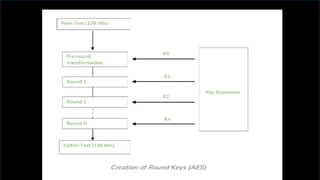
• Each round comprises of 4 steps :
• SubBytes
• ShiftRows
• MixColumns
• Add Round Key
Working of AES
• Data Encryption Standard (DES) is a block cipher with a 56-
bit key length that has played a significant role in data
security. Data encryption standard (DES) has been found
vulnerable to very powerful attacks therefore, the popularity
of DES has been found slightly on the decline. DES is a block
cipher and encrypts data in blocks of size of 64 bits each,
which means 64 bits of plain text go as the input to DES,
which produces 64 bits of ciphertext. The same algorithm
and key are used for encryption and decryption, with minor
differences. The key length is 56 bits.
What is DES?
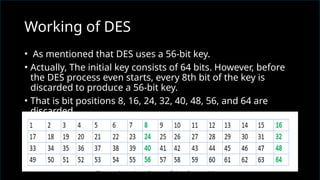
• As mentioned that DES uses a 56-bit key.
• Actually, The initial key consists of 64 bits. However, before
the DES process even starts, every 8th bit of the key is
discarded to produce a 56-bit key.
• That is bit positions 8, 16, 24, 32, 40, 48, 56, and 64 are
discarded.
Working of DES
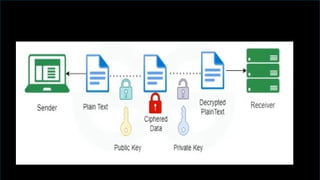
• In Asymmetric Key Cryptography, a pair of keys is used to
encrypt and decrypt information.
• A sender’s public key is used for encryption and a receiver’s
private key is used for decryption.
• Public keys and Private keys are different.
• Even if the public key is known by everyone the intended
receiver can only decode it because he alone knows his
private key.
• The most popular asymmetric key cryptography algorithm is
the RSA algorithm.
Asymmetric cryptography
• RSA algorithm is an asymmetric cryptography algorithm.
• Asymmetric means that it works on two different keys i.e. Public Key and
Private Key.
• As the name describes the Public Key is given to everyone and the Private key
is kept private.
An example of asymmetric cryptography:
• A client (for example browser) sends its public key to the server and requests
some data.
• The server encrypts the data using the client’s public key and sends the
encrypted data.
• The client receives this data and decrypts it.
RSA algorithm(Rivest, Shamir,
Adleman)
• The idea of RSA is based on the fact that it is difficult to
factorize a large integer.
• The public key consists of two numbers where one number
is a multiplication of two large prime numbers.
• And private key is also derived from the same two prime
numbers.
• So if somebody can factorize the large number, the private
key is compromised.
Working of RSA
• Therefore encryption strength lies in the key size and if we
double or triple the key size, the strength of encryption
increases exponentially.
• RSA keys can be typically 1024 or 2048 bits long
Working of RSA
• Digital Signature is a verification method. It does not
provide confidential communication. If you want to achieve
confidentiality, both the message and the signature must be
encrypted using either a secret key or a public key
cryptosystem. This additional layer of security can be
incorporated into a basic digital signature scheme.
What is Digital Signature?
These two are standard Approaches to implement the Digital
Signature:
• Rivest-Shamir-Adleman (RSA)
• Digital Signature Algorithm (DSA)
Method of Digital Signature
• The DSA (Digital Signature Algorithm) approach involves
using of a hash function to create a hash code, same as RSA.
• This hash code is combined with a randomly generated
number k as an input to a signature function
Working of DSA
Implementation
Thank You

Introduction to Network Security presentation

  • 1.
    A webinar onNetwork Security By Krishna Kumari
  • 2.
    • Network securityis the security provided to a network from unauthorized access and risks. It is the duty of network administrators to adopt preventive measures to protect their networks from potential security threats. What is Network Security?
  • 3.
    • Computer networksthat are involved in regular transactions and communication within the government, individuals, or business require security. The most common and simple way of protecting a network resource is by assigning it a unique name and a corresponding password. Simplest form of security
  • 4.
    Active Devices • Thesesecurity devices block the surplus traffic. Firewalls, antivirus scanning devices, and content filtering devices are the examples of such devices. Passive Devices • These devices identify and report on unwanted traffic, for example, intrusion detection appliances. Preventative Devices • These devices scan the networks and identify potential security problems. For example, penetration testing devices and vulnerability assessment appliances. Types of Network Security Devices
  • 5.
    • Security threatsare actions or events that can compromise the confidentiality, integrity, or availability of data and systems. • These threats can originate from various sources, such as individuals, groups, or natural events. • Security threats can be many like Software attacks, theft of intellectual property, etc. Network threats
  • 6.
    • Cryptography • Firewalls •VPNs • Intrusion detection systems Solutions to threats
  • 7.
    • Cryptography isa technique of securing communication by converting plain text into ciphertext. • It involves various algorithms and protocols to ensure data confidentiality, integrity, authentication, and non- repudiation. Cryptography
  • 8.
    Symmetric Key cryptography •It is an encryption system where the sender and receiver of a message use a single common key to encrypt and decrypt messages. • Symmetric Key cryptography is faster and simpler but the problem is that the sender and receiver have to somehow exchange keys securely. • The most popular symmetric key cryptography systems are Data Encryption Systems (DES) and Advanced Encryption Systems (AES) . Types of Cryptography
  • 10.
    • The AdvancedEncryption Standard (AES) is a method that uses the same key to both encrypt and decrypt data. It doesn’t just encrypt the data once; instead, it applies multiple rounds of changes, like swapping, mixing, and rearranging data, to make it much more secure and harder to break. • The key size can be 128/192/256 bits. • Encrypts data in blocks of 128 bits each. What is the AES Advanced Encryption Standard?
  • 12.
    • AES considerseach block as a 16-byte (4 byte x 4 byte = 128 ) grid in a column-major arrangement. • [ b0 | b4 | b8 | b12 | • | b1 | b5 | b9 | b13 | • | b2 | b6 | b10| b14 | • | b3 | b7 | b11| b15 ] • Each round comprises of 4 steps : • SubBytes • ShiftRows • MixColumns • Add Round Key Working of AES
  • 13.
    • Data EncryptionStandard (DES) is a block cipher with a 56- bit key length that has played a significant role in data security. Data encryption standard (DES) has been found vulnerable to very powerful attacks therefore, the popularity of DES has been found slightly on the decline. DES is a block cipher and encrypts data in blocks of size of 64 bits each, which means 64 bits of plain text go as the input to DES, which produces 64 bits of ciphertext. The same algorithm and key are used for encryption and decryption, with minor differences. The key length is 56 bits. What is DES?
  • 14.
    • As mentionedthat DES uses a 56-bit key. • Actually, The initial key consists of 64 bits. However, before the DES process even starts, every 8th bit of the key is discarded to produce a 56-bit key. • That is bit positions 8, 16, 24, 32, 40, 48, 56, and 64 are discarded. Working of DES
  • 15.
    • In AsymmetricKey Cryptography, a pair of keys is used to encrypt and decrypt information. • A sender’s public key is used for encryption and a receiver’s private key is used for decryption. • Public keys and Private keys are different. • Even if the public key is known by everyone the intended receiver can only decode it because he alone knows his private key. • The most popular asymmetric key cryptography algorithm is the RSA algorithm. Asymmetric cryptography
  • 17.
    • RSA algorithmis an asymmetric cryptography algorithm. • Asymmetric means that it works on two different keys i.e. Public Key and Private Key. • As the name describes the Public Key is given to everyone and the Private key is kept private. An example of asymmetric cryptography: • A client (for example browser) sends its public key to the server and requests some data. • The server encrypts the data using the client’s public key and sends the encrypted data. • The client receives this data and decrypts it. RSA algorithm(Rivest, Shamir, Adleman)
  • 18.
    • The ideaof RSA is based on the fact that it is difficult to factorize a large integer. • The public key consists of two numbers where one number is a multiplication of two large prime numbers. • And private key is also derived from the same two prime numbers. • So if somebody can factorize the large number, the private key is compromised. Working of RSA
  • 19.
    • Therefore encryptionstrength lies in the key size and if we double or triple the key size, the strength of encryption increases exponentially. • RSA keys can be typically 1024 or 2048 bits long Working of RSA
  • 20.
    • Digital Signatureis a verification method. It does not provide confidential communication. If you want to achieve confidentiality, both the message and the signature must be encrypted using either a secret key or a public key cryptosystem. This additional layer of security can be incorporated into a basic digital signature scheme. What is Digital Signature?
  • 21.
    These two arestandard Approaches to implement the Digital Signature: • Rivest-Shamir-Adleman (RSA) • Digital Signature Algorithm (DSA) Method of Digital Signature
  • 22.
    • The DSA(Digital Signature Algorithm) approach involves using of a hash function to create a hash code, same as RSA. • This hash code is combined with a randomly generated number k as an input to a signature function Working of DSA
  • 23.
  • 30.