Mathematical Foundations
Adri Jovin J J, M.Tech., Ph.D.
UITC203 CRYPTOGRAPHY AND NETWORK SECURITY
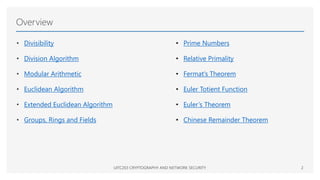
Overview
• Divisibility
• Division Algorithm
• Modular Arithmetic
• Euclidean Algorithm
• Extended Euclidean Algorithm
• Groups, Rings and Fields
UITC203 CRYPTOGRAPHY AND NETWORK SECURITY 2
• Prime Numbers
• Relative Primality
• Fermat’s Theorem
• Euler Totient Function
• Euler’s Theorem
• Chinese Remainder Theorem
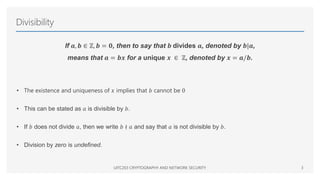
Divisibility
If 𝒂, 𝒃 ∈ ℤ, 𝒃 = 𝟎, then to say that 𝒃 divides 𝒂, denoted by 𝒃|𝒂,
means that 𝒂 = 𝒃𝒙 for a unique 𝒙 ∈ ℤ, denoted by 𝒙 = 𝒂/𝒃.
• The existence and uniqueness of 𝑥 implies that 𝑏 cannot be 0
• This can be stated as 𝑎 is divisible by 𝑏.
• If 𝑏 does not divide 𝑎, then we write 𝑏 ∤ 𝑎 and say that 𝑎 is not divisible by 𝑏.
• Division by zero is undefined.
UITC203 CRYPTOGRAPHY AND NETWORK SECURITY 3
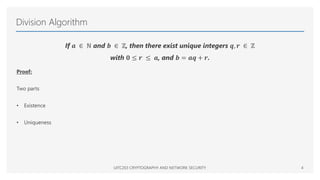
Division Algorithm
If 𝒂 ∈ ℕ and 𝒃 ∈ ℤ, then there exist unique integers 𝒒, 𝒓 ∈ ℤ
with 𝟎 ≤ 𝒓 ≤ 𝒂, and 𝒃 = 𝒂𝒒 + 𝒓.
Proof:
Two parts
• Existence
• Uniqueness
UITC203 CRYPTOGRAPHY AND NETWORK SECURITY 4
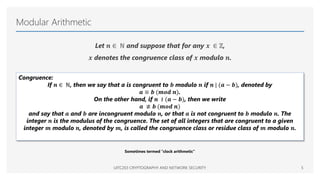
Modular Arithmetic
Let 𝒏 ∈ ℕ and suppose that for any 𝒙 ∈ ℤ,
𝒙 denotes the congruence class of 𝒙 modulo 𝒏.
UITC203 CRYPTOGRAPHY AND NETWORK SECURITY 5
Congruence:
If 𝒏 ∈ ℕ, then we say that a is congruent to 𝒃 modulo 𝒏 if 𝒏 | (𝒂 − 𝒃), denoted by
𝒂 ≡ 𝒃 (𝒎𝒐𝒅 𝒏).
On the other hand, if 𝒏 ∤ (𝒂 − 𝒃), then we write
𝒂 ≢ 𝒃 (𝒎𝒐𝒅 𝒏)
and say that 𝒂 and 𝒃 are incongruent modulo 𝒏, or that 𝒂 is not congruent to 𝒃 modulo 𝒏. The
integer 𝒏 is the modulus of the congruence. The set of all integers that are congruent to a given
integer 𝒎 modulo 𝒏, denoted by 𝒎, is called the congruence class or residue class of 𝒎 modulo 𝒏.
Sometimes termed “clock arithmetic”
Euclidean Algorithm
Let 𝒂, 𝒃 ∈ ℤ (𝒂 ≥ 𝒃 > 𝟎), and set 𝒂 = 𝒓−𝟏, 𝒃 = 𝒓 𝟎. By repeatedly applying the Division
Algorithm, we get 𝒓𝒋−𝟏 = 𝒓𝒋 𝒒𝒋+𝟏 + 𝒓𝒋+𝟏 with 𝟎 < 𝒓𝒋+𝟏 < 𝒓𝒋 for all 𝟎 ≤ 𝒋 < 𝒏, where 𝒏 is the
least non-negative number such that 𝒓 𝒏+𝟏 = 𝟎, in which case 𝒈𝒄𝒅 𝒂, 𝒃 = 𝒓𝒏.
An equivalent definition: 𝒈𝒄𝒅 𝒂, 𝒃 = 𝒎𝒂𝒙 𝒌, 𝒔𝒖𝒄𝒉 𝒕𝒉𝒂𝒕 𝒌 𝒂 𝒂𝒏𝒅 𝒌 𝒃
A simpler form: Let 𝒂, 𝒃 > 𝟏 with 𝒃 ∤ 𝒂. Then,
gcd(𝒂, 𝒃) = gcd(𝒃, [𝒂 𝒎𝒐𝒅 𝒃])
UITC203 CRYPTOGRAPHY AND NETWORK SECURITY 6
The Euclidean algorithm GCD
Input: Integers 𝑎, 𝑏 with 𝑎 ≥ 𝑏 > 0
Output: The greatest common divisor
of 𝑎 and 𝑏
if 𝑏 𝑑𝑖𝑣𝑖𝑑𝑒𝑠 𝑎
return 𝑏
else
return 𝐺𝐶𝐷(𝑏, [𝑎 𝑚𝑜𝑑 𝑏])
Extended Euclidean Algorithm
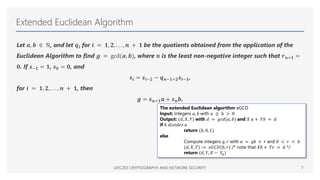
Let 𝒂, 𝒃 ∈ ℕ, and let 𝒒𝒊 for 𝒊 = 𝟏, 𝟐, . . . , 𝒏 + 𝟏 be the quotients obtained from the application of the
Euclidean Algorithm to find 𝒈 = gcd(𝒂, 𝒃), where 𝒏 is the least non-negative integer such that 𝒓 𝒏+𝟏 =
𝟎. If 𝒔−𝟏 = 𝟏, 𝒔 𝟎 = 𝟎, and
𝒔𝒊 = 𝒔𝒊−𝟐 − 𝒒 𝒏−𝟏+𝟐 𝒔𝒊−𝟏,
for 𝒊 = 𝟏, 𝟐, . . . , 𝒏 + 𝟏, then
𝒈 = 𝒔 𝒏+𝟏 𝒂 + 𝒔 𝒏 𝒃.
UITC203 CRYPTOGRAPHY AND NETWORK SECURITY 7
The extended Euclidean algorithm eGCD
Input: Integers 𝑎, 𝑏 with 𝑎 ≥ 𝑏 > 0
Output: (𝑑, 𝑋, 𝑌) with 𝑑 = 𝑔𝑐𝑑(𝑎, 𝑏) and 𝑋 𝑎 + 𝑌𝑏 = 𝑑
if 𝑏 𝑑𝑖𝑣𝑖𝑑𝑒𝑠 𝑎
return (𝑏, 0, 1)
else
Compute integers 𝑞, 𝑟 with 𝑎 = 𝑞𝑏 + 𝑟 and 0 < 𝑟 < 𝑏
(𝑑, 𝑋, 𝑌) ∶= 𝑒𝐺𝐶𝐷(𝑏, 𝑟) /* note that 𝑋𝑏 + 𝑌𝑟 = 𝑑 */
return (𝑑, 𝑌, 𝑋 − 𝑌𝑞)
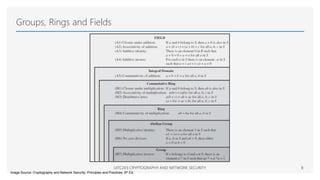
Groups, Rings and Fields
UITC203 CRYPTOGRAPHY AND NETWORK SECURITY 8
Image Source: Cryptography and Network Security: Principles and Practices, 6th Ed.
Prime Numbers
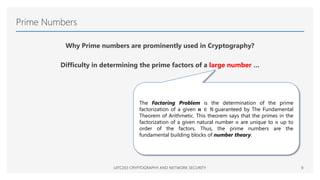
Why Prime numbers are prominently used in Cryptography?
Difficulty in determining the prime factors of a large number …
UITC203 CRYPTOGRAPHY AND NETWORK SECURITY 9
The Factoring Problem is the determination of the prime
factorization of a given 𝒏 ∈ ℕ guaranteed by The Fundamental
Theorem of Arithmetic. This theorem says that the primes in the
factorization of a given natural number 𝑛 are unique to 𝑛 up to
order of the factors. Thus, the prime numbers are the
fundamental building blocks of number theory.
Relative Primality
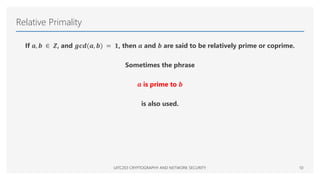
If 𝒂, 𝒃 ∈ 𝒁, and 𝒈𝒄𝒅(𝒂, 𝒃) = 𝟏, then 𝒂 and 𝒃 are said to be relatively prime or coprime.
Sometimes the phrase
𝒂 is prime to 𝒃
is also used.
UITC203 CRYPTOGRAPHY AND NETWORK SECURITY 10
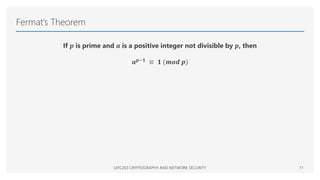
Fermat’s Theorem
If 𝒑 is prime and 𝒂 is a positive integer not divisible by 𝒑, then
𝒂 𝒑−𝟏 ≡ 𝟏 (𝒎𝒐𝒅 𝒑)
UITC203 CRYPTOGRAPHY AND NETWORK SECURITY 11
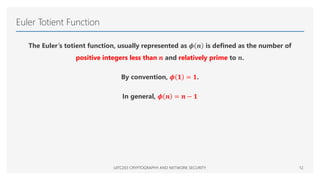
Euler Totient Function
The Euler’s totient function, usually represented as 𝝓 𝒏 is defined as the number of
positive integers less than 𝒏 and relatively prime to 𝒏.
By convention, 𝝓 𝟏 = 𝟏.
In general, 𝝓 𝒏 = 𝒏 − 𝟏
UITC203 CRYPTOGRAPHY AND NETWORK SECURITY 12
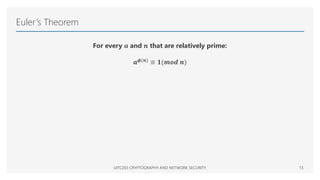
Euler’s Theorem
For every 𝒂 and 𝒏 that are relatively prime:
𝒂 𝝓(𝒏)
≡ 𝟏(𝒎𝒐𝒅 𝒏)
UITC203 CRYPTOGRAPHY AND NETWORK SECURITY 13
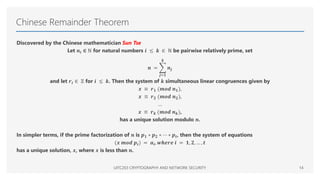
Chinese Remainder Theorem
Discovered by the Chinese mathematician Sun Tse
Let 𝒏𝒊 ∈ ℕ for natural numbers 𝒊 ≤ 𝒌 ∈ ℕ be pairwise relatively prime, set
𝒏 =
𝒋=𝟏
𝒌
𝒏𝒋
and let 𝒓𝒊 ∈ ℤ for 𝒊 ≤ 𝒌. Then the system of 𝒌 simultaneous linear congruences given by
𝒙 ≡ 𝒓 𝟏 (𝒎𝒐𝒅 𝒏 𝟏),
𝒙 ≡ 𝒓 𝟐 (𝒎𝒐𝒅 𝒏 𝟐),
…
𝒙 ≡ 𝒓 𝒌 (𝒎𝒐𝒅 𝒏 𝒌),
has a unique solution modulo 𝒏.
In simpler terms, if the prime factorization of 𝒏 is 𝒑 𝟏 ∗ 𝒑 𝟐 ∗ ⋯ ∗ 𝒑 𝒕, then the system of equations
(𝒙 𝒎𝒐𝒅 𝒑𝒊) = 𝒂𝒊, 𝒘𝒉𝒆𝒓𝒆 𝒊 = 𝟏, 𝟐, … , 𝒕
has a unique solution, 𝒙, where 𝒙 is less than 𝒏.
UITC203 CRYPTOGRAPHY AND NETWORK SECURITY 14
References
Schneier, B. (2007). Applied cryptography: protocols, algorithms, and source code in C. John Wiley & Sons.
Rosen, K. H. (2007). An Introduction to Cryptography. ISBN-10, 1-58488.
Stallings, W. (2014). Cryptography and network security, 6/E. Pearson Education India.
Katz, J., & Lindell, Y. (2014). Introduction to modern cryptography. CRC press.
UITC203 CRYPTOGRAPHY AND NETWORK SECURITY 15

Mathematical Foundations of Cryptography

  • 1.
    Mathematical Foundations Adri JovinJ J, M.Tech., Ph.D. UITC203 CRYPTOGRAPHY AND NETWORK SECURITY
  • 2.
    Overview • Divisibility • DivisionAlgorithm • Modular Arithmetic • Euclidean Algorithm • Extended Euclidean Algorithm • Groups, Rings and Fields UITC203 CRYPTOGRAPHY AND NETWORK SECURITY 2 • Prime Numbers • Relative Primality • Fermat’s Theorem • Euler Totient Function • Euler’s Theorem • Chinese Remainder Theorem
  • 3.
    Divisibility If 𝒂, 𝒃∈ ℤ, 𝒃 = 𝟎, then to say that 𝒃 divides 𝒂, denoted by 𝒃|𝒂, means that 𝒂 = 𝒃𝒙 for a unique 𝒙 ∈ ℤ, denoted by 𝒙 = 𝒂/𝒃. • The existence and uniqueness of 𝑥 implies that 𝑏 cannot be 0 • This can be stated as 𝑎 is divisible by 𝑏. • If 𝑏 does not divide 𝑎, then we write 𝑏 ∤ 𝑎 and say that 𝑎 is not divisible by 𝑏. • Division by zero is undefined. UITC203 CRYPTOGRAPHY AND NETWORK SECURITY 3
  • 4.
    Division Algorithm If 𝒂∈ ℕ and 𝒃 ∈ ℤ, then there exist unique integers 𝒒, 𝒓 ∈ ℤ with 𝟎 ≤ 𝒓 ≤ 𝒂, and 𝒃 = 𝒂𝒒 + 𝒓. Proof: Two parts • Existence • Uniqueness UITC203 CRYPTOGRAPHY AND NETWORK SECURITY 4
  • 5.
    Modular Arithmetic Let 𝒏∈ ℕ and suppose that for any 𝒙 ∈ ℤ, 𝒙 denotes the congruence class of 𝒙 modulo 𝒏. UITC203 CRYPTOGRAPHY AND NETWORK SECURITY 5 Congruence: If 𝒏 ∈ ℕ, then we say that a is congruent to 𝒃 modulo 𝒏 if 𝒏 | (𝒂 − 𝒃), denoted by 𝒂 ≡ 𝒃 (𝒎𝒐𝒅 𝒏). On the other hand, if 𝒏 ∤ (𝒂 − 𝒃), then we write 𝒂 ≢ 𝒃 (𝒎𝒐𝒅 𝒏) and say that 𝒂 and 𝒃 are incongruent modulo 𝒏, or that 𝒂 is not congruent to 𝒃 modulo 𝒏. The integer 𝒏 is the modulus of the congruence. The set of all integers that are congruent to a given integer 𝒎 modulo 𝒏, denoted by 𝒎, is called the congruence class or residue class of 𝒎 modulo 𝒏. Sometimes termed “clock arithmetic”
  • 6.
    Euclidean Algorithm Let 𝒂,𝒃 ∈ ℤ (𝒂 ≥ 𝒃 > 𝟎), and set 𝒂 = 𝒓−𝟏, 𝒃 = 𝒓 𝟎. By repeatedly applying the Division Algorithm, we get 𝒓𝒋−𝟏 = 𝒓𝒋 𝒒𝒋+𝟏 + 𝒓𝒋+𝟏 with 𝟎 < 𝒓𝒋+𝟏 < 𝒓𝒋 for all 𝟎 ≤ 𝒋 < 𝒏, where 𝒏 is the least non-negative number such that 𝒓 𝒏+𝟏 = 𝟎, in which case 𝒈𝒄𝒅 𝒂, 𝒃 = 𝒓𝒏. An equivalent definition: 𝒈𝒄𝒅 𝒂, 𝒃 = 𝒎𝒂𝒙 𝒌, 𝒔𝒖𝒄𝒉 𝒕𝒉𝒂𝒕 𝒌 𝒂 𝒂𝒏𝒅 𝒌 𝒃 A simpler form: Let 𝒂, 𝒃 > 𝟏 with 𝒃 ∤ 𝒂. Then, gcd(𝒂, 𝒃) = gcd(𝒃, [𝒂 𝒎𝒐𝒅 𝒃]) UITC203 CRYPTOGRAPHY AND NETWORK SECURITY 6 The Euclidean algorithm GCD Input: Integers 𝑎, 𝑏 with 𝑎 ≥ 𝑏 > 0 Output: The greatest common divisor of 𝑎 and 𝑏 if 𝑏 𝑑𝑖𝑣𝑖𝑑𝑒𝑠 𝑎 return 𝑏 else return 𝐺𝐶𝐷(𝑏, [𝑎 𝑚𝑜𝑑 𝑏])
  • 7.
    Extended Euclidean Algorithm Let𝒂, 𝒃 ∈ ℕ, and let 𝒒𝒊 for 𝒊 = 𝟏, 𝟐, . . . , 𝒏 + 𝟏 be the quotients obtained from the application of the Euclidean Algorithm to find 𝒈 = gcd(𝒂, 𝒃), where 𝒏 is the least non-negative integer such that 𝒓 𝒏+𝟏 = 𝟎. If 𝒔−𝟏 = 𝟏, 𝒔 𝟎 = 𝟎, and 𝒔𝒊 = 𝒔𝒊−𝟐 − 𝒒 𝒏−𝟏+𝟐 𝒔𝒊−𝟏, for 𝒊 = 𝟏, 𝟐, . . . , 𝒏 + 𝟏, then 𝒈 = 𝒔 𝒏+𝟏 𝒂 + 𝒔 𝒏 𝒃. UITC203 CRYPTOGRAPHY AND NETWORK SECURITY 7 The extended Euclidean algorithm eGCD Input: Integers 𝑎, 𝑏 with 𝑎 ≥ 𝑏 > 0 Output: (𝑑, 𝑋, 𝑌) with 𝑑 = 𝑔𝑐𝑑(𝑎, 𝑏) and 𝑋 𝑎 + 𝑌𝑏 = 𝑑 if 𝑏 𝑑𝑖𝑣𝑖𝑑𝑒𝑠 𝑎 return (𝑏, 0, 1) else Compute integers 𝑞, 𝑟 with 𝑎 = 𝑞𝑏 + 𝑟 and 0 < 𝑟 < 𝑏 (𝑑, 𝑋, 𝑌) ∶= 𝑒𝐺𝐶𝐷(𝑏, 𝑟) /* note that 𝑋𝑏 + 𝑌𝑟 = 𝑑 */ return (𝑑, 𝑌, 𝑋 − 𝑌𝑞)
  • 8.
    Groups, Rings andFields UITC203 CRYPTOGRAPHY AND NETWORK SECURITY 8 Image Source: Cryptography and Network Security: Principles and Practices, 6th Ed.
  • 9.
    Prime Numbers Why Primenumbers are prominently used in Cryptography? Difficulty in determining the prime factors of a large number … UITC203 CRYPTOGRAPHY AND NETWORK SECURITY 9 The Factoring Problem is the determination of the prime factorization of a given 𝒏 ∈ ℕ guaranteed by The Fundamental Theorem of Arithmetic. This theorem says that the primes in the factorization of a given natural number 𝑛 are unique to 𝑛 up to order of the factors. Thus, the prime numbers are the fundamental building blocks of number theory.
  • 10.
    Relative Primality If 𝒂,𝒃 ∈ 𝒁, and 𝒈𝒄𝒅(𝒂, 𝒃) = 𝟏, then 𝒂 and 𝒃 are said to be relatively prime or coprime. Sometimes the phrase 𝒂 is prime to 𝒃 is also used. UITC203 CRYPTOGRAPHY AND NETWORK SECURITY 10
  • 11.
    Fermat’s Theorem If 𝒑is prime and 𝒂 is a positive integer not divisible by 𝒑, then 𝒂 𝒑−𝟏 ≡ 𝟏 (𝒎𝒐𝒅 𝒑) UITC203 CRYPTOGRAPHY AND NETWORK SECURITY 11
  • 12.
    Euler Totient Function TheEuler’s totient function, usually represented as 𝝓 𝒏 is defined as the number of positive integers less than 𝒏 and relatively prime to 𝒏. By convention, 𝝓 𝟏 = 𝟏. In general, 𝝓 𝒏 = 𝒏 − 𝟏 UITC203 CRYPTOGRAPHY AND NETWORK SECURITY 12
  • 13.
    Euler’s Theorem For every𝒂 and 𝒏 that are relatively prime: 𝒂 𝝓(𝒏) ≡ 𝟏(𝒎𝒐𝒅 𝒏) UITC203 CRYPTOGRAPHY AND NETWORK SECURITY 13
  • 14.
    Chinese Remainder Theorem Discoveredby the Chinese mathematician Sun Tse Let 𝒏𝒊 ∈ ℕ for natural numbers 𝒊 ≤ 𝒌 ∈ ℕ be pairwise relatively prime, set 𝒏 = 𝒋=𝟏 𝒌 𝒏𝒋 and let 𝒓𝒊 ∈ ℤ for 𝒊 ≤ 𝒌. Then the system of 𝒌 simultaneous linear congruences given by 𝒙 ≡ 𝒓 𝟏 (𝒎𝒐𝒅 𝒏 𝟏), 𝒙 ≡ 𝒓 𝟐 (𝒎𝒐𝒅 𝒏 𝟐), … 𝒙 ≡ 𝒓 𝒌 (𝒎𝒐𝒅 𝒏 𝒌), has a unique solution modulo 𝒏. In simpler terms, if the prime factorization of 𝒏 is 𝒑 𝟏 ∗ 𝒑 𝟐 ∗ ⋯ ∗ 𝒑 𝒕, then the system of equations (𝒙 𝒎𝒐𝒅 𝒑𝒊) = 𝒂𝒊, 𝒘𝒉𝒆𝒓𝒆 𝒊 = 𝟏, 𝟐, … , 𝒕 has a unique solution, 𝒙, where 𝒙 is less than 𝒏. UITC203 CRYPTOGRAPHY AND NETWORK SECURITY 14
  • 15.
    References Schneier, B. (2007).Applied cryptography: protocols, algorithms, and source code in C. John Wiley & Sons. Rosen, K. H. (2007). An Introduction to Cryptography. ISBN-10, 1-58488. Stallings, W. (2014). Cryptography and network security, 6/E. Pearson Education India. Katz, J., & Lindell, Y. (2014). Introduction to modern cryptography. CRC press. UITC203 CRYPTOGRAPHY AND NETWORK SECURITY 15