Advanced Encryption Standard
Adri Jovin J J, M.Tech., Ph.D.
UITC203 CRYPTOGRAPHY AND NETWORK SECURITY
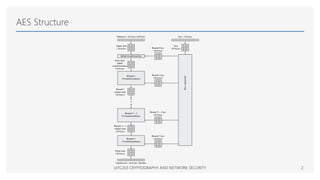
AES Structure
UITC203 CRYPTOGRAPHY AND NETWORK SECURITY 2
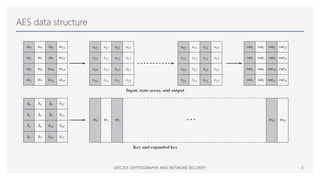
AES data structure
UITC203 CRYPTOGRAPHY AND NETWORK SECURITY 3
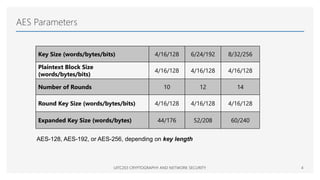
AES Parameters
Key Size (words/bytes/bits) 4/16/128 6/24/192 8/32/256
Plaintext Block Size
(words/bytes/bits)
4/16/128 4/16/128 4/16/128
Number of Rounds 10 12 14
Round Key Size (words/bytes/bits) 4/16/128 4/16/128 4/16/128
Expanded Key Size (words/bytes) 44/176 52/208 60/240
UITC203 CRYPTOGRAPHY AND NETWORK SECURITY 4
AES-128, AES-192, or AES-256, depending on key length
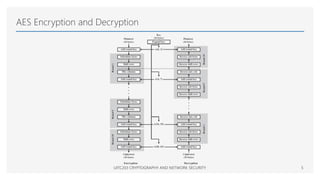
AES Encryption and Decryption
UITC203 CRYPTOGRAPHY AND NETWORK SECURITY 5
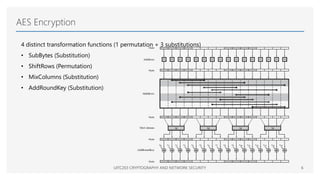
AES Encryption
UITC203 CRYPTOGRAPHY AND NETWORK SECURITY 6
4 distinct transformation functions (1 permutation + 3 substitutions)
• SubBytes (Substitution)
• ShiftRows (Permutation)
• MixColumns (Substitution)
• AddRoundKey (Substitution)
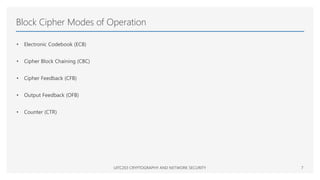
Block Cipher Modes of Operation
• Electronic Codebook (ECB)
• Cipher Block Chaining (CBC)
• Cipher Feedback (CFB)
• Output Feedback (OFB)
• Counter (CTR)
UITC203 CRYPTOGRAPHY AND NETWORK SECURITY 7
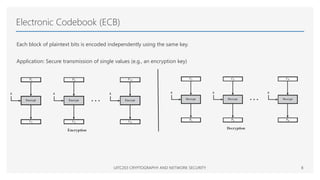
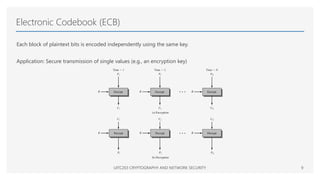
Electronic Codebook (ECB)
Each block of plaintext bits is encoded independently using the same key.
Application: Secure transmission of single values (e.g., an encryption key)
UITC203 CRYPTOGRAPHY AND NETWORK SECURITY 8
Electronic Codebook (ECB)
Each block of plaintext bits is encoded independently using the same key.
Application: Secure transmission of single values (e.g., an encryption key)
UITC203 CRYPTOGRAPHY AND NETWORK SECURITY 9
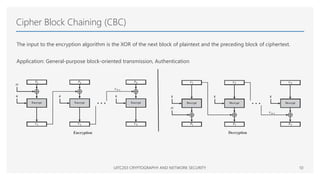
Cipher Block Chaining (CBC)
The input to the encryption algorithm is the XOR of the next block of plaintext and the preceding block of ciphertext.
Application: General-purpose block-oriented transmission, Authentication
UITC203 CRYPTOGRAPHY AND NETWORK SECURITY 10
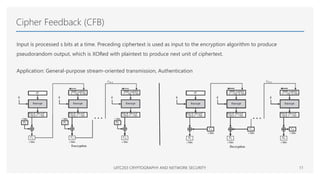
Cipher Feedback (CFB)
Input is processed s bits at a time. Preceding ciphertext is used as input to the encryption algorithm to produce
pseudorandom output, which is XORed with plaintext to produce next unit of ciphertext.
Application: General-purpose stream-oriented transmission, Authentication
UITC203 CRYPTOGRAPHY AND NETWORK SECURITY 11
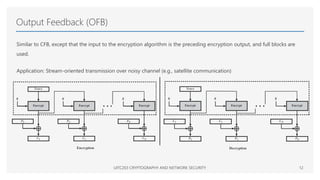
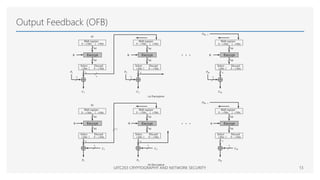
Output Feedback (OFB)
Similar to CFB, except that the input to the encryption algorithm is the preceding encryption output, and full blocks are
used.
Application: Stream-oriented transmission over noisy channel (e.g., satellite communication)
UITC203 CRYPTOGRAPHY AND NETWORK SECURITY 12
Output Feedback (OFB)
UITC203 CRYPTOGRAPHY AND NETWORK SECURITY 13
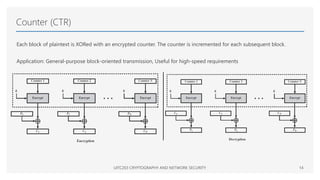
Counter (CTR)
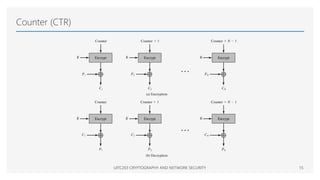
Each block of plaintext is XORed with an encrypted counter. The counter is incremented for each subsequent block.
Application: General-purpose block-oriented transmission, Useful for high-speed requirements
UITC203 CRYPTOGRAPHY AND NETWORK SECURITY 14
Counter (CTR)
UITC203 CRYPTOGRAPHY AND NETWORK SECURITY 15
References
Schneier, B. (2007). Applied cryptography: protocols, algorithms, and source code in C. John Wiley & Sons.
Stallings, W. (2014). Cryptography and network security, 6/E. Pearson Education India.
UITC203 CRYPTOGRAPHY AND NETWORK SECURITY 16

Advanced Encryption System & Block Cipher Modes of Operations

  • 1.
    Advanced Encryption Standard AdriJovin J J, M.Tech., Ph.D. UITC203 CRYPTOGRAPHY AND NETWORK SECURITY
  • 2.
    AES Structure UITC203 CRYPTOGRAPHYAND NETWORK SECURITY 2
  • 3.
    AES data structure UITC203CRYPTOGRAPHY AND NETWORK SECURITY 3
  • 4.
    AES Parameters Key Size(words/bytes/bits) 4/16/128 6/24/192 8/32/256 Plaintext Block Size (words/bytes/bits) 4/16/128 4/16/128 4/16/128 Number of Rounds 10 12 14 Round Key Size (words/bytes/bits) 4/16/128 4/16/128 4/16/128 Expanded Key Size (words/bytes) 44/176 52/208 60/240 UITC203 CRYPTOGRAPHY AND NETWORK SECURITY 4 AES-128, AES-192, or AES-256, depending on key length
  • 5.
    AES Encryption andDecryption UITC203 CRYPTOGRAPHY AND NETWORK SECURITY 5
  • 6.
    AES Encryption UITC203 CRYPTOGRAPHYAND NETWORK SECURITY 6 4 distinct transformation functions (1 permutation + 3 substitutions) • SubBytes (Substitution) • ShiftRows (Permutation) • MixColumns (Substitution) • AddRoundKey (Substitution)
  • 7.
    Block Cipher Modesof Operation • Electronic Codebook (ECB) • Cipher Block Chaining (CBC) • Cipher Feedback (CFB) • Output Feedback (OFB) • Counter (CTR) UITC203 CRYPTOGRAPHY AND NETWORK SECURITY 7
  • 8.
    Electronic Codebook (ECB) Eachblock of plaintext bits is encoded independently using the same key. Application: Secure transmission of single values (e.g., an encryption key) UITC203 CRYPTOGRAPHY AND NETWORK SECURITY 8
  • 9.
    Electronic Codebook (ECB) Eachblock of plaintext bits is encoded independently using the same key. Application: Secure transmission of single values (e.g., an encryption key) UITC203 CRYPTOGRAPHY AND NETWORK SECURITY 9
  • 10.
    Cipher Block Chaining(CBC) The input to the encryption algorithm is the XOR of the next block of plaintext and the preceding block of ciphertext. Application: General-purpose block-oriented transmission, Authentication UITC203 CRYPTOGRAPHY AND NETWORK SECURITY 10
  • 11.
    Cipher Feedback (CFB) Inputis processed s bits at a time. Preceding ciphertext is used as input to the encryption algorithm to produce pseudorandom output, which is XORed with plaintext to produce next unit of ciphertext. Application: General-purpose stream-oriented transmission, Authentication UITC203 CRYPTOGRAPHY AND NETWORK SECURITY 11
  • 12.
    Output Feedback (OFB) Similarto CFB, except that the input to the encryption algorithm is the preceding encryption output, and full blocks are used. Application: Stream-oriented transmission over noisy channel (e.g., satellite communication) UITC203 CRYPTOGRAPHY AND NETWORK SECURITY 12
  • 13.
    Output Feedback (OFB) UITC203CRYPTOGRAPHY AND NETWORK SECURITY 13
  • 14.
    Counter (CTR) Each blockof plaintext is XORed with an encrypted counter. The counter is incremented for each subsequent block. Application: General-purpose block-oriented transmission, Useful for high-speed requirements UITC203 CRYPTOGRAPHY AND NETWORK SECURITY 14
  • 15.
    Counter (CTR) UITC203 CRYPTOGRAPHYAND NETWORK SECURITY 15
  • 16.
    References Schneier, B. (2007).Applied cryptography: protocols, algorithms, and source code in C. John Wiley & Sons. Stallings, W. (2014). Cryptography and network security, 6/E. Pearson Education India. UITC203 CRYPTOGRAPHY AND NETWORK SECURITY 16