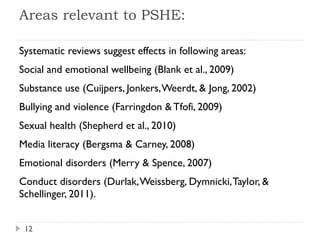
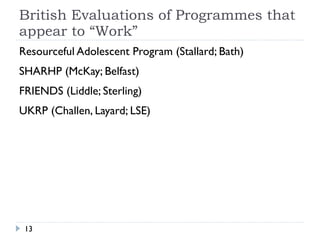
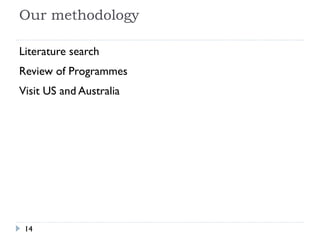
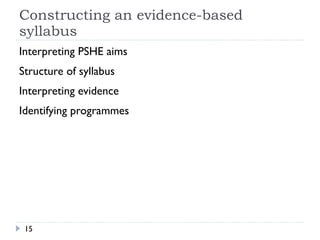
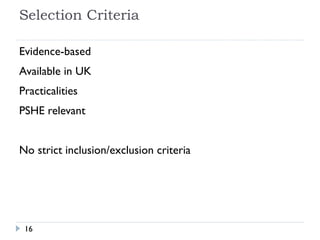
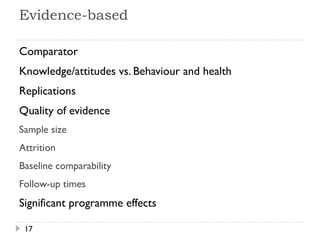
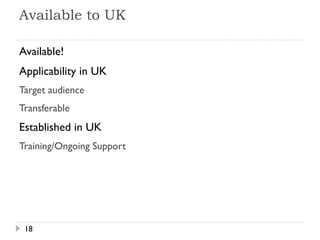
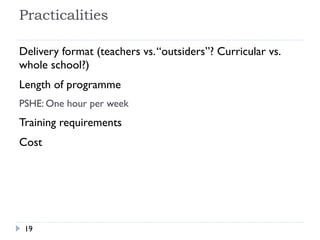
PSHE Project Coleman, Hale and Layard
Aims and objectives of the project To carry out international review of evidence-based programmes relating to life skills for secondary age pupils
To identify the methodological problems involved in evaluating such programmes
To highlight the main facilitators/impediments to evidence-based PSHE
To establish which programmes could be recommended in the UK
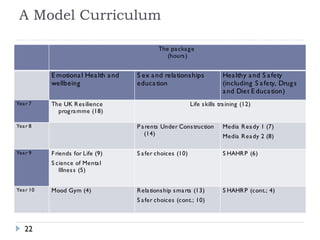
To recommend a notional programme of Life Skills education as part of a future PSHE curriculum  (Secondary, Personal Wellbeing)
Background PSHE: Personal Wellbeing Key Concepts Personal Identities
Healthy lifestyles
Risk
Relationships
Diversity
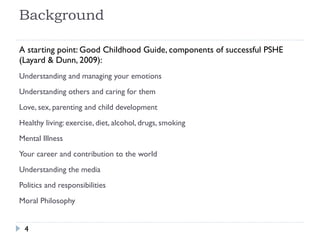
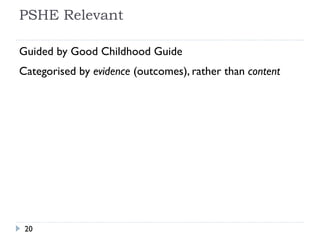
Background A starting point: Good Childhood Guide, components of successful PSHE  (Layard & Dunn, 2009): Understanding and managing your emotions
Understanding others and caring for them
Love, sex, parenting and child development
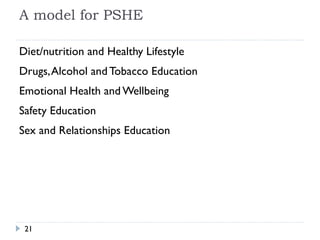
Healthy living: exercise, diet, alcohol, drugs, smoking
Mental Illness
Your career and contribution to the world
Understanding the media
Politics and responsibilities
Moral Philosophy
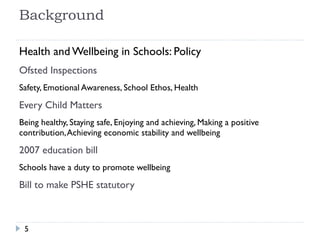
Background Health and Wellbeing in Schools: Policy Ofsted Inspections Safety, Emotional Awareness, School Ethos, Health Every Child Matters Being healthy, Staying safe, Enjoying and achieving, Making a positive contribution, Achieving economic stability and wellbeing 2007 education bill Schools have a duty to promote wellbeing Bill to make PSHE statutory
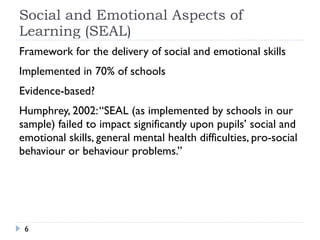
Social and Emotional Aspects of Learning (SEAL) Framework for the delivery of social and emotional skills
Implemented in 70% of schools
Evidence-based?
Humphrey, 2002: “SEAL (as implemented by schools in our sample) failed to impact significantly upon pupils’ social and emotional skills, general mental health difficulties, pro-social behaviour or behaviour problems.”
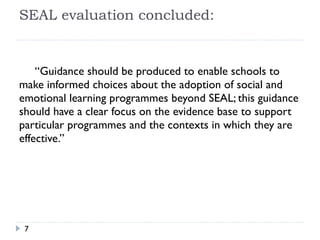
SEAL evaluation concluded: “ Guidance should be produced to enable schools to make informed choices about the adoption of social and emotional learning programmes beyond SEAL; this guidance should have a clear focus on the evidence base to support particular programmes and the contexts in which they are effective.”

LSE's PSHE Project

Editor's Notes

  • #4 Mention flexibility
  • #7 Not designed explicitly for PSHE
  • #10 First question:
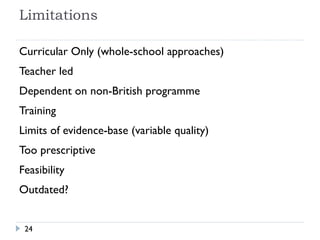
  • #12 Flexibility vs. fidelity