Margaret Jones HMI National Adviser for PSHE www.ofsted.gov.uk   Personal, social, health and economic education in schools Report
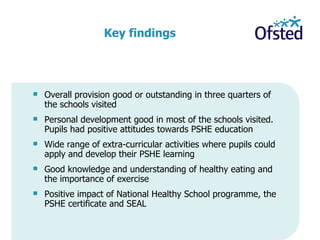
Overall provision good or outstanding in three quarters of the schools visited  Personal development good in most of the schools visited. Pupils had positive attitudes towards PSHE education Wide range of extra-curricular activities where pupils could apply and develop their PSHE learning Good knowledge and understanding of healthy eating and the importance of exercise  Positive impact of National Healthy School programme, the PSHE certificate and SEAL   Key findings
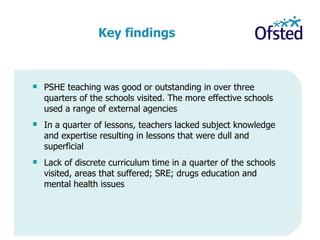
PSHE teaching was good or outstanding in over three quarters of the schools visited. The more effective schools used a range of external agencies  In a quarter of lessons, teachers lacked subject knowledge and expertise resulting in lessons that were dull and superficial Lack of discrete curriculum time in a quarter of the schools visited, areas that suffered; SRE; drugs education and mental health issues  Key findings
Parents rarely involved with or consulted about PSHE education The assessment and tracking of pupils’ progress in PSHE education weakest aspect - inadequate in 15 of the 73 secondary schools visited Patchy provision for economic well-being and financial capability  Key findings
The Department for Education should: ensure teachers training for  PSHE education and promote the take-up of continuing professional development in PSHE education support schools in  implementing the revised guidance on sex and relationships education and drugs education support the development of good practice in assessing PSHE education, and publicise this widely to schools. Recommendations
Local authorities should: consider how they can support schools most effectively in developing PSHE education programmes by providing access to high-quality continuing professional development facilitate networks of teachers to develop PSHE knowledge and skills and, in particular, encourage the involvement of schools where the provision is weak. Recommendations
Schools should: ensure that the timetable is organised so PSHE education is coherent, comprehensive and of high quality meet the needs of pupils for teaching about high-risk areas such as sex and relationships, drugs and mental health issues make lessons active, compelling and relevant, and ensure that teachers have the specialist knowledge, training and skills they need to teach PSHE education successfully implement systems for assessing and tracking pupils’ progress in PSHE education involve and consult parents more in developing and implementing the PSHE curriculum, so they are aware of the topics being covered. Recommendations

PSHE education in School - Ofsted

  • 1.
    Margaret Jones HMINational Adviser for PSHE www.ofsted.gov.uk Personal, social, health and economic education in schools Report
  • 2.
    Overall provision goodor outstanding in three quarters of the schools visited Personal development good in most of the schools visited. Pupils had positive attitudes towards PSHE education Wide range of extra-curricular activities where pupils could apply and develop their PSHE learning Good knowledge and understanding of healthy eating and the importance of exercise Positive impact of National Healthy School programme, the PSHE certificate and SEAL Key findings
  • 3.
    PSHE teaching wasgood or outstanding in over three quarters of the schools visited. The more effective schools used a range of external agencies In a quarter of lessons, teachers lacked subject knowledge and expertise resulting in lessons that were dull and superficial Lack of discrete curriculum time in a quarter of the schools visited, areas that suffered; SRE; drugs education and mental health issues Key findings
  • 4.
    Parents rarely involvedwith or consulted about PSHE education The assessment and tracking of pupils’ progress in PSHE education weakest aspect - inadequate in 15 of the 73 secondary schools visited Patchy provision for economic well-being and financial capability Key findings
  • 5.
    The Department forEducation should: ensure teachers training for PSHE education and promote the take-up of continuing professional development in PSHE education support schools in implementing the revised guidance on sex and relationships education and drugs education support the development of good practice in assessing PSHE education, and publicise this widely to schools. Recommendations
  • 6.
    Local authorities should:consider how they can support schools most effectively in developing PSHE education programmes by providing access to high-quality continuing professional development facilitate networks of teachers to develop PSHE knowledge and skills and, in particular, encourage the involvement of schools where the provision is weak. Recommendations
  • 7.
    Schools should: ensurethat the timetable is organised so PSHE education is coherent, comprehensive and of high quality meet the needs of pupils for teaching about high-risk areas such as sex and relationships, drugs and mental health issues make lessons active, compelling and relevant, and ensure that teachers have the specialist knowledge, training and skills they need to teach PSHE education successfully implement systems for assessing and tracking pupils’ progress in PSHE education involve and consult parents more in developing and implementing the PSHE curriculum, so they are aware of the topics being covered. Recommendations