INTERESTINGINTERESTING
INTEGERS!INTEGERS!
5
-7
-3
-8
4
What You Will Learn:What You Will Learn:
 Vocabulary related to integers
 Rules for adding and subtracting
integers
 A method for proving that a rule is true
Are you ready??Are you ready??
Part I: Introduction to IntegersPart I: Introduction to Integers
•VocabularyVocabulary
• positive numberpositive number
• negative numbernegative number
•Horizontal & vertical number linesHorizontal & vertical number lines
•Comparing IntegersComparing Integers
•Ordering IntegersOrdering Integers
•Vocabulary - continuedVocabulary - continued
• opposite numberopposite number
• integerinteger
•Real World Applications & ExamplesReal World Applications & Examples
• temperaturetemperature
• sea levelsea level
• moneymoney
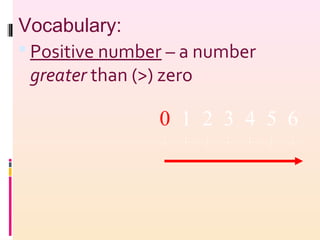
 Positive number – a number
greater than (>) zero
0 1 2 3 4 5 6
Vocabulary:
Hint:Hint:
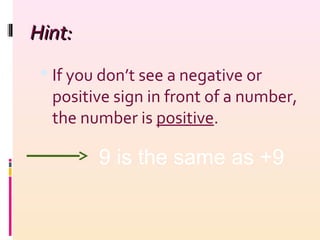
 If you don’t see a negative or
positive sign in front of a number,
the number is positive.
9 is the same as +9
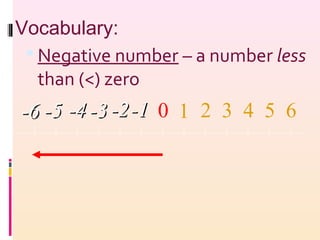
 Negative number – a number less
than (<) zero
0 1 2 3 4 5 6-1-1-2-2-3-3-4-4-5-5-6-6
Vocabulary:
Integer Number LineInteger Number Line
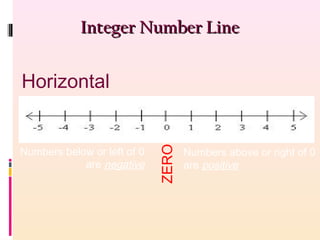
Horizontal
Numbers above or right of 0
are positive
Numbers below or left of 0
are negative ZERO
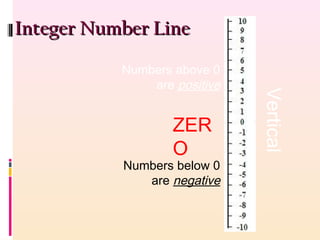
Integer Number LineInteger Number Line
Vertical
Numbers above 0
are positive
ZER
O
Numbers below 0
are negative
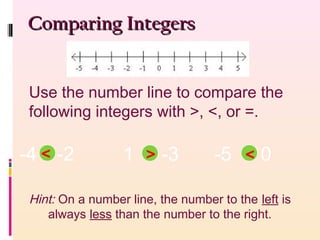
Use the number line to compare the
following integers with >, <, or =.
-4 -2 1 -3 -5 0
Hint: On a number line, the number to the left is
always less than the number to the right.
Comparing IntegersComparing Integers
<
< >
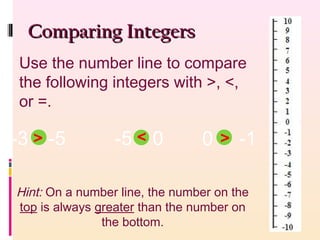
Use the number line to compare
the following integers with >, <,
or =.
Comparing IntegersComparing Integers
Hint: On a number line, the number on the
top is always greater than the number on
the bottom.
-3 -5 -5 0 0 -1>
>
>
Ordering IntegersOrdering Integers
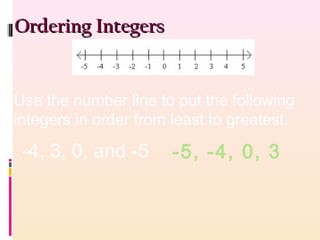
Use the number line to put the following
integers in order from least to greatest.
-4, 3, 0, and -5 -5, -4, 0, 3
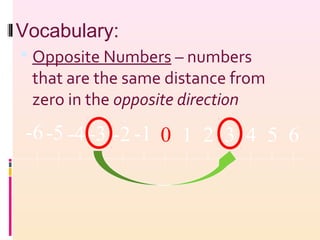
 Opposite Numbers – numbers
that are the same distance from
zero in the opposite direction
0 1 2 3 4 5 6-1-2-3-4-5-6
Vocabulary:
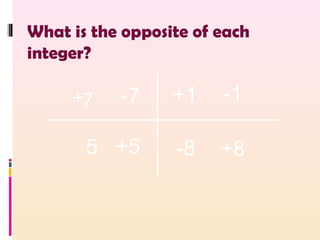
What is the opposite of each
integer?
+7 -7
+5
-1
+8
+1
5 -8
Vocabulary:
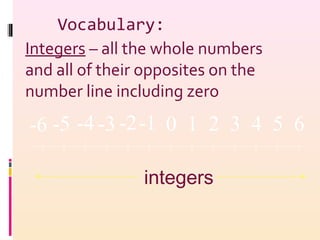
Integers – all the whole numbers
and all of their opposites on the
number line including zero
0 1 2 3 4 5 6-1-2-3-4-5-6
integers
Now, you’re probably saying,
“That’s interesting and
everything, BUT where are
negative numbers in the real
world??
??
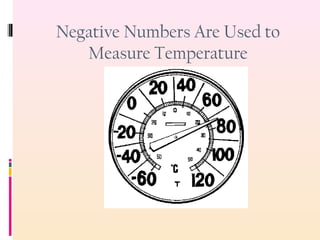
Negative Numbers Are Used to
Measure Temperature
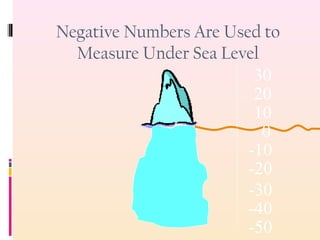
Negative Numbers Are Used to
Measure Under Sea Level
0
10
20
30
-10
-20
-30
-40
-50
Positive and negative numbers
are used when keeping track of
money.
+ Positive +
$$ you earn
- Negative -
$$ you spend
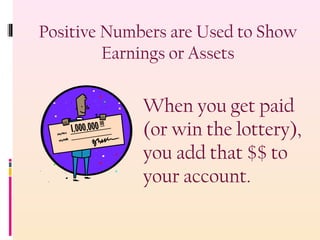
Positive Numbers are Used to Show
Earnings or Assets
When you get paid
(or win the lottery),
you add that $$ to
your account.
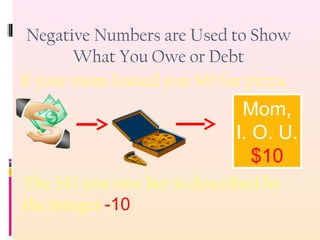
Negative Numbers are Used to Show
What You Owe or Debt
If your mom loaned you $10 for pizza,
Mom,
I. O. U.
$10
The $10 you owe her is described by
the integer -10.
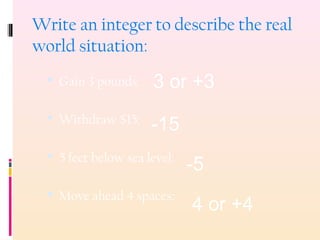
Write an integer to describe the real
world situation:
 Gain 3 pounds:
 Withdraw $15:
 5 feet below sea level:
 Move ahead 4 spaces:
3 or +3
-15
-5
4 or +4
End - Part I: Introduction to IntegersEnd - Part I: Introduction to Integers
•VocabularyVocabulary
• positive numberpositive number
• negative numbernegative number
•Horizontal & vertical number linesHorizontal & vertical number lines
•Comparing IntegersComparing Integers
•Ordering IntegersOrdering Integers
•Vocabulary - continuedVocabulary - continued
• opposite numberopposite number
• integerinteger
•Real World Applications & ExamplesReal World Applications & Examples
• temperaturetemperature
• sea levelsea level
• moneymoney
Part II: Adding IntegersPart II: Adding Integers
Key ConceptsKey Concepts
Integer Addition RulesInteger Addition Rules
Using Number LinesUsing Number Lines
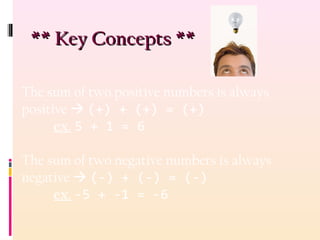
** Key Concepts **** Key Concepts **
The sum of two positive numbers is always
positive  (+) + (+) = (+)
ex. 5 + 1 = 6
The sum of two negative numbers is always
negative  (-) + (-) = (-)
ex. -5 + -1 = -6
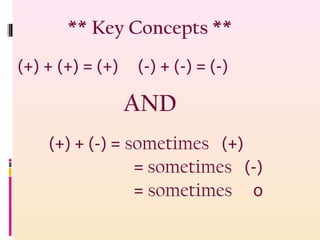
** Key Concepts **
(+) + (+) = (+) (-) + (-) = (-)
(+) + (-) = sometimes (+)
= sometimes (-)
= sometimes 0
AND
Integer Addition RulesInteger Addition Rules
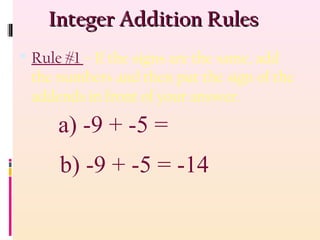
 Rule #1 – If the signs are the same, add
the numbers and then put the sign of the
addends in front of your answer.
b) -9 + -5 = -14
a) -9 + -5 =
SolveSolve the Problemsthe Problems
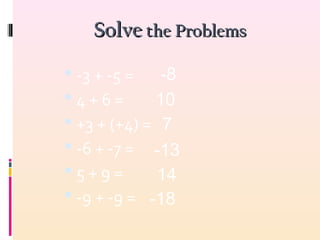
 -3 + -5 =
 4 + 6 =
 +3 + (+4) =
 -6 + -7 =
 5 + 9 =
 -9 + -9 =
-8
-18
14
-13
7
10
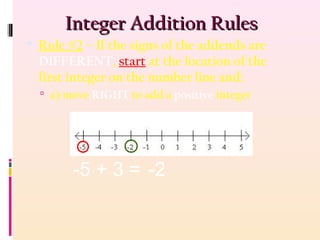
 Rule #2 – If the signs of the addends are
DIFFERENT, start at the location of the
first integer on the number line and:
 a) move RIGHT to add a positive integer
Integer Addition RulesInteger Addition Rules
-5 + 3 = -2
1 2 3
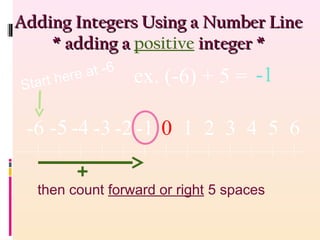
ex. (-6) + 5 = -1Start here at -6
0 1 2 3 4 5 6-1-2-3-4-5-6
then count forward or right 5 spaces
+
Adding Integers Using a Number LineAdding Integers Using a Number Line
* adding a* adding a positive integer *integer *
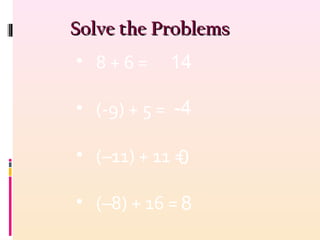
Solve the ProblemsSolve the Problems
• 8 + 6 =
• (-9) + 5 =
• (–11) + 11 =
• (–8) + 16 =
14
0
8
-4
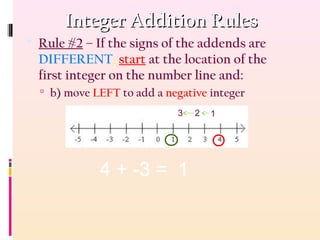
 Rule #2 – If the signs of the addends are
DIFFERENT, start at the location of the
first integer on the number line and:
 b) move LEFT to add a negative integer
Integer Addition RulesInteger Addition Rules
4 + -3 = 1
123
0 1 2 3 4 5 6-1-2-3-4-5-6
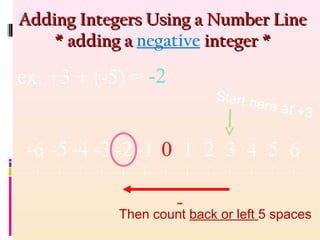
-
ex. +3 + (-5) = -2
Start here at +3
Then count back or left 5 spaces
Adding Integers Using a Number LineAdding Integers Using a Number Line
* adding a* adding a negative integer *integer *
Solve the ProblemsSolve the Problems
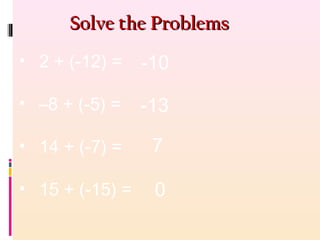
• 2 + (-12) =
• –8 + (-5) =
• 14 + (-7) =
• 15 + (-15) =
-10
7
-13
0
Part III
Part III: Subtracting IntegersPart III: Subtracting Integers
** Key Concept **** Key Concept **
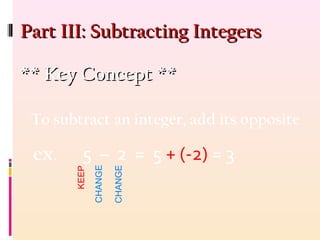
To subtract an integer, add its opposite
ex. 5 – 2 = 5 + (-2) = 3
KEEP
CHANGE
CHANGE
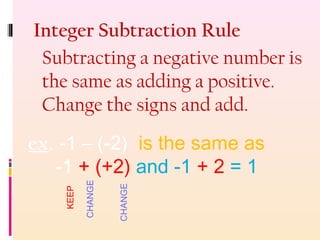
ex. -1 – (-2) is the same as
-1 + (+2) and -1 + 2 = 1
Subtracting a negative number is
the same as adding a positive.
Change the signs and add.
Integer Subtraction Rule
KEEP
CHANGE
CHANGE
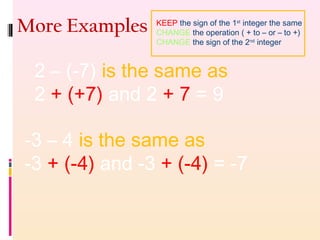
-3 – 4 is the same as
-3 + (-4) and -3 + (-4) = -7
More Examples
2 – (-7) is the same as
2 + (+7) and 2 + 7 = 9
KEEP the sign of the 1st
integer the same
CHANGE the operation ( + to – or – to +)
CHANGE the sign of the 2nd
integer
More Examples
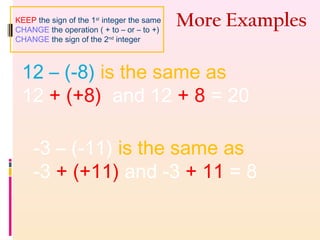
12 – (-8) is the same as
12 + (+8) and 12 + 8 = 20
-3 – (-11) is the same as
-3 + (+11) and -3 + 11 = 8
KEEP the sign of the 1st
integer the same
CHANGE the operation ( + to – or – to +)
CHANGE the sign of the 2nd
integer
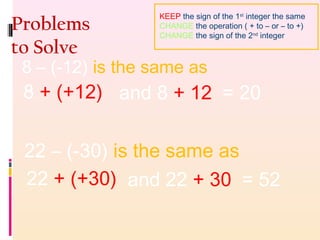
Problems
to Solve
8 – (-12) is the same as
8 + (+12) and 8 + 12 = 20
22 – (-30) is the same as
22 + (+30) and 22 + 30 = 52
KEEP the sign of the 1st
integer the same
CHANGE the operation ( + to – or – to +)
CHANGE the sign of the 2nd
integer
Problems to Solve
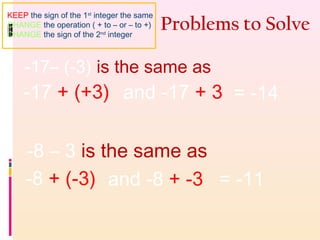
-17– (-3) is the same as
-17 + (+3) and -17 + 3 = -14
-8 – 3 is the same as
-8 + (-3) and -8 + -3 = -11
KEEP the sign of the 1st
integer the same
CHANGE the operation ( + to – or – to +)
CHANGE the sign of the 2nd
integer
Part IV
How do we know that
“Subtracting a negative number is the
same as adding a positive” is true?
We can use the same method we
use to check our answers when we
do regular subtraction.
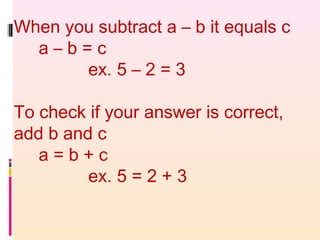
When you subtract a – b it equals c
a – b = c
ex. 5 – 2 = 3
To check if your answer is correct,
add b and c
a = b + c
ex. 5 = 2 + 3
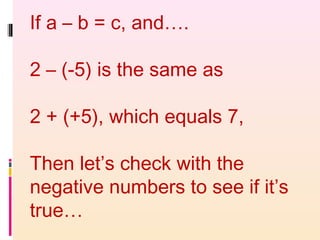
If a – b = c, and….
2 – (-5) is the same as
2 + (+5), which equals 7,
Then let’s check with the
negative numbers to see if it’s
true…
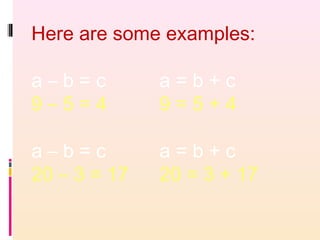
Here are some examples:
a – b = c a = b + c
9 – 5 = 4 9 = 5 + 4
a – b = c a = b + c
20 – 3 = 17 20 = 3 + 17
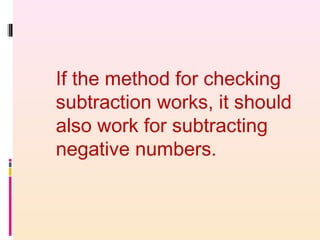
If the method for checking
subtraction works, it should
also work for subtracting
negative numbers.
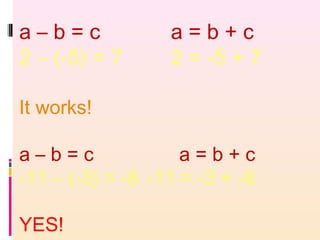
a – b = c a = b + c
2 – (-5) = 7 2 = -5 + 7
It works!
a – b = c a = b + c
-11 – (-3) = -8 -11 = -3 + -8
YES!
Aren’t integers
interesting?

Introduction to Positive and Negative Numbers

  • 1.
  • 2.
    What You WillLearn:What You Will Learn:  Vocabulary related to integers  Rules for adding and subtracting integers  A method for proving that a rule is true Are you ready??Are you ready??
  • 3.
    Part I: Introductionto IntegersPart I: Introduction to Integers •VocabularyVocabulary • positive numberpositive number • negative numbernegative number •Horizontal & vertical number linesHorizontal & vertical number lines •Comparing IntegersComparing Integers •Ordering IntegersOrdering Integers •Vocabulary - continuedVocabulary - continued • opposite numberopposite number • integerinteger •Real World Applications & ExamplesReal World Applications & Examples • temperaturetemperature • sea levelsea level • moneymoney
  • 4.
     Positive number– a number greater than (>) zero 0 1 2 3 4 5 6 Vocabulary:
  • 5.
    Hint:Hint:  If youdon’t see a negative or positive sign in front of a number, the number is positive. 9 is the same as +9
  • 6.
     Negative number– a number less than (<) zero 0 1 2 3 4 5 6-1-1-2-2-3-3-4-4-5-5-6-6 Vocabulary:
  • 7.
    Integer Number LineIntegerNumber Line Horizontal Numbers above or right of 0 are positive Numbers below or left of 0 are negative ZERO
  • 8.
    Integer Number LineIntegerNumber Line Vertical Numbers above 0 are positive ZER O Numbers below 0 are negative
  • 9.
    Use the numberline to compare the following integers with >, <, or =. -4 -2 1 -3 -5 0 Hint: On a number line, the number to the left is always less than the number to the right. Comparing IntegersComparing Integers < < >
  • 10.
    Use the numberline to compare the following integers with >, <, or =. Comparing IntegersComparing Integers Hint: On a number line, the number on the top is always greater than the number on the bottom. -3 -5 -5 0 0 -1> > >
  • 11.
    Ordering IntegersOrdering Integers Usethe number line to put the following integers in order from least to greatest. -4, 3, 0, and -5 -5, -4, 0, 3
  • 12.
     Opposite Numbers– numbers that are the same distance from zero in the opposite direction 0 1 2 3 4 5 6-1-2-3-4-5-6 Vocabulary:
  • 13.
    What is theopposite of each integer? +7 -7 +5 -1 +8 +1 5 -8
  • 14.
    Vocabulary: Integers – allthe whole numbers and all of their opposites on the number line including zero 0 1 2 3 4 5 6-1-2-3-4-5-6 integers
  • 15.
    Now, you’re probablysaying, “That’s interesting and everything, BUT where are negative numbers in the real world?? ??
  • 16.
    Negative Numbers AreUsed to Measure Temperature
  • 17.
    Negative Numbers AreUsed to Measure Under Sea Level 0 10 20 30 -10 -20 -30 -40 -50
  • 18.
    Positive and negativenumbers are used when keeping track of money. + Positive + $$ you earn - Negative - $$ you spend
  • 19.
    Positive Numbers areUsed to Show Earnings or Assets When you get paid (or win the lottery), you add that $$ to your account.
  • 20.
    Negative Numbers areUsed to Show What You Owe or Debt If your mom loaned you $10 for pizza, Mom, I. O. U. $10 The $10 you owe her is described by the integer -10.
  • 21.
    Write an integerto describe the real world situation:  Gain 3 pounds:  Withdraw $15:  5 feet below sea level:  Move ahead 4 spaces: 3 or +3 -15 -5 4 or +4
  • 22.
    End - PartI: Introduction to IntegersEnd - Part I: Introduction to Integers •VocabularyVocabulary • positive numberpositive number • negative numbernegative number •Horizontal & vertical number linesHorizontal & vertical number lines •Comparing IntegersComparing Integers •Ordering IntegersOrdering Integers •Vocabulary - continuedVocabulary - continued • opposite numberopposite number • integerinteger •Real World Applications & ExamplesReal World Applications & Examples • temperaturetemperature • sea levelsea level • moneymoney
  • 23.
    Part II: AddingIntegersPart II: Adding Integers Key ConceptsKey Concepts Integer Addition RulesInteger Addition Rules Using Number LinesUsing Number Lines
  • 24.
    ** Key Concepts**** Key Concepts ** The sum of two positive numbers is always positive  (+) + (+) = (+) ex. 5 + 1 = 6 The sum of two negative numbers is always negative  (-) + (-) = (-) ex. -5 + -1 = -6
  • 25.
    ** Key Concepts** (+) + (+) = (+) (-) + (-) = (-) (+) + (-) = sometimes (+) = sometimes (-) = sometimes 0 AND
  • 26.
    Integer Addition RulesIntegerAddition Rules  Rule #1 – If the signs are the same, add the numbers and then put the sign of the addends in front of your answer. b) -9 + -5 = -14 a) -9 + -5 =
  • 27.
    SolveSolve the ProblemstheProblems  -3 + -5 =  4 + 6 =  +3 + (+4) =  -6 + -7 =  5 + 9 =  -9 + -9 = -8 -18 14 -13 7 10
  • 28.
     Rule #2– If the signs of the addends are DIFFERENT, start at the location of the first integer on the number line and:  a) move RIGHT to add a positive integer Integer Addition RulesInteger Addition Rules -5 + 3 = -2 1 2 3
  • 29.
    ex. (-6) +5 = -1Start here at -6 0 1 2 3 4 5 6-1-2-3-4-5-6 then count forward or right 5 spaces + Adding Integers Using a Number LineAdding Integers Using a Number Line * adding a* adding a positive integer *integer *
  • 30.
    Solve the ProblemsSolvethe Problems • 8 + 6 = • (-9) + 5 = • (–11) + 11 = • (–8) + 16 = 14 0 8 -4
  • 31.
     Rule #2– If the signs of the addends are DIFFERENT, start at the location of the first integer on the number line and:  b) move LEFT to add a negative integer Integer Addition RulesInteger Addition Rules 4 + -3 = 1 123
  • 32.
    0 1 23 4 5 6-1-2-3-4-5-6 - ex. +3 + (-5) = -2 Start here at +3 Then count back or left 5 spaces Adding Integers Using a Number LineAdding Integers Using a Number Line * adding a* adding a negative integer *integer *

  • 33.
    Solve the ProblemsSolvethe Problems • 2 + (-12) = • –8 + (-5) = • 14 + (-7) = • 15 + (-15) = -10 7 -13 0
  • 34.
  • 35.
    Part III: SubtractingIntegersPart III: Subtracting Integers ** Key Concept **** Key Concept ** To subtract an integer, add its opposite ex. 5 – 2 = 5 + (-2) = 3 KEEP CHANGE CHANGE
  • 36.
    ex. -1 –(-2) is the same as -1 + (+2) and -1 + 2 = 1 Subtracting a negative number is the same as adding a positive. Change the signs and add. Integer Subtraction Rule KEEP CHANGE CHANGE
  • 37.
    -3 – 4is the same as -3 + (-4) and -3 + (-4) = -7 More Examples 2 – (-7) is the same as 2 + (+7) and 2 + 7 = 9 KEEP the sign of the 1st integer the same CHANGE the operation ( + to – or – to +) CHANGE the sign of the 2nd integer
  • 38.
    More Examples 12 –(-8) is the same as 12 + (+8) and 12 + 8 = 20 -3 – (-11) is the same as -3 + (+11) and -3 + 11 = 8 KEEP the sign of the 1st integer the same CHANGE the operation ( + to – or – to +) CHANGE the sign of the 2nd integer
  • 39.
    Problems to Solve 8 –(-12) is the same as 8 + (+12) and 8 + 12 = 20 22 – (-30) is the same as 22 + (+30) and 22 + 30 = 52 KEEP the sign of the 1st integer the same CHANGE the operation ( + to – or – to +) CHANGE the sign of the 2nd integer
  • 40.
    Problems to Solve -17–(-3) is the same as -17 + (+3) and -17 + 3 = -14 -8 – 3 is the same as -8 + (-3) and -8 + -3 = -11 KEEP the sign of the 1st integer the same CHANGE the operation ( + to – or – to +) CHANGE the sign of the 2nd integer
  • 41.
  • 42.
    How do weknow that “Subtracting a negative number is the same as adding a positive” is true? We can use the same method we use to check our answers when we do regular subtraction.
  • 43.
    When you subtracta – b it equals c a – b = c ex. 5 – 2 = 3 To check if your answer is correct, add b and c a = b + c ex. 5 = 2 + 3
  • 44.
    If a –b = c, and…. 2 – (-5) is the same as 2 + (+5), which equals 7, Then let’s check with the negative numbers to see if it’s true…
  • 45.
    Here are someexamples: a – b = c a = b + c 9 – 5 = 4 9 = 5 + 4 a – b = c a = b + c 20 – 3 = 17 20 = 3 + 17
  • 46.
    If the methodfor checking subtraction works, it should also work for subtracting negative numbers.
  • 47.
    a – b= c a = b + c 2 – (-5) = 7 2 = -5 + 7 It works! a – b = c a = b + c -11 – (-3) = -8 -11 = -3 + -8 YES!
  • 48.