Reports tell us what
things are (or were) like.
They are sometimes called
non-chronological reports.
This means that they are
not written in time order.
www.teachingpacks.co.uk
Images: © ThinkStock
©
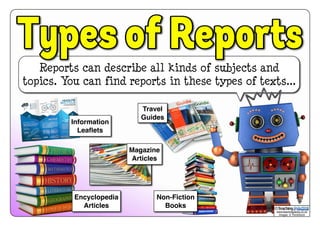
Reports can describe all kinds of subjects and
topics. You can find reports in these types of texts...
Travel
Guides
www.teachingpacks.co.uk
Images: © ThinkStock
©
Encyclopedia
Articles
Information
Leaflets
Non-Fiction
Books
Magazine
Articles
www.teachingpacks.co.uk
Images:©ThinkStock
©
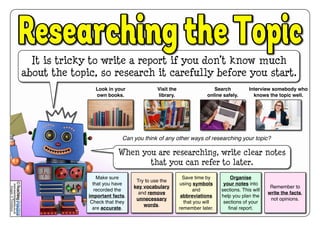
It is tricky to write a report if you don’t know much
about the topic, so research it carefully before you start.
Look in your
own books.
Visit the
library.
Search
online safely.
Interview somebody who
knows the topic well.
Can you think of any other ways of researching your topic?
When you are researching, write clear notes
that you can refer to later.
Make sure
that you have
recorded the
important facts.
Check that they
are accurate.
Try to use the
key vocabulary
and remove
unnecessary
words.
Save time by
using symbols
and
abbreviations
that you will
remember later.
Organise
your notes into
sections. This will
help you plan the
sections of your
final report.
Remember to
write the facts,
not opinions.
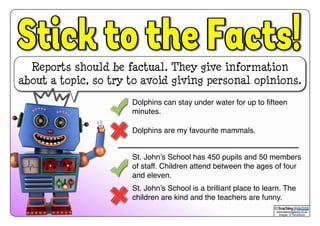
Reports should be factual. They give information
about a topic, so try to avoid giving personal opinions.
www.teachingpacks.co.uk
Images: © ThinkStock
©
Dolphins can stay under water for up to fifteen
minutes.
Dolphins are my favourite mammals.
St. John’s School has 450 pupils and 50 members
of staff. Children attend between the ages of four
and eleven.
St. John’s School is a brilliant place to learn. The
children are kind and the teachers are funny.
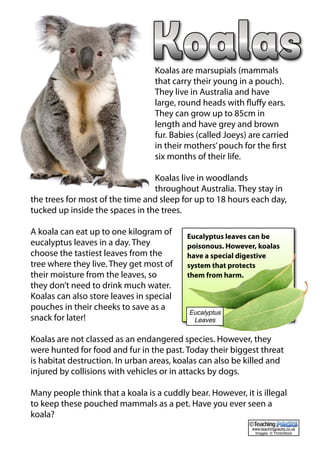
Koalas are marsupials (mammals
that carry their young in a pouch).
They live in Australia and have
large, round heads with fluffy ears.
They can grow up to 85cm in
length and have grey and brown
fur. Babies (called Joeys) are carried
in their mothers’pouch for the first
six months of their life.
Koalas live in woodlands
throughout Australia. They stay in
the trees for most of the time and sleep for up to 18 hours each day,
tucked up inside the spaces in the trees.
A koala can eat up to one kilogram of
eucalyptus leaves in a day. They
choose the tastiest leaves from the
tree where they live. They get most of
their moisture from the leaves, so
they don’t need to drink much water.
Koalas can also store leaves in special
pouches in their cheeks to save as a
snack for later!
Koalas are not classed as an endangered species. However, they
were hunted for food and fur in the past. Today their biggest threat
is habitat destruction. In urban areas, koalas can also be killed and
injured by collisions with vehicles or in attacks by dogs.
Many people think that a koala is a cuddly bear. However, it is illegal
to keep these pouched mammals as a pet. Have you ever seen a
koala?
www.teachingpacks.co.uk
Images: © ThinkStock
©
Eucalyptus leaves can be
poisonous. However, koalas
have a special digestive
system that protects
them from harm.
Eucalyptus
Leaves
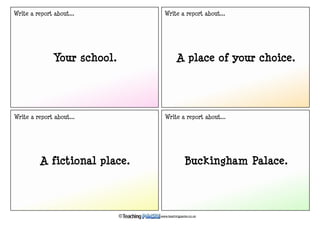
Your school.
Write a report about...
A place of your choice.
A fictional place. Buckingham Palace.
www.teachingpacks.co.uk©
Write a report about...
Write a report about... Write a report about...
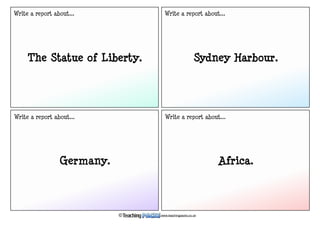
The Statue of Liberty. Sydney Harbour.
Germany. Africa.
www.teachingpacks.co.uk©
Write a report about... Write a report about...
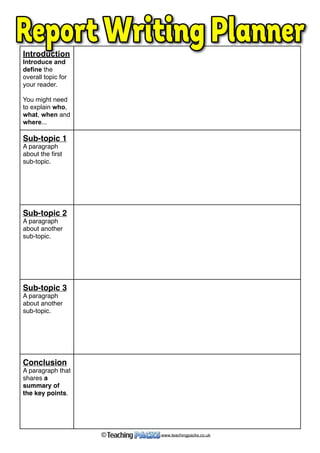
Introduction
Introduce and
define the
overall topic for
your reader.
You might need
to explain who,
what, when and
where...
Sub-topic 1
A paragraph
about the first
sub-topic.
Sub-topic 2
A paragraph
about another
sub-topic.
Sub-topic 3
A paragraph
about another
sub-topic.
Conclusion
A paragraph that
shares a
summary of
the key points.
www.teachingpacks.co.uk©
www.teachingpacks.co.uk
Thank you for looking at this preview
of our Report Writing Pack.
The full pack includes many other
teaching, activity and display
resources. Download it from
http://www.teachingpacks.co.uk/
the-report-writing-pack/
Helen and Mark

The Report Writing Pack

  • 1.
    Reports tell uswhat things are (or were) like. They are sometimes called non-chronological reports. This means that they are not written in time order. www.teachingpacks.co.uk Images: © ThinkStock ©
  • 2.
    Reports can describeall kinds of subjects and topics. You can find reports in these types of texts... Travel Guides www.teachingpacks.co.uk Images: © ThinkStock © Encyclopedia Articles Information Leaflets Non-Fiction Books Magazine Articles
  • 3.
    www.teachingpacks.co.uk Images:©ThinkStock © It is trickyto write a report if you don’t know much about the topic, so research it carefully before you start. Look in your own books. Visit the library. Search online safely. Interview somebody who knows the topic well. Can you think of any other ways of researching your topic? When you are researching, write clear notes that you can refer to later. Make sure that you have recorded the important facts. Check that they are accurate. Try to use the key vocabulary and remove unnecessary words. Save time by using symbols and abbreviations that you will remember later. Organise your notes into sections. This will help you plan the sections of your final report. Remember to write the facts, not opinions.
  • 4.
    Reports should befactual. They give information about a topic, so try to avoid giving personal opinions. www.teachingpacks.co.uk Images: © ThinkStock © Dolphins can stay under water for up to fifteen minutes. Dolphins are my favourite mammals. St. John’s School has 450 pupils and 50 members of staff. Children attend between the ages of four and eleven. St. John’s School is a brilliant place to learn. The children are kind and the teachers are funny.
  • 5.
    Koalas are marsupials(mammals that carry their young in a pouch). They live in Australia and have large, round heads with fluffy ears. They can grow up to 85cm in length and have grey and brown fur. Babies (called Joeys) are carried in their mothers’pouch for the first six months of their life. Koalas live in woodlands throughout Australia. They stay in the trees for most of the time and sleep for up to 18 hours each day, tucked up inside the spaces in the trees. A koala can eat up to one kilogram of eucalyptus leaves in a day. They choose the tastiest leaves from the tree where they live. They get most of their moisture from the leaves, so they don’t need to drink much water. Koalas can also store leaves in special pouches in their cheeks to save as a snack for later! Koalas are not classed as an endangered species. However, they were hunted for food and fur in the past. Today their biggest threat is habitat destruction. In urban areas, koalas can also be killed and injured by collisions with vehicles or in attacks by dogs. Many people think that a koala is a cuddly bear. However, it is illegal to keep these pouched mammals as a pet. Have you ever seen a koala? www.teachingpacks.co.uk Images: © ThinkStock © Eucalyptus leaves can be poisonous. However, koalas have a special digestive system that protects them from harm. Eucalyptus Leaves
  • 6.
    Your school. Write areport about... A place of your choice. A fictional place. Buckingham Palace. www.teachingpacks.co.uk© Write a report about... Write a report about... Write a report about...
  • 7.
    The Statue ofLiberty. Sydney Harbour. Germany. Africa. www.teachingpacks.co.uk© Write a report about... Write a report about... Write a report about... Write a report about...
  • 8.
    Introduction Introduce and define the overalltopic for your reader. You might need to explain who, what, when and where... Sub-topic 1 A paragraph about the first sub-topic. Sub-topic 2 A paragraph about another sub-topic. Sub-topic 3 A paragraph about another sub-topic. Conclusion A paragraph that shares a summary of the key points. www.teachingpacks.co.uk©
  • 9.
    www.teachingpacks.co.uk Thank you forlooking at this preview of our Report Writing Pack. The full pack includes many other teaching, activity and display resources. Download it from http://www.teachingpacks.co.uk/ the-report-writing-pack/ Helen and Mark