Integrated Models of Prevention and
Treatment: An Overview of Positive
Behavior Supports and Restorative Practices
Jeffrey R. Sprague, Ph.D.
The University of Oregon Institute on Violence
and Destructive Behavior
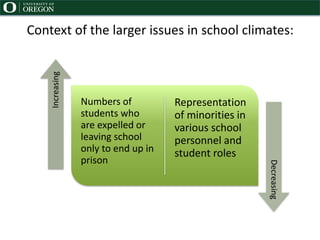
Context of the larger issues in school climates:
Numbers of
students who
are expelled or
leaving school
only to end up in
prison
Representation
of minorities in
various school
personnel and
student roles
Increasing
Decreasing
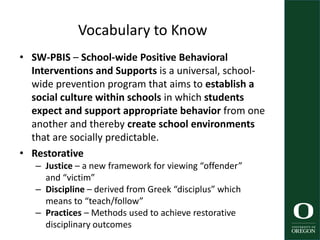
Vocabulary to Know
• SW-PBIS – School-wide Positive Behavioral
Interventions and Supports is a universal, school-
wide prevention program that aims to establish a
social culture within schools in which students
expect and support appropriate behavior from one
another and thereby create school environments
that are socially predictable.
• Restorative
– Justice – a new framework for viewing “offender”
and “victim”
– Discipline – derived from Greek “disciplus” which
means to “teach/follow”
– Practices – Methods used to achieve restorative
disciplinary outcomes
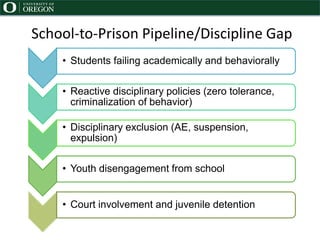
School-to-Prison Pipeline/Discipline Gap
• Students failing academically and behaviorally
• Reactive disciplinary policies (zero tolerance,
criminalization of behavior)
• Disciplinary exclusion (AE, suspension,
expulsion)
• Youth disengagement from school
• Court involvement and juvenile detention
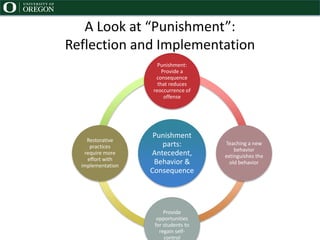
A Look at “Punishment”:
Reflection and Implementation
Punishment
parts:
Antecedent,
Behavior &
Consequence
Punishment:
Provide a
consequence
that reduces
reoccurrence of
offense
Teaching a new
behavior
extinguishes the
old behavior
Provide
opportunities
for students to
regain self-
control
Restorative
practices
require more
effort with
implementation
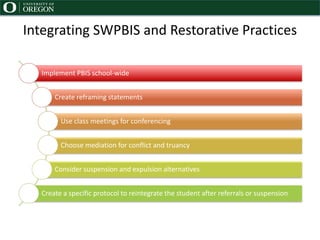
Integrating SWPBIS and Restorative Practices
Implement PBIS school-wide
Create reframing statements
Use class meetings for conferencing
Choose mediation for conflict and truancy
Consider suspension and expulsion alternatives
Create a specific protocol to reintegrate the student after referrals or suspension
What do you already know
about these questions?
• What are the key issues you would need to
consider if you were going to help a school [or
organization] implement restorative practice?
• What kinds of events and practices would occur
in a school that has a fully integrated
restorative practice?
• What would a ‘restorative classroom’ look like?
• What would ‘teaching and learning’ look like?

Rs equity topic_4_readings_dec_lbs_pja

  • 1.
    Integrated Models ofPrevention and Treatment: An Overview of Positive Behavior Supports and Restorative Practices Jeffrey R. Sprague, Ph.D. The University of Oregon Institute on Violence and Destructive Behavior
  • 2.
    Context of thelarger issues in school climates: Numbers of students who are expelled or leaving school only to end up in prison Representation of minorities in various school personnel and student roles Increasing Decreasing
  • 3.
    Vocabulary to Know •SW-PBIS – School-wide Positive Behavioral Interventions and Supports is a universal, school- wide prevention program that aims to establish a social culture within schools in which students expect and support appropriate behavior from one another and thereby create school environments that are socially predictable. • Restorative – Justice – a new framework for viewing “offender” and “victim” – Discipline – derived from Greek “disciplus” which means to “teach/follow” – Practices – Methods used to achieve restorative disciplinary outcomes
  • 4.
    School-to-Prison Pipeline/Discipline Gap •Students failing academically and behaviorally • Reactive disciplinary policies (zero tolerance, criminalization of behavior) • Disciplinary exclusion (AE, suspension, expulsion) • Youth disengagement from school • Court involvement and juvenile detention
  • 5.
    A Look at“Punishment”: Reflection and Implementation Punishment parts: Antecedent, Behavior & Consequence Punishment: Provide a consequence that reduces reoccurrence of offense Teaching a new behavior extinguishes the old behavior Provide opportunities for students to regain self- control Restorative practices require more effort with implementation
  • 6.
    Integrating SWPBIS andRestorative Practices Implement PBIS school-wide Create reframing statements Use class meetings for conferencing Choose mediation for conflict and truancy Consider suspension and expulsion alternatives Create a specific protocol to reintegrate the student after referrals or suspension
  • 7.
    What do youalready know about these questions? • What are the key issues you would need to consider if you were going to help a school [or organization] implement restorative practice? • What kinds of events and practices would occur in a school that has a fully integrated restorative practice? • What would a ‘restorative classroom’ look like? • What would ‘teaching and learning’ look like?