Long term maintenance of a classic brand name
" Have a break...  have a Kit Kat"   What is a brand name?  Kit Kat brand  Product strategy Promotion Strategy Products Product life-cycle Success of the launch Conclusion
What the Brand Is... Brands – products  or firms whose names and/or logos are readily recognised and associated with particular characteristics Branding - is t he process of using a name, sign, symbol or other creative element to identify a product and emphasise its position in the market
Brand name: can be achieved using a company name promises the consumer particular benefits considered by a company to be its most important intangible asset  becomes paramount to a product's success
Kit Kat is the UK's best-selling chocolate bar.  The history of Kit Kat emphasises the importance of successfully managed brand names to the company that owns them. Nestlé was prepared to pay a record price to acquire Rowntree in 1988 because of the prestigious brands in Rowntree's product portfolio. Kit Kat was an important part of the portfolio. Internationally, Kit Kat is now also manufactured in Canada, Germany, India, Malaysia, China, Japan, Australia, South Africa and the United States. It is available in more than 100 countries throughout the World.
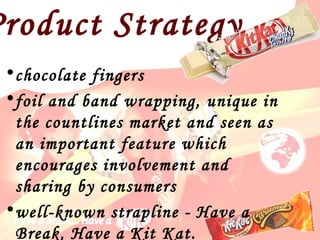
chocolate fingers foil and band wrapping, unique in the countlines market and seen as an important feature which encourages involvement and sharing by consumers well-known strapline -  Have a Break, Have a Kit Kat. Product Strategy
Promotion Strategy T he  “ Have a Break, Have a Kit Kat ”  theme appeared briefly in 1939, but has been the on-going Kit Kat slogan, or strapline, since the mid 1950s free bars in the multi-bar family packs and an instant win deal with Burger King in 1996  on-pack promotion featuring  ‘ The  Simpsons’
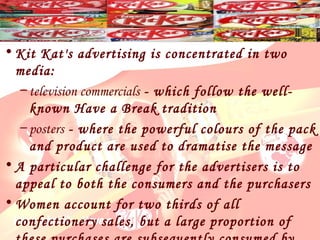
Kit Kat's advertising is concentrated in two media:  television commercials  - which follow the well-known Have a Break tradition  posters  - where the powerful colours of the pack and product are used to dramatise the messag e A particular challenge for the advertisers is to appeal to both the consumers and the purchasers Women account for two thirds of all confectionery sales, but a large proportion of these purchases are subsequently consumed by children
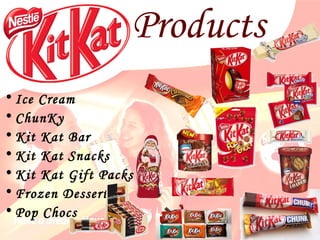
Products Ice Cream ChunKy Kit Kat Bar Kit Kat Snacks Kit Kat Gift Packs Frozen Desserts Pop Chocs
Product life-cycle Business theory suggests that products   follow a life cycle, going through phases of development as follows: research and development introduction to the market the conception of an idea/product
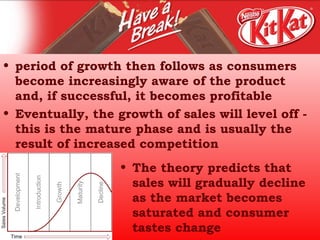
period of growth then follows as consumers become increasingly aware of the product and, if successful, it becomes profitable  Eventually, the growth of sales will level off - this is the mature phase and is usually the result of increased competition  The theory predicts that sales will gradually decline as the market becomes saturated and consumer tastes change
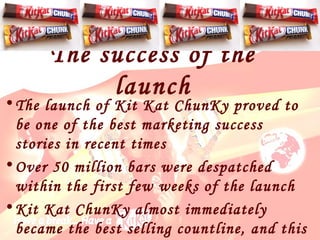
The launch of Kit Kat ChunKy proved to be one of the best marketing success stories in recent time s Over 50 million bars were despatched within the first few weeks of the launch Kit Kat ChunKy almost immediately became the best selling countline, and this success story has continued  The success of the launch
Conclusion Kit Kat's success can be attributed to consistency in its marketing, whilst allowing for minor changes to maintain a modern image Continuous reinforcement of the brand message through advertising and promotions has enabled Kit Kat to sustain its popularity  over a long period of time in the face of  rapidly   changing consumer  attitudes and tastes   and  consumption patterns
Thank you!

Kit Kat

  • 1.
    Long term maintenanceof a classic brand name
  • 2.
    " Have abreak... have a Kit Kat" What is a brand name? Kit Kat brand Product strategy Promotion Strategy Products Product life-cycle Success of the launch Conclusion
  • 3.
    What the BrandIs... Brands – products or firms whose names and/or logos are readily recognised and associated with particular characteristics Branding - is t he process of using a name, sign, symbol or other creative element to identify a product and emphasise its position in the market
  • 4.
    Brand name: canbe achieved using a company name promises the consumer particular benefits considered by a company to be its most important intangible asset becomes paramount to a product's success
  • 5.
    Kit Kat isthe UK's best-selling chocolate bar. The history of Kit Kat emphasises the importance of successfully managed brand names to the company that owns them. Nestlé was prepared to pay a record price to acquire Rowntree in 1988 because of the prestigious brands in Rowntree's product portfolio. Kit Kat was an important part of the portfolio. Internationally, Kit Kat is now also manufactured in Canada, Germany, India, Malaysia, China, Japan, Australia, South Africa and the United States. It is available in more than 100 countries throughout the World.
  • 6.
    chocolate fingers foiland band wrapping, unique in the countlines market and seen as an important feature which encourages involvement and sharing by consumers well-known strapline - Have a Break, Have a Kit Kat. Product Strategy
  • 7.
    Promotion Strategy The “ Have a Break, Have a Kit Kat ” theme appeared briefly in 1939, but has been the on-going Kit Kat slogan, or strapline, since the mid 1950s free bars in the multi-bar family packs and an instant win deal with Burger King in 1996 on-pack promotion featuring ‘ The Simpsons’
  • 8.
    Kit Kat's advertisingis concentrated in two media: television commercials - which follow the well-known Have a Break tradition posters - where the powerful colours of the pack and product are used to dramatise the messag e A particular challenge for the advertisers is to appeal to both the consumers and the purchasers Women account for two thirds of all confectionery sales, but a large proportion of these purchases are subsequently consumed by children
  • 9.
    Products Ice CreamChunKy Kit Kat Bar Kit Kat Snacks Kit Kat Gift Packs Frozen Desserts Pop Chocs
  • 10.
    Product life-cycle Businesstheory suggests that products follow a life cycle, going through phases of development as follows: research and development introduction to the market the conception of an idea/product
  • 11.
    period of growththen follows as consumers become increasingly aware of the product and, if successful, it becomes profitable Eventually, the growth of sales will level off - this is the mature phase and is usually the result of increased competition The theory predicts that sales will gradually decline as the market becomes saturated and consumer tastes change
  • 12.
    The launch ofKit Kat ChunKy proved to be one of the best marketing success stories in recent time s Over 50 million bars were despatched within the first few weeks of the launch Kit Kat ChunKy almost immediately became the best selling countline, and this success story has continued The success of the launch
  • 13.
    Conclusion Kit Kat'ssuccess can be attributed to consistency in its marketing, whilst allowing for minor changes to maintain a modern image Continuous reinforcement of the brand message through advertising and promotions has enabled Kit Kat to sustain its popularity over a long period of time in the face of rapidly changing consumer attitudes and tastes and consumption patterns
  • 14.