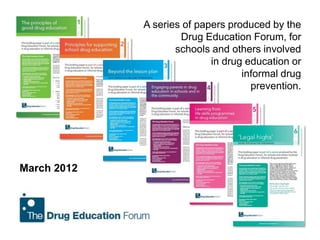
A series of papers produced by the
                     Drug Education Forum, for
                    schools and others involved
                            in drug education or
                                   informal drug
                                     prevention.


March 2012
The principles of good drug education

• Environment: within a whole-school approach
• Planning: relevant and age-appropriate, manageable,
  informed by the evidence base, supported by
  evidence
• Practice: interactive, includes a normative
  component
• Content: using up-to-date information, exploring
  attitudes, developing skills and strengthening
  protective factors
• Evaluation: informed by needs assessment,
  monitoring and evaluation
Principles for supporting school
 drug education
• Visitors’ responsibilities include: using up-to-date
  resources and evidence-based approaches, following
  appropriate guidance
• Schools’ responsibilities include: negotiating content
  and informing visitors about school policies and
  practice as well as class needs
• Teachers’ responsibilities include: overseeing the
  session, reflecting on learning and following it up
  where necessary
Beyond the lesson plan
 Drug prevention and early intervention

• Prevention: What schools can do outside ‘drug
  education’ to reduce young people’s drug use
• Early intervention: ensuring young people get the
  support they need
• What doesn’t work: random drug testing, sniffer
  dogs
The ‘school effect’
• Research suggests ‘better’ schools (lower truancy
  and better exam results than expected) have lower
  drug use
• School attachment – protective factors
   –   relationship with teachers
   –   stable peer group
   –   physical and social environment
   –   belief that education is important and relevant
• Routes to drug use from poor school ethos
   – disengaging, adopting anti-school identities
   – establishing a ‘tough’ reputation for self protection
   – self-medication to deal with problems
What schools can do
• Classroom management, for example the Good
  Behaviour Game
• Pupil participation, e.g. in setting rules
• Improving the school environment
  – physical – is it pleasant, are there unmonitored
    spaces?
  – social, for example the prevalence of bullying
Early intervention
• Schools are responsible for identifying pupils at risk
  of drug misuse, and providing where appropriate:
   – general information and education
   – targeted prevention
   – a more detailed assessment of young people’s needs
• Other pupils need support because someone
  else in their family is misusing drugs. Schools
  should have a comprehensive policy on meeting the
  needs of young carers
Random drug testing – a magic bullet?
• Commonly used in the US
• The evidence that it works is not strong (the
  largest study found no effect)
• Negative impact on relationship with school
• Possible negative consequences – switching to
  alcohol
• No positive test = no problem...?
• Positive test, followed by punishment (deterrent)
  and/or treatment = problem solved...? Or made
  worse?
Engaging parents in drug education
 in schools and in the community
Protective factors against misuse of drugs include:
• young people spending time with their family
• parents knowing where they are when they are
  out (in particular young people disclosing this to
  their parents)
• clear rules which include limiting direct access
  to alcohol
• close family relationships
• good family communication (including parents
  listening to their children)
Ways of reaching parents
•   One-off events or workshops
•   Courses for parents or families
•   Events with children in school
•   Community-based events
•   Homework
•   Leaflets
•   Web or phone-based support
What if no one turns up?
•   What do they want? Ask them
•   Is a ‘drugs’ event off-putting?
•   What are the practical barriers, e.g. childcare?
•   Who’s asking? – the personal connection
•   School events will be in the context of the
    wider parent-school relationship...
Parents and schools
• Are schools getting the basics right in
  communicating with parents?
• Are parents partners with an active voice?
• How can problems be solved and parents
  supported – does the school have a link worker?
• It is generally much easier for primary schools to
  build up a good relationship with parents, but it is
  important for secondary schools as well.
Learning from life skills programmes
 in drug education
• Good PSHE teaching is all about life skills, and
  many programmes focus on them.
• In this paper we focus on LST and Unplugged –
  the two programmes with the strongest
  evidence base in RCTs.
There are many reasons young people
             may take drugs
 Curiosity             To gain               Boredom
                     confidence
                                  ‘Everybody
To look         To fit in with      does it’
 tough            a group                      Thrill-seeking
                           Enjoyment
To relax                                           To assert
              To bond         To deal with      independence
             with friends      anxiety or
                                 stress
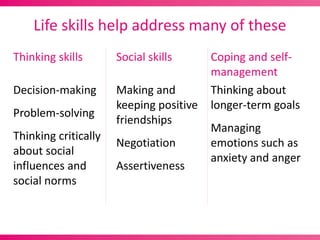
Life skills help address many of these
Thinking skills       Social skills      Coping and self-
                                         management
Decision-making       Making and         Thinking about
                      keeping positive   longer-term goals
Problem-solving
                      friendships
                                         Managing
Thinking critically
                      Negotiation        emotions such as
about social
                                         anxiety and anger
influences and        Assertiveness
social norms
Life skills teaching as a process
• Using wider life skills with a specific focus on
  drugs
• Interactive learning
• Practice outside the classroom
• Reflection and review
• Learning as a long-term process, rather than one-off
  sessions
• Teachers trained and supported
‘Legal highs’
 Novel psychoactive substances

This paper aims:
• To give teachers confidence in covering this topic
  as part of general drug education
• To cover issues specific to ‘legal highs’ –
  debunking myths
• To promote principles of good drug education
Teacher’s role
• Needs assessment: should legal highs be covered
  in detail?
• Discussing the issues: does legal always mean
  safe?
• Following principles of good drug education
  including life skills and social norms
• Getting pupils to find out for themselves – from
  the right sources!
• Credibility is not the same as being an expert on
  the detail
Myth: these drugs are legal
• They are not legally sold for human consumption
• They may contain illegal drugs
Myth: they are safe
• The health risks are similar to those of similar
  illegal drugs…
• …with added uncertainty
Myth: their use is common
• Social norms
• The principles of good drug            All papers available from
  education                              www.drugeducationforum.com
• Principles for supporting school
                                         or contact
  drug education
                                         andrew.brown@mentoruk.org
• Beyond the lesson plan: Drug
  prevention and early intervention
• Engaging parents in drug education
• Learning from life skills programmes
  in drug education
• Legal highs

DEF briefing papers

  • 1.
    A series ofpapers produced by the Drug Education Forum, for schools and others involved in drug education or informal drug prevention. March 2012
  • 2.
    The principles ofgood drug education • Environment: within a whole-school approach • Planning: relevant and age-appropriate, manageable, informed by the evidence base, supported by evidence • Practice: interactive, includes a normative component • Content: using up-to-date information, exploring attitudes, developing skills and strengthening protective factors • Evaluation: informed by needs assessment, monitoring and evaluation
  • 3.
    Principles for supportingschool drug education • Visitors’ responsibilities include: using up-to-date resources and evidence-based approaches, following appropriate guidance • Schools’ responsibilities include: negotiating content and informing visitors about school policies and practice as well as class needs • Teachers’ responsibilities include: overseeing the session, reflecting on learning and following it up where necessary
  • 4.
    Beyond the lessonplan Drug prevention and early intervention • Prevention: What schools can do outside ‘drug education’ to reduce young people’s drug use • Early intervention: ensuring young people get the support they need • What doesn’t work: random drug testing, sniffer dogs
  • 5.
    The ‘school effect’ •Research suggests ‘better’ schools (lower truancy and better exam results than expected) have lower drug use • School attachment – protective factors – relationship with teachers – stable peer group – physical and social environment – belief that education is important and relevant • Routes to drug use from poor school ethos – disengaging, adopting anti-school identities – establishing a ‘tough’ reputation for self protection – self-medication to deal with problems
  • 6.
    What schools cando • Classroom management, for example the Good Behaviour Game • Pupil participation, e.g. in setting rules • Improving the school environment – physical – is it pleasant, are there unmonitored spaces? – social, for example the prevalence of bullying
  • 7.
    Early intervention • Schoolsare responsible for identifying pupils at risk of drug misuse, and providing where appropriate: – general information and education – targeted prevention – a more detailed assessment of young people’s needs • Other pupils need support because someone else in their family is misusing drugs. Schools should have a comprehensive policy on meeting the needs of young carers
  • 8.
    Random drug testing– a magic bullet? • Commonly used in the US • The evidence that it works is not strong (the largest study found no effect) • Negative impact on relationship with school • Possible negative consequences – switching to alcohol • No positive test = no problem...? • Positive test, followed by punishment (deterrent) and/or treatment = problem solved...? Or made worse?
  • 9.
    Engaging parents indrug education in schools and in the community Protective factors against misuse of drugs include: • young people spending time with their family • parents knowing where they are when they are out (in particular young people disclosing this to their parents) • clear rules which include limiting direct access to alcohol • close family relationships • good family communication (including parents listening to their children)
  • 10.
    Ways of reachingparents • One-off events or workshops • Courses for parents or families • Events with children in school • Community-based events • Homework • Leaflets • Web or phone-based support
  • 11.
    What if noone turns up? • What do they want? Ask them • Is a ‘drugs’ event off-putting? • What are the practical barriers, e.g. childcare? • Who’s asking? – the personal connection • School events will be in the context of the wider parent-school relationship...
  • 12.
    Parents and schools •Are schools getting the basics right in communicating with parents? • Are parents partners with an active voice? • How can problems be solved and parents supported – does the school have a link worker? • It is generally much easier for primary schools to build up a good relationship with parents, but it is important for secondary schools as well.
  • 13.
    Learning from lifeskills programmes in drug education • Good PSHE teaching is all about life skills, and many programmes focus on them. • In this paper we focus on LST and Unplugged – the two programmes with the strongest evidence base in RCTs.
  • 14.
    There are manyreasons young people may take drugs Curiosity To gain Boredom confidence ‘Everybody To look To fit in with does it’ tough a group Thrill-seeking Enjoyment To relax To assert To bond To deal with independence with friends anxiety or stress
  • 15.
    Life skills helpaddress many of these Thinking skills Social skills Coping and self- management Decision-making Making and Thinking about keeping positive longer-term goals Problem-solving friendships Managing Thinking critically Negotiation emotions such as about social anxiety and anger influences and Assertiveness social norms
  • 16.
    Life skills teachingas a process • Using wider life skills with a specific focus on drugs • Interactive learning • Practice outside the classroom • Reflection and review • Learning as a long-term process, rather than one-off sessions • Teachers trained and supported
  • 17.
    ‘Legal highs’ Novelpsychoactive substances This paper aims: • To give teachers confidence in covering this topic as part of general drug education • To cover issues specific to ‘legal highs’ – debunking myths • To promote principles of good drug education
  • 18.
    Teacher’s role • Needsassessment: should legal highs be covered in detail? • Discussing the issues: does legal always mean safe? • Following principles of good drug education including life skills and social norms • Getting pupils to find out for themselves – from the right sources! • Credibility is not the same as being an expert on the detail
  • 19.
    Myth: these drugsare legal • They are not legally sold for human consumption • They may contain illegal drugs Myth: they are safe • The health risks are similar to those of similar illegal drugs… • …with added uncertainty Myth: their use is common • Social norms
  • 20.
    • The principlesof good drug All papers available from education www.drugeducationforum.com • Principles for supporting school or contact drug education andrew.brown@mentoruk.org • Beyond the lesson plan: Drug prevention and early intervention • Engaging parents in drug education • Learning from life skills programmes in drug education • Legal highs