Transforming Complexity into Practical Action Rob Horner University of Oregon www.pbis.org
The Challenge Intense Accountability focused on Student Outcomes Multiple and Evolving Initiatives Complex Federal and State Regulations
Development of  Science to Practice Efforts David Tilly/ Hill Walker Identification of basic principles of behavior Development of evidence-based practices Development of implementation technology
The current technology of Implementation 94-142 and IDEA  Focus on Access to Education Access to services NCLB and RTI Focus on Outcomes Implementation of Effective Practices
Implementation An effective intervention is one thing Implementation of an effective  intervention is a very different thing Dean Fixsen © Dean Fixsen, Karen Blase, Robert Horner, George Sugai, 2008
Sobering Observation © Dean Fixsen, Karen Blase, Robert Horner, George Sugai, 2008 "All organizations [and systems] are designed, intentionally or unwittingly, to achieve precisely the results they get." R. Spencer Darling  (Business Expert)
Unintended Effects Our systems are organized to meet administrative requirements, not student outcomes Conflicting programs Conflicting funding streams Redundancy Lack of coordination across programs Inconsistent rules about program access Extreme complexity and fiscal inefficiency
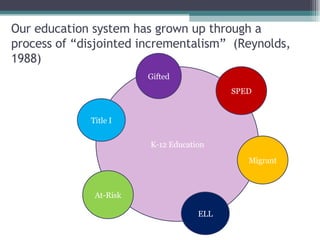
Our education system has grown up through a process of “disjointed incrementalism”  (Reynolds, 1988) K-12 Education SPED Migrant ELL At-Risk Title I Gifted
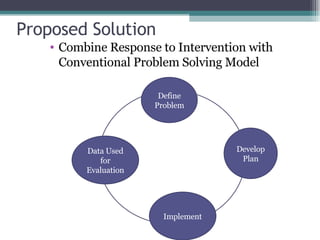
Proposed Solution Combine Response to Intervention with Conventional Problem Solving Model Define Problem Develop Plan Implement Data Used for Evaluation
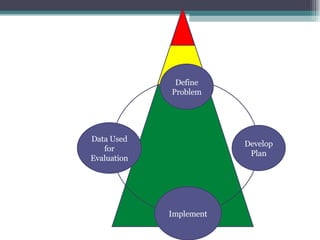
Define Problem Develop Plan Implement Data Used for Evaluation
Lessons Learned from PBIS  Never  stop doing what works Focus on the smallest changes that will produce the largest effects on valued outcomes Make any initiative adapt to your school culture Never introduce something new without simultaneously defining what you will stop doing to create the resources for the new effort.
Lessons Learned Invest in initiatives that will be implemented with high fidelity and maintained for at least 10 years. Braid Initiatives by Focusing first on outcomes Implementing practices not programs. Achieve fidelity through comprehensive implementation Provide instruction on content Provide opportunities for demonstration Provide opportunities for practice Provide coaching in performance context. Implement the policies that will support effect practice
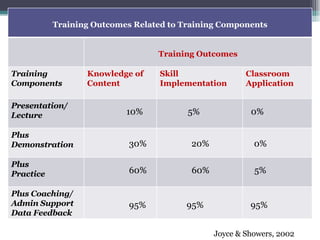
10%  5%  0% 30%  20%  0% 60%  60%  5% 95%  95%  95% Joyce & Showers, 2002 Training Outcomes Related to Training Components Training Outcomes Training Components Knowledge of Content Skill Implementation Classroom Application Presentation/ Lecture Plus Demonstration Plus  Practice Plus Coaching/ Admin Support Data Feedback
Discipline Foundation Policy: LAUSD School-Wide Positive Behavior Support NUMBER:  BUL-3638.0 ISSUER:  Donnalyn Jaque-Antón, Executive Officer, Educational Services DATE: March 27, 2007 POLICY: Every student, pre-school through adult, has the right to be educated in a safe, respectful and welcoming environment. Every educator has the right to teach in an atmosphere free from disruption and obstacles that impede learning. This will be achieved through the adoption and implementation of a consistent school-wide positive behavior support and discipline plan for every school in LAUSD.  All school level discipline plans will be consistent with the  Culture of Discipline: Guiding Principles for the School Community (Attachment A) and Culture of Discipline: Student Expectations (Attachment B). This will include: teaching school rules and social-emotional  skills; reinforcing appropriate student behavior; using effective classroom management and positive behavior support strategies by providing early intervention for misconduct and appropriate use of consequences.
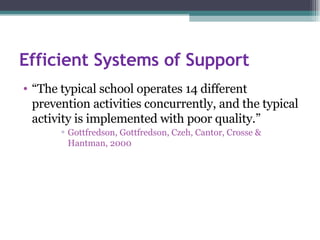
Efficient Systems of Support “ The typical school operates 14 different prevention activities concurrently, and the typical activity is implemented with poor quality.” Gottfredson, Gottfredson, Czeh, Cantor, Crosse & Hantman, 2000
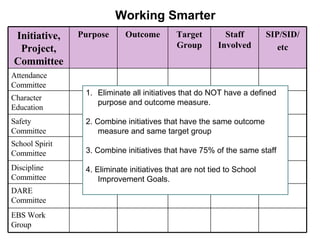
Working Smarter Eliminate all initiatives that do NOT have a defined purpose and outcome measure. 2. Combine initiatives that have the same outcome measure and same target group 3. Combine initiatives that have 75% of the same staff 4. Eliminate initiatives that are not tied to School Improvement Goals. Initiative, Project, Committee Purpose Outcome Target Group Staff Involved SIP/SID/ etc Attendance Committee Character Education Safety Committee School Spirit Committee Discipline Committee DARE Committee EBS Work Group
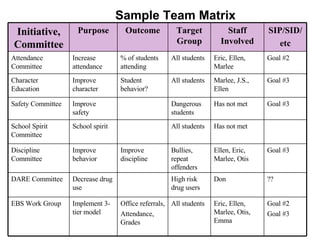
Sample Team Matrix Initiative, Committee Purpose Outcome Target Group Staff Involved SIP/SID/ etc Attendance Committee Increase attendance % of students attending All students Eric, Ellen, Marlee Goal #2 Character Education Improve character Student behavior? All students Marlee, J.S., Ellen Goal #3 Safety Committee Improve safety Dangerous students Has not met Goal #3 School Spirit Committee School spirit All students Has not met Discipline Committee Improve behavior Improve discipline Bullies, repeat offenders Ellen, Eric, Marlee, Otis Goal #3 DARE Committee Decrease drug use High risk drug users Don ?? EBS Work Group Implement 3-tier model Office referrals, Attendance, Grades All students Eric, Ellen, Marlee, Otis, Emma Goal #2 Goal #3
Lessons Learned Invest  in capacity development
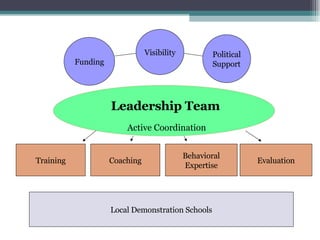
Leadership Team Funding Visibility Political Support Training Coaching Evaluation Local Demonstration Schools Active Coordination Behavioral Expertise
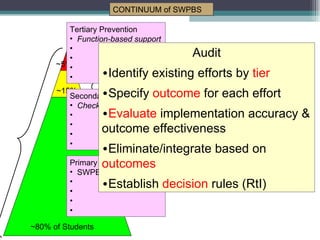
~80% of Students ~15%  ~5%  CONTINUUM of SWPBS Tertiary Prevention Function-based support Secondary Prevention Check in/out Primary Prevention SWPBS Audit Identify existing efforts by  tier Specify  outcome  for each effort Evaluate  implementation accuracy & outcome effectiveness Eliminate/integrate based on  outcomes Establish  decision  rules (RtI)
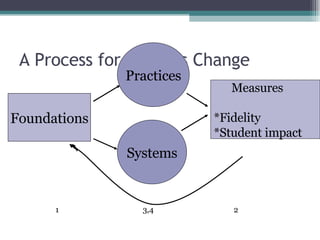
A Process for Systems Change Foundations Practices Systems Measures *Fidelity *Student impact 1  3,4  2
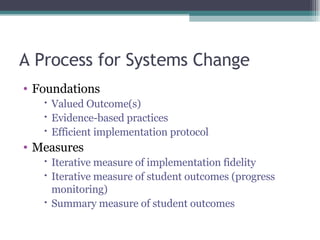
A Process for Systems Change Foundations Valued Outcome(s) Evidence-based practices Efficient implementation protocol Measures Iterative measure of implementation fidelity Iterative measure of student outcomes (progress monitoring) Summary measure of student outcomes
A Process for Systems Change Implement “systems” as well as “practices”
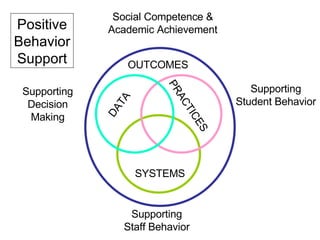
SYSTEMS PRACTICES DATA Supporting Staff Behavior Supporting Decision Making Supporting Student Behavior Positive Behavior Support OUTCOMES Social Competence & Academic Achievement
“ What the Worlds Greatest Managers Do Differently ” --  Buckingham & Coffman 2002, Gallup Interviews with 1 million workers, 80,000 managers, in 400 companies.   Create working environments where employees : 1. Know what is expected 2. Have the materials and equipment to do the job correctly 3. Receive recognition each week for good work. 4. Have a supervisor who cares, and pays attention 5. Receive encouragement to contribute and improve 6. Can identify a person at work who is a “best friend.” 7. Feel the mission of the organization makes them feel like their jobs are important 8. See the people around them committed to doing a good job 9. Feel like they are learning new things (getting better) 10. Have the opportunity to do their job well.
Summary School building administrators are essential for organizational change We get the outcomes our systems are designed to produce.  If we don’t like the outcome, then change the system. Invest in capacity for high fidelity implementation of a small number of core initiatives.

Horner:Administrator Training MO SW-PBS SI 08

  • 1.
    Transforming Complexity intoPractical Action Rob Horner University of Oregon www.pbis.org
  • 2.
    The Challenge IntenseAccountability focused on Student Outcomes Multiple and Evolving Initiatives Complex Federal and State Regulations
  • 3.
    Development of Science to Practice Efforts David Tilly/ Hill Walker Identification of basic principles of behavior Development of evidence-based practices Development of implementation technology
  • 4.
    The current technologyof Implementation 94-142 and IDEA Focus on Access to Education Access to services NCLB and RTI Focus on Outcomes Implementation of Effective Practices
  • 5.
    Implementation An effectiveintervention is one thing Implementation of an effective intervention is a very different thing Dean Fixsen © Dean Fixsen, Karen Blase, Robert Horner, George Sugai, 2008
  • 6.
    Sobering Observation ©Dean Fixsen, Karen Blase, Robert Horner, George Sugai, 2008 "All organizations [and systems] are designed, intentionally or unwittingly, to achieve precisely the results they get." R. Spencer Darling (Business Expert)
  • 7.
    Unintended Effects Oursystems are organized to meet administrative requirements, not student outcomes Conflicting programs Conflicting funding streams Redundancy Lack of coordination across programs Inconsistent rules about program access Extreme complexity and fiscal inefficiency
  • 8.
    Our education systemhas grown up through a process of “disjointed incrementalism” (Reynolds, 1988) K-12 Education SPED Migrant ELL At-Risk Title I Gifted
  • 9.
    Proposed Solution CombineResponse to Intervention with Conventional Problem Solving Model Define Problem Develop Plan Implement Data Used for Evaluation
  • 10.
    Define Problem DevelopPlan Implement Data Used for Evaluation
  • 11.
    Lessons Learned fromPBIS Never stop doing what works Focus on the smallest changes that will produce the largest effects on valued outcomes Make any initiative adapt to your school culture Never introduce something new without simultaneously defining what you will stop doing to create the resources for the new effort.
  • 12.
    Lessons Learned Investin initiatives that will be implemented with high fidelity and maintained for at least 10 years. Braid Initiatives by Focusing first on outcomes Implementing practices not programs. Achieve fidelity through comprehensive implementation Provide instruction on content Provide opportunities for demonstration Provide opportunities for practice Provide coaching in performance context. Implement the policies that will support effect practice
  • 13.
    10% 5% 0% 30% 20% 0% 60% 60% 5% 95% 95% 95% Joyce & Showers, 2002 Training Outcomes Related to Training Components Training Outcomes Training Components Knowledge of Content Skill Implementation Classroom Application Presentation/ Lecture Plus Demonstration Plus Practice Plus Coaching/ Admin Support Data Feedback
  • 14.
    Discipline Foundation Policy:LAUSD School-Wide Positive Behavior Support NUMBER: BUL-3638.0 ISSUER: Donnalyn Jaque-Antón, Executive Officer, Educational Services DATE: March 27, 2007 POLICY: Every student, pre-school through adult, has the right to be educated in a safe, respectful and welcoming environment. Every educator has the right to teach in an atmosphere free from disruption and obstacles that impede learning. This will be achieved through the adoption and implementation of a consistent school-wide positive behavior support and discipline plan for every school in LAUSD. All school level discipline plans will be consistent with the Culture of Discipline: Guiding Principles for the School Community (Attachment A) and Culture of Discipline: Student Expectations (Attachment B). This will include: teaching school rules and social-emotional skills; reinforcing appropriate student behavior; using effective classroom management and positive behavior support strategies by providing early intervention for misconduct and appropriate use of consequences.
  • 15.
    Efficient Systems ofSupport “ The typical school operates 14 different prevention activities concurrently, and the typical activity is implemented with poor quality.” Gottfredson, Gottfredson, Czeh, Cantor, Crosse & Hantman, 2000
  • 16.
    Working Smarter Eliminateall initiatives that do NOT have a defined purpose and outcome measure. 2. Combine initiatives that have the same outcome measure and same target group 3. Combine initiatives that have 75% of the same staff 4. Eliminate initiatives that are not tied to School Improvement Goals. Initiative, Project, Committee Purpose Outcome Target Group Staff Involved SIP/SID/ etc Attendance Committee Character Education Safety Committee School Spirit Committee Discipline Committee DARE Committee EBS Work Group
  • 17.
    Sample Team MatrixInitiative, Committee Purpose Outcome Target Group Staff Involved SIP/SID/ etc Attendance Committee Increase attendance % of students attending All students Eric, Ellen, Marlee Goal #2 Character Education Improve character Student behavior? All students Marlee, J.S., Ellen Goal #3 Safety Committee Improve safety Dangerous students Has not met Goal #3 School Spirit Committee School spirit All students Has not met Discipline Committee Improve behavior Improve discipline Bullies, repeat offenders Ellen, Eric, Marlee, Otis Goal #3 DARE Committee Decrease drug use High risk drug users Don ?? EBS Work Group Implement 3-tier model Office referrals, Attendance, Grades All students Eric, Ellen, Marlee, Otis, Emma Goal #2 Goal #3
  • 18.
    Lessons Learned Invest in capacity development
  • 19.
    Leadership Team FundingVisibility Political Support Training Coaching Evaluation Local Demonstration Schools Active Coordination Behavioral Expertise
  • 20.
    ~80% of Students~15% ~5% CONTINUUM of SWPBS Tertiary Prevention Function-based support Secondary Prevention Check in/out Primary Prevention SWPBS Audit Identify existing efforts by tier Specify outcome for each effort Evaluate implementation accuracy & outcome effectiveness Eliminate/integrate based on outcomes Establish decision rules (RtI)
  • 21.
    A Process forSystems Change Foundations Practices Systems Measures *Fidelity *Student impact 1 3,4 2
  • 22.
    A Process forSystems Change Foundations Valued Outcome(s) Evidence-based practices Efficient implementation protocol Measures Iterative measure of implementation fidelity Iterative measure of student outcomes (progress monitoring) Summary measure of student outcomes
  • 23.
    A Process forSystems Change Implement “systems” as well as “practices”
  • 24.
    SYSTEMS PRACTICES DATASupporting Staff Behavior Supporting Decision Making Supporting Student Behavior Positive Behavior Support OUTCOMES Social Competence & Academic Achievement
  • 25.
    “ What theWorlds Greatest Managers Do Differently ” -- Buckingham & Coffman 2002, Gallup Interviews with 1 million workers, 80,000 managers, in 400 companies. Create working environments where employees : 1. Know what is expected 2. Have the materials and equipment to do the job correctly 3. Receive recognition each week for good work. 4. Have a supervisor who cares, and pays attention 5. Receive encouragement to contribute and improve 6. Can identify a person at work who is a “best friend.” 7. Feel the mission of the organization makes them feel like their jobs are important 8. See the people around them committed to doing a good job 9. Feel like they are learning new things (getting better) 10. Have the opportunity to do their job well.
  • 26.
    Summary School buildingadministrators are essential for organizational change We get the outcomes our systems are designed to produce. If we don’t like the outcome, then change the system. Invest in capacity for high fidelity implementation of a small number of core initiatives.