DAMP
PROOF
COURSE
G R O U P M E M B E R S :
SHIVAM SRIVASTAVA(GROUP LEADER)
S H I V A N G I N I S I N G H
S A U M Y A S I N G H
S A U R A B H R A N A
S H A M B H A V I S R I V A S T A V A
S H A I L E S H K U N W A R
S H I V A M K E S H R I
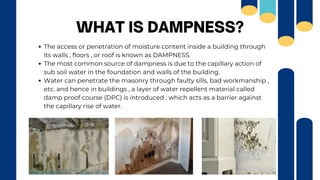
The access or penetration of moisture content inside a building through
its walls , floors , or roof is known as DAMPNESS.
The most common source of dampness is due to the capillary action of
sub soil water in the foundation and walls of the building.
Water can penetrate the masonry through faulty sills, bad workmanship ,
etc. and hence in buildings , a layer of water repellent material called
damp proof course (DPC) is introduced , which acts as a barrier against
the capillary rise of water.
WHAT IS DAMPNESS?
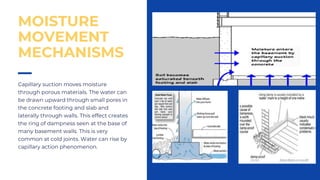
Capillary suction moves moisture
through porous materials. The water can
be drawn upward through small pores in
the concrete footing and slab and
laterally through walls. This effect creates
the ring of dampness seen at the base of
many basement walls. This is very
common at cold joints. Water can rise by
capillary action phenomenon.
MOISTURE
MOVEMENT
MECHANISMS
SOURCES OF
DAMPNESS
(1.) Moisture rising from
the ground to the walls
It rises either through
the bottom or through
the ground surface
adjacent to the wall.
Moisture penetrating the
water as a result of rain
beating on them during
continued wet weather.
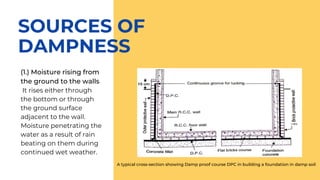
A typical cross-section showing Damp proof course DPC in building a foundation in damp soil
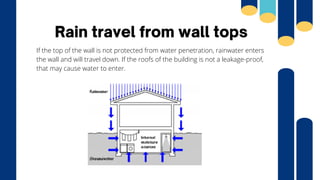
Rain travel from wall tops
If the top of the wall is not protected from water penetration, rainwater enters
the wall and will travel down. If the roofs of the building is not a leakage-proof,
that may cause water to enter.
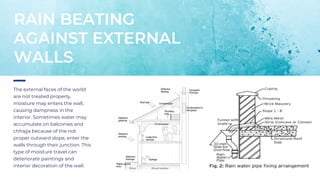
The external faces of the world
are not treated properly,
moisture may enters the wall,
causing dampness in the
interior. Sometimes water may
accumulate on balconies and
chhajja because of the not
proper outward slope, enter the
walls through their junction. This
type of moisture travel can
deteriorate paintings and
interior decoration of the wall.
RAIN BEATING
AGAINST EXTERNAL
WALLS
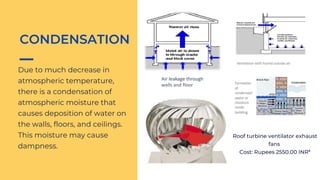
Due to much decrease in
atmospheric temperature,
there is a condensation of
atmospheric moisture that
causes deposition of water on
the walls, floors, and ceilings.
This moisture may cause
dampness.
CONDENSATION
Roof turbine ventilator exhaust
fans
Cost: Rupees 2550.00 INR*
Promotes and accelerates
growth of termites.
Travel of moisture through
walls and ceilings.
EFFECTS OF
DAMPNESS
Responsible for
disintegration of bricks,
stones, tiles etc.
Timber fittings gets
deteriorated because of
warping, buckling, dry
rutting etc .
Dangerous when electrical
fittings come in contact
with dampness
Metal fitting get corroded
and rusted
Reduces the life of
structure.
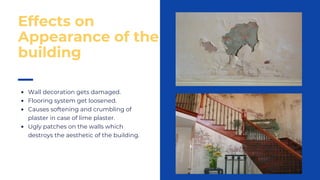
Wall decoration gets damaged.
Flooring system get loosened.
Causes softening and crumbling of
plaster in case of lime plaster.
Ugly patches on the walls which
destroys the aesthetic of the building.
Effects on
Appearance of the
building
Responsible for breeding of mosquitoes.
EFFECTS
ON
HEALTH
Rise of dangerous diseases such as tuberculosis,
neuralgia, rheumatism etc.
Those with existing skin problems, such as eczema,
respiratory problems, such as allergies and asthma,
with a weakened immune system or those having
chemotherapy etc. are also affected.
PREVENTION OF DAMPNESS
In RCC work, the designer must ensure avoiding of shrinkage cracks.
Impermeable concrete should be specified when the members are in
contact with water and the designer should take the uplift pressure from the
subsoil into consideration.
Planning and Design Stage
Site Investigation:- Preliminary investigation is necessary to fix the under ground
water table level
After Investigation:- The plinth level of the building should be fixed so that it is
well above the adjoining area and surface water level.
Design In RCC :-
Quality of Workmanship: The quality of
workmanship in masonry, concreting,
plastering etc. should be well controlled
and supervised.
Water Stops: Special attention is required
in respect of water stops provided in RCC
members.
Voids in Materials: Once voids are formed, a
path of least resistance for the passage of
water will result. Water entering through
the voids corrode the reinforcement and
further deterioration of concrete takes
place.
Expansion/construction joints: In case of
construction joints, the standard
specifications of cleaning the surface and
providing a layer of rich cement slurry
before laying fresh concrete should be
strictly followed while in expansion joints
there should be cover over the joints
location and the gap filled up with proper
sealants.
CONSTRUCTION
STAGE
WATER PROOF SURFACE TREATMENTS
TECHNIQUES
USED TO
OVERCOME
DAMPNESS
CAVITY WALLS OR HOLLOW WALLS
PRESSURE GROUTING OR CEMENTATION
INTEGRAL DAMP PROOFING TREATMENT
GUNITING OR SHOT CONCRETE
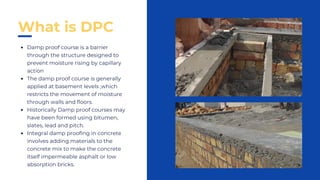
Damp proof course is a barrier
through the structure designed to
prevent moisture rising by capillary
action
The damp proof course is generally
applied at basement levels ,which
restricts the movement of moisture
through walls and floors.
Historically Damp proof courses may
have been formed using bitumen,
slates, lead and pitch.
Integral damp proofing in concrete
involves adding materials to the
concrete mix to make the concrete
itself impermeable asphalt or low
absorption bricks.
What is DPC
Prevent health issues that can occur from
being in a damp property
Avoid unpleasant smells
Improve the appearance of your home by
damp proofing walls
Prevent structural problems in your
building
Avoid decreasing the value of your property
Normal cracks sometimes develop in this
damp proofing process.
Also, it provides additional weight to the
entire structure.
It leads to the level problem.
Sometimes it creates ugly patches up to
the roof.
ADVANTAGES OF
DPC
DISADVANTAGES
OF DPC
Why is damp proofing
necessary ?
Damp proofing ensures that your walls resist this moisture hazard so that
your family can stay safe and healthy.
When condensation builds up inside your walls, or water is allowed to sit
without sufficient ventilation.
Properties which have no appropriate damp protection layer or has a
damaged damp proof course may be affected by excess moisture rising from
the ground.
Mold and bacteria begin to grow.
The damp proofing should
cover the full thickness of walls,
excluding rendering.
GENERAL PRINCIPLES
FOLLOWED WHILE PROVIDING
DAMP PROOFING
The mortar bed supporting
damp proof course should be
leveled and even, and should
be free from projections, so
that damp proof course is not
damaged.
Damp proof course should be
laid in such a way that a
continuous projection is
provided.
At junctions and corners of
walls, the horizontal damp
proof course should be laid
continuous.
When a horizontal damp proof
course (i.e. that of a floor) is
continued to a vertical face, a
cement concrete fillet of 7.5 cm
radius should be provided at
the junction.
Each damp proof course
should be placed in correct
relation to other dampproof
course, so as to ensure a
complete and continuous
barrier to the passage of water
from floors, walls or roof.
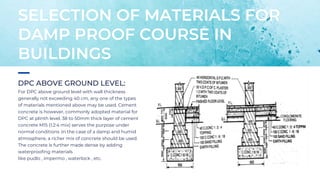
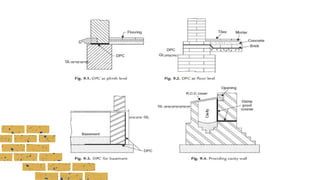
DPC ABOVE GROUND LEVEL:
For DPC above ground level with wall thickness
generally not exceeding 40 cm, any one of the types
of materials mentioned above may be used. Cement
concrete is however, commonly adopted material for
DPC at plinth level, 38 to 50mm thick layer of cement
concrete M15 (1:2:4 mix) serves the purpose under
normal conditions .In the case of a damp and humid
atmosphere, a richer mix of concrete should be used.
The concrete is further made dense by adding
waterproofing materials
like pudlo , impermo , waterlock , etc.
SELECTION OF MATERIALS FOR
DAMP PROOF COURSE IN
BUILDINGS
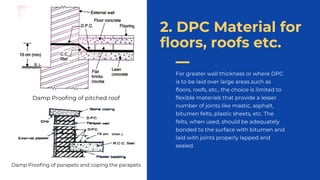
For greater wall thickness or where DPC
is to be laid over large areas such as
floors, roofs, etc., the choice is limited to
flexible materials that provide a lesser
number of joints like mastic, asphalt,
bitumen felts, plastic sheets, etc. The
felts, when used, should be adequately
bonded to the surface with bitumen and
laid with joints properly lapped and
sealed..
2. DPC Material for
floors, roofs etc.
Damp Proofing of pitched roof
Damp Proofing of parapets and coping the parapets
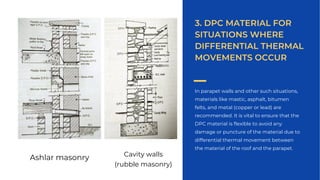
In parapet walls and other such situations,
materials like mastic, asphalt, bitumen
felts, and metal (copper or lead) are
recommended. It is vital to ensure that the
DPC material is flexible to avoid any
damage or puncture of the material due to
differential thermal movement between
the material of the roof and the parapet.
3. DPC MATERIAL FOR
SITUATIONS WHERE
DIFFERENTIAL THERMAL
MOVEMENTS OCCUR
Ashlar masonry Cavity walls
(rubble masonry)
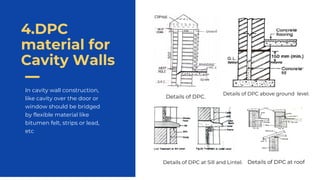
In cavity wall construction,
like cavity over the door or
window should be bridged
by flexible material like
bitumen felt, strips or lead,
etc
4.DPC
material for
Cavity Walls
Details of DPC.
Details of DPC above ground level.
Details of DPC at Sill and Lintel. Details of DPC at roof
DESIRABLE PROPERTIES
OF DPC MATERIAL:
It should be free from
deliquescent salts like
sulfates, chlorides, and
nitrates.
It should be dimensionally
stable.
It should be strong and
durable and should be
capable of withstanding
both dead as well as live
loads without damage.
It should be impervious.
TYPES OF DPC MATERIAL
1) Flexible Materials for Damp Proof
Course
The materials, which do not crack and deform their
shape when subjected to loading, are called Flexible
Materials.
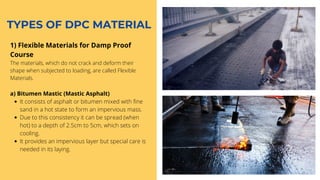
It consists of asphalt or bitumen mixed with fine
sand in a hot state to form an impervious mass.
Due to this consistency it can be spread (when
hot) to a depth of 2.5cm to 5cm, which sets on
cooling.
It provides an impervious layer but special care is
needed in its laying.
a) Bitumen Mastic (Mastic Asphalt)
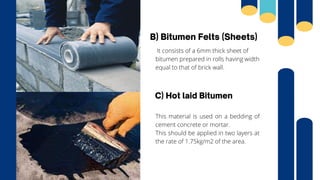
B) Bitumen Felts (Sheets)
It consists of a 6mm thick sheet of
bitumen prepared in rolls having width
equal to that of brick wall.
C) Hot laid Bitumen
This material is used on a bedding of
cement concrete or mortar.
This should be applied in two layers at
the rate of 1.75kg/m2 of the area.
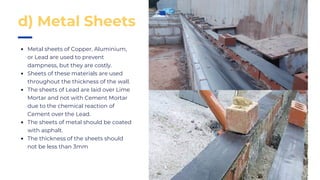
Metal sheets of Copper, Aluminium,
or Lead are used to prevent
dampness, but they are costly.
Sheets of these materials are used
throughout the thickness of the wall.
The sheets of Lead are laid over Lime
Mortar and not with Cement Mortar
due to the chemical reaction of
Cement over the Lead.
The sheets of metal should be coated
with asphalt.
The thickness of the sheets should
not be less than 3mm
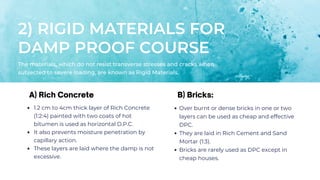
d) Metal Sheets
2) RIGID MATERIALS FOR
DAMP PROOF COURSE
The materials, which do not resist transverse stresses and cracks when
subjected to severe loading, are known as Rigid Materials.
1.2 cm to 4cm thick layer of Rich Concrete
(1:2:4) painted with two coats of hot
bitumen is used as horizontal D.P.C.
It also prevents moisture penetration by
capillary action.
These layers are laid where the damp is not
excessive.
A) Rich Concrete B) Bricks:
Over burnt or dense bricks in one or two
layers can be used as cheap and effective
DPC.
They are laid in Rich Cement and Sand
Mortar (1:3).
Bricks are rarely used as DPC except in
cheap houses.
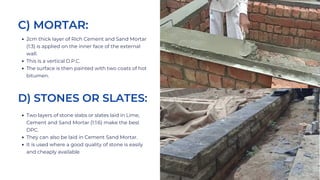
2cm thick layer of Rich Cement and Sand Mortar
(1:3) is applied on the inner face of the external
wall.
This is a vertical D.P.C.
The surface is then painted with two coats of hot
bitumen.
C) MORTAR:
D) STONES OR SLATES:
Two layers of stone slabs or slates laid in Lime,
Cement and Sand Mortar (1:1:6) make the best
DPC.
They can also be laid in Cement Sand Mortar.
It is used where a good quality of stone is easily
and cheaply available
The surface treatment consists in filling or
blinding the pores of the material exposed to
moisture by painting a water-repellent material
over the surface.
Surface treatment is effective only when the
moisture is superficial and is not under pressure.
The walls plastered with cement, lime and sand
mixed in proportions of 1:1:6 is found to serve the
purpose of preventing dampness in wall due to
rain effectively.
METHODS
OF DAMP
PROOFING
(1) BY SURFACE
TREATMENT:
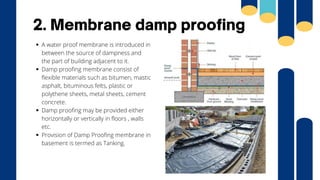
A water proof membrane is introduced in
between the source of dampness and
the part of building adjacent to it.
Damp proofing membrane consist of
flexible materials such as bitumen, mastic
asphalt, bituminous felts, plastic or
polythene sheets, metal sheets, cement
concrete.
Damp proofing may be provided either
horizontally or vertically in floors , walls
etc.
Provision of Damp Proofing membrane in
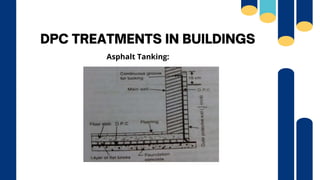
basement is termed as Tanking.
2. Membrane damp proofing
By constructing the external walls of
sufficient thickness.
By using the bricks of good quality for
constructing the external walls.
By building the walls in rich cement
mortar.
By providing string courses and
cornices.
(4) BY SPECIAL
CONSTRUCTIONAL
TECHNIQUES
This consits of adding certain components to the
concrete or mortar during the process of mixing, to
make it more dense by filling the pores through
chemical action or mechanical effect.
For example, compounds like chalk, talc, fullers
earth etc. act mechanically and compounds like
alkaline silicates, aluminium or zinc sulphates,
calcium, aluminium or ammonium chlorides, iron
fillings etc. act chemically.
5% soap is added in the water to be used for
preparing the mortar, the pores get clogged and
coating of water repellent substance stick to the
wall surface which makes it sufficiently damp
proof.
(3) BY INTEGRAL
TREATMENT
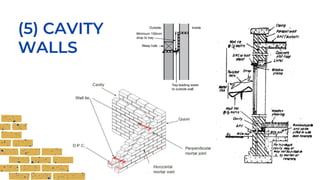
A cavity wall consists of two parallel walls/leaves of masonry, separated by a continuous air space/cavity.
The two leaves forming a cavity in between may be of equal thickness or may not be.
Provision of continuous cavity in the wall efficiently prevents the transmission of dampness from outer to inner leaf.
As there is no contact between outer and inner leaf walls of a cavity wall except at wall ties, which are impervious
material, so possibility of moisture penetration is reduced to a minimum.
Under climatic conditions of India (hot-dry/hot-humid),cavity type construction is most desirable as it offers many
advantages such as better living and comfort conditions ,economic construction and preservation of buildings
against dampness.
(5) CAVITY WALLS
(5) CAVITY
WALLS
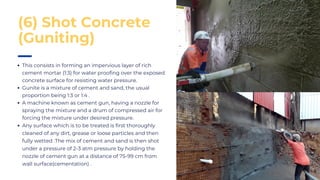
This consists in forming an impervious layer of rich
cement mortar (1:3) for water proofing over the exposed
concrete surface for resisting water pressure.
Gunite is a mixture of cement and sand, the usual
proportion being 1:3 or 1:4 .
A machine known as cement gun, having a nozzle for
spraying the mixture and a drum of compressed air for
forcing the mixture under desired pressure.
Any surface which is to be treated is first thoroughly
cleaned of any dirt, grease or loose particles and then
fully wetted .The mix of cement and sand is then shot
under a pressure of 2-3 atm pressure by holding the
nozzle of cement gun at a distance of 75-99 cm from
wall surface(cementation) .
(6) Shot Concrete
(Guniting)
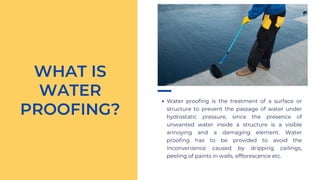
Water proofing is the treatment of a surface or
structure to prevent the passage of water under
hydrostatic pressure, since the presence of
unwanted water inside a structure is a visible
annoying and a damaging element. Water
proofing has to be provided to avoid the
inconvenience caused by dripping ceilings,
peeling of paints in walls, efflorescence etc.
WHAT IS
WATER
PROOFING?
DIFFERENCE BETWEEN WATER
PROOFING AND DPC:
Damp proofing is tar based, while water proofing is rubber based.
Damp proofing slows the process of water absorption.
Water proofing prevents the process of water absorption.
Water proofing is friendlier when it comes to environmental concerns.
Water proofing is initially more expensive.
Damp proofing is cheaper in the beginning, but leads to more expensive problems
later on.
Damp proofing cracks along with the foundation, while water proofing stretches to
cover those cracks.
Water proofing prevents hydroelectric pressure from ruining a foundation.
TYPES OF WATERPROOFING
COMPOUND
(1.) Polyurethane:
will be the best option. It offers numerous benefits and many of
them are not available with the alternatives. This material is
going to offer a seamless waterproofing membrane .This
waterproofing material will fill all capillary cracks. It can decrease
concrete water absorbency. Another thing to note is that this
material will harden the concrete uppermost surface.
(2.) Cementitious Coating:
Cementitious coating is a powder that consists of sand, organic
and inorganic chemicals, and silica-based substances. When the
active ingredients are combined with lime, it causes a hydration
reaction, creating a waterproof seal. Many experts prefer working
with this type of coating because it is so easy to utilize.
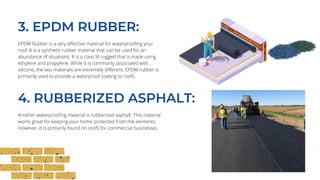
3. EPDM RUBBER:
4. RUBBERIZED ASPHALT:
EPDM Rubber is a very effective material for waterproofing your
roof. It is a synthetic rubber material that can be used for an
abundance of situations. It is a class M rugged that is made using
ethylene and propylene. While it is commonly associated with
silicone, the two materials are extremely different. EPDM rubber is
primarily used to provide a waterproof coating to roofs.
Another waterproofing material is rubberized asphalt. This material
works great for keeping your home protected from the elements.
However, it is primarily found on roofs for commercial businesses.
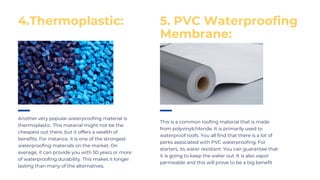
Another very popular waterproofing material is
thermoplastic. This material might not be the
cheapest out there, but it offers a wealth of
benefits. For instance, it is one of the strongest
waterproofing materials on the market. On
average, it can provide you with 50 years or more
of waterproofing durability. This makes it longer
lasting than many of the alternatives.
This is a common roofing material that is made
from polyvinylchloride. It is primarily used to
waterproof roofs. You all find that there is a lot of
perks associated with PVC waterproofing. For
starters, its water resistant. You can guarantee that
it is going to keep the water out. It is also vapor
permeable and this will prove to be a big benefit
4.Thermoplastic: 5. PVC Waterproofing
Membrane:
DAMP
PROOFING
COURSE
IN
BUILDING
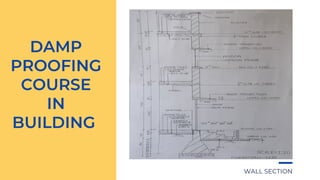
WALL SECTION
It is provided in the walls at plinth level in the form of 38 mm to 50 mm thick layer. thick layer of 1:2:4 cement
concrete covered with two coat of hot bitumen or a polythene sheet or metal sheets of lead, copper or aluminum.
It is also provided in the roofs in the form of two coats of hot bitumen, bitumen felt, mastic asphalt or sheets of
polythene, lead, copper, or aluminum over the R.C.C. slab.
Horizontal D.P.C. is also provided in floors if the sub-soil water table is high and moisture is likely to rise in the floors
by seepage, added by the capillary action of the soil.
PROVIDING A DAMP
PROOF COURSE
Damp proof course is of two types:
1. HORIZONTAL DPC:
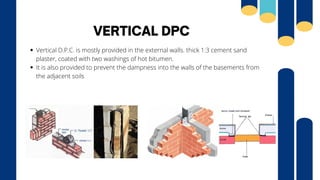
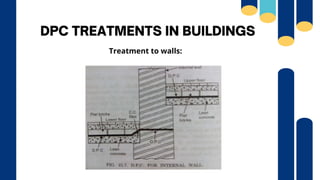
VERTICAL DPC
Vertical D.P.C. is mostly provided in the external walls. thick 1:3 cement sand
plaster, coated with two washings of hot bitumen.
It is also provided to prevent the dampness into the walls of the basements from
the adjacent soils
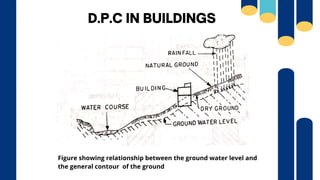
D.P.C IN BUILDINGS
Figure showing relationship between the ground water level and
the general contour of the ground
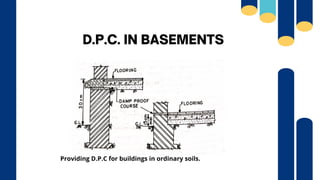
D.P.C. IN BASEMENTS
Providing D.P.C for buildings in ordinary soils.
D.P.C. IN BASEMENTS
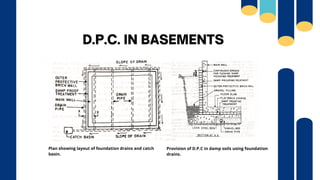
Plan showing layout of foundation drains and catch
basin.
Provision of D.P.C in damp soils using foundation
drains.
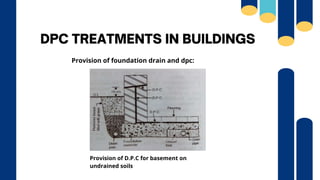
DPC TREATMENTS IN BUILDINGS
Provision of foundation drain and dpc:
Provision of D.P.C for basement on
undrained soils
DPC TREATMENTS IN BUILDINGS
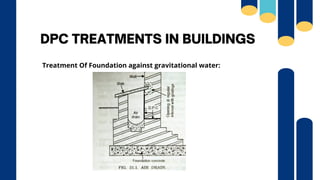
Treatment Of Foundation against gravitational water:
DPC TREATMENTS IN BUILDINGS
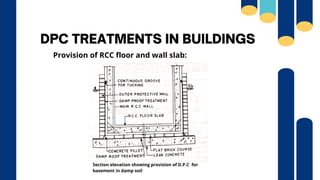
Provision of RCC floor and wall slab:
Section elevation showing provision of D.P.C for
basement in damp soil
DPC TREATMENTS IN BUILDINGS
Asphalt Tanking:
DPC TREATMENTS IN BUILDINGS
Treatment to walls:
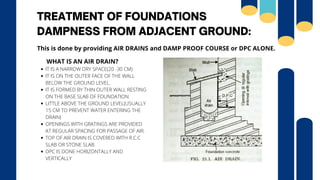
TREATMENT OF FOUNDATIONS
DAMPNESS FROM ADJACENT GROUND:
IT IS A NARROW DRY SPACE(20 -30 CM)
IT IS ON THE OUTER FACE OF THE WALL
BELOW THE GROUND LEVEL.
IT IS FORMED BY THIN OUTER WALL RESTING
ON THE BASE SLAB OF FOUNDATION.
LITTLE ABOVE THE GROUND LEVEL(USUALLY
15 CM TO PREVENT WATER ENTERING THE
DRAIN)
OPENINGS WITH GRATINGS ARE PROVIDED
AT REGULAR SPACING FOR PASSAGE OF AIR.
TOP OF AIR DRAIN IS COVERED WITH R.C.C
SLAB OR STONE SLAB.
DPC IS DONE HORIZONTALLY AND
VERTICALLY
WHAT IS AN AIR DRAIN?
This is done by providing AIR DRAINS and DAMP PROOF COURSE or DPC ALONE.
YOU
THANK

Introduction to Damp proof course (DPC) and its uses

  • 1.
    DAMP PROOF COURSE G R OU P M E M B E R S : SHIVAM SRIVASTAVA(GROUP LEADER) S H I V A N G I N I S I N G H S A U M Y A S I N G H S A U R A B H R A N A S H A M B H A V I S R I V A S T A V A S H A I L E S H K U N W A R S H I V A M K E S H R I
  • 2.
    The access orpenetration of moisture content inside a building through its walls , floors , or roof is known as DAMPNESS. The most common source of dampness is due to the capillary action of sub soil water in the foundation and walls of the building. Water can penetrate the masonry through faulty sills, bad workmanship , etc. and hence in buildings , a layer of water repellent material called damp proof course (DPC) is introduced , which acts as a barrier against the capillary rise of water. WHAT IS DAMPNESS?
  • 3.
    Capillary suction movesmoisture through porous materials. The water can be drawn upward through small pores in the concrete footing and slab and laterally through walls. This effect creates the ring of dampness seen at the base of many basement walls. This is very common at cold joints. Water can rise by capillary action phenomenon. MOISTURE MOVEMENT MECHANISMS
  • 4.
    SOURCES OF DAMPNESS (1.) Moisturerising from the ground to the walls It rises either through the bottom or through the ground surface adjacent to the wall. Moisture penetrating the water as a result of rain beating on them during continued wet weather. A typical cross-section showing Damp proof course DPC in building a foundation in damp soil
  • 5.
    Rain travel fromwall tops If the top of the wall is not protected from water penetration, rainwater enters the wall and will travel down. If the roofs of the building is not a leakage-proof, that may cause water to enter.
  • 6.
    The external facesof the world are not treated properly, moisture may enters the wall, causing dampness in the interior. Sometimes water may accumulate on balconies and chhajja because of the not proper outward slope, enter the walls through their junction. This type of moisture travel can deteriorate paintings and interior decoration of the wall. RAIN BEATING AGAINST EXTERNAL WALLS
  • 7.
    Due to muchdecrease in atmospheric temperature, there is a condensation of atmospheric moisture that causes deposition of water on the walls, floors, and ceilings. This moisture may cause dampness. CONDENSATION Roof turbine ventilator exhaust fans Cost: Rupees 2550.00 INR*
  • 8.
    Promotes and accelerates growthof termites. Travel of moisture through walls and ceilings. EFFECTS OF DAMPNESS Responsible for disintegration of bricks, stones, tiles etc. Timber fittings gets deteriorated because of warping, buckling, dry rutting etc . Dangerous when electrical fittings come in contact with dampness Metal fitting get corroded and rusted Reduces the life of structure.
  • 9.
    Wall decoration getsdamaged. Flooring system get loosened. Causes softening and crumbling of plaster in case of lime plaster. Ugly patches on the walls which destroys the aesthetic of the building. Effects on Appearance of the building
  • 10.
    Responsible for breedingof mosquitoes. EFFECTS ON HEALTH Rise of dangerous diseases such as tuberculosis, neuralgia, rheumatism etc. Those with existing skin problems, such as eczema, respiratory problems, such as allergies and asthma, with a weakened immune system or those having chemotherapy etc. are also affected.
  • 11.
    PREVENTION OF DAMPNESS InRCC work, the designer must ensure avoiding of shrinkage cracks. Impermeable concrete should be specified when the members are in contact with water and the designer should take the uplift pressure from the subsoil into consideration. Planning and Design Stage Site Investigation:- Preliminary investigation is necessary to fix the under ground water table level After Investigation:- The plinth level of the building should be fixed so that it is well above the adjoining area and surface water level. Design In RCC :-
  • 12.
    Quality of Workmanship:The quality of workmanship in masonry, concreting, plastering etc. should be well controlled and supervised. Water Stops: Special attention is required in respect of water stops provided in RCC members. Voids in Materials: Once voids are formed, a path of least resistance for the passage of water will result. Water entering through the voids corrode the reinforcement and further deterioration of concrete takes place. Expansion/construction joints: In case of construction joints, the standard specifications of cleaning the surface and providing a layer of rich cement slurry before laying fresh concrete should be strictly followed while in expansion joints there should be cover over the joints location and the gap filled up with proper sealants. CONSTRUCTION STAGE
  • 13.
    WATER PROOF SURFACETREATMENTS TECHNIQUES USED TO OVERCOME DAMPNESS CAVITY WALLS OR HOLLOW WALLS PRESSURE GROUTING OR CEMENTATION INTEGRAL DAMP PROOFING TREATMENT GUNITING OR SHOT CONCRETE
  • 14.
    Damp proof courseis a barrier through the structure designed to prevent moisture rising by capillary action The damp proof course is generally applied at basement levels ,which restricts the movement of moisture through walls and floors. Historically Damp proof courses may have been formed using bitumen, slates, lead and pitch. Integral damp proofing in concrete involves adding materials to the concrete mix to make the concrete itself impermeable asphalt or low absorption bricks. What is DPC
  • 15.
    Prevent health issuesthat can occur from being in a damp property Avoid unpleasant smells Improve the appearance of your home by damp proofing walls Prevent structural problems in your building Avoid decreasing the value of your property Normal cracks sometimes develop in this damp proofing process. Also, it provides additional weight to the entire structure. It leads to the level problem. Sometimes it creates ugly patches up to the roof. ADVANTAGES OF DPC DISADVANTAGES OF DPC
  • 16.
    Why is dampproofing necessary ? Damp proofing ensures that your walls resist this moisture hazard so that your family can stay safe and healthy. When condensation builds up inside your walls, or water is allowed to sit without sufficient ventilation. Properties which have no appropriate damp protection layer or has a damaged damp proof course may be affected by excess moisture rising from the ground. Mold and bacteria begin to grow.
  • 17.
    The damp proofingshould cover the full thickness of walls, excluding rendering. GENERAL PRINCIPLES FOLLOWED WHILE PROVIDING DAMP PROOFING The mortar bed supporting damp proof course should be leveled and even, and should be free from projections, so that damp proof course is not damaged. Damp proof course should be laid in such a way that a continuous projection is provided. At junctions and corners of walls, the horizontal damp proof course should be laid continuous. When a horizontal damp proof course (i.e. that of a floor) is continued to a vertical face, a cement concrete fillet of 7.5 cm radius should be provided at the junction. Each damp proof course should be placed in correct relation to other dampproof course, so as to ensure a complete and continuous barrier to the passage of water from floors, walls or roof.
  • 18.
    DPC ABOVE GROUNDLEVEL: For DPC above ground level with wall thickness generally not exceeding 40 cm, any one of the types of materials mentioned above may be used. Cement concrete is however, commonly adopted material for DPC at plinth level, 38 to 50mm thick layer of cement concrete M15 (1:2:4 mix) serves the purpose under normal conditions .In the case of a damp and humid atmosphere, a richer mix of concrete should be used. The concrete is further made dense by adding waterproofing materials like pudlo , impermo , waterlock , etc. SELECTION OF MATERIALS FOR DAMP PROOF COURSE IN BUILDINGS
  • 19.
    For greater wallthickness or where DPC is to be laid over large areas such as floors, roofs, etc., the choice is limited to flexible materials that provide a lesser number of joints like mastic, asphalt, bitumen felts, plastic sheets, etc. The felts, when used, should be adequately bonded to the surface with bitumen and laid with joints properly lapped and sealed.. 2. DPC Material for floors, roofs etc. Damp Proofing of pitched roof Damp Proofing of parapets and coping the parapets
  • 20.
    In parapet wallsand other such situations, materials like mastic, asphalt, bitumen felts, and metal (copper or lead) are recommended. It is vital to ensure that the DPC material is flexible to avoid any damage or puncture of the material due to differential thermal movement between the material of the roof and the parapet. 3. DPC MATERIAL FOR SITUATIONS WHERE DIFFERENTIAL THERMAL MOVEMENTS OCCUR Ashlar masonry Cavity walls (rubble masonry)
  • 21.
    In cavity wallconstruction, like cavity over the door or window should be bridged by flexible material like bitumen felt, strips or lead, etc 4.DPC material for Cavity Walls Details of DPC. Details of DPC above ground level. Details of DPC at Sill and Lintel. Details of DPC at roof
  • 22.
    DESIRABLE PROPERTIES OF DPCMATERIAL: It should be free from deliquescent salts like sulfates, chlorides, and nitrates. It should be dimensionally stable. It should be strong and durable and should be capable of withstanding both dead as well as live loads without damage. It should be impervious.
  • 23.
    TYPES OF DPCMATERIAL 1) Flexible Materials for Damp Proof Course The materials, which do not crack and deform their shape when subjected to loading, are called Flexible Materials. It consists of asphalt or bitumen mixed with fine sand in a hot state to form an impervious mass. Due to this consistency it can be spread (when hot) to a depth of 2.5cm to 5cm, which sets on cooling. It provides an impervious layer but special care is needed in its laying. a) Bitumen Mastic (Mastic Asphalt)
  • 24.
    B) Bitumen Felts(Sheets) It consists of a 6mm thick sheet of bitumen prepared in rolls having width equal to that of brick wall. C) Hot laid Bitumen This material is used on a bedding of cement concrete or mortar. This should be applied in two layers at the rate of 1.75kg/m2 of the area.
  • 25.
    Metal sheets ofCopper, Aluminium, or Lead are used to prevent dampness, but they are costly. Sheets of these materials are used throughout the thickness of the wall. The sheets of Lead are laid over Lime Mortar and not with Cement Mortar due to the chemical reaction of Cement over the Lead. The sheets of metal should be coated with asphalt. The thickness of the sheets should not be less than 3mm d) Metal Sheets
  • 26.
    2) RIGID MATERIALSFOR DAMP PROOF COURSE The materials, which do not resist transverse stresses and cracks when subjected to severe loading, are known as Rigid Materials. 1.2 cm to 4cm thick layer of Rich Concrete (1:2:4) painted with two coats of hot bitumen is used as horizontal D.P.C. It also prevents moisture penetration by capillary action. These layers are laid where the damp is not excessive. A) Rich Concrete B) Bricks: Over burnt or dense bricks in one or two layers can be used as cheap and effective DPC. They are laid in Rich Cement and Sand Mortar (1:3). Bricks are rarely used as DPC except in cheap houses.
  • 27.
    2cm thick layerof Rich Cement and Sand Mortar (1:3) is applied on the inner face of the external wall. This is a vertical D.P.C. The surface is then painted with two coats of hot bitumen. C) MORTAR: D) STONES OR SLATES: Two layers of stone slabs or slates laid in Lime, Cement and Sand Mortar (1:1:6) make the best DPC. They can also be laid in Cement Sand Mortar. It is used where a good quality of stone is easily and cheaply available
  • 28.
    The surface treatmentconsists in filling or blinding the pores of the material exposed to moisture by painting a water-repellent material over the surface. Surface treatment is effective only when the moisture is superficial and is not under pressure. The walls plastered with cement, lime and sand mixed in proportions of 1:1:6 is found to serve the purpose of preventing dampness in wall due to rain effectively. METHODS OF DAMP PROOFING (1) BY SURFACE TREATMENT:
  • 29.
    A water proofmembrane is introduced in between the source of dampness and the part of building adjacent to it. Damp proofing membrane consist of flexible materials such as bitumen, mastic asphalt, bituminous felts, plastic or polythene sheets, metal sheets, cement concrete. Damp proofing may be provided either horizontally or vertically in floors , walls etc. Provision of Damp Proofing membrane in basement is termed as Tanking. 2. Membrane damp proofing
  • 30.
    By constructing theexternal walls of sufficient thickness. By using the bricks of good quality for constructing the external walls. By building the walls in rich cement mortar. By providing string courses and cornices. (4) BY SPECIAL CONSTRUCTIONAL TECHNIQUES This consits of adding certain components to the concrete or mortar during the process of mixing, to make it more dense by filling the pores through chemical action or mechanical effect. For example, compounds like chalk, talc, fullers earth etc. act mechanically and compounds like alkaline silicates, aluminium or zinc sulphates, calcium, aluminium or ammonium chlorides, iron fillings etc. act chemically. 5% soap is added in the water to be used for preparing the mortar, the pores get clogged and coating of water repellent substance stick to the wall surface which makes it sufficiently damp proof. (3) BY INTEGRAL TREATMENT
  • 31.
    A cavity wallconsists of two parallel walls/leaves of masonry, separated by a continuous air space/cavity. The two leaves forming a cavity in between may be of equal thickness or may not be. Provision of continuous cavity in the wall efficiently prevents the transmission of dampness from outer to inner leaf. As there is no contact between outer and inner leaf walls of a cavity wall except at wall ties, which are impervious material, so possibility of moisture penetration is reduced to a minimum. Under climatic conditions of India (hot-dry/hot-humid),cavity type construction is most desirable as it offers many advantages such as better living and comfort conditions ,economic construction and preservation of buildings against dampness. (5) CAVITY WALLS
  • 32.
  • 33.
    This consists informing an impervious layer of rich cement mortar (1:3) for water proofing over the exposed concrete surface for resisting water pressure. Gunite is a mixture of cement and sand, the usual proportion being 1:3 or 1:4 . A machine known as cement gun, having a nozzle for spraying the mixture and a drum of compressed air for forcing the mixture under desired pressure. Any surface which is to be treated is first thoroughly cleaned of any dirt, grease or loose particles and then fully wetted .The mix of cement and sand is then shot under a pressure of 2-3 atm pressure by holding the nozzle of cement gun at a distance of 75-99 cm from wall surface(cementation) . (6) Shot Concrete (Guniting)
  • 34.
    Water proofing isthe treatment of a surface or structure to prevent the passage of water under hydrostatic pressure, since the presence of unwanted water inside a structure is a visible annoying and a damaging element. Water proofing has to be provided to avoid the inconvenience caused by dripping ceilings, peeling of paints in walls, efflorescence etc. WHAT IS WATER PROOFING?
  • 35.
    DIFFERENCE BETWEEN WATER PROOFINGAND DPC: Damp proofing is tar based, while water proofing is rubber based. Damp proofing slows the process of water absorption. Water proofing prevents the process of water absorption. Water proofing is friendlier when it comes to environmental concerns. Water proofing is initially more expensive. Damp proofing is cheaper in the beginning, but leads to more expensive problems later on. Damp proofing cracks along with the foundation, while water proofing stretches to cover those cracks. Water proofing prevents hydroelectric pressure from ruining a foundation.
  • 36.
    TYPES OF WATERPROOFING COMPOUND (1.)Polyurethane: will be the best option. It offers numerous benefits and many of them are not available with the alternatives. This material is going to offer a seamless waterproofing membrane .This waterproofing material will fill all capillary cracks. It can decrease concrete water absorbency. Another thing to note is that this material will harden the concrete uppermost surface. (2.) Cementitious Coating: Cementitious coating is a powder that consists of sand, organic and inorganic chemicals, and silica-based substances. When the active ingredients are combined with lime, it causes a hydration reaction, creating a waterproof seal. Many experts prefer working with this type of coating because it is so easy to utilize.
  • 37.
    3. EPDM RUBBER: 4.RUBBERIZED ASPHALT: EPDM Rubber is a very effective material for waterproofing your roof. It is a synthetic rubber material that can be used for an abundance of situations. It is a class M rugged that is made using ethylene and propylene. While it is commonly associated with silicone, the two materials are extremely different. EPDM rubber is primarily used to provide a waterproof coating to roofs. Another waterproofing material is rubberized asphalt. This material works great for keeping your home protected from the elements. However, it is primarily found on roofs for commercial businesses.
  • 38.
    Another very popularwaterproofing material is thermoplastic. This material might not be the cheapest out there, but it offers a wealth of benefits. For instance, it is one of the strongest waterproofing materials on the market. On average, it can provide you with 50 years or more of waterproofing durability. This makes it longer lasting than many of the alternatives. This is a common roofing material that is made from polyvinylchloride. It is primarily used to waterproof roofs. You all find that there is a lot of perks associated with PVC waterproofing. For starters, its water resistant. You can guarantee that it is going to keep the water out. It is also vapor permeable and this will prove to be a big benefit 4.Thermoplastic: 5. PVC Waterproofing Membrane:
  • 39.
  • 40.
    It is providedin the walls at plinth level in the form of 38 mm to 50 mm thick layer. thick layer of 1:2:4 cement concrete covered with two coat of hot bitumen or a polythene sheet or metal sheets of lead, copper or aluminum. It is also provided in the roofs in the form of two coats of hot bitumen, bitumen felt, mastic asphalt or sheets of polythene, lead, copper, or aluminum over the R.C.C. slab. Horizontal D.P.C. is also provided in floors if the sub-soil water table is high and moisture is likely to rise in the floors by seepage, added by the capillary action of the soil. PROVIDING A DAMP PROOF COURSE Damp proof course is of two types: 1. HORIZONTAL DPC:
  • 42.
    VERTICAL DPC Vertical D.P.C.is mostly provided in the external walls. thick 1:3 cement sand plaster, coated with two washings of hot bitumen. It is also provided to prevent the dampness into the walls of the basements from the adjacent soils
  • 43.
    D.P.C IN BUILDINGS Figureshowing relationship between the ground water level and the general contour of the ground
  • 44.
    D.P.C. IN BASEMENTS ProvidingD.P.C for buildings in ordinary soils.
  • 45.
    D.P.C. IN BASEMENTS Planshowing layout of foundation drains and catch basin. Provision of D.P.C in damp soils using foundation drains.
  • 46.
    DPC TREATMENTS INBUILDINGS Provision of foundation drain and dpc: Provision of D.P.C for basement on undrained soils
  • 47.
    DPC TREATMENTS INBUILDINGS Treatment Of Foundation against gravitational water:
  • 48.
    DPC TREATMENTS INBUILDINGS Provision of RCC floor and wall slab: Section elevation showing provision of D.P.C for basement in damp soil
  • 49.
    DPC TREATMENTS INBUILDINGS Asphalt Tanking:
  • 50.
    DPC TREATMENTS INBUILDINGS Treatment to walls:
  • 51.
    TREATMENT OF FOUNDATIONS DAMPNESSFROM ADJACENT GROUND: IT IS A NARROW DRY SPACE(20 -30 CM) IT IS ON THE OUTER FACE OF THE WALL BELOW THE GROUND LEVEL. IT IS FORMED BY THIN OUTER WALL RESTING ON THE BASE SLAB OF FOUNDATION. LITTLE ABOVE THE GROUND LEVEL(USUALLY 15 CM TO PREVENT WATER ENTERING THE DRAIN) OPENINGS WITH GRATINGS ARE PROVIDED AT REGULAR SPACING FOR PASSAGE OF AIR. TOP OF AIR DRAIN IS COVERED WITH R.C.C SLAB OR STONE SLAB. DPC IS DONE HORIZONTALLY AND VERTICALLY WHAT IS AN AIR DRAIN? This is done by providing AIR DRAINS and DAMP PROOF COURSE or DPC ALONE.
  • 59.