Charlie Gupta
B.Arch VIII Sem
Methods of Post
Tensioning
What is Post Tensioning?
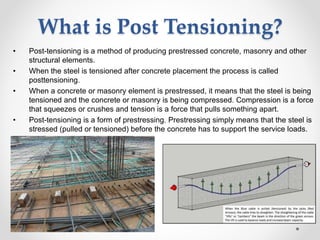
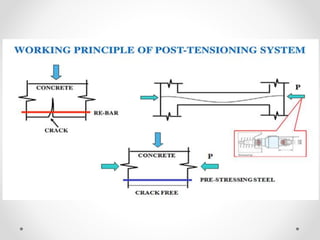
• Post-tensioning is a method of producing prestressed concrete, masonry and other
structural elements.
• When the steel is tensioned after concrete placement the process is called
posttensioning.
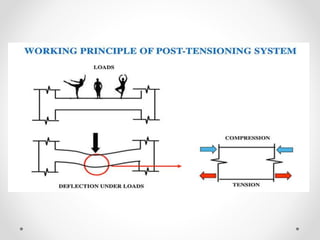
• When a concrete or masonry element is prestressed, it means that the steel is being
tensioned and the concrete or masonry is being compressed. Compression is a force
that squeezes or crushes and tension is a force that pulls something apart.
• Post-tensioning is a form of prestressing. Prestressing simply means that the steel is
stressed (pulled or tensioned) before the concrete has to support the service loads.
Freyssinet System
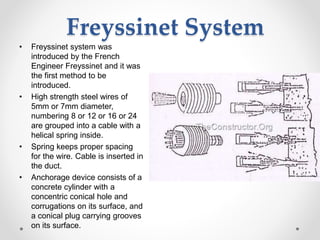
• Freyssinet system was
introduced by the French
Engineer Freyssinet and it was
the first method to be
introduced.
• High strength steel wires of
5mm or 7mm diameter,
numbering 8 or 12 or 16 or 24
are grouped into a cable with a
helical spring inside.
• Spring keeps proper spacing
for the wire. Cable is inserted in
the duct.
• Anchorage device consists of a
concrete cylinder with a
concentric conical hole and
corrugations on its surface, and
a conical plug carrying grooves
on its surface.
Magnel Blaton system
• In Freyssinet system several
wires are stretched at a time. In
Magnel Blaton system, two
wires are stretched at a time
• In this system, the anchorage
device consists of sandwich
plate having grooves to hold
the wires and wedges which
are also grooved.
• Each plate carries eight wires.
Between the two ends the
spacing of the wires is
maintained by spacers.
• Wires of 5mm or 7mm are
adopted. Cables consists of
wires in multiples of 8 wires.
Gifford Udall System
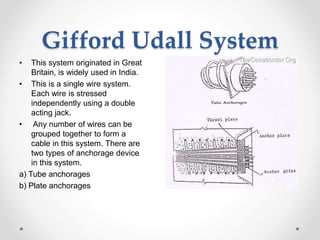
• This system originated in Great
Britain, is widely used in India.
• This is a single wire system.
Each wire is stressed
independently using a double
acting jack.
• Any number of wires can be
grouped together to form a
cable in this system. There are
two types of anchorage device
in this system.
a) Tube anchorages
b) Plate anchorages
Lee McCall System:
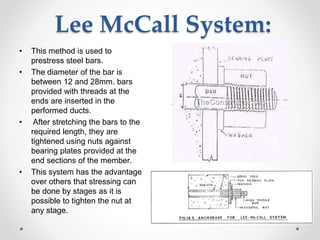
• This method is used to
prestress steel bars.
• The diameter of the bar is
between 12 and 28mm. bars
provided with threads at the
ends are inserted in the
performed ducts.
• After stretching the bars to the
required length, they are
tightened using nuts against
bearing plates provided at the
end sections of the member.
• This system has the advantage
over others that stressing can
be done by stages as it is
possible to tighten the nut at
any stage.

What is post tensioning

  • 1.
    Charlie Gupta B.Arch VIIISem Methods of Post Tensioning
  • 2.
    What is PostTensioning? • Post-tensioning is a method of producing prestressed concrete, masonry and other structural elements. • When the steel is tensioned after concrete placement the process is called posttensioning. • When a concrete or masonry element is prestressed, it means that the steel is being tensioned and the concrete or masonry is being compressed. Compression is a force that squeezes or crushes and tension is a force that pulls something apart. • Post-tensioning is a form of prestressing. Prestressing simply means that the steel is stressed (pulled or tensioned) before the concrete has to support the service loads.
  • 5.
    Freyssinet System • Freyssinetsystem was introduced by the French Engineer Freyssinet and it was the first method to be introduced. • High strength steel wires of 5mm or 7mm diameter, numbering 8 or 12 or 16 or 24 are grouped into a cable with a helical spring inside. • Spring keeps proper spacing for the wire. Cable is inserted in the duct. • Anchorage device consists of a concrete cylinder with a concentric conical hole and corrugations on its surface, and a conical plug carrying grooves on its surface.
  • 6.
    Magnel Blaton system •In Freyssinet system several wires are stretched at a time. In Magnel Blaton system, two wires are stretched at a time • In this system, the anchorage device consists of sandwich plate having grooves to hold the wires and wedges which are also grooved. • Each plate carries eight wires. Between the two ends the spacing of the wires is maintained by spacers. • Wires of 5mm or 7mm are adopted. Cables consists of wires in multiples of 8 wires.
  • 7.
    Gifford Udall System •This system originated in Great Britain, is widely used in India. • This is a single wire system. Each wire is stressed independently using a double acting jack. • Any number of wires can be grouped together to form a cable in this system. There are two types of anchorage device in this system. a) Tube anchorages b) Plate anchorages
  • 8.
    Lee McCall System: •This method is used to prestress steel bars. • The diameter of the bar is between 12 and 28mm. bars provided with threads at the ends are inserted in the performed ducts. • After stretching the bars to the required length, they are tightened using nuts against bearing plates provided at the end sections of the member. • This system has the advantage over others that stressing can be done by stages as it is possible to tighten the nut at any stage.