 The AASHTO, 1993 Guide for Design of Pavement
Structures considers the following factors in the
design of rigid pavements:
 Effective modulus of subgrade reaction
 Concrete elastic modulus
 Concrete modulus of rupture
 Load Transfer coefficient
 Reliability and standard deviation
 Traffic load application
 Serviceability loss
Design considerations for the AASHTO Rigid
Pavement Design
Dr. Rizwan Memon 1
Effective modulus of subgrade reaction
 The AASHTO 1993 includes an intricate procedure
for evaluating the level of slab support, expressed as
the modulus of subgrade reaction.
 The table shown in next slides, is illustrating the
process for developing an effective modulus of
subgrade reaction.
 Resilient modulus of roadbed material and seasonal
elastic modulus values for the subbase should be
determined and entered in the table 20.8.
Dr. Rizwan Memon 2
Dr. Rizwan Memon 3
 The composite modulus
of subgrade reaction, K
value, pci, is
determined from figure
and entered in the
table 20.8
 If there is no subbase,
the composite modulus
of subgrade reaction
may be determined
from following equation
K = MR/19.4
Dr. Rizwan Memon 4
If a rigid foundation exists within 10 ft of the surface, its
effect on the k-value can then be determine by the chart and
values are entered in table 20.8.
Dr. Rizwan Memon 5
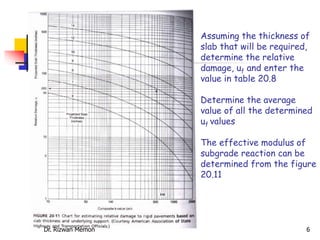
Assuming the thickness of
slab that will be required,
determine the relative
damage, uf and enter the
value in table 20.8
Determine the average
value of all the determined
uf values
The effective modulus of
subgrade reaction can be
determined from the figure
20.11
Dr. Rizwan Memon 6
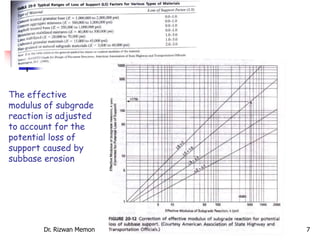
The effective
modulus of subgrade
reaction is adjusted
to account for the
potential loss of
support caused by
subbase erosion
Dr. Rizwan Memon 7
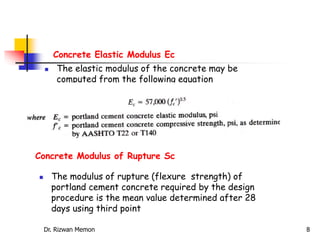
Concrete Elastic Modulus Ec
 The elastic modulus of the concrete may be
computed from the following equation
Concrete Modulus of Rupture Sc
 The modulus of rupture (flexure strength) of
portland cement concrete required by the design
procedure is the mean value determined after 28
days using third point
Dr. Rizwan Memon 8
Load – Transfer Coefficient, J
 The load transfer coefficient, J, is used in rigid pavement
design to account for he ability to transfer or distribute load
across discontinuities, such as joints and cracks.
 Table 20.10 shows the AASHTO recommended load transfer
coefficients for various pavements types and design conditions.
Dr. Rizwan Memon 9
Drainage Coefficient, Cd
 The effects of drainage coefficient, Cd which varies from 0.7
for vaer poor drainage to 1.25 for excellent conditions. Table
20.11 gives recommended values of Cd for rigid pavement design.
Dr. Rizwan Memon 10
Reliability and Standard Dviation
 It provides a predetermined level of assurance (R) that
pavement sections will survive the period for which they were
designed.
 It is the function of the overall standard deviation (So), the
chance variation in traffic prediction and the normal variance in
pavement performance.
 In rigid pavement the standard deviation values commonly range
from 0.30 to 0.40.
Dr. Rizwan Memon 11
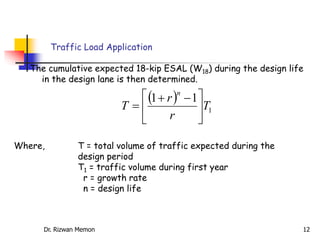
Traffic Load Application
The cumulative expected 18-kip ESAL (W18) during the design life
in the design lane is then determined.
 
1
1
1
T
r
r
T
n





 


Where, T = total volume of traffic expected during the
design period
T1 = traffic volume during first year
r = growth rate
n = design life
Dr. Rizwan Memon 12
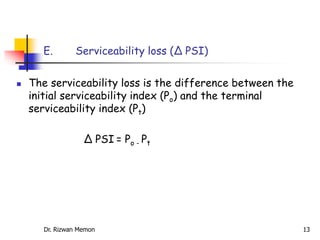
E. Serviceability loss (Δ PSI)
 The serviceability loss is the difference between the
initial serviceability index (Po) and the terminal
serviceability index (Pt)
Δ PSI = Po - Pt
Dr. Rizwan Memon 13
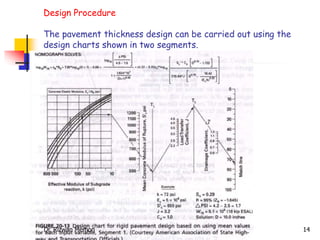
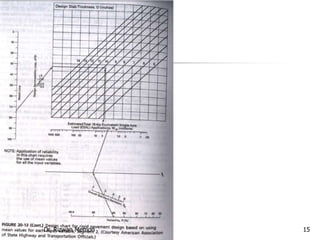
Design Procedure
The pavement thickness design can be carried out using the
design charts shown in two segments.
Dr. Rizwan Memon 14
Dr. Rizwan Memon 15

16. AASHTO Pavement Design Method (Rigid).pptx

  • 1.
     The AASHTO,1993 Guide for Design of Pavement Structures considers the following factors in the design of rigid pavements:  Effective modulus of subgrade reaction  Concrete elastic modulus  Concrete modulus of rupture  Load Transfer coefficient  Reliability and standard deviation  Traffic load application  Serviceability loss Design considerations for the AASHTO Rigid Pavement Design Dr. Rizwan Memon 1
  • 2.
    Effective modulus ofsubgrade reaction  The AASHTO 1993 includes an intricate procedure for evaluating the level of slab support, expressed as the modulus of subgrade reaction.  The table shown in next slides, is illustrating the process for developing an effective modulus of subgrade reaction.  Resilient modulus of roadbed material and seasonal elastic modulus values for the subbase should be determined and entered in the table 20.8. Dr. Rizwan Memon 2
  • 3.
  • 4.
     The compositemodulus of subgrade reaction, K value, pci, is determined from figure and entered in the table 20.8  If there is no subbase, the composite modulus of subgrade reaction may be determined from following equation K = MR/19.4 Dr. Rizwan Memon 4
  • 5.
    If a rigidfoundation exists within 10 ft of the surface, its effect on the k-value can then be determine by the chart and values are entered in table 20.8. Dr. Rizwan Memon 5
  • 6.
    Assuming the thicknessof slab that will be required, determine the relative damage, uf and enter the value in table 20.8 Determine the average value of all the determined uf values The effective modulus of subgrade reaction can be determined from the figure 20.11 Dr. Rizwan Memon 6
  • 7.
    The effective modulus ofsubgrade reaction is adjusted to account for the potential loss of support caused by subbase erosion Dr. Rizwan Memon 7
  • 8.
    Concrete Elastic ModulusEc  The elastic modulus of the concrete may be computed from the following equation Concrete Modulus of Rupture Sc  The modulus of rupture (flexure strength) of portland cement concrete required by the design procedure is the mean value determined after 28 days using third point Dr. Rizwan Memon 8
  • 9.
    Load – TransferCoefficient, J  The load transfer coefficient, J, is used in rigid pavement design to account for he ability to transfer or distribute load across discontinuities, such as joints and cracks.  Table 20.10 shows the AASHTO recommended load transfer coefficients for various pavements types and design conditions. Dr. Rizwan Memon 9
  • 10.
    Drainage Coefficient, Cd The effects of drainage coefficient, Cd which varies from 0.7 for vaer poor drainage to 1.25 for excellent conditions. Table 20.11 gives recommended values of Cd for rigid pavement design. Dr. Rizwan Memon 10
  • 11.
    Reliability and StandardDviation  It provides a predetermined level of assurance (R) that pavement sections will survive the period for which they were designed.  It is the function of the overall standard deviation (So), the chance variation in traffic prediction and the normal variance in pavement performance.  In rigid pavement the standard deviation values commonly range from 0.30 to 0.40. Dr. Rizwan Memon 11
  • 12.
    Traffic Load Application Thecumulative expected 18-kip ESAL (W18) during the design life in the design lane is then determined.   1 1 1 T r r T n          Where, T = total volume of traffic expected during the design period T1 = traffic volume during first year r = growth rate n = design life Dr. Rizwan Memon 12
  • 13.
    E. Serviceability loss(Δ PSI)  The serviceability loss is the difference between the initial serviceability index (Po) and the terminal serviceability index (Pt) Δ PSI = Po - Pt Dr. Rizwan Memon 13
  • 14.
    Design Procedure The pavementthickness design can be carried out using the design charts shown in two segments. Dr. Rizwan Memon 14
  • 15.