DESIGN OF SIGNALIZED INTERSECTION
One of the important steps in designing a fixed time signal
system is to determine the cycle time.
• Main consideration in selecting the cycle time should be
that the least delay is caused to the traffic passing
through the intersection.
• If the cycle time is small, the proportion of the time
lost to the cycle time will be high, resulting in an
inefficient signal operation and lengthy delays.
• If the cycle time is too large, there is a danger that a
good portion of the green time will be used by
unsaturated flow of traffic, which again leads to
inefficiency.
Dr. Rizwan Memon 1
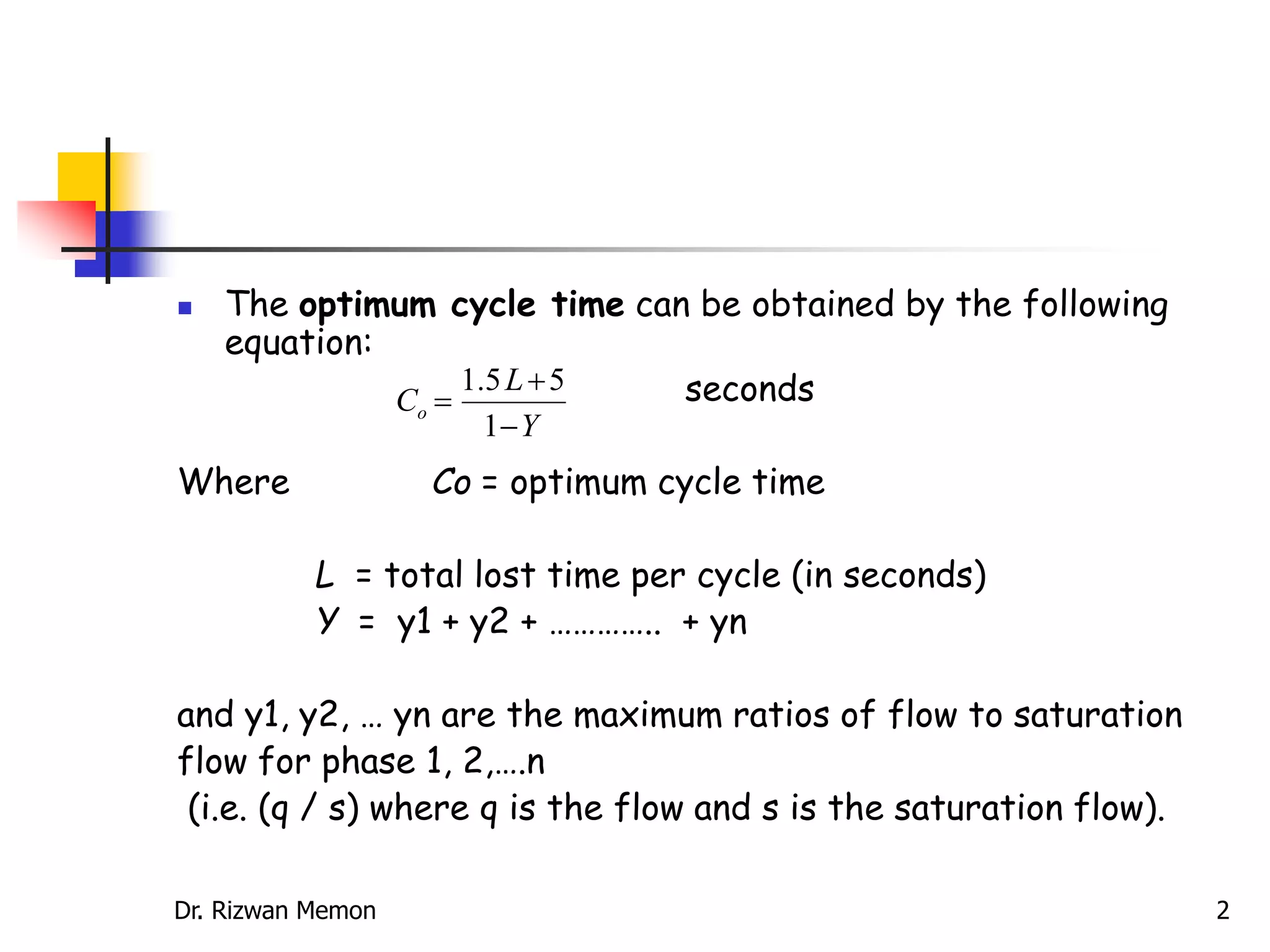
 The optimum cycle time can be obtained by the following
equation:
seconds
Where Co = optimum cycle time
L = total lost time per cycle (in seconds)
Y = y1 + y2 + ………….. + yn
and y1, y2, … yn are the maximum ratios of flow to saturation
flow for phase 1, 2,….n
(i.e. (q / s) where q is the flow and s is the saturation flow).
Y
L
Co



1
5
5
.
1
Dr. Rizwan Memon 2
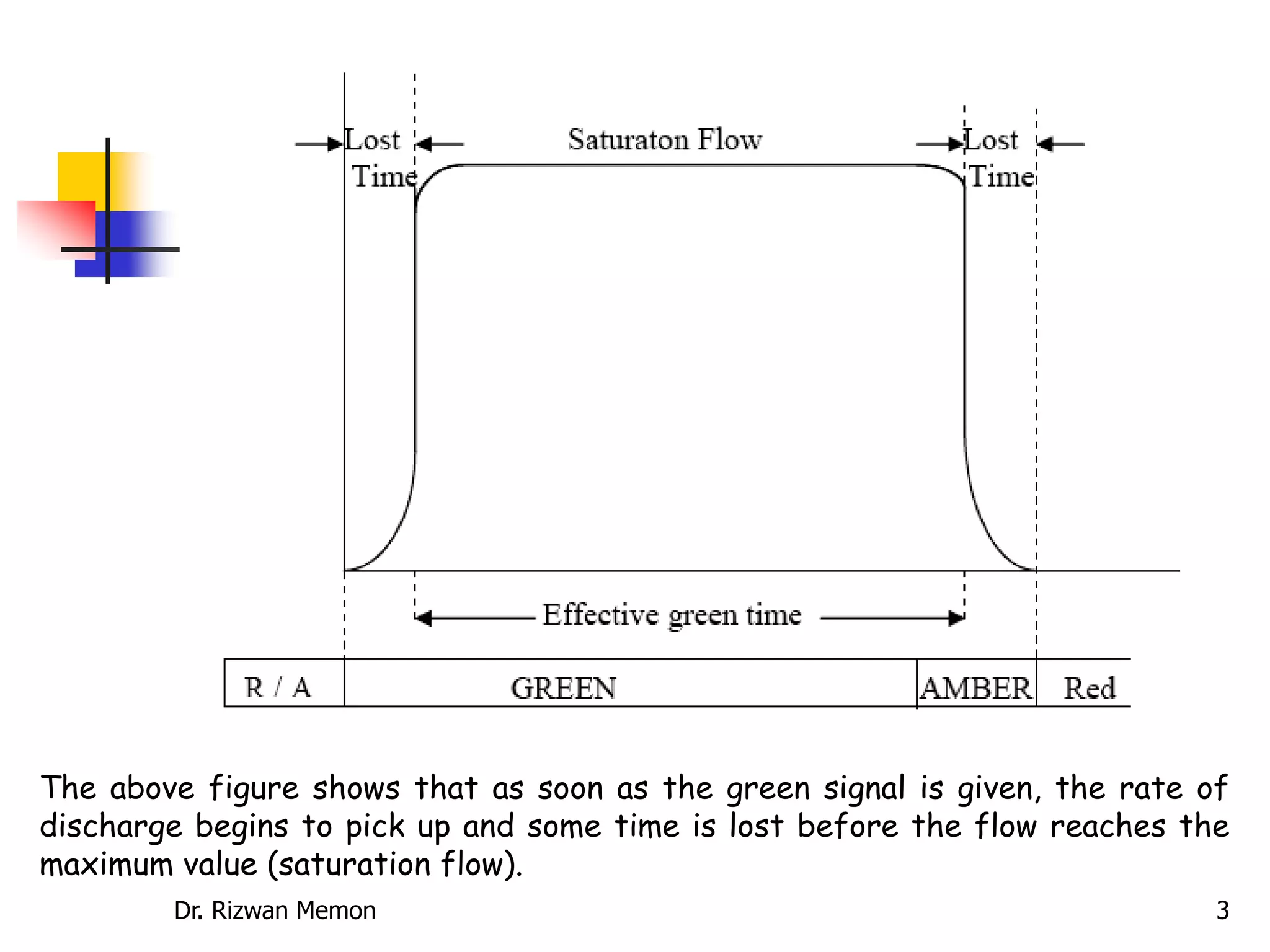
The above figure shows that as soon as the green signal is given, the rate of
discharge begins to pick up and some time is lost before the flow reaches the
maximum value (saturation flow).
Dr. Rizwan Memon 3
Saturation Flow:
In determining the y values the saturation flow should be
measured at existing sites, wherever possible. In absence of
such data the following simple formula devised by the Road
Research Laboratory (RRL), U.K can be used.
s = 525 w (PCU/hour)
where s = saturation flow
w = width of approach road in meters
The above formula is valid for widths of from 5.5 to 18 m. For
lesser widths the values may be obtained from following
table.
Width w in
(m)
3.0 3.5 4.0 4.5 5.0 5.5
s (PCU /
hour)
1850 1875 1975 2175 2250 2900
Dr. Rizwan Memon 4
Dr. Rizwan Memon 5
Dr. Rizwan Memon 6
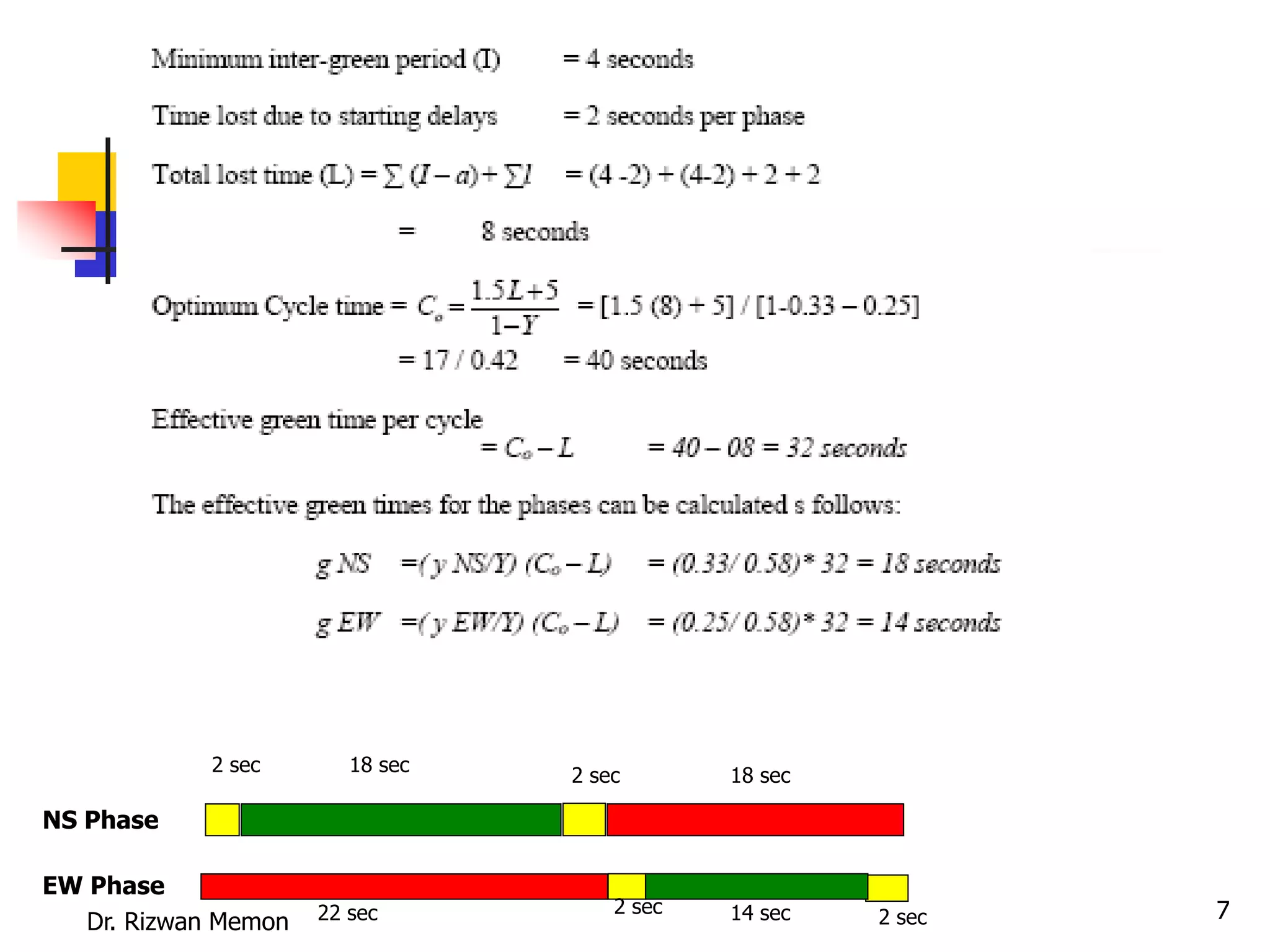
2 sec 18 sec
14 sec
18 sec
2 sec
2 sec
2 sec
22 sec
NS Phase
EW Phase
Dr. Rizwan Memon 7
Dr. Rizwan Memon 8
Dr. Rizwan Memon 9
Dr. Rizwan Memon 10
Dr. Rizwan Memon 11
Dr. Rizwan Memon 12

21. Design of signalized Intersection.pptx

  • 1.
    DESIGN OF SIGNALIZEDINTERSECTION One of the important steps in designing a fixed time signal system is to determine the cycle time. • Main consideration in selecting the cycle time should be that the least delay is caused to the traffic passing through the intersection. • If the cycle time is small, the proportion of the time lost to the cycle time will be high, resulting in an inefficient signal operation and lengthy delays. • If the cycle time is too large, there is a danger that a good portion of the green time will be used by unsaturated flow of traffic, which again leads to inefficiency. Dr. Rizwan Memon 1
  • 2.
     The optimumcycle time can be obtained by the following equation: seconds Where Co = optimum cycle time L = total lost time per cycle (in seconds) Y = y1 + y2 + ………….. + yn and y1, y2, … yn are the maximum ratios of flow to saturation flow for phase 1, 2,….n (i.e. (q / s) where q is the flow and s is the saturation flow). Y L Co    1 5 5 . 1 Dr. Rizwan Memon 2
  • 3.
    The above figureshows that as soon as the green signal is given, the rate of discharge begins to pick up and some time is lost before the flow reaches the maximum value (saturation flow). Dr. Rizwan Memon 3
  • 4.
    Saturation Flow: In determiningthe y values the saturation flow should be measured at existing sites, wherever possible. In absence of such data the following simple formula devised by the Road Research Laboratory (RRL), U.K can be used. s = 525 w (PCU/hour) where s = saturation flow w = width of approach road in meters The above formula is valid for widths of from 5.5 to 18 m. For lesser widths the values may be obtained from following table. Width w in (m) 3.0 3.5 4.0 4.5 5.0 5.5 s (PCU / hour) 1850 1875 1975 2175 2250 2900 Dr. Rizwan Memon 4
  • 5.
  • 6.
  • 7.
    2 sec 18sec 14 sec 18 sec 2 sec 2 sec 2 sec 22 sec NS Phase EW Phase Dr. Rizwan Memon 7
  • 8.
  • 9.
  • 10.
  • 11.
  • 12.