Traffic Engineering
Traffic engineering is that phase of transportation
engineering which deals with the
planning,
geometric design and
traffic operations
of roads, streets, and highways, their networks,
terminals, abutting lands, and relationships with
other modes of transportation.
1
2
Safety: The Primary Objective
The principal goal of the traffic engineer
remains the provision of a safe system for
highway traffic.
Other Objectives of Traffic Engineer
• Speed
• Comfort
• Convenience
• Economy
• Environmental compatibility
3
•While SPEED of travel is much to be desired, it is limited by
transportation technology, human characteristics, and the need
to provide safety.
•COMFORT and CONVENIENCE are generic terms and mean
different things to different people.
•Comfort involves the physical characteristics of vehicles and
roadways, and is influenced by our perception of safety.
•Convenience relates more to the ease with which trips are
made and the ability of transport systems to accommodate all
of our travel needs at appropriate times.
4
• ECONOMY is also relative.
Highway and other transportation systems involve massive
construction, maintenance, and operating expenditures, most of
which are provided through general and user taxes and fees.
Nevertheless, every engineer, regardless of discipline, is called
upon to provide the best possible systems for the money.
•HARMONY WITH THE ENVIRONMENT is a complex issue
that has become more important over time. All transportation
systems have some negative impacts on the environment. All
produce air and noise pollution in some forms, and all utilize
valuable land resources.
Traffic Engineering Studies
Main Categories of Traffic
Studies
 INVENTORIES-provides a list or graphic display
of existing information such as street widths,
parking spaces, transit routes, traffic regulations.
 ADMINISTRATIVE STUDIES-Use existing
records, available in government agencies and
departments.
 DYNAMIC STUDIES- Involves to collect the data
and include studies of speed, traffic volume,
travel time and delay, parking and crashes.
Spot Speed Studies
 Location for Spot Speed Studies
 Time of Day and Duration of Spot Speed Studies
 Sample Size for Spot Speed Studies
 Methods for Conducting Spot Studies
 Presentation and Analysis of Spot Speed Data
Volume Studies
 Average Annual Daily Traffic (AADT)
 Average Daily Traffic(ADT)
 Peak Hour Volume (PHV)
 Vehicle Classification (VC)
 Vehicle Miles of Travel (VMT)
Average Annual Daily Traffic (AADT)
AADT is the average of 24-hour counts collected every day
of the year. AADTs are used in several traffic and
transportation analyses for:
(a) Estimation of highway user revenues
(b) Computation of crash rates in terms of number of crashes
per 100 million vehicle miles.
(c) Establishment of traffic volume trends
(d) Evaluation of the economic feasibility of highway projects
(e) Development freeway and major arterial street systems
(f) Development of improvement and maintenance programs
Average Daily Traffic(ADT)
ADT is the average of 24-hour counts collected over a number
of days greater than one but less than a year. ADTs may be
used for:
(a) Planning for highway activities
(b) Measurement of current demand
(c) Evaluation of existing traffic flow
Peak Hour Volume (PHV)
PHV is the maximum number of vehicles that pass a point on a
highway during a period of 60 consecutive minute. PHVs are
used for:
(a) Functional classification of highways
(b) Design of geometric characteristics of a highway, for example,
number of lanes, intersection signalization, or channelization
(c) Capacity analysis
(d) Development of programs related to traffic operations for
example, one-way street systems of traffic routing
(e) Development of parking regulations
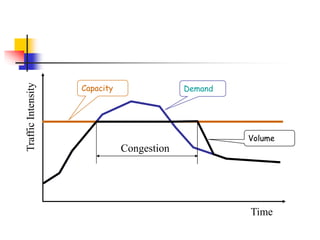
Definitions
 Count – number of vehicles/travelers
passing a highway spot in a counting
period
 Volume – number of vehicles/travelers
passing a highway spot per unit time
 Capacity – maximum and repeatable
volume of vehicles/travelers
 Demand – volume not influenced by
highway capacity
Demand
Capacity
Volume
Congestion
Time
Traffic
Intensity
Types of Volume Counts
 Cordon Counts
 Screen Line Counts
 Intersection Counts
 Pedestrian Volume Counts
 Periodic Volume Counts
 Continuous Counts
 Control Counts
 Coverage Counts
Traffic Volume Data
Presentation
 Traffic Flow Maps
 Intersection Summary Sheets
 Time-Based Distribution Charts
 Summary Tables
Travel Time and Delay
Studies
A travel time study determines the amount of time
required to travel from one point to another on a
given route.
In conducting such a study, information may also be
collected on the locations, durations and causes of
delays is known as travel time and delay studies.

Traffic Engineering.pptx

  • 1.
    Traffic Engineering Traffic engineeringis that phase of transportation engineering which deals with the planning, geometric design and traffic operations of roads, streets, and highways, their networks, terminals, abutting lands, and relationships with other modes of transportation. 1
  • 2.
    2 Safety: The PrimaryObjective The principal goal of the traffic engineer remains the provision of a safe system for highway traffic. Other Objectives of Traffic Engineer • Speed • Comfort • Convenience • Economy • Environmental compatibility
  • 3.
    3 •While SPEED oftravel is much to be desired, it is limited by transportation technology, human characteristics, and the need to provide safety. •COMFORT and CONVENIENCE are generic terms and mean different things to different people. •Comfort involves the physical characteristics of vehicles and roadways, and is influenced by our perception of safety. •Convenience relates more to the ease with which trips are made and the ability of transport systems to accommodate all of our travel needs at appropriate times.
  • 4.
    4 • ECONOMY isalso relative. Highway and other transportation systems involve massive construction, maintenance, and operating expenditures, most of which are provided through general and user taxes and fees. Nevertheless, every engineer, regardless of discipline, is called upon to provide the best possible systems for the money. •HARMONY WITH THE ENVIRONMENT is a complex issue that has become more important over time. All transportation systems have some negative impacts on the environment. All produce air and noise pollution in some forms, and all utilize valuable land resources.
  • 5.
  • 6.
    Main Categories ofTraffic Studies  INVENTORIES-provides a list or graphic display of existing information such as street widths, parking spaces, transit routes, traffic regulations.  ADMINISTRATIVE STUDIES-Use existing records, available in government agencies and departments.  DYNAMIC STUDIES- Involves to collect the data and include studies of speed, traffic volume, travel time and delay, parking and crashes.
  • 7.
    Spot Speed Studies Location for Spot Speed Studies  Time of Day and Duration of Spot Speed Studies  Sample Size for Spot Speed Studies  Methods for Conducting Spot Studies  Presentation and Analysis of Spot Speed Data
  • 8.
    Volume Studies  AverageAnnual Daily Traffic (AADT)  Average Daily Traffic(ADT)  Peak Hour Volume (PHV)  Vehicle Classification (VC)  Vehicle Miles of Travel (VMT)
  • 9.
    Average Annual DailyTraffic (AADT) AADT is the average of 24-hour counts collected every day of the year. AADTs are used in several traffic and transportation analyses for: (a) Estimation of highway user revenues (b) Computation of crash rates in terms of number of crashes per 100 million vehicle miles. (c) Establishment of traffic volume trends (d) Evaluation of the economic feasibility of highway projects (e) Development freeway and major arterial street systems (f) Development of improvement and maintenance programs
  • 10.
    Average Daily Traffic(ADT) ADTis the average of 24-hour counts collected over a number of days greater than one but less than a year. ADTs may be used for: (a) Planning for highway activities (b) Measurement of current demand (c) Evaluation of existing traffic flow
  • 11.
    Peak Hour Volume(PHV) PHV is the maximum number of vehicles that pass a point on a highway during a period of 60 consecutive minute. PHVs are used for: (a) Functional classification of highways (b) Design of geometric characteristics of a highway, for example, number of lanes, intersection signalization, or channelization (c) Capacity analysis (d) Development of programs related to traffic operations for example, one-way street systems of traffic routing (e) Development of parking regulations
  • 12.
    Definitions  Count –number of vehicles/travelers passing a highway spot in a counting period  Volume – number of vehicles/travelers passing a highway spot per unit time  Capacity – maximum and repeatable volume of vehicles/travelers  Demand – volume not influenced by highway capacity
  • 13.
  • 14.
    Types of VolumeCounts  Cordon Counts  Screen Line Counts  Intersection Counts  Pedestrian Volume Counts  Periodic Volume Counts  Continuous Counts  Control Counts  Coverage Counts
  • 15.
    Traffic Volume Data Presentation Traffic Flow Maps  Intersection Summary Sheets  Time-Based Distribution Charts  Summary Tables
  • 16.
    Travel Time andDelay Studies A travel time study determines the amount of time required to travel from one point to another on a given route. In conducting such a study, information may also be collected on the locations, durations and causes of delays is known as travel time and delay studies.