Prof. Karan S. Chauhan
Assistant Professor
Department Of Civil Engineering
@ Shri Labhubhai Trivedi Institute Of
Engineering And Technology
Doors & WindowsDoors & Windows
Subject :- Building Construction
Subject Code : 2130607
Doors
 A Door may be defined as an openable barrier secured in a
wall opening,
 A door is an accessible barrier which is provided in a wall
opening to give an access to the inside of a room of a
building. The internal portions of a building are connected
by doors.
Window
 It is a vented barrier secured ina wall opening,
 Function of window is to admit light and air to the building
and to give a view to outside.
 It must provide insulation against heat loss and in some case
again sound.
 It alos required to give a measure resistance to fire.
Ventilator
 It is a small window secured in an opening wall provided at
greater height i.e. near to roof of room or at lintel level or at top
of door or window for purpose of providing ventilation in room.
 It generally provided in w.c. , bath & storeroom.
 No of doors in room should be kept minimum, cause it
consume large number of doors & obstruct for in more
area.
 Doors should be in corner of room nearly about 20 cm,
not in centre of wall length.
 If two rooms are there it should be opposite in wall
facing each other so it provide good ventilation and
more air circulation in room.
 Size and number of window should be decided on the
basis of some important factors, such as distribution
of light, control of ventilation & privacy of the
occupants.
 Location of window also give functional interior
decoration of furniture
 Windows should be located in opposite wall, facing a
door or another window, so cross ventilation is
achieved.
 From the point of view of fresh air, the window should
be located on the northern side of a room & should be
located in the prevalent direction of wind.
 The sill level of window should be located min. About 70
to 80 cm floor level of the room.
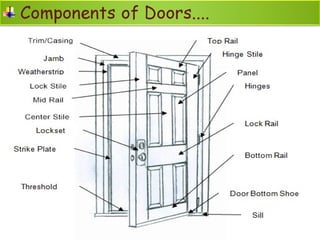
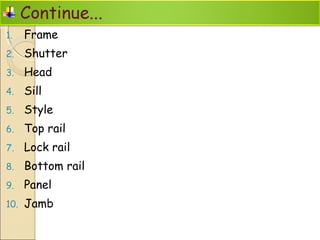
1. Frame
2. Shutter
3. Head
4. Sill
5. Style
6. Top rail
7. Lock rail
8. Bottom rail
9. Panel
10. Jamb
 It should be such that to allow movement of largest
object or tallest person likely to use door.
 As per rule the height of a door should not be less than
1.8 m to 2 m
 The width of door should be such that two person can
pass through it walking shoulder to shoulder
 Width = 0.4 m to 0.6 Height
 Height = (width + 1.2) meter.
 Doors for residential buildings :-
1. External Door = 1.10 X 2 m to 1.20 X 2 m
2. Internal door = 0.9 X 2.0 m to 1.0 X 2.0 m
3. Bath & W.C. = 0.7 X 2.0 m to 0.8 X 2.0 m
4. Garages for car = 2.25(Height) X 2.25(width) m to
2.40(Height) X 2.25(width) m
 Doors for public building such as schools, hospitals,
library etc... :-
1. 1.2 m X 2.0 m
2. 1.2 m X 2.1 m
3. 1.2 m X 2.25 m
It is based depending upon…
(1.) Types of materials used
Timber, Steel section, Aluminum section, Concrete, etc..
(2) Arrangement of different components of the door
1. Battened & ledge doors..
2. Battened , ledge & braced doors…
3. Battened, ledge, framed doors…
4. Battened, ledge, braced, & framed doors..
(3) Method of construction
1. Framed & panneled doors…
2. Glazed or sash doors…
3. Flush doors…
4. Louvered doors
5. Wire-gauged doors…
(4) Nature of working operation…
1. Revolving doors
2. Sliding doors
3. Swing doors
4. Collapsible steel doors
5. Rolling steel shutter doors
(5) Metal doors…
1. Mild steel sheet doors
2. Corrugated steel sheet doors
3. Hollow metal doors
4. Metal covered plywood doors
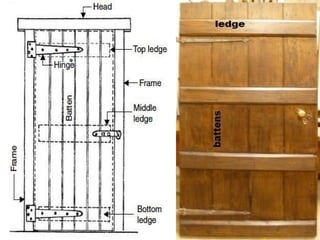
1. Battened and Ledged Doors1. Battened and Ledged Doors
 Battens are vertical bonds which are having grooves are
attached together by horizontal supports called ledges as
shown in below figure.
 General Dimensions of batten are 100-150mm width and 20-
30mm thick.
 General dimension of ledges are 100-200mm width and 25-
30mm thick.
 This type of battened and ledged doors suitable for narrow
openings.
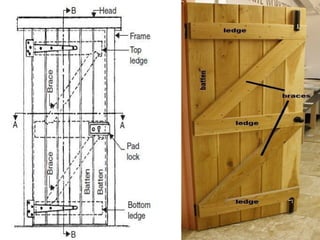
2.Battened, Ledged and Braced Doors2.Battened, Ledged and Braced Doors
 To make more rigid, braces are provided diagonally in
additional to battens and ledges as shown in figure.
 Braces are having 100-150mm width and 25-30mm thickness
are preferable.
 Braces should place upwards from handing side, then they
acts as struts and take compression.
 These type of doors can be used for wider openings.
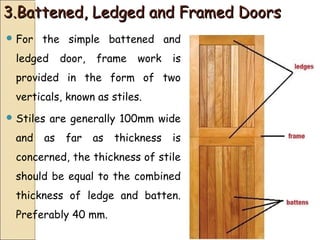
3.Battened, Ledged and Framed Doors3.Battened, Ledged and Framed Doors
 For the simple battened and
ledged door, frame work is
provided in the form of two
verticals, known as stiles.
 Stiles are generally 100mm wide
and as far as thickness is
concerned, the thickness of stile
should be equal to the combined
thickness of ledge and batten.
Preferably 40 mm.
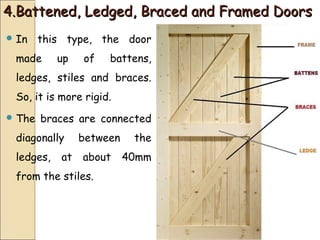
4.Battened, Ledged, Braced and Framed Doors4.Battened, Ledged, Braced and Framed Doors
 In this type, the door
made up of battens,
ledges, stiles and braces.
So, it is more rigid.
 The braces are connected
diagonally between the
ledges, at about 40mm
from the stiles.
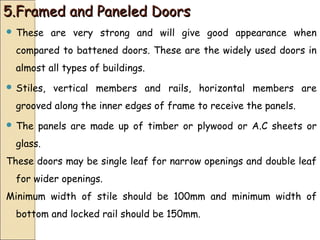
5.Framed and Paneled Doors5.Framed and Paneled Doors
 These are very strong and will give good appearance when
compared to battened doors. These are the widely used doors in
almost all types of buildings.
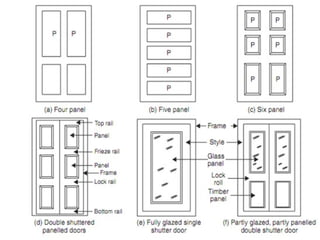
 Stiles, vertical members and rails, horizontal members are
grooved along the inner edges of frame to receive the panels.
 The panels are made up of timber or plywood or A.C sheets or
glass.
These doors may be single leaf for narrow openings and double leaf
for wider openings.
Minimum width of stile should be 100mm and minimum width of
bottom and locked rail should be 150mm.
6.Glazed or Sash Doors6.Glazed or Sash Doors
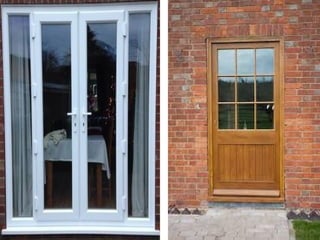
 Glazed doors are generally provided in interior wall
openings or in hospitals, colleges etc.
 The interior of room is visible through glazed doors
and light also passes through glazed portion of the
door.
 These may be fully glazed or partly glazed and partly
paneled. Glass panels are provided for glazed doors.
7.Flush Doors7.Flush Doors
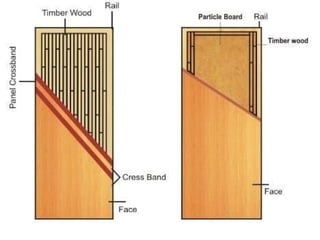
 In flush doors, a solid or semi-solid or core portion is
covered on both sides with plywood or face veneer. Now a
days these type of doors are widely used because of good
appearance, economic, ease of construction and greater
durability.
 There are two types of Flushed doors
1. Solid Core or Laminated Core Flush Door
2. Hollow core and cellular core flush door
Solid Core or Laminated Core Flush Door
 The core part in solid core flush door consists of core
strips of timber which are glued under high pressure
condition. Similarly in the laminated core, battens of 25mm
width are glued under high pressure.
 These doors consists of wooden frame with stiles and rails
for holding the core.
 Finally plywood sheets or face veneer and cross-bands are
glued under pressure on both side of doors.
Hollow Core and Cellular Core Flush DoorHollow Core and Cellular Core Flush Door
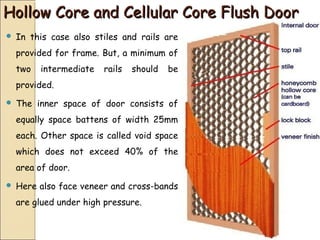
 In this case also stiles and rails are
provided for frame. But, a minimum of
two intermediate rails should be
provided.
 The inner space of door consists of
equally space battens of width 25mm
each. Other space is called void space
which does not exceed 40% of the
area of door.
 Here also face veneer and cross-bands
are glued under high pressure.
Louvered DoorsLouvered Doors
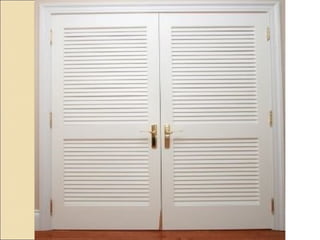
 The louvers permit natural ventilation when the door is
closed and also provide privacy in the room.
 These are generally used for toilets of residential and
public buildings.
 The door may be fully louvered are partly louvered.
 Louvers are made up of timber or glass or plywood and
these may be either fixed or movable.
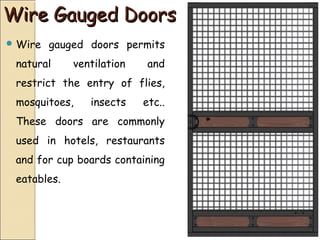
Wire Gauged DoorsWire Gauged Doors
 Wire gauged doors permits
natural ventilation and
restrict the entry of flies,
mosquitoes, insects etc..
These doors are commonly
used in hotels, restaurants
and for cup boards containing
eatables.
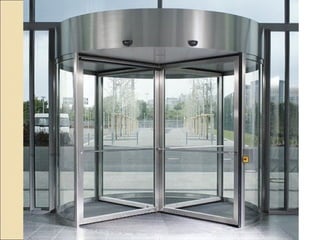
Revolving DoorsRevolving Doors
 Revolving doors are only provided in public buildings
like museums, banks, libraries etc., because of
constant visitors. It consists mullion at its centre to
which four radiating shutters are attached.
Sliding DoorsSliding Doors
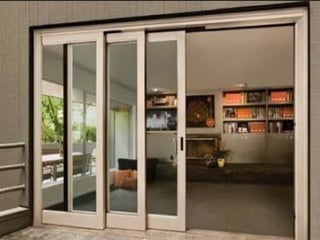
 In this type, with the help of runners and guide rails the
door slides to the sides. The door may have one or more
sliding shutter depending up on the opening available.
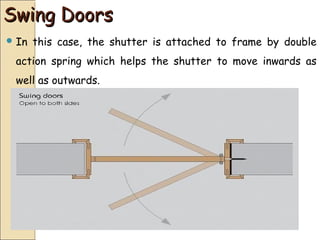
Swing DoorsSwing Doors
 In this case, the shutter is attached to frame by double
action spring which helps the shutter to move inwards as
well as outwards.
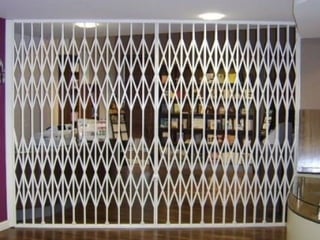
Collapsible Steel DoorsCollapsible Steel Doors
 Collapsible steel doors are generally used for workshops,
sheds, warehouses etc.. It acts like a steel curtain which
will opened or closed by horizontal pull or push. Vertical
double channel units of (20x10x2 mm) are spaced at 100
to 120 mm thick and are braced flat iron diagonals 10 to
20mm wide and 5mm thick
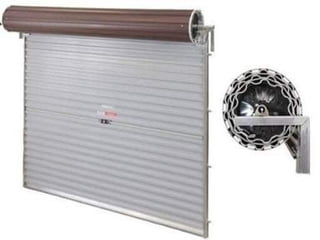
Rolling Steel Shutter DoorsRolling Steel Shutter Doors
 Rolling steel shutter doors are commonly used for
warehouses, garages, shops etc.. These are very strong and
offer proper safety to the property. The door consists
frame, drum and a shutter of thin steel plate inter locked
together. A horizontal shaft is provided in the drum which
helps to open or close the shutter.
Mild Steel Sheet DoorsMild Steel Sheet Doors
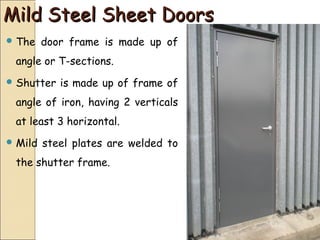
 The door frame is made up of
angle or T-sections.
 Shutter is made up of frame of
angle of iron, having 2 verticals
at least 3 horizontal.
 Mild steel plates are welded to
the shutter frame.
Corrugated Steel Sheet DoorsCorrugated Steel Sheet Doors
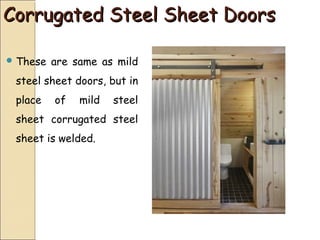
 These are same as mild
steel sheet doors, but in
place of mild steel
sheet corrugated steel
sheet is welded.
Hollow Metal DoorsHollow Metal Doors
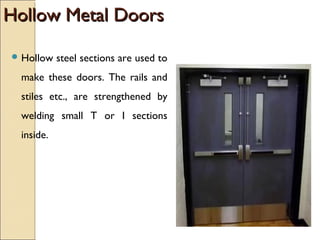
 Hollow steel sections are used to
make these doors. The rails and
stiles etc., are strengthened by
welding small T or I sections
inside.
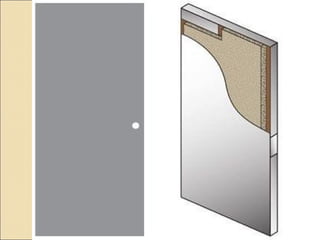
Metal Covered Plywood DoorsMetal Covered Plywood Doors
 This type of door is a composite construction of
hollow metal door and wood door.
 The door is encased in tight fitting sheet metal,
having tightly folded joints to exclude air so that the
core of the door does not ignite. So, it acts as fire
proof.
Selection Criteria for WindowsSelection Criteria for Windows
 Selection of suitable window in a particular place
should be dependent of following factors.
1. Location of room
2. Size of room
3. Direction of wind
4. Climatic conditions
5. Utility of room
6. Architectural point of view
Types of WindowsTypes of Windows
 There are so many types of windows are available based on their
positions, materials and functioning. Windows are classified as
follows.
1. Fixed Windows
2. Sliding Windows
3. Pivoted Windows
4. Double Hung Windows
5. Louvered Windows
6. Casement Windows
7. Metal Windows
8. Sash Windows
9. Corner Windows
10. Bay Windows
11. Dormer Windows
12. Clerestory Windows
13. Lantern Windows
14. Gable Windows
15. Ventilators
16. Skylights
Fixed WindowsFixed Windows
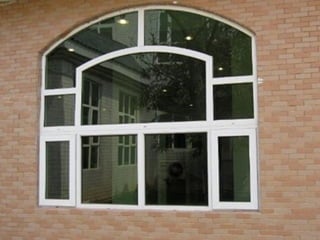
 Fixed windows are fixed to the wall without any
closing or opening operation. In general, they are
provided to transmit the light into the room. Fully
glazed shutters are fixed to the window frame. The
shutters provided are generally weather proof.
Sliding WindowsSliding Windows
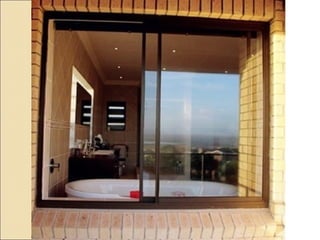
 In this case, window shutters are movable in the
frame. The movement may be horizontal or vertical
based on our requirement. The movement of shutters
is done by the provision of roller bearings. Generally,
this type of window is provided in buses, bank
counters, shops etc..
Pivoted WindowsPivoted Windows
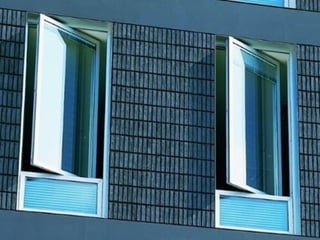
 In this type of windows, pivots are provided to
window frames. Pivot is a shaft which helps to
oscillate the shutter. No rebates are required for
the frame. The swinging may either horizontal or
vertical based on the position of pivots.
Double Hung WindowsDouble Hung Windows
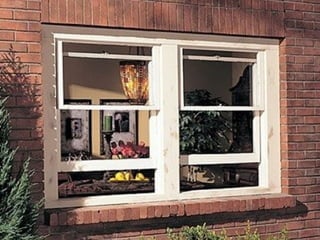
 Double hung windows consist of pair of shutters attached to one
frame. The shutters are arranged one above the other. These two
shutters can slide vertically with in the frame. So, we can open the
windows on top or at bottom to our required level.
 To operate the double hung windows, a chain or cord consisting
metal weights is metal provided which is connected over pulleys.
So, by pulling the weights of cord the shutters can move vertically.
 Then we can fix the windows at our required position of
ventilation or light etc..
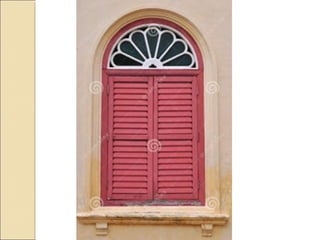
Louvered WindowsLouvered Windows
 Louvered windows are similar to louvered doors which are
provided for the ventilation without any outside vision. The louvers
may be made of wood, glass or metal. Louvers can also be folded
by provision of cord over pulleys. We can maintain the slope of
louvers by tilting cord and lifting cord. Recommended angle of
inclination of louvers is about 45o
. The sloping of louvers is
downward to the outside to run-off the rain water. Generally, they
are provided for bath rooms, toilets and privacy places etc..
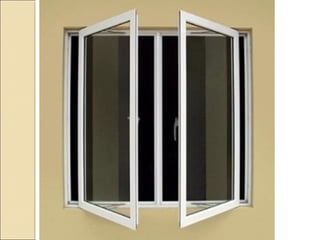
Casement WindowsCasement Windows
 Casement windows are the widely used and common
windows nowadays. The shutters are attached to frame and
these can be opened and closed like door shutters. Rebates
are provided to the frame to receive the shutters. The panels
of shutters may be single or multiple. Sometimes wired mesh
is provided to stop entering of fly’s.
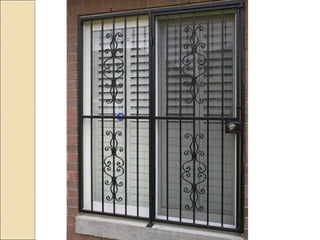
Metal WindowsMetal Windows
 Metal windows, generally mild steel is used for making metal
windows. These are very cheap and have more strength. So,
now days these are widely using especially for public
buildings, private building etc. some other metals like
aluminum, bronze, stainless steel etc. also used to make
windows. But they are costly compared to mild steel
windows. For normal casement windows also, metal shutters
are provided to give strong support to the panels.
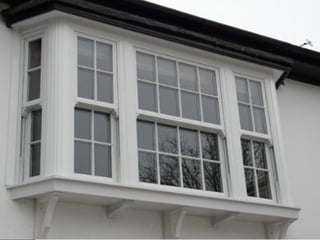
Sash WindowsSash Windows
 Sash window is type of casement window, but in this case
panels are fully glazed. It consists top, bottom and
intermediate rails. The space between the rails is divided into
small panels by mean of small timber members called sash
bars or glazing bars.
Corner WindowsCorner Windows
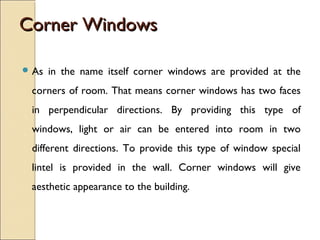
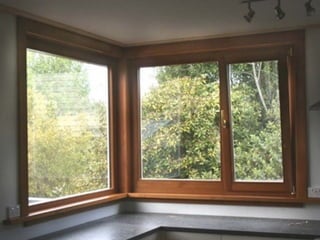
 As in the name itself corner windows are provided at the
corners of room. That means corner windows has two faces
in perpendicular directions. By providing this type of
windows, light or air can be entered into room in two
different directions. To provide this type of window special
lintel is provided in the wall. Corner windows will give
aesthetic appearance to the building.
Bay WindowsBay Windows
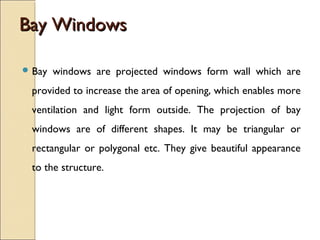
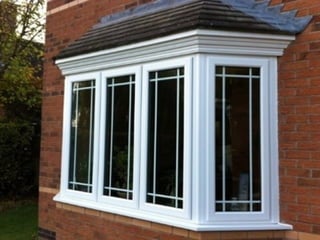
 Bay windows are projected windows form wall which are
provided to increase the area of opening, which enables more
ventilation and light form outside. The projection of bay
windows are of different shapes. It may be triangular or
rectangular or polygonal etc. They give beautiful appearance
to the structure.
Dormer WindowsDormer Windows
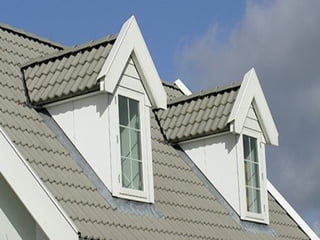
 Dormer windows are provided for sloped roofs. These are
projected form the sloping surface as shown in below image.
They provide ventilation as well as lighting to the room. They
also enhance aesthetic sense of room.
Clerestory WindowsClerestory Windows
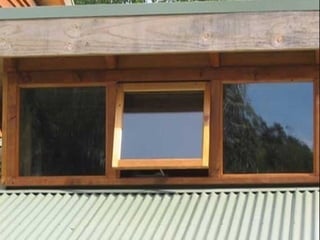
 If the rooms in a building are of different ceiling heights,
clerestory windows are provided for the room which has
greater ceiling height than the other rooms. The shutters able
to swing with the help of cord over pulleys. These also
enhances the beauty of building.
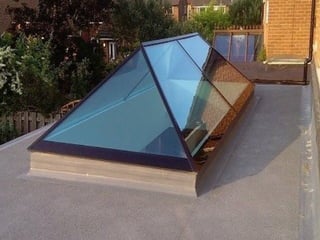
Lantern WindowsLantern Windows
 Lantern windows are provided for over the flat roofs. The
main purpose of this window is to provide the more light and
air circulation to the interior rooms. Generally, they are
projected from the roof surface so, we can close the roof
surface when we required.
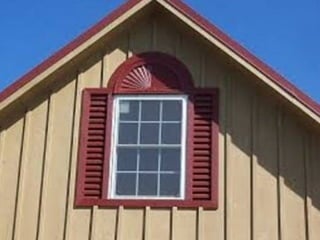
Gable WindowsGable Windows
 Gable windows are provided for sloped roof buildings. These
windows are provided at the gable end of sloped roof so;
they are called as gable windows. They also improve the
appearance of building.
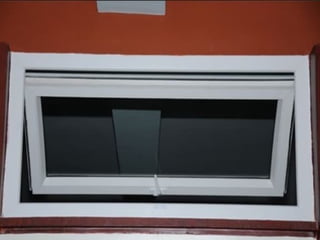
VentilatorsVentilators
 Ventilators are provided for the purpose of ventilation in the
room. They are provided at greater height than windows
nearer to roof level. It is in very small size. Horizontally
pivoted shutters are provided for ventilators. Sometimes
shutter is replaced by wired mesh, in this case sunshade is
provided to prevent against rain water.
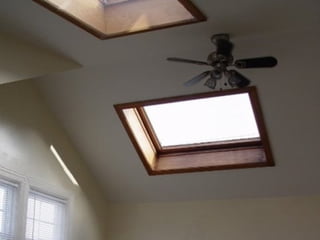
SkylightsSkylights
 Skylights or generally provided on the top of sloped roofs. To
admit light in to the rooms, sky lights are provided. It is
provided parallel to the sloping surface. Sky lights can be
opened when we required. Lead gutters are arranged to
frame to make it as water proof.
Doors,Windows & Ventilator in Building Construction

Doors,Windows & Ventilator in Building Construction

  • 1.
    Prof. Karan S.Chauhan Assistant Professor Department Of Civil Engineering @ Shri Labhubhai Trivedi Institute Of Engineering And Technology Doors & WindowsDoors & Windows Subject :- Building Construction Subject Code : 2130607
  • 2.
    Doors  A Doormay be defined as an openable barrier secured in a wall opening,  A door is an accessible barrier which is provided in a wall opening to give an access to the inside of a room of a building. The internal portions of a building are connected by doors.
  • 3.
    Window  It isa vented barrier secured ina wall opening,  Function of window is to admit light and air to the building and to give a view to outside.  It must provide insulation against heat loss and in some case again sound.  It alos required to give a measure resistance to fire.
  • 4.
    Ventilator  It isa small window secured in an opening wall provided at greater height i.e. near to roof of room or at lintel level or at top of door or window for purpose of providing ventilation in room.  It generally provided in w.c. , bath & storeroom.
  • 5.
     No ofdoors in room should be kept minimum, cause it consume large number of doors & obstruct for in more area.  Doors should be in corner of room nearly about 20 cm, not in centre of wall length.  If two rooms are there it should be opposite in wall facing each other so it provide good ventilation and more air circulation in room.  Size and number of window should be decided on the basis of some important factors, such as distribution of light, control of ventilation & privacy of the occupants.  Location of window also give functional interior decoration of furniture
  • 6.
     Windows shouldbe located in opposite wall, facing a door or another window, so cross ventilation is achieved.  From the point of view of fresh air, the window should be located on the northern side of a room & should be located in the prevalent direction of wind.  The sill level of window should be located min. About 70 to 80 cm floor level of the room.
  • 8.
    1. Frame 2. Shutter 3.Head 4. Sill 5. Style 6. Top rail 7. Lock rail 8. Bottom rail 9. Panel 10. Jamb
  • 9.
     It shouldbe such that to allow movement of largest object or tallest person likely to use door.  As per rule the height of a door should not be less than 1.8 m to 2 m  The width of door should be such that two person can pass through it walking shoulder to shoulder  Width = 0.4 m to 0.6 Height  Height = (width + 1.2) meter.
  • 10.
     Doors forresidential buildings :- 1. External Door = 1.10 X 2 m to 1.20 X 2 m 2. Internal door = 0.9 X 2.0 m to 1.0 X 2.0 m 3. Bath & W.C. = 0.7 X 2.0 m to 0.8 X 2.0 m 4. Garages for car = 2.25(Height) X 2.25(width) m to 2.40(Height) X 2.25(width) m  Doors for public building such as schools, hospitals, library etc... :- 1. 1.2 m X 2.0 m 2. 1.2 m X 2.1 m 3. 1.2 m X 2.25 m
  • 11.
    It is baseddepending upon… (1.) Types of materials used Timber, Steel section, Aluminum section, Concrete, etc.. (2) Arrangement of different components of the door 1. Battened & ledge doors.. 2. Battened , ledge & braced doors… 3. Battened, ledge, framed doors… 4. Battened, ledge, braced, & framed doors.. (3) Method of construction 1. Framed & panneled doors… 2. Glazed or sash doors… 3. Flush doors… 4. Louvered doors 5. Wire-gauged doors…
  • 12.
    (4) Nature ofworking operation… 1. Revolving doors 2. Sliding doors 3. Swing doors 4. Collapsible steel doors 5. Rolling steel shutter doors (5) Metal doors… 1. Mild steel sheet doors 2. Corrugated steel sheet doors 3. Hollow metal doors 4. Metal covered plywood doors
  • 13.
    1. Battened andLedged Doors1. Battened and Ledged Doors  Battens are vertical bonds which are having grooves are attached together by horizontal supports called ledges as shown in below figure.  General Dimensions of batten are 100-150mm width and 20- 30mm thick.  General dimension of ledges are 100-200mm width and 25- 30mm thick.  This type of battened and ledged doors suitable for narrow openings.
  • 15.
    2.Battened, Ledged andBraced Doors2.Battened, Ledged and Braced Doors  To make more rigid, braces are provided diagonally in additional to battens and ledges as shown in figure.  Braces are having 100-150mm width and 25-30mm thickness are preferable.  Braces should place upwards from handing side, then they acts as struts and take compression.  These type of doors can be used for wider openings.
  • 17.
    3.Battened, Ledged andFramed Doors3.Battened, Ledged and Framed Doors  For the simple battened and ledged door, frame work is provided in the form of two verticals, known as stiles.  Stiles are generally 100mm wide and as far as thickness is concerned, the thickness of stile should be equal to the combined thickness of ledge and batten. Preferably 40 mm.
  • 18.
    4.Battened, Ledged, Bracedand Framed Doors4.Battened, Ledged, Braced and Framed Doors  In this type, the door made up of battens, ledges, stiles and braces. So, it is more rigid.  The braces are connected diagonally between the ledges, at about 40mm from the stiles.
  • 19.
    5.Framed and PaneledDoors5.Framed and Paneled Doors  These are very strong and will give good appearance when compared to battened doors. These are the widely used doors in almost all types of buildings.  Stiles, vertical members and rails, horizontal members are grooved along the inner edges of frame to receive the panels.  The panels are made up of timber or plywood or A.C sheets or glass. These doors may be single leaf for narrow openings and double leaf for wider openings. Minimum width of stile should be 100mm and minimum width of bottom and locked rail should be 150mm.
  • 21.
    6.Glazed or SashDoors6.Glazed or Sash Doors  Glazed doors are generally provided in interior wall openings or in hospitals, colleges etc.  The interior of room is visible through glazed doors and light also passes through glazed portion of the door.  These may be fully glazed or partly glazed and partly paneled. Glass panels are provided for glazed doors.
  • 23.
    7.Flush Doors7.Flush Doors In flush doors, a solid or semi-solid or core portion is covered on both sides with plywood or face veneer. Now a days these type of doors are widely used because of good appearance, economic, ease of construction and greater durability.  There are two types of Flushed doors 1. Solid Core or Laminated Core Flush Door 2. Hollow core and cellular core flush door
  • 24.
    Solid Core orLaminated Core Flush Door  The core part in solid core flush door consists of core strips of timber which are glued under high pressure condition. Similarly in the laminated core, battens of 25mm width are glued under high pressure.  These doors consists of wooden frame with stiles and rails for holding the core.  Finally plywood sheets or face veneer and cross-bands are glued under pressure on both side of doors.
  • 26.
    Hollow Core andCellular Core Flush DoorHollow Core and Cellular Core Flush Door  In this case also stiles and rails are provided for frame. But, a minimum of two intermediate rails should be provided.  The inner space of door consists of equally space battens of width 25mm each. Other space is called void space which does not exceed 40% of the area of door.  Here also face veneer and cross-bands are glued under high pressure.
  • 27.
    Louvered DoorsLouvered Doors The louvers permit natural ventilation when the door is closed and also provide privacy in the room.  These are generally used for toilets of residential and public buildings.  The door may be fully louvered are partly louvered.  Louvers are made up of timber or glass or plywood and these may be either fixed or movable.
  • 29.
    Wire Gauged DoorsWireGauged Doors  Wire gauged doors permits natural ventilation and restrict the entry of flies, mosquitoes, insects etc.. These doors are commonly used in hotels, restaurants and for cup boards containing eatables.
  • 30.
    Revolving DoorsRevolving Doors Revolving doors are only provided in public buildings like museums, banks, libraries etc., because of constant visitors. It consists mullion at its centre to which four radiating shutters are attached.
  • 32.
    Sliding DoorsSliding Doors In this type, with the help of runners and guide rails the door slides to the sides. The door may have one or more sliding shutter depending up on the opening available.
  • 34.
    Swing DoorsSwing Doors In this case, the shutter is attached to frame by double action spring which helps the shutter to move inwards as well as outwards.
  • 35.
    Collapsible Steel DoorsCollapsibleSteel Doors  Collapsible steel doors are generally used for workshops, sheds, warehouses etc.. It acts like a steel curtain which will opened or closed by horizontal pull or push. Vertical double channel units of (20x10x2 mm) are spaced at 100 to 120 mm thick and are braced flat iron diagonals 10 to 20mm wide and 5mm thick
  • 37.
    Rolling Steel ShutterDoorsRolling Steel Shutter Doors  Rolling steel shutter doors are commonly used for warehouses, garages, shops etc.. These are very strong and offer proper safety to the property. The door consists frame, drum and a shutter of thin steel plate inter locked together. A horizontal shaft is provided in the drum which helps to open or close the shutter.
  • 39.
    Mild Steel SheetDoorsMild Steel Sheet Doors  The door frame is made up of angle or T-sections.  Shutter is made up of frame of angle of iron, having 2 verticals at least 3 horizontal.  Mild steel plates are welded to the shutter frame.
  • 40.
    Corrugated Steel SheetDoorsCorrugated Steel Sheet Doors  These are same as mild steel sheet doors, but in place of mild steel sheet corrugated steel sheet is welded.
  • 41.
    Hollow Metal DoorsHollowMetal Doors  Hollow steel sections are used to make these doors. The rails and stiles etc., are strengthened by welding small T or I sections inside.
  • 42.
    Metal Covered PlywoodDoorsMetal Covered Plywood Doors  This type of door is a composite construction of hollow metal door and wood door.  The door is encased in tight fitting sheet metal, having tightly folded joints to exclude air so that the core of the door does not ignite. So, it acts as fire proof.
  • 44.
    Selection Criteria forWindowsSelection Criteria for Windows  Selection of suitable window in a particular place should be dependent of following factors. 1. Location of room 2. Size of room 3. Direction of wind 4. Climatic conditions 5. Utility of room 6. Architectural point of view
  • 45.
    Types of WindowsTypesof Windows  There are so many types of windows are available based on their positions, materials and functioning. Windows are classified as follows. 1. Fixed Windows 2. Sliding Windows 3. Pivoted Windows 4. Double Hung Windows 5. Louvered Windows 6. Casement Windows 7. Metal Windows 8. Sash Windows 9. Corner Windows 10. Bay Windows 11. Dormer Windows 12. Clerestory Windows 13. Lantern Windows 14. Gable Windows 15. Ventilators 16. Skylights
  • 46.
    Fixed WindowsFixed Windows Fixed windows are fixed to the wall without any closing or opening operation. In general, they are provided to transmit the light into the room. Fully glazed shutters are fixed to the window frame. The shutters provided are generally weather proof.
  • 48.
    Sliding WindowsSliding Windows In this case, window shutters are movable in the frame. The movement may be horizontal or vertical based on our requirement. The movement of shutters is done by the provision of roller bearings. Generally, this type of window is provided in buses, bank counters, shops etc..
  • 50.
    Pivoted WindowsPivoted Windows In this type of windows, pivots are provided to window frames. Pivot is a shaft which helps to oscillate the shutter. No rebates are required for the frame. The swinging may either horizontal or vertical based on the position of pivots.
  • 52.
    Double Hung WindowsDoubleHung Windows  Double hung windows consist of pair of shutters attached to one frame. The shutters are arranged one above the other. These two shutters can slide vertically with in the frame. So, we can open the windows on top or at bottom to our required level.  To operate the double hung windows, a chain or cord consisting metal weights is metal provided which is connected over pulleys. So, by pulling the weights of cord the shutters can move vertically.  Then we can fix the windows at our required position of ventilation or light etc..
  • 54.
    Louvered WindowsLouvered Windows Louvered windows are similar to louvered doors which are provided for the ventilation without any outside vision. The louvers may be made of wood, glass or metal. Louvers can also be folded by provision of cord over pulleys. We can maintain the slope of louvers by tilting cord and lifting cord. Recommended angle of inclination of louvers is about 45o . The sloping of louvers is downward to the outside to run-off the rain water. Generally, they are provided for bath rooms, toilets and privacy places etc..
  • 56.
    Casement WindowsCasement Windows Casement windows are the widely used and common windows nowadays. The shutters are attached to frame and these can be opened and closed like door shutters. Rebates are provided to the frame to receive the shutters. The panels of shutters may be single or multiple. Sometimes wired mesh is provided to stop entering of fly’s.
  • 58.
    Metal WindowsMetal Windows Metal windows, generally mild steel is used for making metal windows. These are very cheap and have more strength. So, now days these are widely using especially for public buildings, private building etc. some other metals like aluminum, bronze, stainless steel etc. also used to make windows. But they are costly compared to mild steel windows. For normal casement windows also, metal shutters are provided to give strong support to the panels.
  • 60.
    Sash WindowsSash Windows Sash window is type of casement window, but in this case panels are fully glazed. It consists top, bottom and intermediate rails. The space between the rails is divided into small panels by mean of small timber members called sash bars or glazing bars.
  • 62.
    Corner WindowsCorner Windows As in the name itself corner windows are provided at the corners of room. That means corner windows has two faces in perpendicular directions. By providing this type of windows, light or air can be entered into room in two different directions. To provide this type of window special lintel is provided in the wall. Corner windows will give aesthetic appearance to the building.
  • 64.
    Bay WindowsBay Windows Bay windows are projected windows form wall which are provided to increase the area of opening, which enables more ventilation and light form outside. The projection of bay windows are of different shapes. It may be triangular or rectangular or polygonal etc. They give beautiful appearance to the structure.
  • 66.
    Dormer WindowsDormer Windows Dormer windows are provided for sloped roofs. These are projected form the sloping surface as shown in below image. They provide ventilation as well as lighting to the room. They also enhance aesthetic sense of room.
  • 68.
    Clerestory WindowsClerestory Windows If the rooms in a building are of different ceiling heights, clerestory windows are provided for the room which has greater ceiling height than the other rooms. The shutters able to swing with the help of cord over pulleys. These also enhances the beauty of building.
  • 70.
    Lantern WindowsLantern Windows Lantern windows are provided for over the flat roofs. The main purpose of this window is to provide the more light and air circulation to the interior rooms. Generally, they are projected from the roof surface so, we can close the roof surface when we required.
  • 72.
    Gable WindowsGable Windows Gable windows are provided for sloped roof buildings. These windows are provided at the gable end of sloped roof so; they are called as gable windows. They also improve the appearance of building.
  • 74.
    VentilatorsVentilators  Ventilators areprovided for the purpose of ventilation in the room. They are provided at greater height than windows nearer to roof level. It is in very small size. Horizontally pivoted shutters are provided for ventilators. Sometimes shutter is replaced by wired mesh, in this case sunshade is provided to prevent against rain water.
  • 76.
    SkylightsSkylights  Skylights orgenerally provided on the top of sloped roofs. To admit light in to the rooms, sky lights are provided. It is provided parallel to the sloping surface. Sky lights can be opened when we required. Lead gutters are arranged to frame to make it as water proof.