Functional Classification of Roads
Mobility & Accessibility
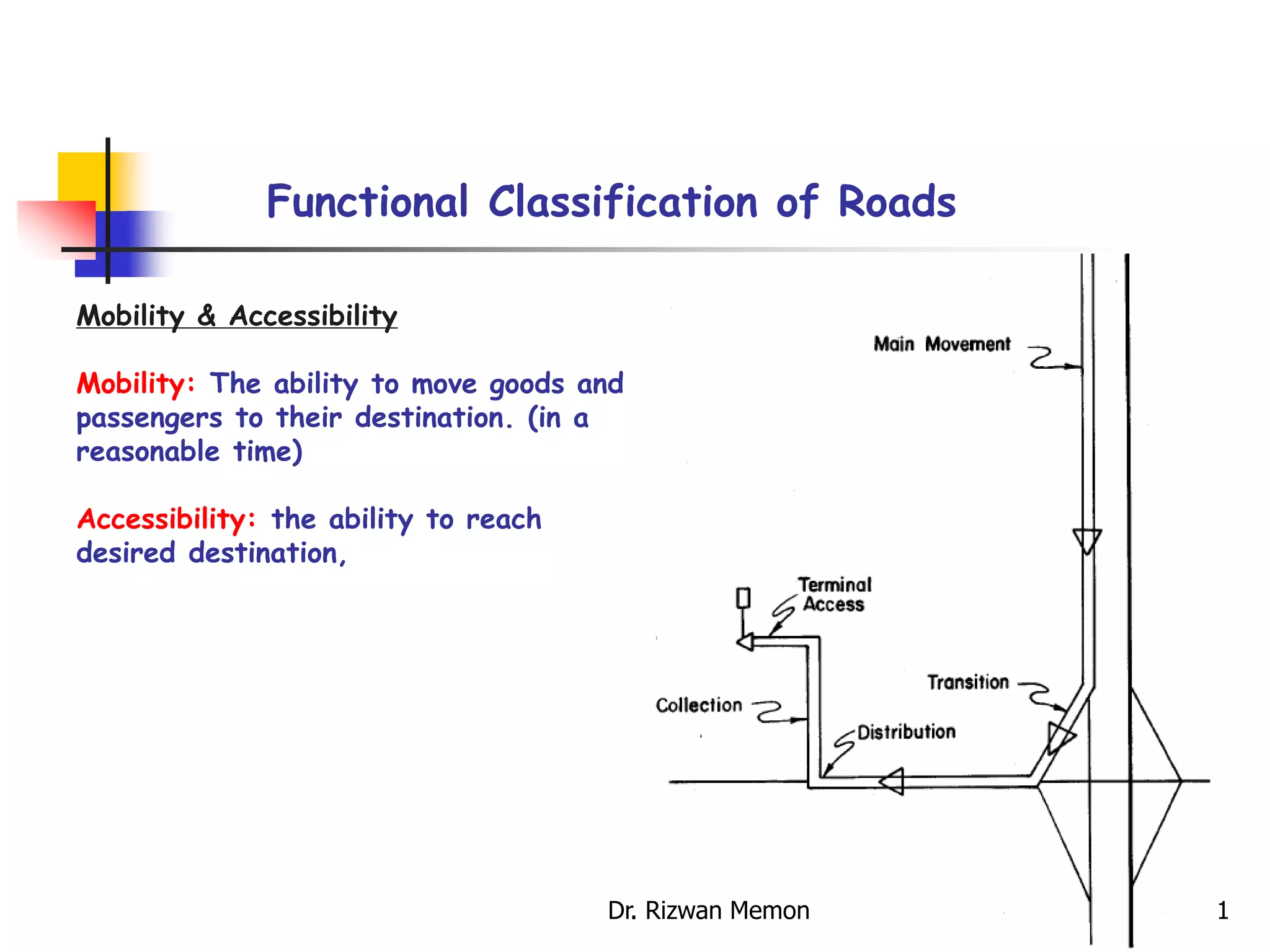
Mobility: The ability to move goods and
passengers to their destination. (in a
reasonable time)
Accessibility: the ability to reach
desired destination,
1
Dr. Rizwan Memon
• The first step in the design process is to define the
function that the facility is to serve.
• The level of service required to fulfill this function
for the anticipated volume and composition of traffic
provides a rational and cost-effective basis for the
selection of design speed and geometric criteria
within the range of values available to the designer
(for the specified functional classification).
• The use of functional classification as a design type
should appropriately integrate the highway planning
and design process. 2
Dr. Rizwan Memon
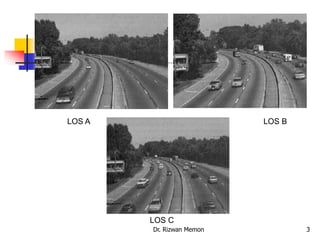
LOS A
LOS C
LOS B
3
Dr. Rizwan Memon
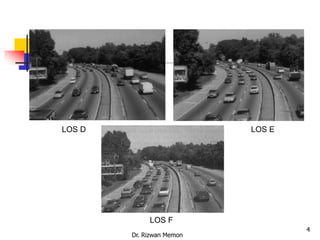
LOS D
LOS F
LOS E
4
Dr. Rizwan Memon
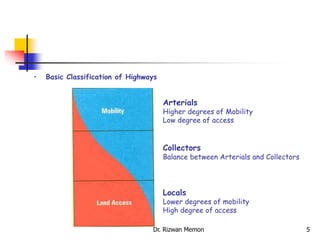
• Basic Classification of Highways
Arterials
Higher degrees of Mobility
Low degree of access
Collectors
Balance between Arterials and Collectors
Locals
Lower degrees of mobility
High degree of access
5
Dr. Rizwan Memon
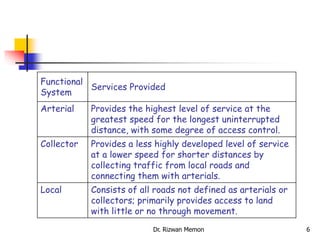
Functional
System
Services Provided
Arterial Provides the highest level of service at the
greatest speed for the longest uninterrupted
distance, with some degree of access control.
Collector Provides a less highly developed level of service
at a lower speed for shorter distances by
collecting traffic from local roads and
connecting them with arterials.
Local Consists of all roads not defined as arterials or
collectors; primarily provides access to land
with little or no through movement.
6
Dr. Rizwan Memon
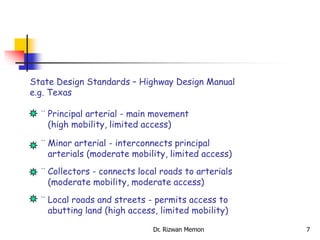
¨ Principal arterial - main movement
(high mobility, limited access)
¨ Minor arterial - interconnects principal
arterials (moderate mobility, limited access)
¨ Collectors - connects local roads to arterials
(moderate mobility, moderate access)
¨ Local roads and streets - permits access to
abutting land (high access, limited mobility)
State Design Standards – Highway Design Manual
e.g. Texas
7
Dr. Rizwan Memon
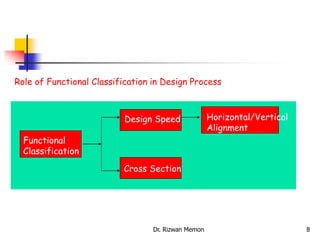
Role of Functional Classification in Design Process
Functional
Classification
Design Speed
Cross Section
Horizontal/Vertical
Alignment
8
Dr. Rizwan Memon
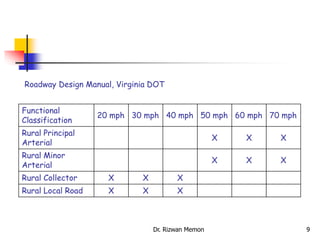
Functional
Classification
20 mph 30 mph 40 mph 50 mph 60 mph 70 mph
Rural Principal
Arterial
X X X
Rural Minor
Arterial
X X X
Rural Collector X X X
Rural Local Road X X X
Roadway Design Manual, Virginia DOT
9
Dr. Rizwan Memon
Dr. Rizwan Memon 10
Dr. Rizwan Memon 11
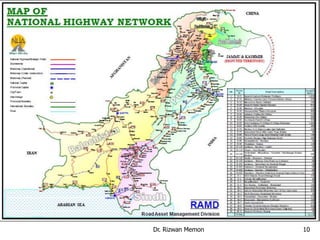
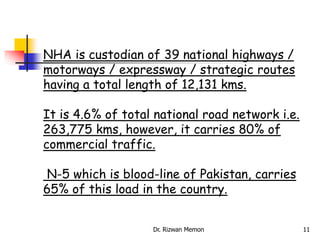
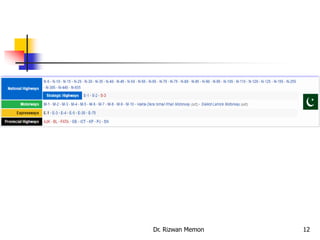
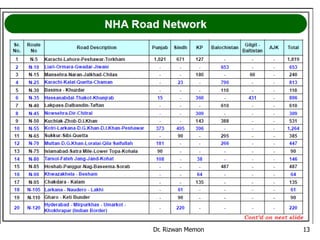
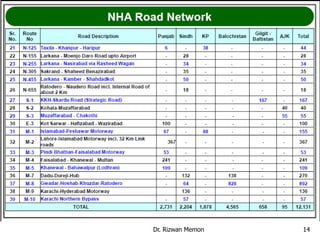
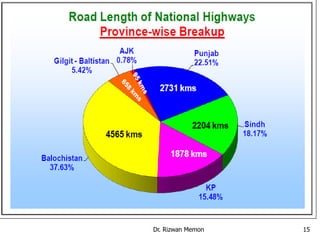
NHA is custodian of 39 national highways /
motorways / expressway / strategic routes
having a total length of 12,131 kms.
It is 4.6% of total national road network i.e.
263,775 kms, however, it carries 80% of
commercial traffic.
N-5 which is blood-line of Pakistan, carries
65% of this load in the country.
Dr. Rizwan Memon 12
Dr. Rizwan Memon 13
Dr. Rizwan Memon 14
Dr. Rizwan Memon 15
Dr. Rizwan Memon 16

05. Classification of Roads.pptx

  • 1.
    Functional Classification ofRoads Mobility & Accessibility Mobility: The ability to move goods and passengers to their destination. (in a reasonable time) Accessibility: the ability to reach desired destination, 1 Dr. Rizwan Memon
  • 2.
    • The firststep in the design process is to define the function that the facility is to serve. • The level of service required to fulfill this function for the anticipated volume and composition of traffic provides a rational and cost-effective basis for the selection of design speed and geometric criteria within the range of values available to the designer (for the specified functional classification). • The use of functional classification as a design type should appropriately integrate the highway planning and design process. 2 Dr. Rizwan Memon
  • 3.
    LOS A LOS C LOSB 3 Dr. Rizwan Memon
  • 4.
    LOS D LOS F LOSE 4 Dr. Rizwan Memon
  • 5.
    • Basic Classificationof Highways Arterials Higher degrees of Mobility Low degree of access Collectors Balance between Arterials and Collectors Locals Lower degrees of mobility High degree of access 5 Dr. Rizwan Memon
  • 6.
    Functional System Services Provided Arterial Providesthe highest level of service at the greatest speed for the longest uninterrupted distance, with some degree of access control. Collector Provides a less highly developed level of service at a lower speed for shorter distances by collecting traffic from local roads and connecting them with arterials. Local Consists of all roads not defined as arterials or collectors; primarily provides access to land with little or no through movement. 6 Dr. Rizwan Memon
  • 7.
    ¨ Principal arterial- main movement (high mobility, limited access) ¨ Minor arterial - interconnects principal arterials (moderate mobility, limited access) ¨ Collectors - connects local roads to arterials (moderate mobility, moderate access) ¨ Local roads and streets - permits access to abutting land (high access, limited mobility) State Design Standards – Highway Design Manual e.g. Texas 7 Dr. Rizwan Memon
  • 8.
    Role of FunctionalClassification in Design Process Functional Classification Design Speed Cross Section Horizontal/Vertical Alignment 8 Dr. Rizwan Memon
  • 9.
    Functional Classification 20 mph 30mph 40 mph 50 mph 60 mph 70 mph Rural Principal Arterial X X X Rural Minor Arterial X X X Rural Collector X X X Rural Local Road X X X Roadway Design Manual, Virginia DOT 9 Dr. Rizwan Memon
  • 10.
  • 11.
    Dr. Rizwan Memon11 NHA is custodian of 39 national highways / motorways / expressway / strategic routes having a total length of 12,131 kms. It is 4.6% of total national road network i.e. 263,775 kms, however, it carries 80% of commercial traffic. N-5 which is blood-line of Pakistan, carries 65% of this load in the country.
  • 12.
  • 13.
  • 14.
  • 15.
  • 16.