Highway Planning
 Planning is considered as a prerequisite before
attempting any development program, particularly
when the funds are limited and total requirements
are much higher.
 Highway planning is also a basic need for highway
development.
1
Dr. Rizwan Memon
The objects of highway Planning are:
1. To plan a road net work for efficient and safe
traffic operation, but at minimum cost.
2. To arrive at the road system having maximum
utility which could be constructed within the
available resources during the plan period.
3. To fix the priorities for development of each road
link based on the utility as the main criteria for
phasing the road development.
2
Dr. Rizwan Memon
4. To plan for future requirement and improvements
of roads in view of anticipated developments
5. To work out financing systems
Highway planning phase includes:
a) Assessment of road length requirement for an
area.
b) Preparation of Master Plan showing the phasing of
plan in annual or five year plans.
3
Dr. Rizwan Memon
The planning surveys includes following studies:
A. Economic Studies
B. Finacial Stuides
C. Traffic or road use studies
D. Engineering Studies
Planning Surveys
4
Dr. Rizwan Memon
A. Economic Studies includes:
i. Population and its distribution in each village, town
or other locality
ii. Trend of population growth
iii. Agricultural and Industrial products and their
listing in classified groups area wise.
iv. Industrial and Agricultural development and
future trends
v. Existing facilities with regards to communication,
recreation and income.
vi. Per capita income
5
Dr. Rizwan Memon
B. Financial Studies includes:
i. Sources of income and estimated revenue from
road transport
ii. Living Standards
iii. Resource from local levels, toll taxes, vehicle
registration and fines
iv. Future trends in financial aspects
6
Dr. Rizwan Memon
C. Traffic and Road use Studies includes:
i. Traffic volume in Vehicles/day, Annual Average
Daily Traffic (AADT) and Peak Hourly Volume
(PHV)
ii. Origin and Destination Studies (O & D Studies)
iii. Traffic Flow Patterns
iv. Accidents, their cost analysis and causes
v. Future trend and growth in traffic volume and
goods traffic
vi. Growth of passenger trips and the trend in the
choice of modes
7
Dr. Rizwan Memon
D. Engineering Studies includes:
i. Topographic Surveys
ii. Soil Surveys
iii. Location and Classification of existing roads
iv. Estimation of possible developments in all aspects
due to proposed highway development
v. Special problems in drainage, construction and
maintenance of roads
8
Dr. Rizwan Memon
 The various details collected from the planning
survey should be presented in the form of PLANS
 The Master Plan should be prepared, which is the
final road development plan for the area under
study.
 The next step is to compare the various alternates
proposed of road systems in hand and to select
the one which may be considered as best under
plan period.
9
Dr. Rizwan Memon
Components of Highway Geometric
Design
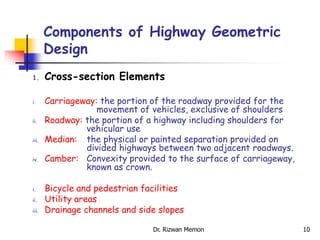
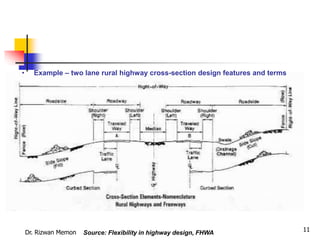
1. Cross-section Elements
i. Carriageway: the portion of the roadway provided for the
movement of vehicles, exclusive of shoulders
ii. Roadway: the portion of a highway including shoulders for
vehicular use
iii. Median: the physical or painted separation provided on
divided highways between two adjacent roadways.
iv. Camber: Convexity provided to the surface of carriageway,
known as crown.
i. Bicycle and pedestrian facilities
ii. Utility areas
iii. Drainage channels and side slopes
10
Dr. Rizwan Memon
• Example – two lane rural highway cross-section design features and terms
Source: Flexibility in highway design, FHWA 11
Dr. Rizwan Memon
Components of Highway Geometric
Design
2. Sight Distances Consideration
Length of the roadway ahead visible to drivers,
must allow driver to perceive, reaction, stop,
change speed, and change direction etc. when
necessary
i. Stopping Sight Distance (SSD)
ii. Overtaking Sight Distance (OSD)
iii. Intersection Sight Distance (ISD)
12
Dr. Rizwan Memon
Components of Highway Geometric
Design
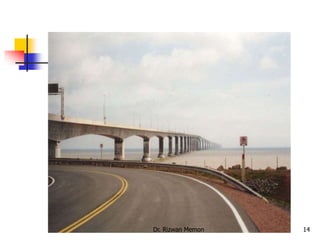
3. Horizontal Alignment
i. Horizontal Curves
The change in road direction be made possible by
introducing horizontal curves
ii. Superelevation
Raising of outer edge to counteract the centrifugal force
iii. Extra widening of Pavement
To introduce the centrifugal force and superelevaion
iv. Transition Curve
Gradual change between the straight and Circular Curve
13
Dr. Rizwan Memon
14
Dr. Rizwan Memon
Components of Highway Geometric
Design
4. Vertical Alignment
i. Gradient
Rate of rise or fall of road level along its ength
ii. Vertical Curves
The change in gradient be made possible by introducing
vertical curves
a) Summit Curves
b) Valley Curve
15
Dr. Rizwan Memon
Components of Highway Geometric
Design
5. Intersection Elements
Design of road intersections with facilities for safe and
efficient movement of traffic.
i. At-Grade Intersection
ii. Grade -Separated Intersection
16
Dr. Rizwan Memon

03. Highway Planning and highway components.pptx

  • 1.
    Highway Planning  Planningis considered as a prerequisite before attempting any development program, particularly when the funds are limited and total requirements are much higher.  Highway planning is also a basic need for highway development. 1 Dr. Rizwan Memon
  • 2.
    The objects ofhighway Planning are: 1. To plan a road net work for efficient and safe traffic operation, but at minimum cost. 2. To arrive at the road system having maximum utility which could be constructed within the available resources during the plan period. 3. To fix the priorities for development of each road link based on the utility as the main criteria for phasing the road development. 2 Dr. Rizwan Memon
  • 3.
    4. To planfor future requirement and improvements of roads in view of anticipated developments 5. To work out financing systems Highway planning phase includes: a) Assessment of road length requirement for an area. b) Preparation of Master Plan showing the phasing of plan in annual or five year plans. 3 Dr. Rizwan Memon
  • 4.
    The planning surveysincludes following studies: A. Economic Studies B. Finacial Stuides C. Traffic or road use studies D. Engineering Studies Planning Surveys 4 Dr. Rizwan Memon
  • 5.
    A. Economic Studiesincludes: i. Population and its distribution in each village, town or other locality ii. Trend of population growth iii. Agricultural and Industrial products and their listing in classified groups area wise. iv. Industrial and Agricultural development and future trends v. Existing facilities with regards to communication, recreation and income. vi. Per capita income 5 Dr. Rizwan Memon
  • 6.
    B. Financial Studiesincludes: i. Sources of income and estimated revenue from road transport ii. Living Standards iii. Resource from local levels, toll taxes, vehicle registration and fines iv. Future trends in financial aspects 6 Dr. Rizwan Memon
  • 7.
    C. Traffic andRoad use Studies includes: i. Traffic volume in Vehicles/day, Annual Average Daily Traffic (AADT) and Peak Hourly Volume (PHV) ii. Origin and Destination Studies (O & D Studies) iii. Traffic Flow Patterns iv. Accidents, their cost analysis and causes v. Future trend and growth in traffic volume and goods traffic vi. Growth of passenger trips and the trend in the choice of modes 7 Dr. Rizwan Memon
  • 8.
    D. Engineering Studiesincludes: i. Topographic Surveys ii. Soil Surveys iii. Location and Classification of existing roads iv. Estimation of possible developments in all aspects due to proposed highway development v. Special problems in drainage, construction and maintenance of roads 8 Dr. Rizwan Memon
  • 9.
     The variousdetails collected from the planning survey should be presented in the form of PLANS  The Master Plan should be prepared, which is the final road development plan for the area under study.  The next step is to compare the various alternates proposed of road systems in hand and to select the one which may be considered as best under plan period. 9 Dr. Rizwan Memon
  • 10.
    Components of HighwayGeometric Design 1. Cross-section Elements i. Carriageway: the portion of the roadway provided for the movement of vehicles, exclusive of shoulders ii. Roadway: the portion of a highway including shoulders for vehicular use iii. Median: the physical or painted separation provided on divided highways between two adjacent roadways. iv. Camber: Convexity provided to the surface of carriageway, known as crown. i. Bicycle and pedestrian facilities ii. Utility areas iii. Drainage channels and side slopes 10 Dr. Rizwan Memon
  • 11.
    • Example –two lane rural highway cross-section design features and terms Source: Flexibility in highway design, FHWA 11 Dr. Rizwan Memon
  • 12.
    Components of HighwayGeometric Design 2. Sight Distances Consideration Length of the roadway ahead visible to drivers, must allow driver to perceive, reaction, stop, change speed, and change direction etc. when necessary i. Stopping Sight Distance (SSD) ii. Overtaking Sight Distance (OSD) iii. Intersection Sight Distance (ISD) 12 Dr. Rizwan Memon
  • 13.
    Components of HighwayGeometric Design 3. Horizontal Alignment i. Horizontal Curves The change in road direction be made possible by introducing horizontal curves ii. Superelevation Raising of outer edge to counteract the centrifugal force iii. Extra widening of Pavement To introduce the centrifugal force and superelevaion iv. Transition Curve Gradual change between the straight and Circular Curve 13 Dr. Rizwan Memon
  • 14.
  • 15.
    Components of HighwayGeometric Design 4. Vertical Alignment i. Gradient Rate of rise or fall of road level along its ength ii. Vertical Curves The change in gradient be made possible by introducing vertical curves a) Summit Curves b) Valley Curve 15 Dr. Rizwan Memon
  • 16.
    Components of HighwayGeometric Design 5. Intersection Elements Design of road intersections with facilities for safe and efficient movement of traffic. i. At-Grade Intersection ii. Grade -Separated Intersection 16 Dr. Rizwan Memon