Presented by :
Irshad Ansari
( CONSTRUCTION TECHNOLOGY )
DAMP PROOFING
IT IS A
TREATMENT
OF SURFACE
OR
STRUCTURE
IN A
BUILDING
TO PREVENT
LEAKAGE.
DAMP PROOFING
CAUSES OF DAMPNESS
1. RAIN PENETRATION :
It takes place through the joints, roof components and porous
bricks or stones
2. GROUND MOISTURE
Clayey soil retains moisture causes dampness due to
capillary rise.
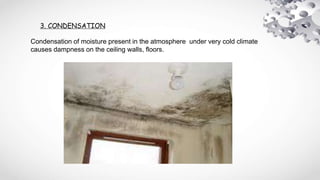
3. CONDENSATION
Condensation of moisture present in the atmosphere under very cold climate
causes dampness on the ceiling walls, floors.
4. POOR DRAINAGE AT SITE :
• Dampness gives rise to breeding of mosquitoes & create unhealthy
conditions.
• It may causes softening & crumling of plasters.
• Wall decoration & paint is damaged.
• Moisture causes rusting & corrosion of metal fittings.
• Dampness breeds germs of disease like tuberculosis, neuralgia.
• Dampness promotes & accelerated growth of termites.
• Timber fittings such as doors, windows etc. coming in contact with damp
walls get damaged because of warping etc.
• Electrical fittings get damaged, giving rise to leakage of electricity & danger
of short circuiting.
• Floor coverings get damaged.
EFFECTS OF DAMPNESS
METHODS OF DAMP PROOFING
1. Use of damp proofing course (DPC) :
membrane damp proofing
2. Integral damp proofing
3. Surface treatment
4. Cavity wall construction
5. Guniting
6. Pressure grouting
1. Use of Damp Proofing Course ( DPC) : Membrane
Damp Proofing
These are the layers of water repellent materials such as bituminous, mastic asphalt,
plastic sheets, cement concrete, metal sheets, mortar etc.
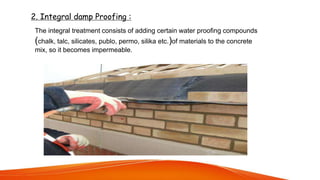
2. Integral damp Proofing :
The integral treatment consists of adding certain water proofing compounds
(chalk, talc, silicates, publo, permo, silika etc.)of materials to the concrete
mix, so it becomes impermeable.
• The surface treatment consists of application of layer of water repellent
substances on the surface through which moisture enters.
• It is only successful when moisture is superficial, i.e. not under much
pressure.
3. Surface Treatment :
Distempering Plastering
4.Cavity Wall Construction :
In this main wall is shielded by an outer skin wall, leaving a cavity
between the two.
5. Guniting :
This consists of depositing layer of rich cement mortar(1 cement : 3 sand or
fine mix) by pressure (2 to 3 Kg/cm2) to the exposed surface of wall
• In this method, cement
grout is filled in cracks,
voids in the structure of
building by pressure.
• This method is effective to
control entry of gound water
through foundations.
6. Pressure Grouting :
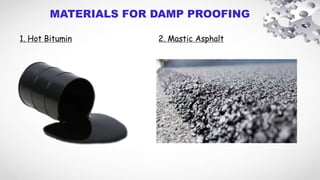
MATERIALS FOR DAMP PROOFING
1. Hot Bitumin 2. Mastic Asphalt
3. Bituminous asphalt 4. Metal sheets
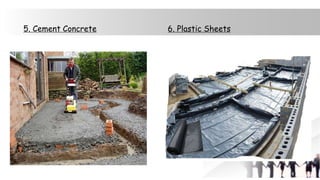
5. Cement Concrete 6. Plastic Sheets
• Foundation may receive water percolating from adjacent ground and this
moisture may rise in walls.
• This can be checked by providing air drain parallel to the external wall.
• RCC cover is provided.
• Opening and gratings are provided at regular interval for passage of air.
• Usual DPC are also provided horizontally & vertically.
DPC TREATMENT IN BUILDING
1. Treatment to foundations against gravitational water
• Provision of foundation drains &
DPC.
• Provision of RCC raft & wall slab.
• Asphalt tanking.
2. Treatment for basements
When basement in dump soils are constructed, following
methods are followed :
THANKS

Damp proofing

  • 1.
    Presented by : IrshadAnsari ( CONSTRUCTION TECHNOLOGY ) DAMP PROOFING
  • 2.
    IT IS A TREATMENT OFSURFACE OR STRUCTURE IN A BUILDING TO PREVENT LEAKAGE. DAMP PROOFING
  • 3.
    CAUSES OF DAMPNESS 1.RAIN PENETRATION : It takes place through the joints, roof components and porous bricks or stones
  • 4.
    2. GROUND MOISTURE Clayeysoil retains moisture causes dampness due to capillary rise.
  • 5.
    3. CONDENSATION Condensation ofmoisture present in the atmosphere under very cold climate causes dampness on the ceiling walls, floors.
  • 6.
  • 7.
    • Dampness givesrise to breeding of mosquitoes & create unhealthy conditions. • It may causes softening & crumling of plasters. • Wall decoration & paint is damaged. • Moisture causes rusting & corrosion of metal fittings. • Dampness breeds germs of disease like tuberculosis, neuralgia. • Dampness promotes & accelerated growth of termites. • Timber fittings such as doors, windows etc. coming in contact with damp walls get damaged because of warping etc. • Electrical fittings get damaged, giving rise to leakage of electricity & danger of short circuiting. • Floor coverings get damaged. EFFECTS OF DAMPNESS
  • 8.
    METHODS OF DAMPPROOFING 1. Use of damp proofing course (DPC) : membrane damp proofing 2. Integral damp proofing 3. Surface treatment 4. Cavity wall construction 5. Guniting 6. Pressure grouting
  • 9.
    1. Use ofDamp Proofing Course ( DPC) : Membrane Damp Proofing These are the layers of water repellent materials such as bituminous, mastic asphalt, plastic sheets, cement concrete, metal sheets, mortar etc.
  • 10.
    2. Integral dampProofing : The integral treatment consists of adding certain water proofing compounds (chalk, talc, silicates, publo, permo, silika etc.)of materials to the concrete mix, so it becomes impermeable.
  • 11.
    • The surfacetreatment consists of application of layer of water repellent substances on the surface through which moisture enters. • It is only successful when moisture is superficial, i.e. not under much pressure. 3. Surface Treatment : Distempering Plastering
  • 12.
    4.Cavity Wall Construction: In this main wall is shielded by an outer skin wall, leaving a cavity between the two.
  • 13.
    5. Guniting : Thisconsists of depositing layer of rich cement mortar(1 cement : 3 sand or fine mix) by pressure (2 to 3 Kg/cm2) to the exposed surface of wall
  • 14.
    • In thismethod, cement grout is filled in cracks, voids in the structure of building by pressure. • This method is effective to control entry of gound water through foundations. 6. Pressure Grouting :
  • 15.
    MATERIALS FOR DAMPPROOFING 1. Hot Bitumin 2. Mastic Asphalt
  • 16.
    3. Bituminous asphalt4. Metal sheets
  • 17.
    5. Cement Concrete6. Plastic Sheets
  • 18.
    • Foundation mayreceive water percolating from adjacent ground and this moisture may rise in walls. • This can be checked by providing air drain parallel to the external wall. • RCC cover is provided. • Opening and gratings are provided at regular interval for passage of air. • Usual DPC are also provided horizontally & vertically. DPC TREATMENT IN BUILDING 1. Treatment to foundations against gravitational water
  • 19.
    • Provision offoundation drains & DPC. • Provision of RCC raft & wall slab. • Asphalt tanking. 2. Treatment for basements When basement in dump soils are constructed, following methods are followed :
  • 20.