Lecture
Building Construction and
Drawings, CE-213
Engr. Abid Ali
Department of Civil Engineering,
SUIT, Peshawar
Lecturer Outlines
Dampness Control in
Buildings:
□ What is Dampness?
□ Causes of Dampness in Building
□ Ill effect of Dampness
□ Dampness Control
□ Damp-proofing Materials
□ Damp Proofing in different Situation
What is Dampness?
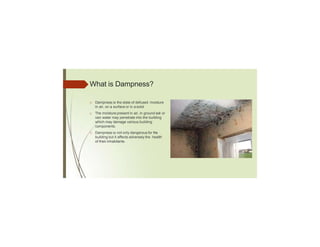
□ Dampness is the state of defused moisture
in air, on a surface or in a solid
□ The moisture present in air, in ground soil or
rain water may penetrate into the building
which may damage various building
components.
□ Dampness is not only dangerous for the
building but it affects adversely the health
of their inhabitants.
Cause of Dampness in Building
General
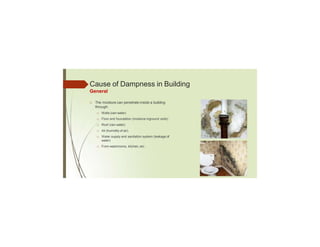
□ The moisture can penetrate inside a building
through:
□ Walls (rain water)
□ Floor and foundation (moisture inground soils)
□ Roof (rain water)
□ Air (humidity of air)
□ Water supply and sanitation system (leakage of
water)
□ From washrooms, kitchen, etc.
Cause of Dampness in Building (Cont..)
Rain Water Penetration
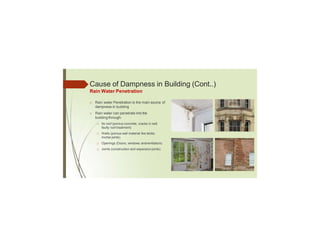
□ Rain water Penetration is the main source of
dampness in building
□ Rain water can penetrate into the
building through:
□ Its roof (porous concrete, cracks in roof,
faulty roof treatment)
□ Walls (porous wall material like bricks,
mortar joints)
□ Openings (Doors, windows andventilators)
□ Joints (construction and expansion joints)
Cause of Dampness in Building (Cont..)
Level and Drainage of Site
□ If a building is located on site which is at
lower level than the adjacent ground, water
can accumulate in the surroundings of
building and thus can easily penetrate into
the building through walls, foundations, floors
etc.
□ A building with a poor drainage system
around it, may result in water penetration to
the building through walls, foundations, floors
etc.
Cause of Dampness in Building (Cont..)
Climate Condition and Defective Orientation
□ Climate Condition:
□ Dampness is also caused due to
condensation of moisture present in the air in
very cold climate.
□ Defective Orientation:
□ A wall subjected to splashes of rain water
and getting less direct sun rays due to
defective orientation is liable to dampness
Cause of Dampness in Building (Cont..)
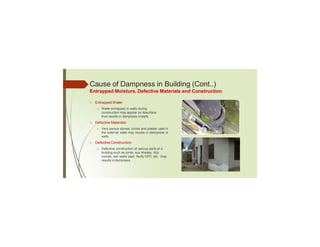
Entrapped Moisture, Defective Materials and Construction
□ Entrapped Water:
□ Water entrapped in walls during
construction may appear on itssurface
thus results in dampness inwalls.
□ Defective Materials:
□ Very porous stones, bricks and plaster used in
the external walls may results in dampness in
walls
□ DefectiveConstruction:
□ Defective construction of various parts of a
building such as joints, sun shades, drip
course, rain water pipe, faulty DPC, etc. may
results in dampness.
Cause of Dampness in Building (Cont..)
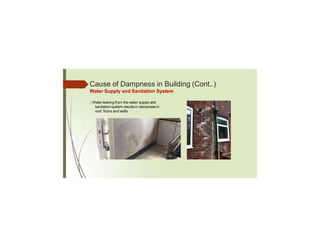
Water Supply and Sanitation System
□Waterleaking from the water supply and
sanitation system results in dampness in
roof, floors and walls
Ill Effects of Dampness
□ Building become ecstatically poor
□ Dry and wet rot to the wooden member of the building
□ Corrosion of metal used in the building
□ Peeling of plaster
□ Bleaching and blistering of paints
□ Carpet used on damped floor gets destroyed earlier
□ Electrical installations get deteriorated.
□ Efflorescence in and deterioration of brick masonrywalls
□ Reduce life of the structure as whole
□ Unhygienic condition for the inhabitants
□ Promotes growth of termites
Dampness Control in Building
□ Dampness in buildings may be controlled by:
□ Damp-proof course (DPC)
□ Surface Treatment
□ Other methods
Dampness Control in Building
Damp Proof Course:
□ A continuous layer of impervious material provided between the source of dampness and part
of the building is known as DPC.
□ DPC generally comprises 7.5 cm thick layer of PCC 1:2:4 (in ¼“ down aggregate), two coats of
hot bitumen (1.75 kg/m2) and polythene sheet.
□ Ready to mix water based materials are also available in market which can replace the bitumen.
□ Some times terrazzo may be applied on top of PCC. Water resistance admixture may be added to
the terrazzo at the time of mixing
Dampness Control in Building
Damp Proof Course:
□ Damp Proof Course may be:
□ Horizontal DPC: Provided 15 to 20 cm above GL in Exterior Wall and at the floor level in
the interior walls to intercept vertical movement of moisture in walls
□ Vertical DPC: Provided between horizontal DPC in exterior walls and the floor finish to intercept
horizontal movement of moisture from ground soil to the wall.
FF
L
GL
Horizontal
DPC
Vertical DPC
Exterior Wall Interior Wall
Horizontal
DPC
Compacted Earth
Moisture Movement
Dampness Control in Building
Surface Treatment:
□ In this type of dampness control, the
surface of wall is prevented from
penetration of rain water by application of:
□ Water repellant paint/chemicals
□ Water resistant Plaster, water resistant
admixture may be added to the mortarat the
time of mixing.
□ Water resistant Terrazzo
□ Water resistant Tiles (natural orceramic)
Dampness Control in Building
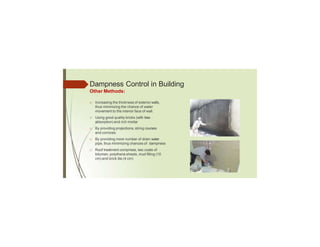
Other Methods:
□ Increasing the thickness of exterior walls,
thus minimizing the chance of water
movement to the interior face of wall.
□ Using good quality bricks (with less
absorption) and rich mortar
□ By providing projections, string courses
and cornices
□ By providing more number of drain water
pipe, thus minimizing chances of dampness
□ Roof treatment comprises, two coats of
bitumen, polythene sheets, mud filling (10
cm) and brick tile (4 cm)
Dampness Control in Building
Damp Proofing Material:
□ Different damp proofing materials are used for preventing dampness in different parts of a
building
□ A good damp proofing material:
□ Should be Impervious
□ Should be Durable
□ Should have enough strength (not to disintegrate under loading)
□ Should have enough Stiffness (not move sideway under loading)
□ Should develop good bond with the underlying surface
□ Should provide uniform and homogeneouslayer
□ Should cover full thickness ofwall
□ Should be cheaply and easilyavailable
Dampness Control in Building
Damp Proofing Material (Cont..):
□ Damp Proofing Material may flexible or rigid:
□ Flexible Material: A material which can deform without cracking is flexibledamp
proofingmaterial.
□ Bitumen Mastic (Mastic Asphalt) is bitumen mixed with fine sand in hot state. It is of such
consistency that it can be spread when hot to a depth of 2.5 to 5.0 cm
□ Bitumen Felt: it consists of about 5 to 6 mm thick sheets of bitumen available in rolls having width equal
to that of brick masonrywall.
□ Hot Laid Bitumen: Hot bitumen is applied on concrete and mortar surface in two coats at the rate of
1.75 kg/m2.
□
Metal sheets (not less than 3 mm) of lead, copper or aluminum are also used as DPC but they are
costly. Lead and aluminum sheets may be coated with asphalt for better performance. Lead sheets
shall be laid with lime mortar due to chemical reaction of cement with lead
Dampness Control in Building
Damp Proofing Material (Cont..):
□ Rigid Material: The material which cannot resist lateral strains and are liable to crack when
subjected to lateral strains. These strains may be due to load on it or relative movement in
the underlying surface due to its cracking and joint movement.
□ PCC: A layer of rich concrete (1:2:4) having thickness of 4 to 7.5 mm painted with two coats of hot
bitumen is used as horizontal and vertical DPC. To make the PCC relatively impervious small size
aggregates (1/4 “ down) are used in preparation of PCC. Terrazzo may be applied on PCC for better
performance
□ Rich cement sand plaster with or without water resistant admixtures may be used as vertical DPC on
walls, especially in basements. Terrazzo and/or two coats of bitumen may be added for better
performance
□ Dense bricks in rich mortar (one or two courses) may be used as an effective and cheap DPC
□ Stone Slabs or Slates (two courses) laid in rich cement-sand or lime-cement-sand mortar is one of the
best DPC where stones are cheaplyavailable.
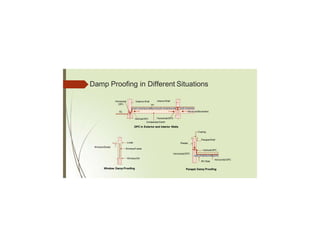
Damp Proofing in Different Situations
Horizontal DPC
Coping
ParapetWall
VerticalDPC
RC Slab
Plaster
Horizontal DPC
Parapet Damp Proofing
FF
L
GL
Horizontal
DPC
VerticalDPC
ExteriorWall InteriorWall
Horizontal DPC
MoistureMovement
Compacted Earth
DPC in Exterior and Interior Walls
WindowShade
Window Damp Proofing
WindowFrame
WindowSill
Lintel
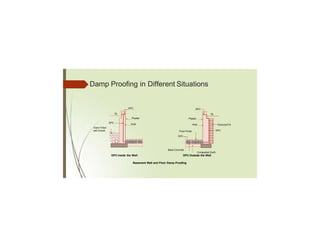
Damp Proofing in Different Situations
DPC
Wall
DPC
Plaster
GL
Floor Finish
DPC
GranularFill
Wall
Plaster
GL
DPC
DPC
Drain Filled
with Gravel
Base Concrete
Compacted Earth
DPC Inside the Wall DPC Outside the Wall
Basement Wall and Floor Damp Proofing

Lecture - Dampness.pptx

  • 1.
    Lecture Building Construction and Drawings,CE-213 Engr. Abid Ali Department of Civil Engineering, SUIT, Peshawar
  • 2.
    Lecturer Outlines Dampness Controlin Buildings: □ What is Dampness? □ Causes of Dampness in Building □ Ill effect of Dampness □ Dampness Control □ Damp-proofing Materials □ Damp Proofing in different Situation
  • 3.
    What is Dampness? □Dampness is the state of defused moisture in air, on a surface or in a solid □ The moisture present in air, in ground soil or rain water may penetrate into the building which may damage various building components. □ Dampness is not only dangerous for the building but it affects adversely the health of their inhabitants.
  • 4.
    Cause of Dampnessin Building General □ The moisture can penetrate inside a building through: □ Walls (rain water) □ Floor and foundation (moisture inground soils) □ Roof (rain water) □ Air (humidity of air) □ Water supply and sanitation system (leakage of water) □ From washrooms, kitchen, etc.
  • 5.
    Cause of Dampnessin Building (Cont..) Rain Water Penetration □ Rain water Penetration is the main source of dampness in building □ Rain water can penetrate into the building through: □ Its roof (porous concrete, cracks in roof, faulty roof treatment) □ Walls (porous wall material like bricks, mortar joints) □ Openings (Doors, windows andventilators) □ Joints (construction and expansion joints)
  • 6.
    Cause of Dampnessin Building (Cont..) Level and Drainage of Site □ If a building is located on site which is at lower level than the adjacent ground, water can accumulate in the surroundings of building and thus can easily penetrate into the building through walls, foundations, floors etc. □ A building with a poor drainage system around it, may result in water penetration to the building through walls, foundations, floors etc.
  • 7.
    Cause of Dampnessin Building (Cont..) Climate Condition and Defective Orientation □ Climate Condition: □ Dampness is also caused due to condensation of moisture present in the air in very cold climate. □ Defective Orientation: □ A wall subjected to splashes of rain water and getting less direct sun rays due to defective orientation is liable to dampness
  • 8.
    Cause of Dampnessin Building (Cont..) Entrapped Moisture, Defective Materials and Construction □ Entrapped Water: □ Water entrapped in walls during construction may appear on itssurface thus results in dampness inwalls. □ Defective Materials: □ Very porous stones, bricks and plaster used in the external walls may results in dampness in walls □ DefectiveConstruction: □ Defective construction of various parts of a building such as joints, sun shades, drip course, rain water pipe, faulty DPC, etc. may results in dampness.
  • 9.
    Cause of Dampnessin Building (Cont..) Water Supply and Sanitation System □Waterleaking from the water supply and sanitation system results in dampness in roof, floors and walls
  • 10.
    Ill Effects ofDampness □ Building become ecstatically poor □ Dry and wet rot to the wooden member of the building □ Corrosion of metal used in the building □ Peeling of plaster □ Bleaching and blistering of paints □ Carpet used on damped floor gets destroyed earlier □ Electrical installations get deteriorated. □ Efflorescence in and deterioration of brick masonrywalls □ Reduce life of the structure as whole □ Unhygienic condition for the inhabitants □ Promotes growth of termites
  • 11.
    Dampness Control inBuilding □ Dampness in buildings may be controlled by: □ Damp-proof course (DPC) □ Surface Treatment □ Other methods
  • 12.
    Dampness Control inBuilding Damp Proof Course: □ A continuous layer of impervious material provided between the source of dampness and part of the building is known as DPC. □ DPC generally comprises 7.5 cm thick layer of PCC 1:2:4 (in ¼“ down aggregate), two coats of hot bitumen (1.75 kg/m2) and polythene sheet. □ Ready to mix water based materials are also available in market which can replace the bitumen. □ Some times terrazzo may be applied on top of PCC. Water resistance admixture may be added to the terrazzo at the time of mixing
  • 13.
    Dampness Control inBuilding Damp Proof Course: □ Damp Proof Course may be: □ Horizontal DPC: Provided 15 to 20 cm above GL in Exterior Wall and at the floor level in the interior walls to intercept vertical movement of moisture in walls □ Vertical DPC: Provided between horizontal DPC in exterior walls and the floor finish to intercept horizontal movement of moisture from ground soil to the wall. FF L GL Horizontal DPC Vertical DPC Exterior Wall Interior Wall Horizontal DPC Compacted Earth Moisture Movement
  • 14.
    Dampness Control inBuilding Surface Treatment: □ In this type of dampness control, the surface of wall is prevented from penetration of rain water by application of: □ Water repellant paint/chemicals □ Water resistant Plaster, water resistant admixture may be added to the mortarat the time of mixing. □ Water resistant Terrazzo □ Water resistant Tiles (natural orceramic)
  • 15.
    Dampness Control inBuilding Other Methods: □ Increasing the thickness of exterior walls, thus minimizing the chance of water movement to the interior face of wall. □ Using good quality bricks (with less absorption) and rich mortar □ By providing projections, string courses and cornices □ By providing more number of drain water pipe, thus minimizing chances of dampness □ Roof treatment comprises, two coats of bitumen, polythene sheets, mud filling (10 cm) and brick tile (4 cm)
  • 16.
    Dampness Control inBuilding Damp Proofing Material: □ Different damp proofing materials are used for preventing dampness in different parts of a building □ A good damp proofing material: □ Should be Impervious □ Should be Durable □ Should have enough strength (not to disintegrate under loading) □ Should have enough Stiffness (not move sideway under loading) □ Should develop good bond with the underlying surface □ Should provide uniform and homogeneouslayer □ Should cover full thickness ofwall □ Should be cheaply and easilyavailable
  • 17.
    Dampness Control inBuilding Damp Proofing Material (Cont..): □ Damp Proofing Material may flexible or rigid: □ Flexible Material: A material which can deform without cracking is flexibledamp proofingmaterial. □ Bitumen Mastic (Mastic Asphalt) is bitumen mixed with fine sand in hot state. It is of such consistency that it can be spread when hot to a depth of 2.5 to 5.0 cm □ Bitumen Felt: it consists of about 5 to 6 mm thick sheets of bitumen available in rolls having width equal to that of brick masonrywall. □ Hot Laid Bitumen: Hot bitumen is applied on concrete and mortar surface in two coats at the rate of 1.75 kg/m2. □ Metal sheets (not less than 3 mm) of lead, copper or aluminum are also used as DPC but they are costly. Lead and aluminum sheets may be coated with asphalt for better performance. Lead sheets shall be laid with lime mortar due to chemical reaction of cement with lead
  • 18.
    Dampness Control inBuilding Damp Proofing Material (Cont..): □ Rigid Material: The material which cannot resist lateral strains and are liable to crack when subjected to lateral strains. These strains may be due to load on it or relative movement in the underlying surface due to its cracking and joint movement. □ PCC: A layer of rich concrete (1:2:4) having thickness of 4 to 7.5 mm painted with two coats of hot bitumen is used as horizontal and vertical DPC. To make the PCC relatively impervious small size aggregates (1/4 “ down) are used in preparation of PCC. Terrazzo may be applied on PCC for better performance □ Rich cement sand plaster with or without water resistant admixtures may be used as vertical DPC on walls, especially in basements. Terrazzo and/or two coats of bitumen may be added for better performance □ Dense bricks in rich mortar (one or two courses) may be used as an effective and cheap DPC □ Stone Slabs or Slates (two courses) laid in rich cement-sand or lime-cement-sand mortar is one of the best DPC where stones are cheaplyavailable.
  • 19.
    Damp Proofing inDifferent Situations Horizontal DPC Coping ParapetWall VerticalDPC RC Slab Plaster Horizontal DPC Parapet Damp Proofing FF L GL Horizontal DPC VerticalDPC ExteriorWall InteriorWall Horizontal DPC MoistureMovement Compacted Earth DPC in Exterior and Interior Walls WindowShade Window Damp Proofing WindowFrame WindowSill Lintel
  • 20.
    Damp Proofing inDifferent Situations DPC Wall DPC Plaster GL Floor Finish DPC GranularFill Wall Plaster GL DPC DPC Drain Filled with Gravel Base Concrete Compacted Earth DPC Inside the Wall DPC Outside the Wall Basement Wall and Floor Damp Proofing