INTRODUCTION
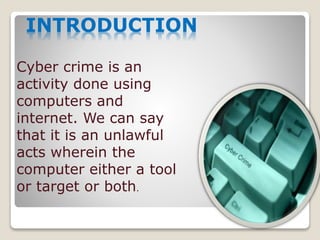
Cyber crime is an
activity done using
computers and
internet. We can say
that it is an unlawful
acts wherein the
computer either a tool
or target or both.
“Cyber crime encompasses any
criminal act dealing with
computers and networks (called
hacking). Additionally, cyber
crime also includes traditional
crimes conducted through the
Internet.”
What is a Cyber Security?
 ‘Cyber security is the body of
technologies, processes and
practices designed to protect
networks, computers, programs and
data from attack, damage or
unauthorized’
Categories of cyber crime
We can categorize cyber crime in two ways.
 The computer as a target :- using a
computer to attacks other computer, e.g.
Hacking, virus/worms attacks, Dos attack
etc.
 The computer as a weapon :- using a
computer to commit real world crime e.g.
cyber terrorism, credit card fraud etc.
Why Cyber Security is needed ?
For Securing:
 Information
 Information System
 Maintain individual privacy
 Etc…
Syllabus
 UNIT-1
 Introduction to information systems,
Types of information Systems,
Development of Information Systems,
Introduction to information security, Need
for Information security, Threats to
Information Systems, Information
Assurance, Cyber Security, and Security
Risk Analysis.
 UNIT-2
 Application security (Database, E-mail and
Internet), Data Security Considerations-
Backups, Archival Storage and Disposal of
Data, Security Technology-Firewall and VPNs,
Intrusion Detection, Access Control.
 Security Threats -Viruses, Worms, Trojan
Horse, Bombs, Trapdoors, Spoofs, E-mail
viruses, Macro viruses, Malicious Software,
Network and Denial of Services Attack,
Security Threats to E-Commerce-
 Electronic Payment System, e-Cash,
Credit/Debit Cards. Digital Signature, public
Key Cryptography
 UNIT-3
 Developing Secure Information Systems,
Application Development Security,
Information Security Governance & Risk
Management, Security Architecture &
Design
 Security Issues in Hardware, Data Storage
& Downloadable Devices, Physical
Security of IT Assets, Access Control,
CCTV and intrusion Detection Systems,
Backup Security Measures.
 UNIT-4
 Security Policies, Why Policies should be
developed, WWW policies, Email Security
policies, Policy Review Process-Corporate
policies-Sample Security Policies,
Publishing and Notification Requirement of
the Policies.
 Information Security Standards-ISO, IT
Act, Copyright Act, Patent Law, IPR. Cyber
Laws in India; IT
 Act 2000 Provisions, Intellectual Property
Law: Copy Right Law, Software License,
Semiconductor Law and Patent Law.
Information System
 IS – a set of interrelated components
working together to collect, retrieve,
process, store, and distribute information
for the purpose of control, coordination,
analysis, and decision making in business
organizations
What is an Information
System
Organized combination of
1. Hardware
2. Software
3. Communications Networks
4. Data
5. People
Types of Information
Systems
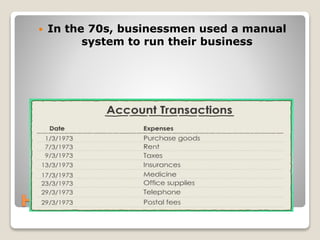
History Before Usage of IS
 In the 70s, businessmen used a manual
system to run their business
History Before Usage of IS
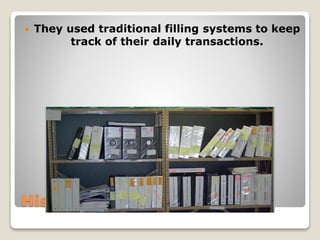
 They used traditional filling systems to keep
track of their daily transactions.
History Before Usage of IS
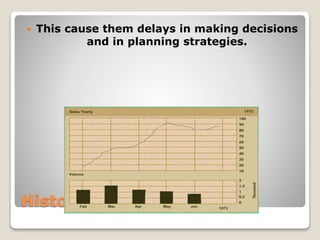
 This cause them delays in making decisions
and in planning strategies.
The Usage of Information
Systems
1. Management Information System
(MIS)
2. Transaction Processing System (TPS)
3. Decision Support System (DSS)
4. Executive Information System (EIS)
5. Expert System (ES)
Objective 1
 The usage of Management Information
System (MIS).
Management Information System
(MIS)
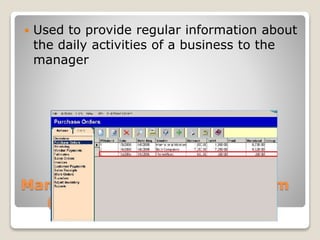
 Used to provide regular information about
the daily activities of a business to the
manager
Management Information System
(MIS)
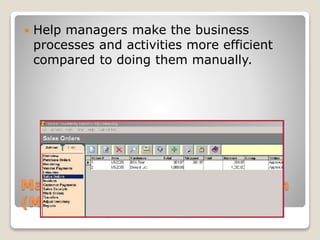
 Help managers make the business
processes and activities more efficient
compared to doing them manually.
Management Information System
(MIS)
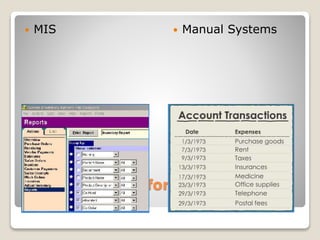
 MIS  Manual Systems
Objective 2
 The usage of Transaction Processing
System (TPS)
Transaction Processing System
(TPS)
 Used to record business transactions.
Information and Communication Technology [Form 5]
Transaction Processing System
(TPS)
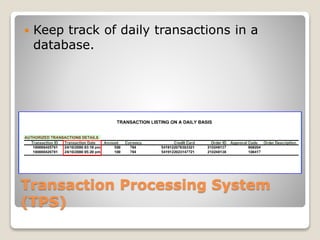
 Keep track of daily transactions in a
database.
Objective 3
 The usage of Decision Support System
(DSS).
Decision Support System
(DSS)
 Provide managers with information to
make the best decisions.
Information and Communication Technology [Form 5]
Decision Support System
(DSS)
 Most Decision Support System report are
in the form of charts and diagrams.
Objective 4
 The usage of Executive Information
System (EIS).
Executive Information System
(EIS)
 Helps top-level management to plan
strategies.
Executive Information System
(EIS)
 Used to forecast future trends.
Objective 5
 The usage of Expert System (ES).
Expert System(ES)
 Used to store knowledge and make logical
suggestions for the user.
Expert System(ES)
 Expert system users can be professionals
like doctors and scantiest.
Expert System(ES)
 An expert System can suggest conditions
and estimate the probability of having
illness.
Cyber security

Cyber security

  • 2.
    INTRODUCTION Cyber crime isan activity done using computers and internet. We can say that it is an unlawful acts wherein the computer either a tool or target or both.
  • 3.
    “Cyber crime encompassesany criminal act dealing with computers and networks (called hacking). Additionally, cyber crime also includes traditional crimes conducted through the Internet.”
  • 4.
    What is aCyber Security?  ‘Cyber security is the body of technologies, processes and practices designed to protect networks, computers, programs and data from attack, damage or unauthorized’
  • 5.
    Categories of cybercrime We can categorize cyber crime in two ways.  The computer as a target :- using a computer to attacks other computer, e.g. Hacking, virus/worms attacks, Dos attack etc.  The computer as a weapon :- using a computer to commit real world crime e.g. cyber terrorism, credit card fraud etc.
  • 6.
    Why Cyber Securityis needed ? For Securing:  Information  Information System  Maintain individual privacy  Etc…
  • 7.
    Syllabus  UNIT-1  Introductionto information systems, Types of information Systems, Development of Information Systems, Introduction to information security, Need for Information security, Threats to Information Systems, Information Assurance, Cyber Security, and Security Risk Analysis.
  • 8.
     UNIT-2  Applicationsecurity (Database, E-mail and Internet), Data Security Considerations- Backups, Archival Storage and Disposal of Data, Security Technology-Firewall and VPNs, Intrusion Detection, Access Control.  Security Threats -Viruses, Worms, Trojan Horse, Bombs, Trapdoors, Spoofs, E-mail viruses, Macro viruses, Malicious Software, Network and Denial of Services Attack, Security Threats to E-Commerce-  Electronic Payment System, e-Cash, Credit/Debit Cards. Digital Signature, public Key Cryptography
  • 9.
     UNIT-3  DevelopingSecure Information Systems, Application Development Security, Information Security Governance & Risk Management, Security Architecture & Design  Security Issues in Hardware, Data Storage & Downloadable Devices, Physical Security of IT Assets, Access Control, CCTV and intrusion Detection Systems, Backup Security Measures.
  • 10.
     UNIT-4  SecurityPolicies, Why Policies should be developed, WWW policies, Email Security policies, Policy Review Process-Corporate policies-Sample Security Policies, Publishing and Notification Requirement of the Policies.  Information Security Standards-ISO, IT Act, Copyright Act, Patent Law, IPR. Cyber Laws in India; IT  Act 2000 Provisions, Intellectual Property Law: Copy Right Law, Software License, Semiconductor Law and Patent Law.
  • 11.
    Information System  IS– a set of interrelated components working together to collect, retrieve, process, store, and distribute information for the purpose of control, coordination, analysis, and decision making in business organizations
  • 12.
    What is anInformation System Organized combination of 1. Hardware 2. Software 3. Communications Networks 4. Data 5. People
  • 13.
  • 14.
    History Before Usageof IS  In the 70s, businessmen used a manual system to run their business
  • 15.
    History Before Usageof IS  They used traditional filling systems to keep track of their daily transactions.
  • 16.
    History Before Usageof IS  This cause them delays in making decisions and in planning strategies.
  • 17.
    The Usage ofInformation Systems 1. Management Information System (MIS) 2. Transaction Processing System (TPS) 3. Decision Support System (DSS) 4. Executive Information System (EIS) 5. Expert System (ES)
  • 18.
    Objective 1  Theusage of Management Information System (MIS).
  • 19.
    Management Information System (MIS) Used to provide regular information about the daily activities of a business to the manager
  • 20.
    Management Information System (MIS) Help managers make the business processes and activities more efficient compared to doing them manually.
  • 21.
  • 22.
    Objective 2  Theusage of Transaction Processing System (TPS)
  • 23.
    Transaction Processing System (TPS) Used to record business transactions. Information and Communication Technology [Form 5]
  • 24.
    Transaction Processing System (TPS) Keep track of daily transactions in a database.
  • 25.
    Objective 3  Theusage of Decision Support System (DSS).
  • 26.
    Decision Support System (DSS) Provide managers with information to make the best decisions. Information and Communication Technology [Form 5]
  • 27.
    Decision Support System (DSS) Most Decision Support System report are in the form of charts and diagrams.
  • 28.
    Objective 4  Theusage of Executive Information System (EIS).
  • 29.
    Executive Information System (EIS) Helps top-level management to plan strategies.
  • 30.
    Executive Information System (EIS) Used to forecast future trends.
  • 31.
    Objective 5  Theusage of Expert System (ES).
  • 32.
    Expert System(ES)  Usedto store knowledge and make logical suggestions for the user.
  • 33.
    Expert System(ES)  Expertsystem users can be professionals like doctors and scantiest.
  • 34.
    Expert System(ES)  Anexpert System can suggest conditions and estimate the probability of having illness.