Cyber Attack
&
Cyber Crime
Presentation By Peace
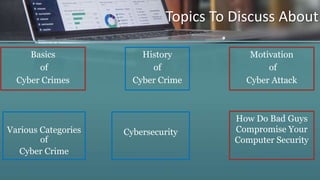
Topics To Discuss About
History
of
Cyber Crime
Basics
of
Cyber Crimes
Various Categories
of
Cyber Crime
Motivation
of
Cyber Attack
How Do Bad Guys
Compromise Your
Computer Security
Cybersecurity
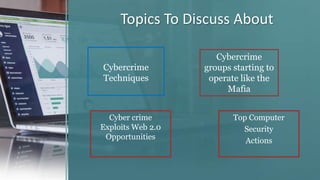
Cyber crime
Exploits Web 2.0
Opportunities
Cybercrime
groups starting to
operate like the
Mafia
Cybercrime
Techniques
Topics To Discuss About
Top Computer
Security
Actions
Basics
Of
Cyber Crimes
What is Cyber Attack ?
• Cyber attack is an attack employed by individuals or whole organizations
that targets computer information systems, infrastructures, computer
networks, and/or personal computer devices by various means of malicious
acts
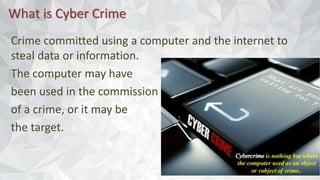
What is Cyber Crime
Crime committed using a computer and the internet to
steal data or information.
The computer may have
been used in the commission
of a crime, or it may be
the target.
Why Should We Know about Cyber crime
 In this Tech-savvy world of 21st Century every one is engaged
with internet, through WhatsApp, twitter, Facebook, net
banking & lots of other platforms are there.
 And some criminal minded persons commit crimes here, which
is included under cyber crime
 So we should be aware about crimes happening around in the
cyber-space.
History of Cybercrime
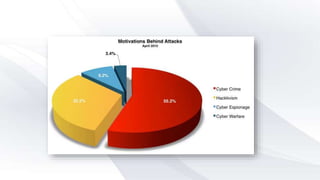
Motivation of Cybercrime
Motivation
Depending on the motivation, according to Ray5,
Verisign iDefense Security Intelligence Services
classifies cyber-attacks into three categories:
• Hacktivism
• Cyber crime and Cyberespionage.
Hacktivism
• Hacktivism is the act of hacking, or breaking
into a computer system, for a politically or
socially or ideologically motivated purpose.
• It is basically used as a means to promote an
agenda.
• Hacktivists are responsible for denial-of-service
(DoS), distributed denial of service (DDoS),
information theft, data breaches, web site
defacement etc.
Cyber crime
• Such activity can be a direct one, e.g.,
fraudulent bank transaction, or an
indirect one, e.g., selling stolen
information in black market.
Cyberespionage
• Cyber spying, or cyber espionage, is the act or
practice of obtaining secrets without the
permission of the holder of the information
(personal, sensitive, proprietary or of classified
nature)
• From individuals, competitors, rivals, groups,
governments and enemies
• For personal, economic, political or military
advantage using methods on the Internet,
networks or individual computers through the
use of cracking techniques and malicious
software including Trojan horses and spyware.
Various Categories of Cyber Crime
Cyber Crime may be basically
divided into 3 categories-
• Against Persons
• Against Property
• Against Government
Against Persons
• Cybercrimes committed against
persons include various crimes like
transmission of child pornography,
harassment of any one with the use
of a computer such as e-mail, and
cyber-stalking
Against Property
• The second category of Cybercrimes
is that of Cybercrimes against all
forms of property.
• These crimes include unauthorized
computer trespassing through
cyberspace, computer vandalism and
unauthorized possession of
computerized information.
Against Government
The 3rd category of Cybercrimes relate to
Cybercrimes against Government. Cyber
terrorism is one distinct kind of crime in
this category.
• This crime manifests itself into terrorism
when an individual “cracks” into a
government or military maintained
website.
Examples
of
Cybercrimes
Cyber Security
It’s objectives is to establish rules and
measures to use against attacks over the
internet.
Advantage
- Defend us from critical attacks
- Browse the safe website
- Internet security process all the
incoming and outgoing data on our
computer.
How Do Bad Guys Compromise
Your Computer Security
1. Social Engineering
Social engineering is a non-technical method of intrusion hackers
use that relies heavily on human interaction and often involves
tricking people into breaking normal security procedures.
Types
- Baiting
- Phishing
- Pretexting
2. Reverse Social Engineering Attack
In this kind of cyber attack, the attacker convinces a user that they
have a problem and that the attacker has a solution to the problem.
3. Virus
Virus is a program that replicates.
4. Worm

- Standalone program. They don’t infect existing files –
they spread copies of themselves instead.
5. Trojan
6. Ransomware – Makes the system nonfunctional unless
the victim agrees to pay a ransom.
7. Spyware – A class of malicious program that secretly
steals your personal information and sends it to
advertisers or hackers.
8. Rogue Antivirus – A fake program that disguises itself as
a genuine software but performs malicious activities in
user’s machine
Cybercrime Techniques
Generally speaking, today’s cybercriminals have to
consider two different techniques to achieve the
desired end result – Delivery and Deployment.
 Delivery - 1st step is delivering and installing the
malware. The ideal setup for criminals is a
vulnerable victim machine that allows malware to
be installed immediately.
 Deployment – Once the malware is delivered, the
criminals strive for it to remain undetected for as
long as possible.
Cybercrime groups
starting to
operate
like the Mafia
• Cybercrime is evolving. The lone hacker who steals and resells
credit card numbers is being replaced by a well-structured
business model.
• The game is no longer simply about hacking for fame, but rather
about creating a business where you have frequent customers
who buy your stolen product.
• The latest research report from web security company Finjan
gives a peek at what exactly is going on.
In 2006, vulnerabilities were being sold
online to the highest bidder. Last year,
software packages that provided
various ways of attacking websites and
stealing valuable data were sold by
professional hackers.
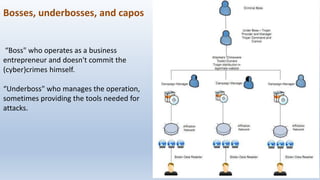
Bosses, underbosses, and capos
“Boss" who operates as a business
entrepreneur and doesn't commit the
(cyber)crimes himself.
“Underboss" who manages the operation,
sometimes providing the tools needed for
attacks.
Cyber crime Exploits Web 2.0
Opportunities
The avalanche of new services that are available via the
Internet, along with a world population that now more
readily adopts these new services, also contributes to the
success of cybercrime. Areas that are especially vulnerable
to attack may include; online games, internet-money &
online banking and Web 2.0.
Web 2.0 – Online social networking, blogs,
forums, wikis, Myspace, YouTube, Twitter – all
rely on the easy downloading, publishing, and
other information-sharing techniques that
make every participant vulnerable to malware
infections.
COUNTERMEASURES
Cyber security presentation

Cyber security presentation

  • 1.
  • 2.
    Topics To DiscussAbout History of Cyber Crime Basics of Cyber Crimes Various Categories of Cyber Crime Motivation of Cyber Attack How Do Bad Guys Compromise Your Computer Security Cybersecurity
  • 3.
    Cyber crime Exploits Web2.0 Opportunities Cybercrime groups starting to operate like the Mafia Cybercrime Techniques Topics To Discuss About Top Computer Security Actions
  • 4.
  • 5.
    What is CyberAttack ? • Cyber attack is an attack employed by individuals or whole organizations that targets computer information systems, infrastructures, computer networks, and/or personal computer devices by various means of malicious acts
  • 6.
    What is CyberCrime Crime committed using a computer and the internet to steal data or information. The computer may have been used in the commission of a crime, or it may be the target.
  • 7.
    Why Should WeKnow about Cyber crime  In this Tech-savvy world of 21st Century every one is engaged with internet, through WhatsApp, twitter, Facebook, net banking & lots of other platforms are there.  And some criminal minded persons commit crimes here, which is included under cyber crime  So we should be aware about crimes happening around in the cyber-space.
  • 8.
  • 11.
  • 12.
    Motivation Depending on themotivation, according to Ray5, Verisign iDefense Security Intelligence Services classifies cyber-attacks into three categories: • Hacktivism • Cyber crime and Cyberespionage.
  • 13.
    Hacktivism • Hacktivism isthe act of hacking, or breaking into a computer system, for a politically or socially or ideologically motivated purpose. • It is basically used as a means to promote an agenda. • Hacktivists are responsible for denial-of-service (DoS), distributed denial of service (DDoS), information theft, data breaches, web site defacement etc.
  • 14.
    Cyber crime • Suchactivity can be a direct one, e.g., fraudulent bank transaction, or an indirect one, e.g., selling stolen information in black market.
  • 15.
    Cyberespionage • Cyber spying,or cyber espionage, is the act or practice of obtaining secrets without the permission of the holder of the information (personal, sensitive, proprietary or of classified nature) • From individuals, competitors, rivals, groups, governments and enemies • For personal, economic, political or military advantage using methods on the Internet, networks or individual computers through the use of cracking techniques and malicious software including Trojan horses and spyware.
  • 17.
    Various Categories ofCyber Crime Cyber Crime may be basically divided into 3 categories- • Against Persons • Against Property • Against Government
  • 18.
    Against Persons • Cybercrimescommitted against persons include various crimes like transmission of child pornography, harassment of any one with the use of a computer such as e-mail, and cyber-stalking
  • 19.
    Against Property • Thesecond category of Cybercrimes is that of Cybercrimes against all forms of property. • These crimes include unauthorized computer trespassing through cyberspace, computer vandalism and unauthorized possession of computerized information.
  • 20.
    Against Government The 3rdcategory of Cybercrimes relate to Cybercrimes against Government. Cyber terrorism is one distinct kind of crime in this category. • This crime manifests itself into terrorism when an individual “cracks” into a government or military maintained website.
  • 21.
  • 24.
    Cyber Security It’s objectivesis to establish rules and measures to use against attacks over the internet. Advantage - Defend us from critical attacks - Browse the safe website - Internet security process all the incoming and outgoing data on our computer.
  • 25.
    How Do BadGuys Compromise Your Computer Security
  • 26.
    1. Social Engineering Socialengineering is a non-technical method of intrusion hackers use that relies heavily on human interaction and often involves tricking people into breaking normal security procedures. Types - Baiting - Phishing - Pretexting
  • 27.
    2. Reverse SocialEngineering Attack In this kind of cyber attack, the attacker convinces a user that they have a problem and that the attacker has a solution to the problem. 3. Virus Virus is a program that replicates. 4. Worm - Standalone program. They don’t infect existing files – they spread copies of themselves instead.
  • 28.
    5. Trojan 6. Ransomware– Makes the system nonfunctional unless the victim agrees to pay a ransom. 7. Spyware – A class of malicious program that secretly steals your personal information and sends it to advertisers or hackers. 8. Rogue Antivirus – A fake program that disguises itself as a genuine software but performs malicious activities in user’s machine
  • 29.
  • 30.
    Generally speaking, today’scybercriminals have to consider two different techniques to achieve the desired end result – Delivery and Deployment.  Delivery - 1st step is delivering and installing the malware. The ideal setup for criminals is a vulnerable victim machine that allows malware to be installed immediately.  Deployment – Once the malware is delivered, the criminals strive for it to remain undetected for as long as possible.
  • 31.
  • 32.
    • Cybercrime isevolving. The lone hacker who steals and resells credit card numbers is being replaced by a well-structured business model. • The game is no longer simply about hacking for fame, but rather about creating a business where you have frequent customers who buy your stolen product. • The latest research report from web security company Finjan gives a peek at what exactly is going on.
  • 33.
    In 2006, vulnerabilitieswere being sold online to the highest bidder. Last year, software packages that provided various ways of attacking websites and stealing valuable data were sold by professional hackers.
  • 34.
    Bosses, underbosses, andcapos “Boss" who operates as a business entrepreneur and doesn't commit the (cyber)crimes himself. “Underboss" who manages the operation, sometimes providing the tools needed for attacks.
  • 35.
    Cyber crime ExploitsWeb 2.0 Opportunities
  • 36.
    The avalanche ofnew services that are available via the Internet, along with a world population that now more readily adopts these new services, also contributes to the success of cybercrime. Areas that are especially vulnerable to attack may include; online games, internet-money & online banking and Web 2.0.
  • 37.
    Web 2.0 –Online social networking, blogs, forums, wikis, Myspace, YouTube, Twitter – all rely on the easy downloading, publishing, and other information-sharing techniques that make every participant vulnerable to malware infections.
  • 38.