Cyber Security Seminar
“It Will Never Happen To
Me”
What is Cyber Crime
Webopedia Definition
• Cyber crime encompasses any criminal act dealing with computers and
networks(called hacking)
• Additionally, cyber crime also includes traditional crimes conducted
through the internet
• For example; hate crimes, telemarketing and Internet fraud, identity
theft,
• Credit card account thefts are considered to be cyber crimes when the
illegal activities are committed through the use of a computer and the
Internet.
Cyber Crime Statistics
*Crime rate in England and Wales soars as cybercrime is included
for first time
• The sharp rise in the headline figures is due to the inclusion of an
estimated 5.1m online fraud incidents and 2.5m cybercrime offences for
the first time
• The detailed figures for online fraud show 14% of victims lost less than
£20, 27% lost less than £100 and a further 37% lost less than £500. One
per cent lost more than £5,000.
• The virus or malware, known as Dridex netted criminals £20m in funds
from UK Banks in 1 heist
• Report also stated is was reported to have netted over $100m worldwide
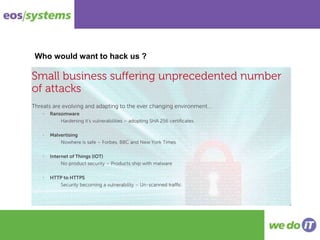
What is Ransomware
• Ransomware is a strain of malware (malicious software) that encrypts or
locks all of the files on your computer or server, and then demands a
payment (or ransom) to unlock your files.
• It takes many forms, including its most infamous incarnation,
Cryptolocker.
• Other strains include Locky, Teslacrypt, and Cryptowall.
• In some instances, ransomware’s presence can be betrayed by a .EXE
file extension - but cyber criminals are getting more and more
sophisticated, so this often isn’t the case.
How Does Ransomware Spread ?
• Like many viruses, the most common source of infection is from emails,
when a user opens contaminated attachments or clicks a malicious link.
However, there are many other sources, like rogue USB sticks, or even
joining free WiFi networks.
How can I Remove it ?
• Unfortunately, there’s no sure-fire way to remove Ransomware.
• Even paying up doesn’t always work; criminals have been known to ask
for higher and higher sums, or claim to have lost the ‘key’.
• The best approach is to access your backups.
What can I do to avoid Ransomware?
• There are three major forms of protection:
• Preventative measures,
• Anti-virus & backup.
• Preventative measures are the first lines of defence against Ransomware:
education can ensure that staff are aware of the risks and know what to
look out for, and changing system permissions can lower the risk of
infection.
• Anti-virus is a must for all businesses, and can detect and deflect a high
percentage of attacks.
What can I do to avoid Ransomware? Cont’d
• However, due to the ever-changing nature of Ransomware, these steps
aren’t 100% effective. That’s when you need a backup and business
continuity solution. This allows you to roll back to a point prior to infection.
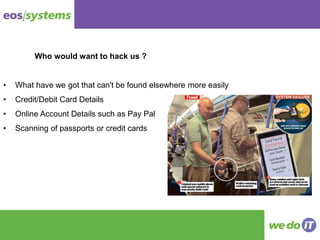
Who would want to hack us ?
• What have we got that can't be found elsewhere more easily
• Credit/Debit Card Details
• Online Account Details such as Pay Pal
• Scanning of passports or credit cards
Who would want to hack us ?
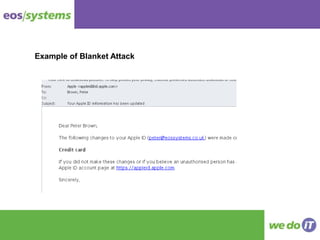
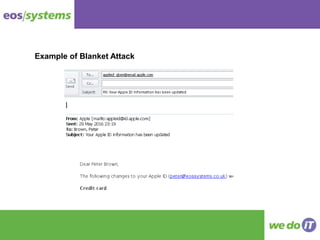
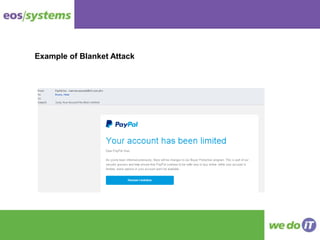
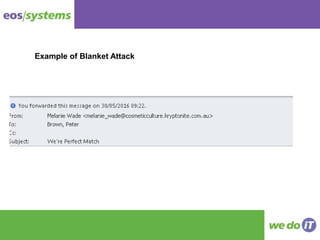
• There are basic kinds of phishing
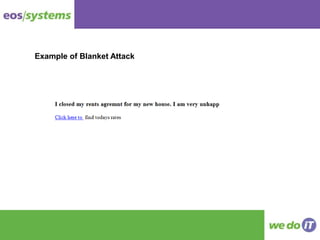
• Blanket
• Spear Phishing
• Whaling
Types of attacks?
Example of Social Engineering
Example of Blanket Attack
• They will ring you up to inform you , “you have an issue with Internet Traffic from
your connection “ you may have spyware
• Call reference you Credit Card being used
• Scammers who pretend to be tech support from Microsoft
Tech Support Scammers
• Crypto Locker , CryptoDefense and CryptoWall
• 5 Stages of Crypto Ransomware
1. Installation
2. Contacting Headquarters
3. Hand Shake and Keys
4. Encryption
5. Extortion
Most Commonly known attack !
• You don’t get calls from your Bank about the Balance in your account
• You don’t get phone calls from Microsoft Technical Support or other support
agents
• You don’t get emails from HMRC “ You are owed credit and to contact them”
• You probably don’t have a long lost Relative in the Congo who has Millions that
they need you to hold for them just short term
• Passwords should be changed regularly and not use common ones
How Do we Protect Ourselves
Educating our users on the Do’s and Don'ts is a Major factor in
reducing he impact to your Business

Cyber Security Presentation "It Will Never Happen To Me"

  • 1.
    Cyber Security Seminar “ItWill Never Happen To Me”
  • 2.
    What is CyberCrime Webopedia Definition • Cyber crime encompasses any criminal act dealing with computers and networks(called hacking) • Additionally, cyber crime also includes traditional crimes conducted through the internet • For example; hate crimes, telemarketing and Internet fraud, identity theft, • Credit card account thefts are considered to be cyber crimes when the illegal activities are committed through the use of a computer and the Internet.
  • 3.
    Cyber Crime Statistics *Crimerate in England and Wales soars as cybercrime is included for first time • The sharp rise in the headline figures is due to the inclusion of an estimated 5.1m online fraud incidents and 2.5m cybercrime offences for the first time • The detailed figures for online fraud show 14% of victims lost less than £20, 27% lost less than £100 and a further 37% lost less than £500. One per cent lost more than £5,000. • The virus or malware, known as Dridex netted criminals £20m in funds from UK Banks in 1 heist • Report also stated is was reported to have netted over $100m worldwide
  • 4.
    What is Ransomware •Ransomware is a strain of malware (malicious software) that encrypts or locks all of the files on your computer or server, and then demands a payment (or ransom) to unlock your files. • It takes many forms, including its most infamous incarnation, Cryptolocker. • Other strains include Locky, Teslacrypt, and Cryptowall. • In some instances, ransomware’s presence can be betrayed by a .EXE file extension - but cyber criminals are getting more and more sophisticated, so this often isn’t the case.
  • 5.
    How Does RansomwareSpread ? • Like many viruses, the most common source of infection is from emails, when a user opens contaminated attachments or clicks a malicious link. However, there are many other sources, like rogue USB sticks, or even joining free WiFi networks. How can I Remove it ? • Unfortunately, there’s no sure-fire way to remove Ransomware. • Even paying up doesn’t always work; criminals have been known to ask for higher and higher sums, or claim to have lost the ‘key’. • The best approach is to access your backups.
  • 6.
    What can Ido to avoid Ransomware? • There are three major forms of protection: • Preventative measures, • Anti-virus & backup. • Preventative measures are the first lines of defence against Ransomware: education can ensure that staff are aware of the risks and know what to look out for, and changing system permissions can lower the risk of infection. • Anti-virus is a must for all businesses, and can detect and deflect a high percentage of attacks.
  • 7.
    What can Ido to avoid Ransomware? Cont’d • However, due to the ever-changing nature of Ransomware, these steps aren’t 100% effective. That’s when you need a backup and business continuity solution. This allows you to roll back to a point prior to infection.
  • 8.
    Who would wantto hack us ?
  • 9.
    • What havewe got that can't be found elsewhere more easily • Credit/Debit Card Details • Online Account Details such as Pay Pal • Scanning of passports or credit cards Who would want to hack us ?
  • 10.
    • There arebasic kinds of phishing • Blanket • Spear Phishing • Whaling Types of attacks?
  • 11.
    Example of SocialEngineering
  • 12.
  • 13.
  • 14.
  • 15.
  • 16.
  • 17.
    • They willring you up to inform you , “you have an issue with Internet Traffic from your connection “ you may have spyware • Call reference you Credit Card being used • Scammers who pretend to be tech support from Microsoft Tech Support Scammers
  • 18.
    • Crypto Locker, CryptoDefense and CryptoWall • 5 Stages of Crypto Ransomware 1. Installation 2. Contacting Headquarters 3. Hand Shake and Keys 4. Encryption 5. Extortion Most Commonly known attack !
  • 19.
    • You don’tget calls from your Bank about the Balance in your account • You don’t get phone calls from Microsoft Technical Support or other support agents • You don’t get emails from HMRC “ You are owed credit and to contact them” • You probably don’t have a long lost Relative in the Congo who has Millions that they need you to hold for them just short term • Passwords should be changed regularly and not use common ones How Do we Protect Ourselves Educating our users on the Do’s and Don'ts is a Major factor in reducing he impact to your Business