Cyanotic Heart Lesions


                                             Dr. Kalpana Malla
                                            MBBS MD (Pediatrics)
                                         Manipal Teaching Hospital


Download more documents and slide shows on The Medical Post [ www.themedicalpost.net ]
Cyanotic Heart Lesions
• The 5 Ts
   – Tetralogy of Fallot
   – Transposition of the Great Arteries
   – Truncus Arteriosus (Persistent)
   – Tricuspid Atresia
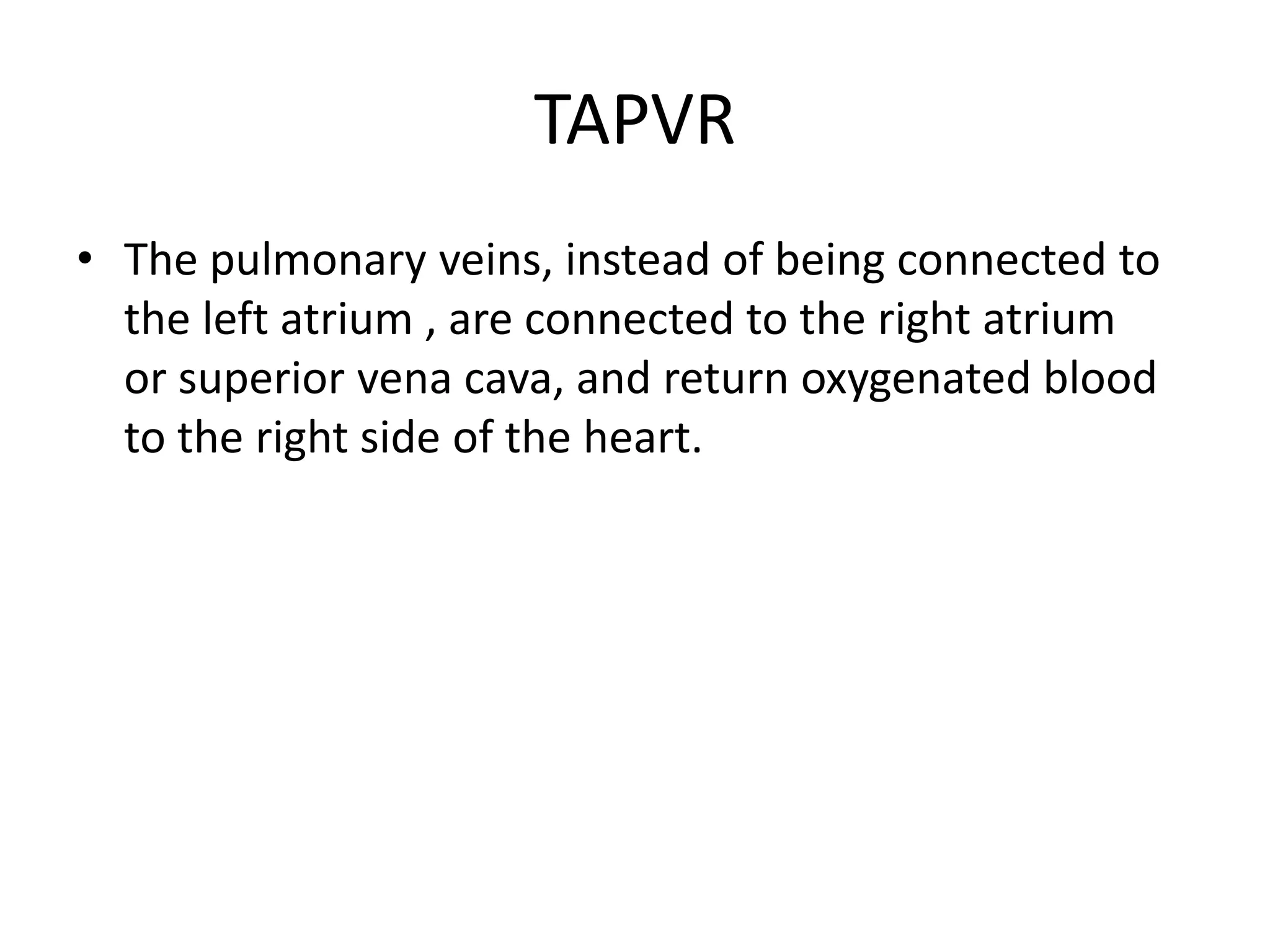
   – Total Anomalous Pulmonary Venous Return
    (TAPVR)
Cyanotic Heart Lesions

•   Hypoplastic left heart syndrome (HLH)
•   Pulmonary atresia (PA) / critical PS
•   Double outlet right ventricle (DORV)
•   Ebstein anomaly
•   Single ventricle
R    L
R L with pulmonary stenosis
• TOF
• Tricuspid atresia
• Ebstein’s anomaly
Evaluation possible congenital heart
Exam: rate, rhythm, impulse, murmur, pulses
  (brachial and femoral)
• Oxygen saturation - Hyperoxia test
• ABG
• Chest X- ray
• Echocardiogram
• Cardiac catheterization
Tetralogy of Fallot (TOF):

•   Most common (75% )cyanotic CHD in >2yrs

•   ~ 10% of all CHD
Tetralogy of Fallot
• TOF = consists
   – Ventricular septal defect
   – Rt ventricular outflow obstruction – infundibular or
     infundibular + pulmonary valve stenosis

   – Aorta position is shifted to the right and over-rides the VSD

   – Hypertrophy of the right ventricle
Essential components:
                VSD
                Pulmonary stenosis
Other components :
                overriding of Aorta
                RVH

Pentalogy of Fallot: all above + ASD
Hemodynamics:
• Large, non-restrictive VSD, perimembranous type,
  extending upto right ventricular outlet allows
  equalisation of pressures in two ventricles VSD is
  silent

• Pulmonary stenosis Shunting of blood from R L
  ventricle mixing of oxygenated & deoxygenated
  blood in left ventricle circulated to whole body
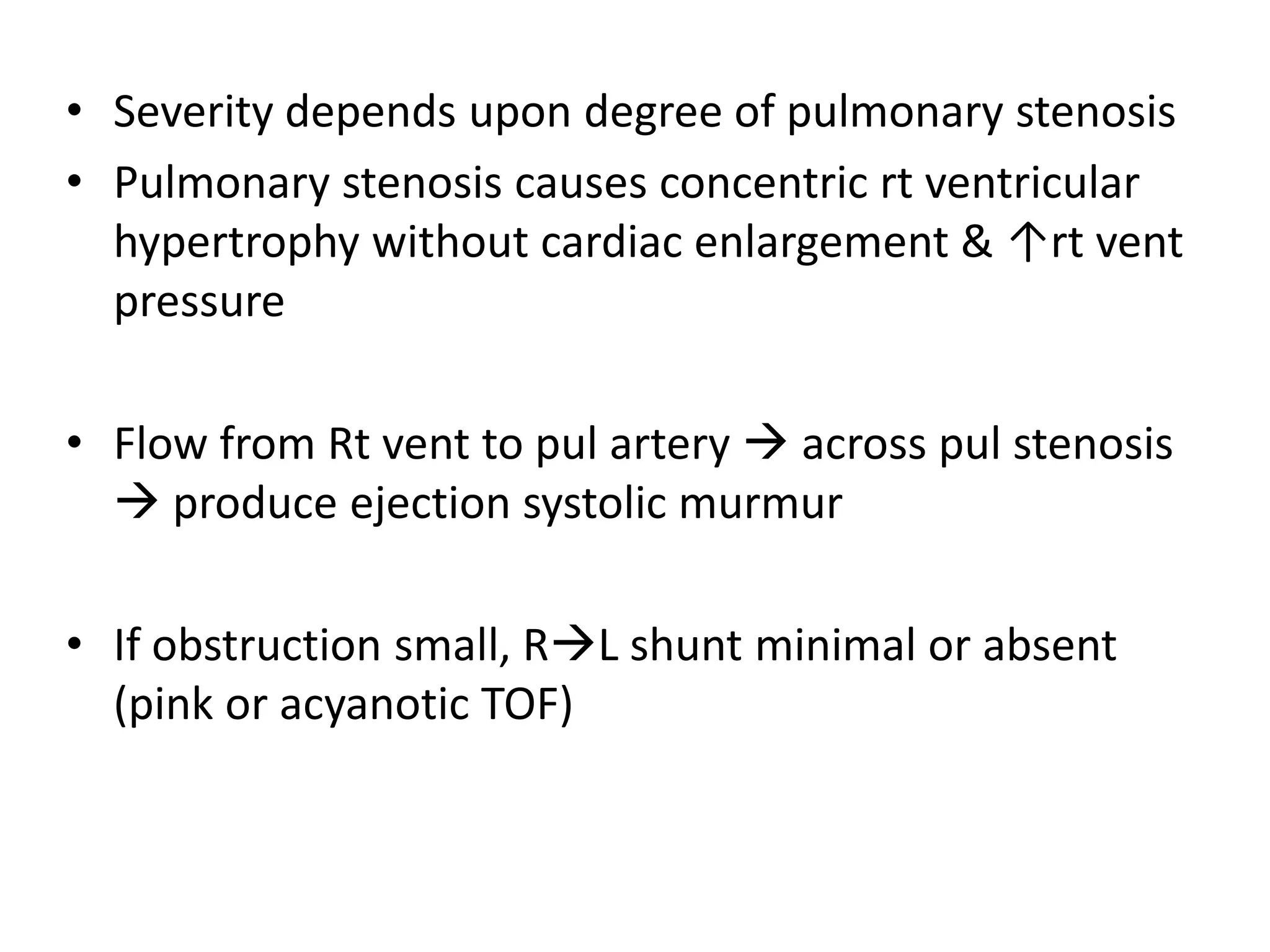
• Severity depends upon degree of pulmonary stenosis
• Pulmonary stenosis causes concentric rt ventricular
  hypertrophy without cardiac enlargement & ↑rt vent
  pressure

• Flow from Rt vent to pul artery  across pul stenosis
   produce ejection systolic murmur

• If obstruction small, RL shunt minimal or absent
  (pink or acyanotic TOF)
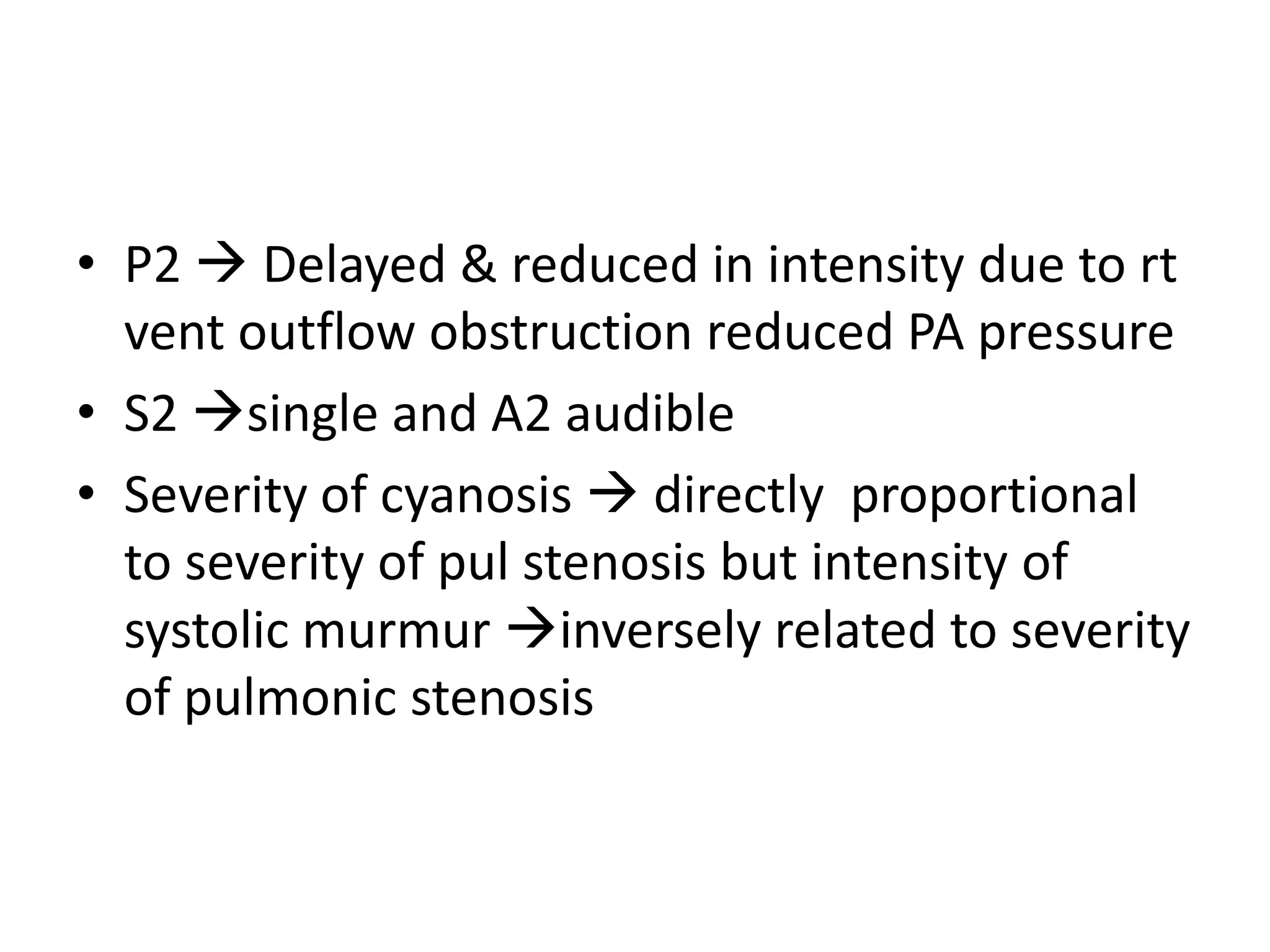
• P2  Delayed & reduced in intensity due to rt
  vent outflow obstruction reduced PA pressure
• S2 single and A2 audible
• Severity of cyanosis  directly proportional
  to severity of pul stenosis but intensity of
  systolic murmur inversely related to severity
  of pulmonic stenosis
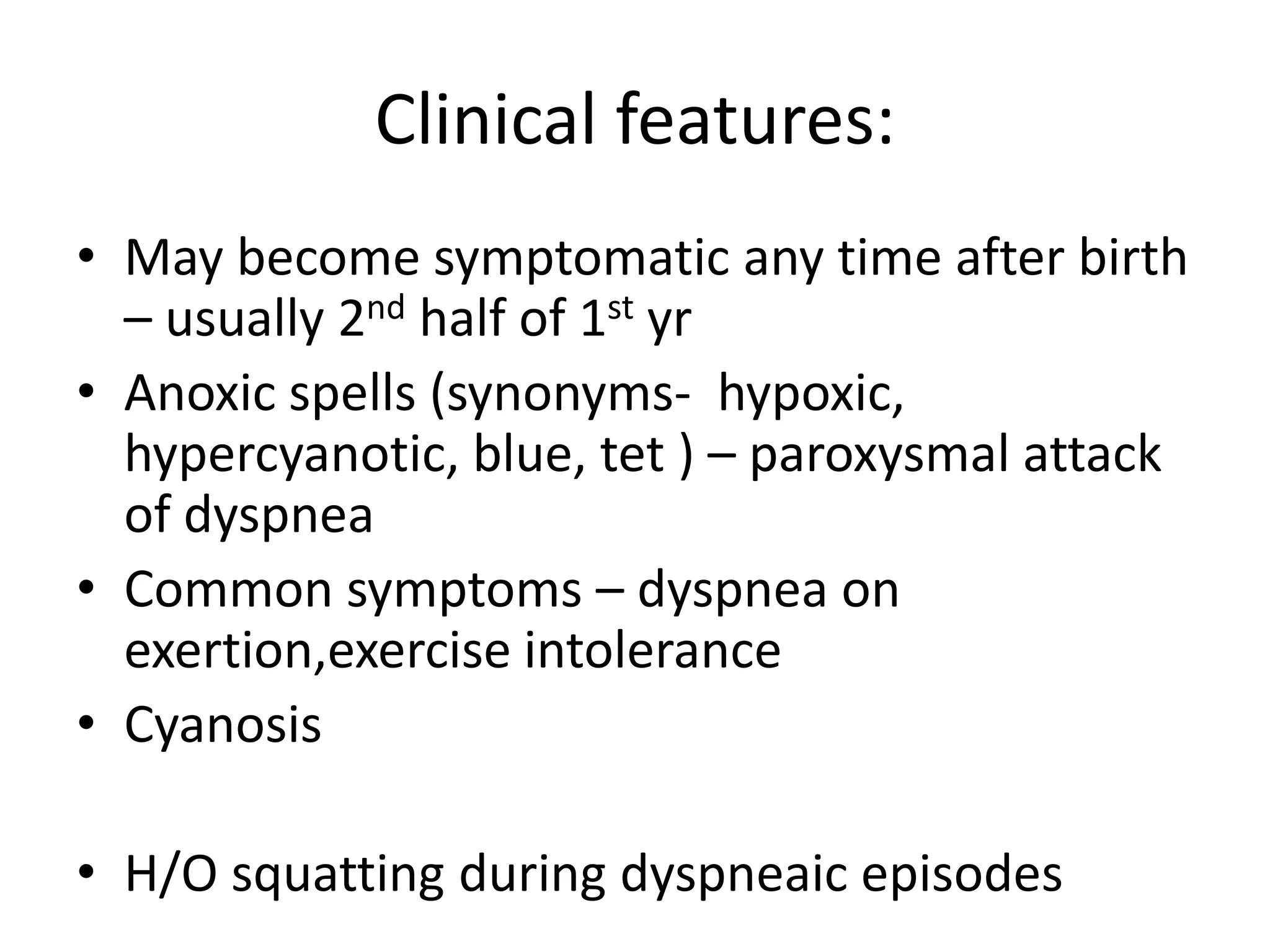
Clinical features:
• May become symptomatic any time after birth
  – usually 2nd half of 1st yr
• Anoxic spells (synonyms- hypoxic,
  hypercyanotic, blue, tet ) – paroxysmal attack
  of dyspnea
• Common symptoms – dyspnea on
  exertion,exercise intolerance
• Cyanosis

• H/O squatting during dyspneaic episodes
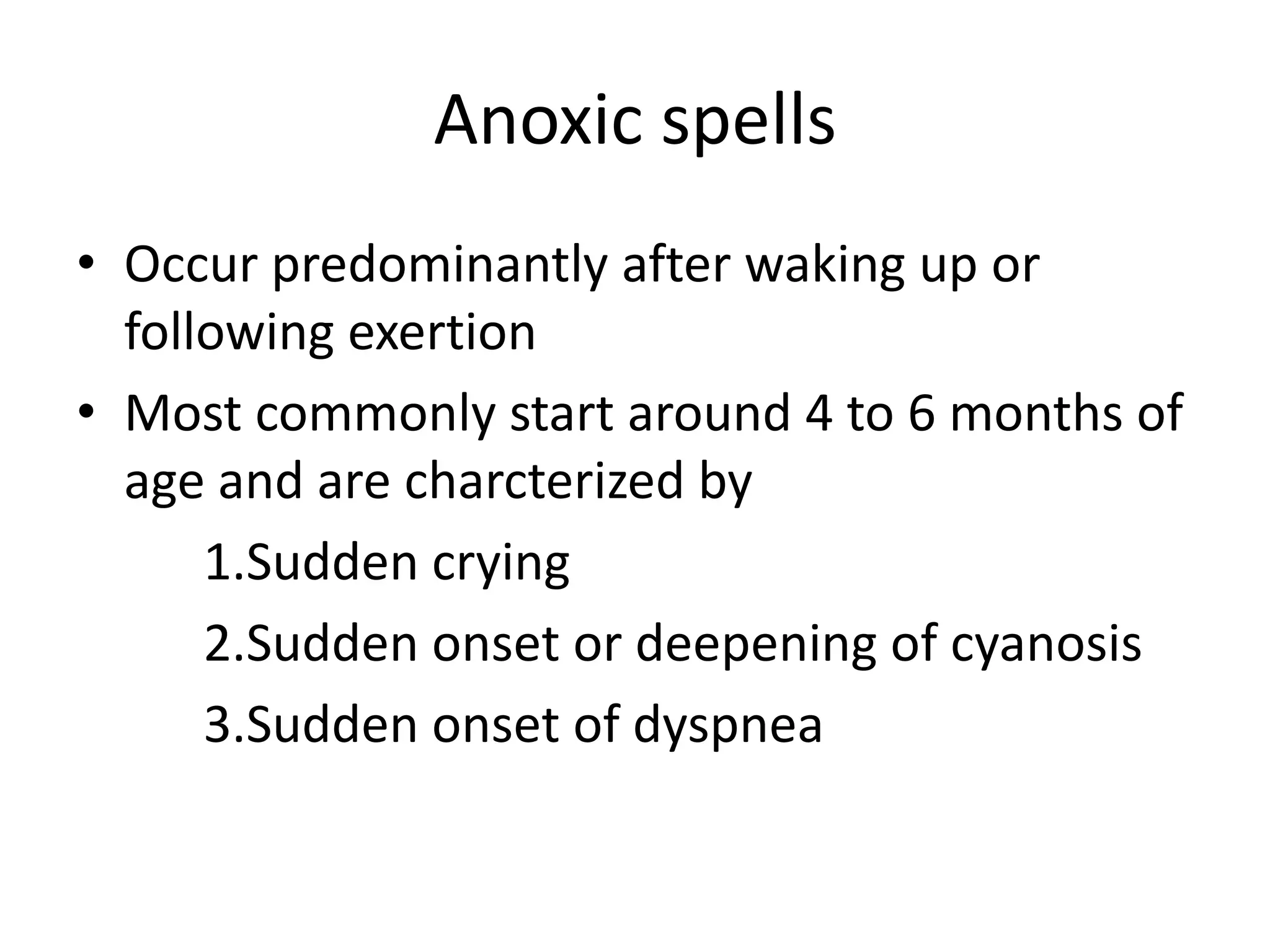
Anoxic spells
• Occur predominantly after waking up or
  following exertion
• Most commonly start around 4 to 6 months of
  age and are charcterized by
      1.Sudden crying
      2.Sudden onset or deepening of cyanosis
      3.Sudden onset of dyspnea
Anoxic spells
4. Alterations of consciousness
5. Convulsions
6.Decrease in intensity of systolic murmur
Frequency varies from once in a few days
   to numerous attacks every day
• Mild outflow obstruction: cyanosis in later part of 1st year

• Severe outflow obstruction: cyanosis immediately after
  birth (as ductus starts to close)

CCF unusual in children with TOF except in:
 Severe anemia
 Valvular regurgitation
 Infective endocarditis
 Systemic hypertension
 Coincidental myocardial diseases
Physical examination:
•   Cyanosis
•   Clubbing
•   Polycythemia
•   Normal sized heart
•   Mild parastrnal impulse
Auscultation
•   S1 –normal
•   S2 – Single, (A2 heard,P2 soft &delayed
•   Murmur –
•   Shunt – absent
•   Flow - Loud short pulmonary ejection systolic
    murmur grade 3-5/6 at 3rd ICS in left side
Diagnosis:
• Blood: polycythemia
• CXR:
1. Upturned apex (RVH)- Small boot shaped
   heart
2. Oligemic lung fields
3. Absence or concavity of pulmonary artery
   segment gives the shape described as cor-
   en sabot
4. Right aortic arch ~25 -30%
• Diagnosis:

• ECG:
    RAD, RVH with tall peaked p waves

• Echo: overriding aorta,RVH,outflow
  obstruction

• Cardiac catheterisation
Complications:
• Cerebral thrombosis

• Brain abscess

• Bleeding diathesis

• Infective endocarditis

• CCF-in acyanotic or pink TOF
Complications:
• CNS - Embolism to CNS - sluggish circulation
  from polycythemia
• Hemiplegia - infarction in CNS during anoxic
  spell
Management:

• Management of Tet spells:
        - knee-chest position

            - humidified O2 inhalation

             - morphine 0.1 mg/kg s/c/ iv
Management of Tet spells:
 - IV fluids
 - Correct metabolic acidosis- Na-bicarbonate
 - Propanolol – 0.1mg/kg/iv during spell (0.5-1
  mg/kg PO 6 hrly
Management:

• Vasopressors- methoxamine IM or IV drip
  penylephrine
• Correct anemia
• Consider surgery
• General measures:
      - Correction of iron deficiency anemia
      - Adequate hydration
      - Antibiotics for infection
      - Prophylaxis with propranolol
Surgery
• Palliative surgery:
 - Blalock-Taussig shunt – subclavian artery to
   pulm artery
  - Pott’s shunt-descending aorta to PA
   - Waterson operation – ascending aorta to
    Rt pulm artery
-Modified Blalock-Taussig shunt
• Corrective surgery: open heart surgery for –
   closer of VSD
 - resecting the infundibular obstruction PS
Surgery can be performed at any age
Success – 85-90%
Complications of surgery
•   Complete heart block
•   RBBB
•   Residual VSD & Pulm stenosis
•   Pulm regurgitation
Tricuspid atresia


   • Cong absence of
     Tricuspid valve
  • Rt ven hypoplastic
• Absent inflow portion
      • 2% of CHD
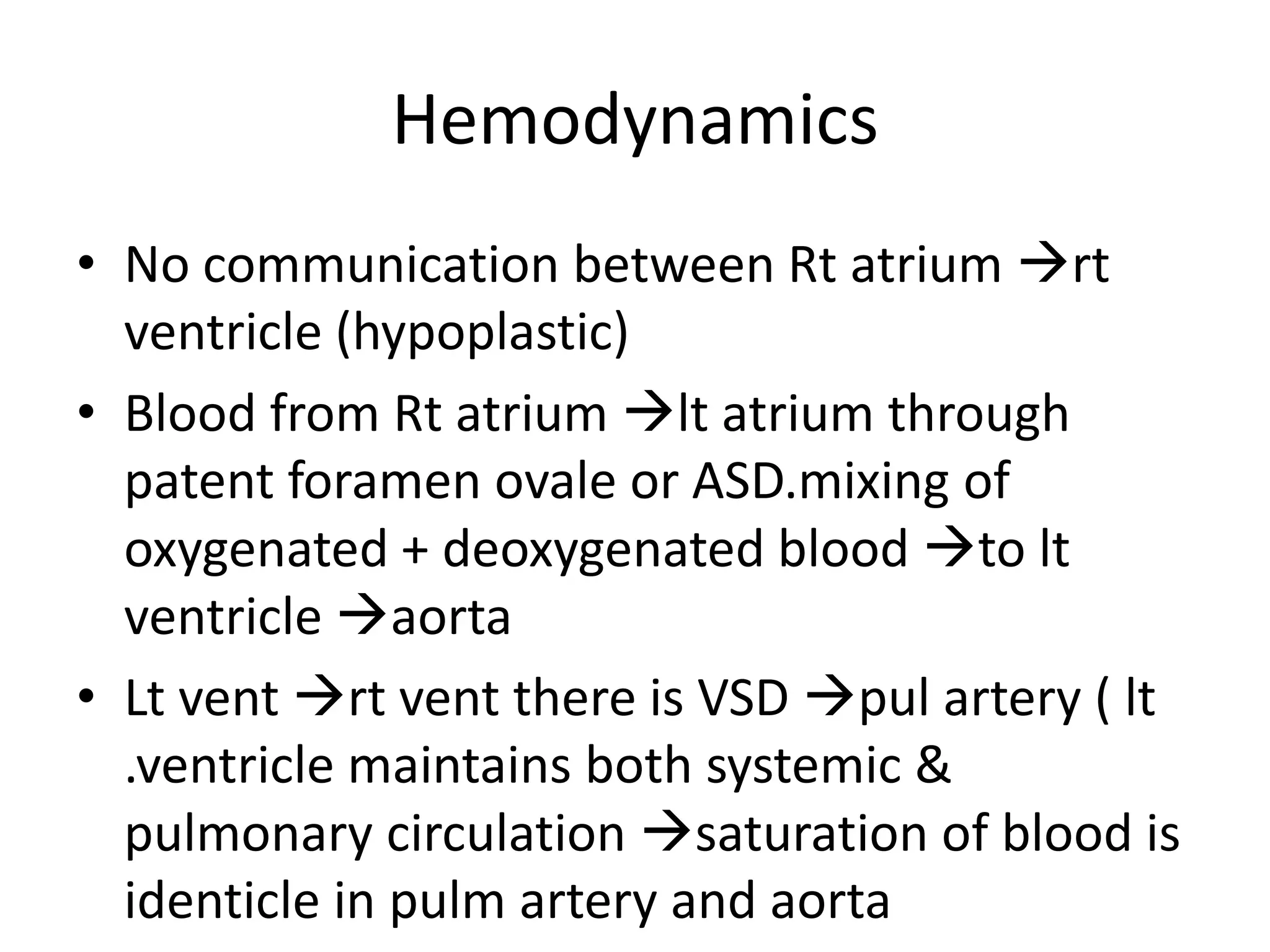
Hemodynamics
• No communication between Rt atrium rt
  ventricle (hypoplastic)
• Blood from Rt atrium lt atrium through
  patent foramen ovale or ASD.mixing of
  oxygenated + deoxygenated blood to lt
  ventricle aorta
• Lt vent rt vent there is VSD pul artery ( lt
  .ventricle maintains both systemic &
  pulmonary circulation saturation of blood is
  identicle in pulm artery and aorta
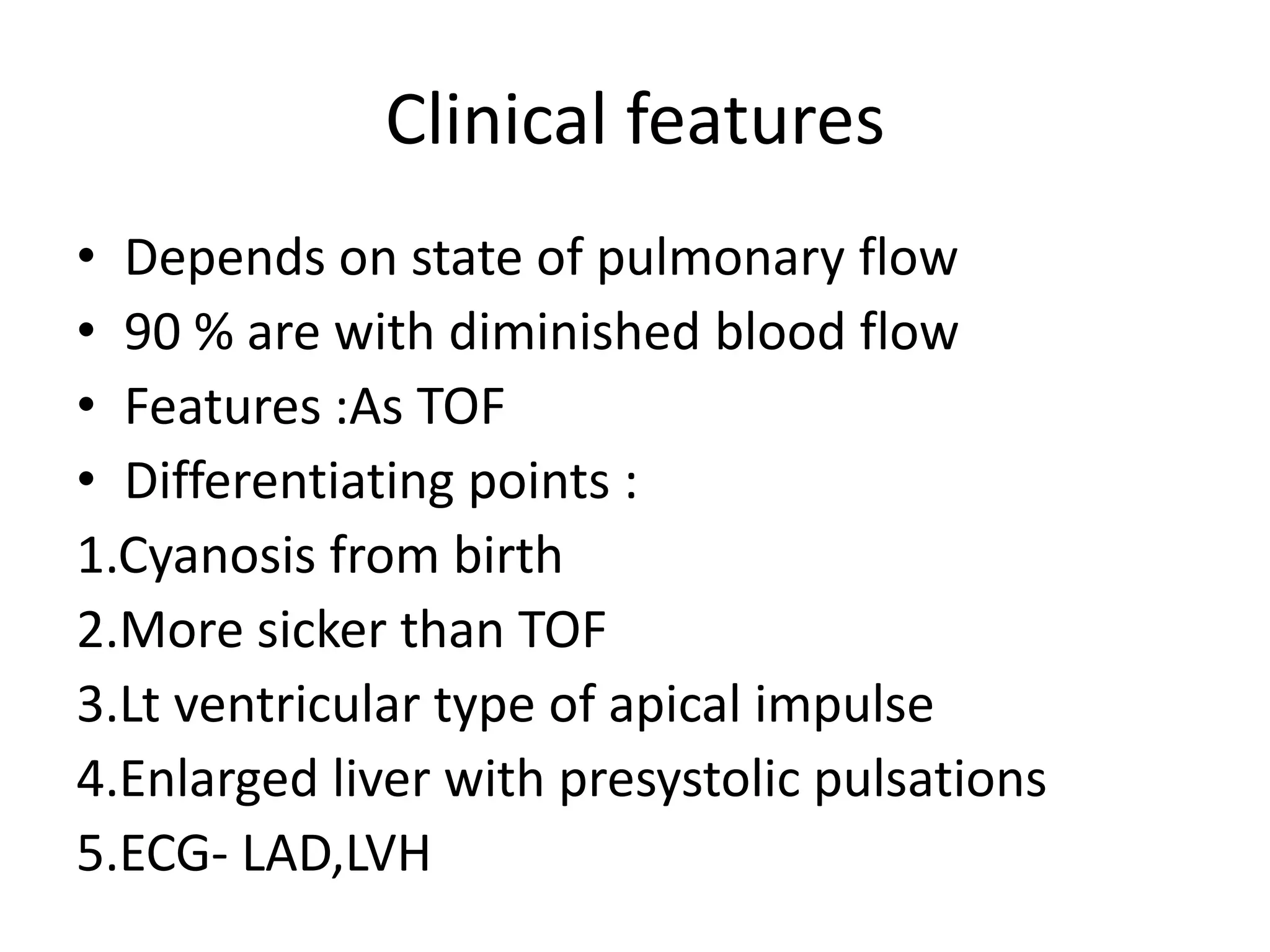
Clinical features
• Depends on state of pulmonary flow
• 90 % are with diminished blood flow
• Features :As TOF
• Differentiating points :
1.Cyanosis from birth
2.More sicker than TOF
3.Lt ventricular type of apical impulse
4.Enlarged liver with presystolic pulsations
5.ECG- LAD,LVH
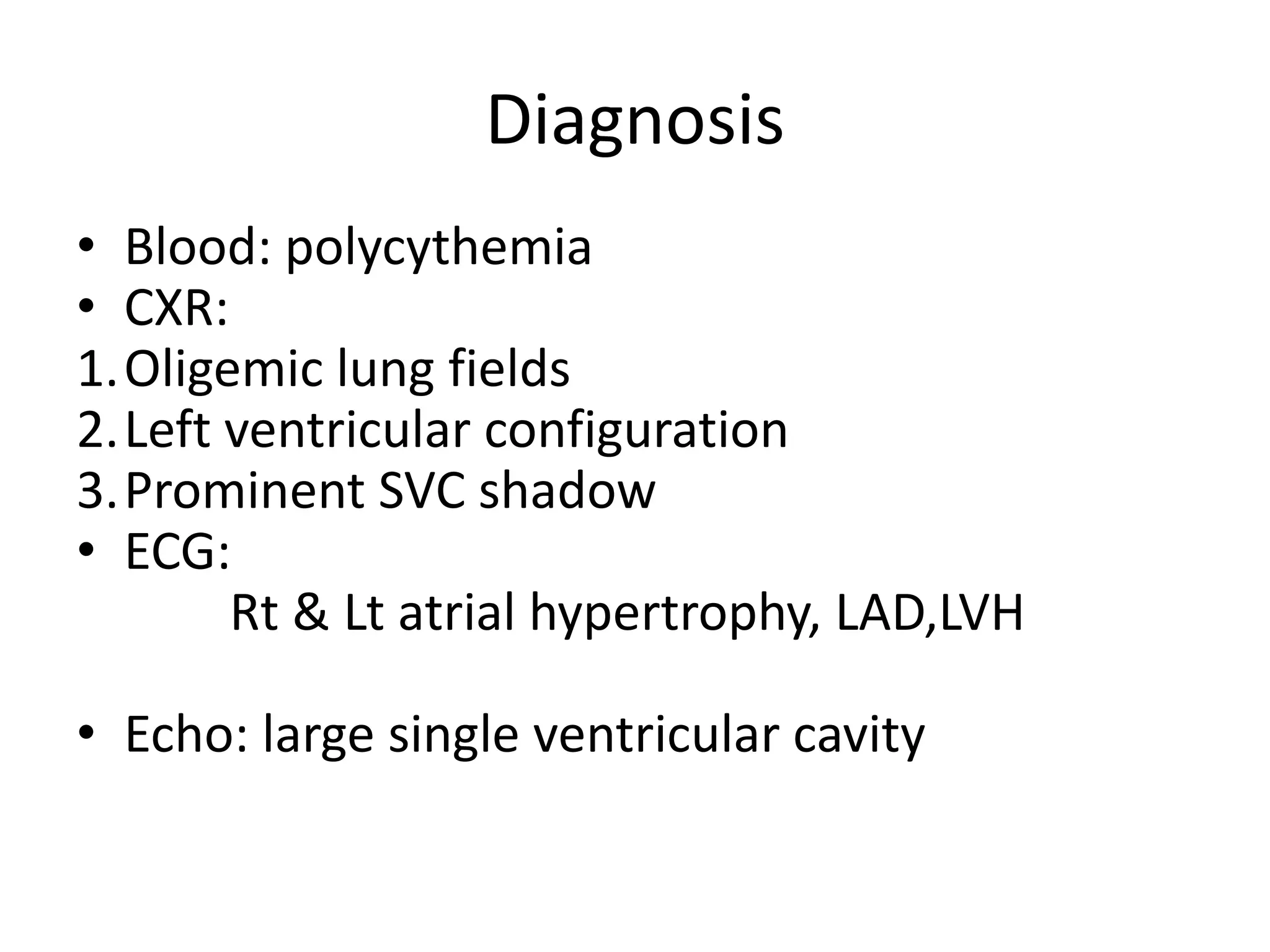
Diagnosis
• Blood: polycythemia
• CXR:
1.Oligemic lung fields
2.Left ventricular configuration
3.Prominent SVC shadow
• ECG:
       Rt & Lt atrial hypertrophy, LAD,LVH

• Echo: large single ventricular cavity
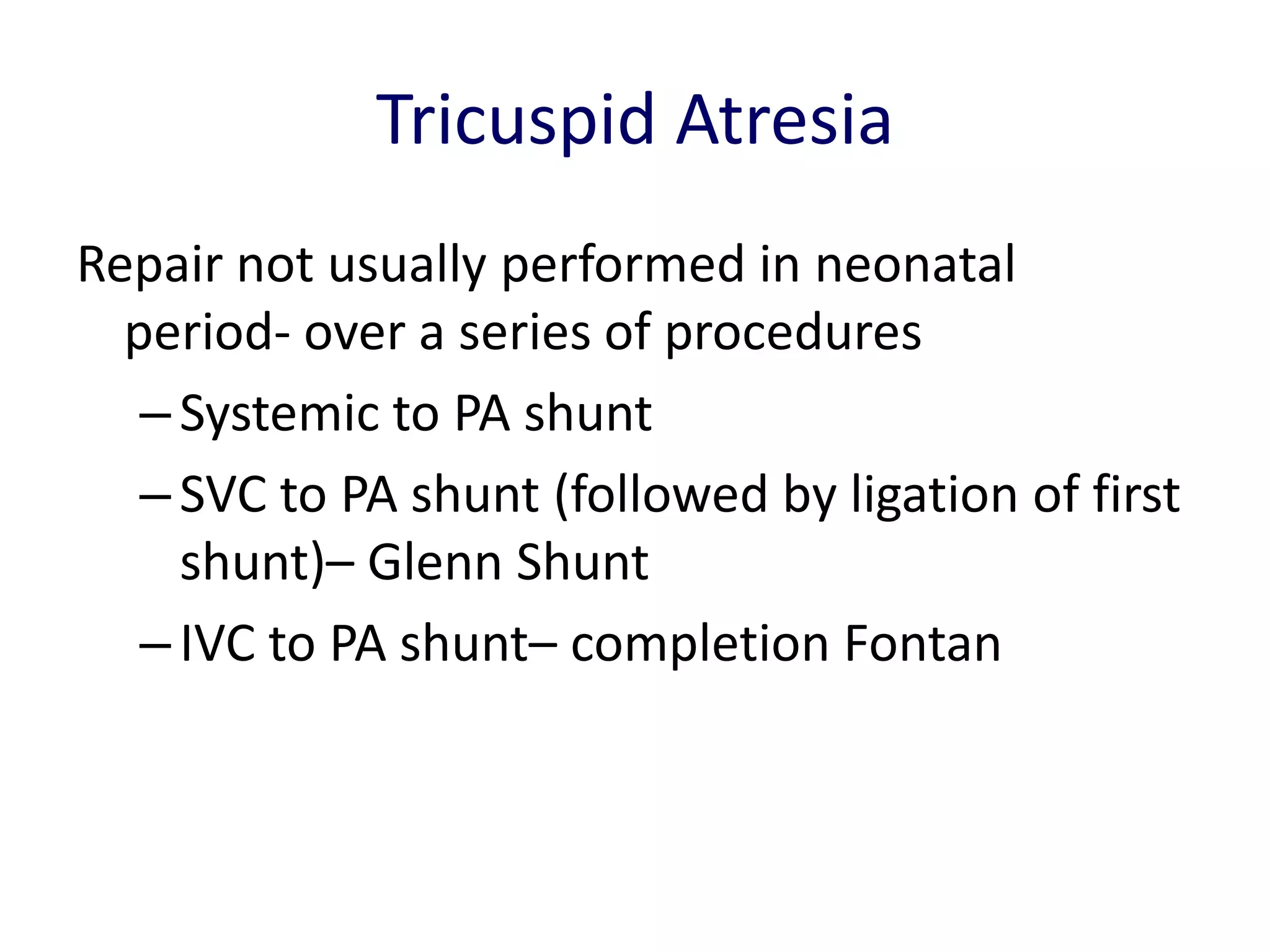
Tricuspid Atresia
Repair not usually performed in neonatal
  period- over a series of procedures
   – Systemic to PA shunt
   – SVC to PA shunt (followed by ligation of first
     shunt)– Glenn Shunt
   – IVC to PA shunt– completion Fontan
Ebsteins Anomaly
• Rare CCHD
• Post and septal leaflet of TV – displaced downwards
  –
• The upper part of the right ventricle is part of the
  right atrium - atrialized rt ventricle
• Rt ventricle is too small and Rt. atrium is too large.
• Leaflets – malformed and fused – obstruction of
  flow to rt ventricle
Ebsteins Anomaly
• Often Associated with other heart lesions
  – ASD
  – Pulmonary Stenosis
  – Pulmonary Atresia
Hemodynamics :

Abnormal leaflets obstruction to forward
 flow & regurgitation from Rt ven to Rt
 atrium atrium dilates Patent FO / ASD
 allows R L shunt( cyanosis) Lt atrium
 (enlarged) Lt ventricle (enlarged &
 hypertrophied)
Clinical picture
•   Cyanosis
•   Effort intolerance
•   Fatigue
•   Paroxysmal attack of tachycardia
•   Clubbing
•   Lt ventricular apical impulse
•   Systolic thrill may be palpable LSB
Auscultation
• S1- normal
• S2 – widely split but variable
• Rt ventricular 3rd soundor rt atrial 4th sound
  audible – triple/quadruple sound usually
  heard
• Murmur-midsystolic ejection or pansystolic
• Short tricuspid delayed diastolic M
Investigations
• CXR cardiomegaly –square shaped
           Lung – oligemic
ECG- ‘p’ pulmonale ‘p’mitrale,RBBB
Wolff Parkinson white type conducton defect
  maybe seen
ECHO- displaced tricuspid valve
Treatment
• Surgical – obliteration of atrialised portion of
  rt.ventricle and repairof tricuspid valve
Fallot’s physiology
• Presence of large VSD with PS
• Useful for bedside identification of group of
  condition with similar clinical findings
• Defects with Fallot’s physiology:
1. Complete TGA with VSD & PS
2. DORV with PS & large VSD (subaortic)
3. Tricuspid atresia with diminished pul flow
4.Single ventricle with PS
5. corrected TGA with VSD & PS
Transposition of the Great Arteries
• Most common cyanotic condition that
  requires hospitalization in first 2 weeks of
  life
• Aorta arises from RV
• Pulmonary artery originates in the left
  ventricle
• Oxygenated pulmonary venous blood
  recirculates in lungs and systemic venous
  blood recirculates in systemic circulation
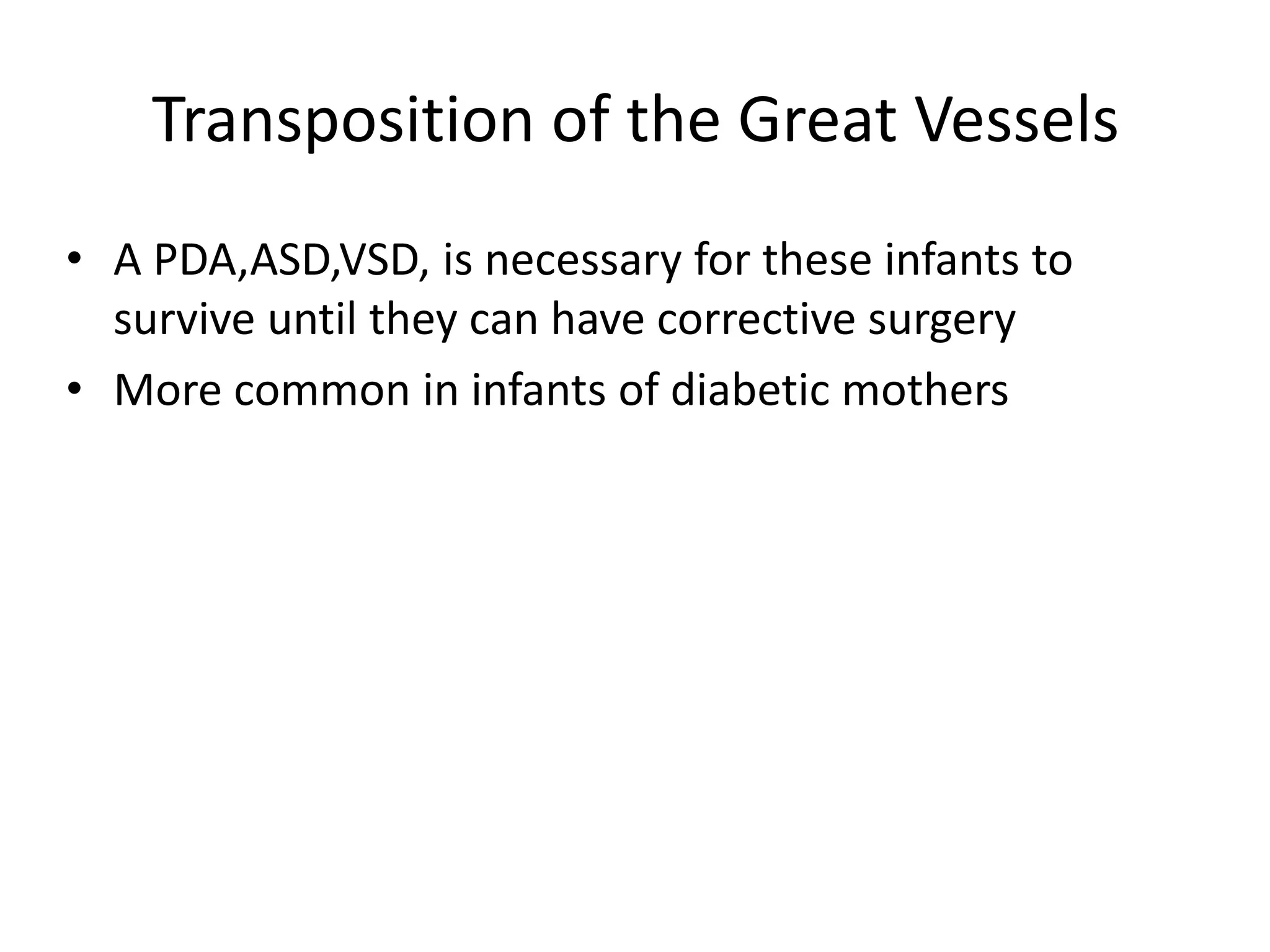
Transposition of the Great Vessels
• A PDA,ASD,VSD, is necessary for these infants to
  survive until they can have corrective surgery
• More common in infants of diabetic mothers
Classification
1. Complete variety
2. Physiologically corrected type
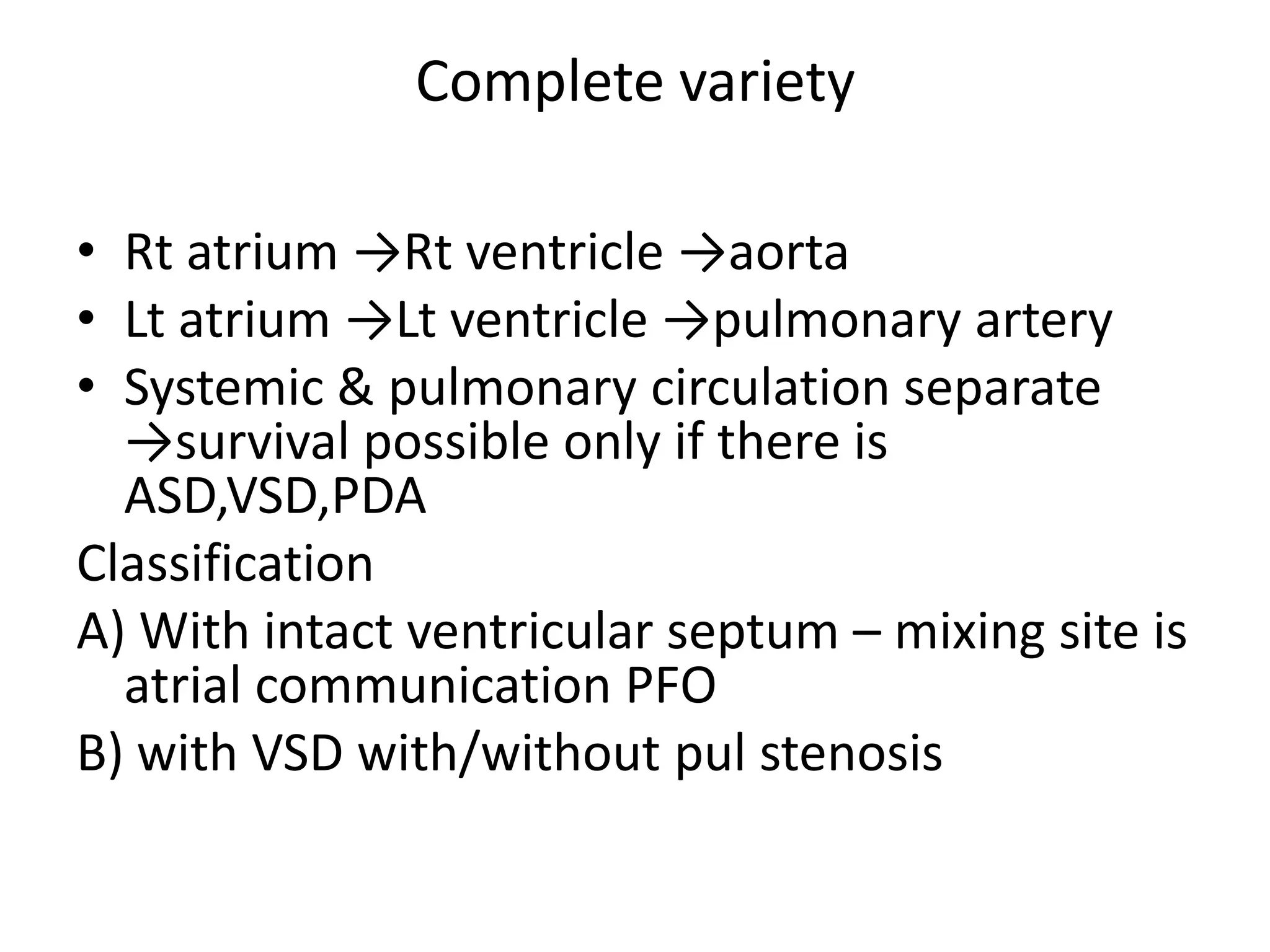
Complete variety

• Rt atrium →Rt ventricle →aorta
• Lt atrium →Lt ventricle →pulmonary artery
• Systemic & pulmonary circulation separate
  →survival possible only if there is
  ASD,VSD,PDA
Classification
A) With intact ventricular septum – mixing site is
  atrial communication PFO
B) with VSD with/without pul stenosis
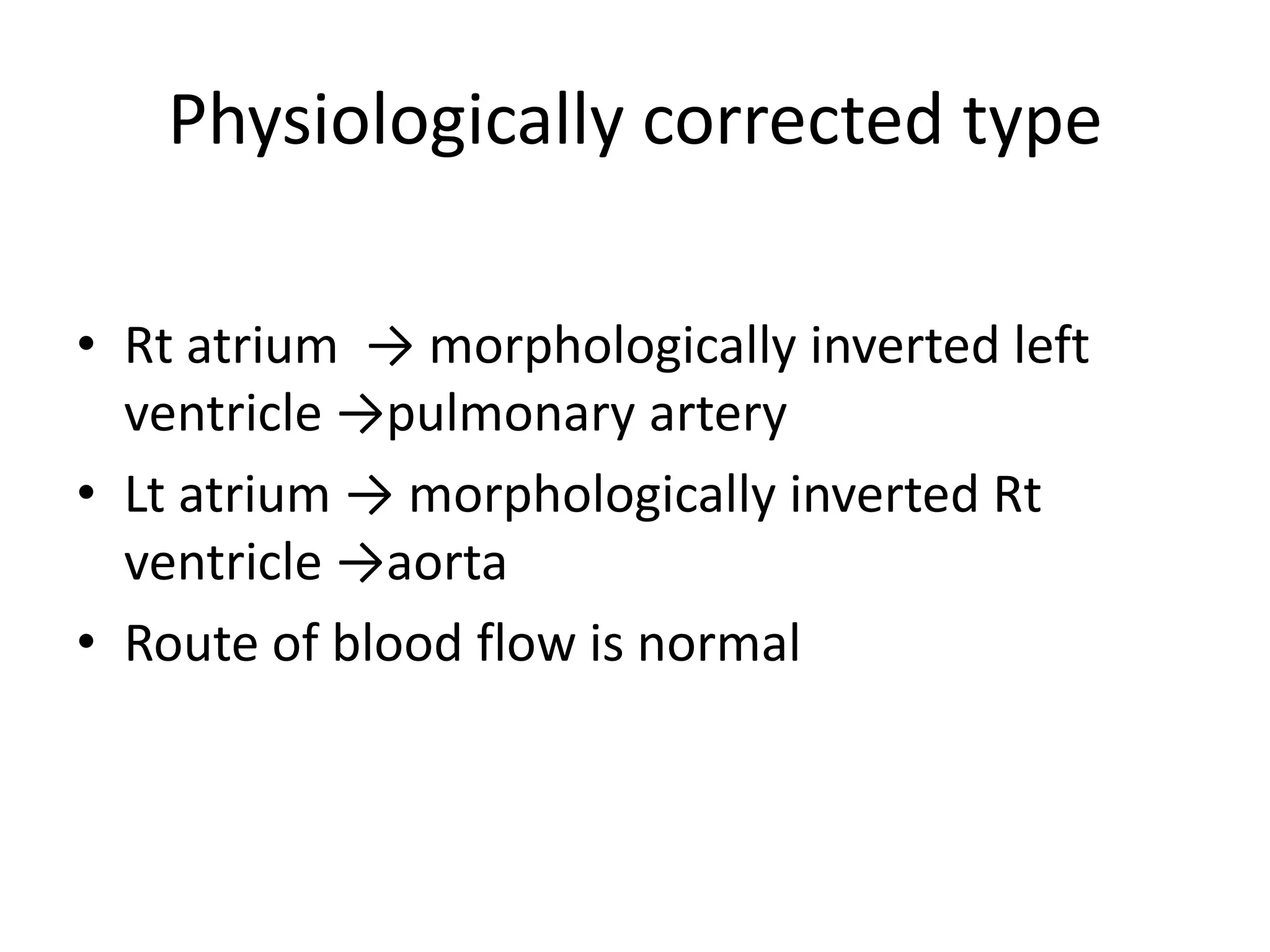
Physiologically corrected type

• Rt atrium → morphologically inverted left
  ventricle →pulmonary artery
• Lt atrium → morphologically inverted Rt
  ventricle →aorta
• Route of blood flow is normal
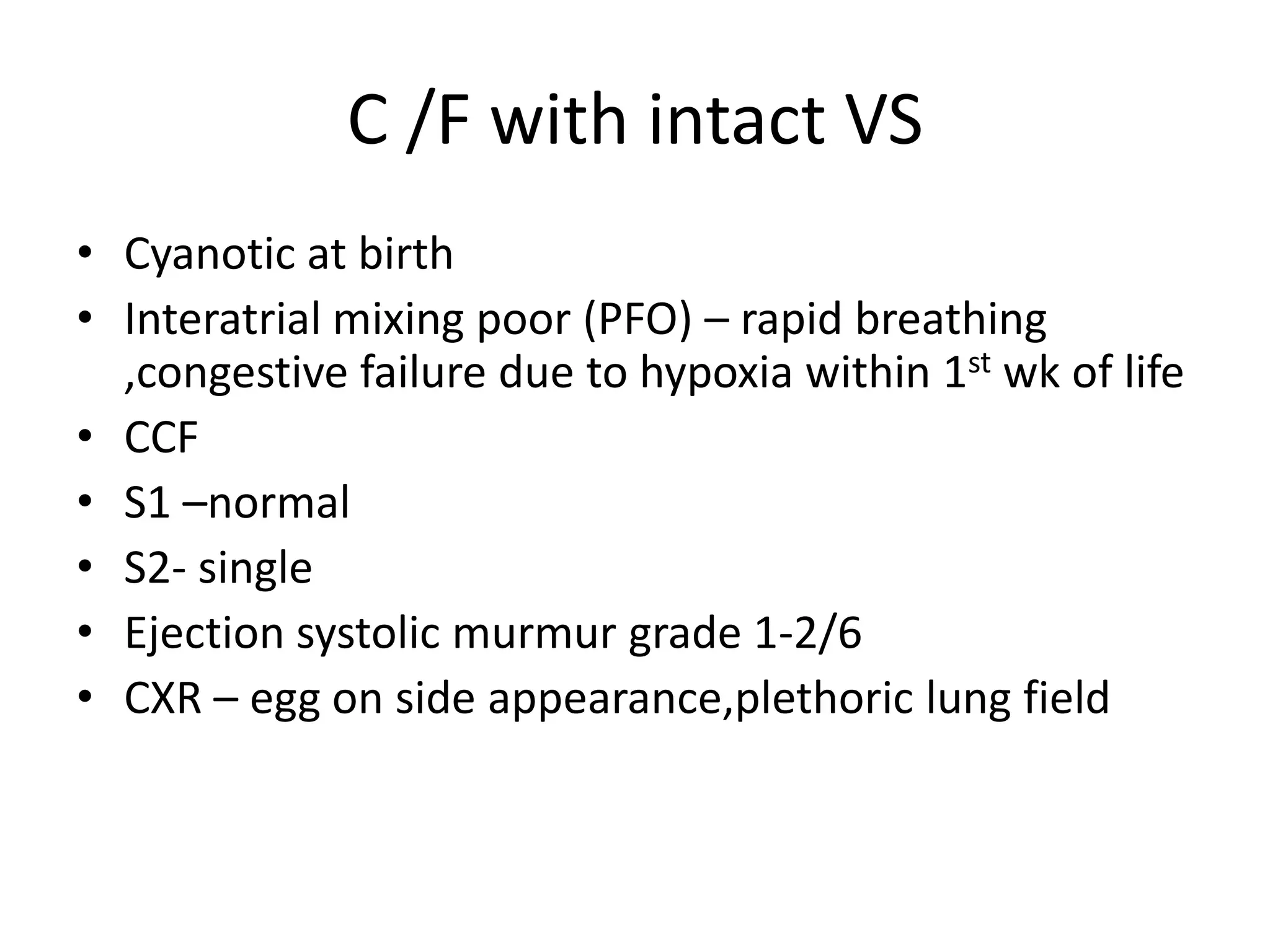
C /F with intact VS
• Cyanotic at birth
• Interatrial mixing poor (PFO) – rapid breathing
  ,congestive failure due to hypoxia within 1st wk of life
• CCF
• S1 –normal
• S2- single
• Ejection systolic murmur grade 1-2/6
• CXR – egg on side appearance,plethoric lung field
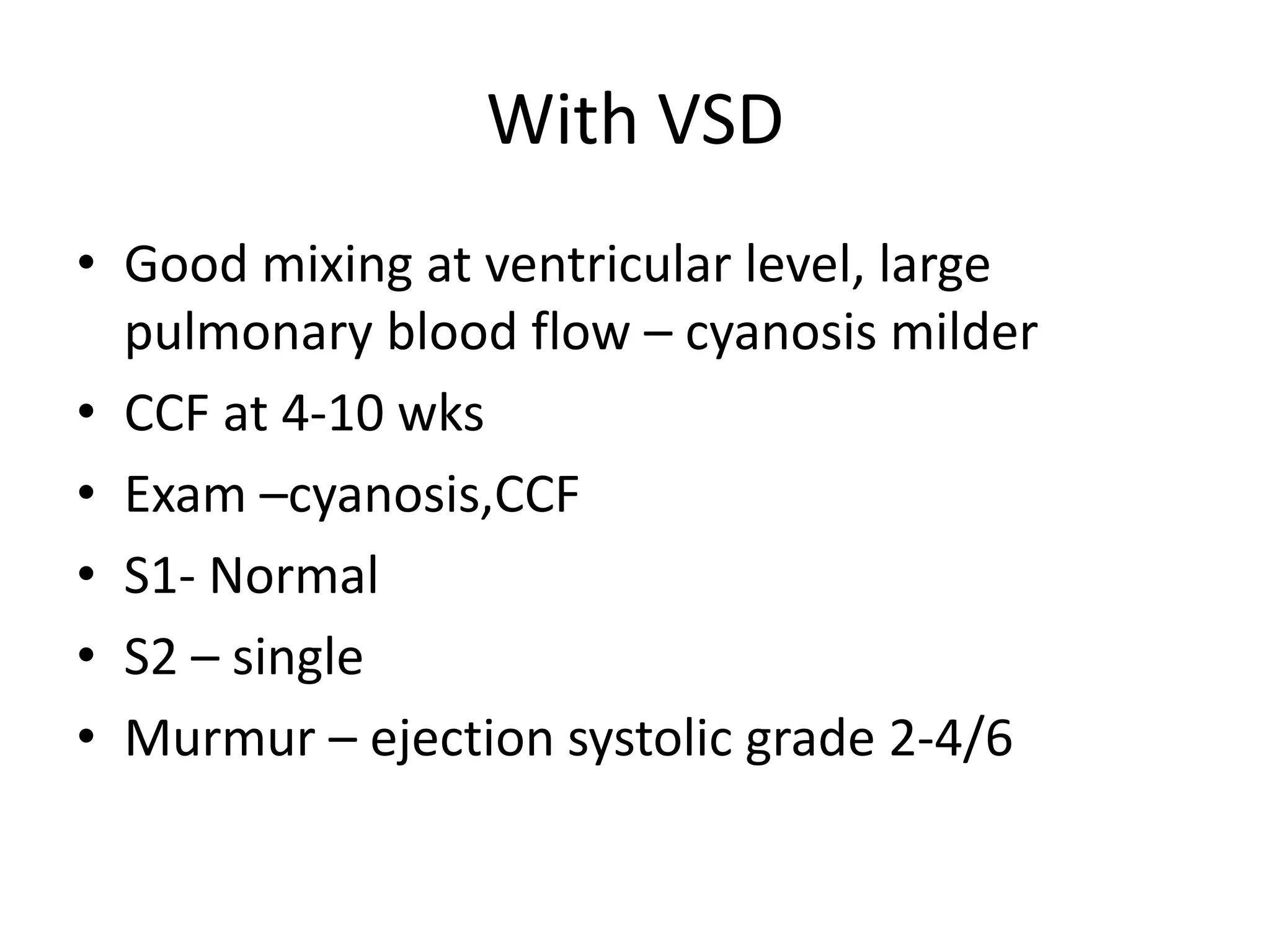
With VSD
• Good mixing at ventricular level, large
  pulmonary blood flow – cyanosis milder
• CCF at 4-10 wks
• Exam –cyanosis,CCF
• S1- Normal
• S2 – single
• Murmur – ejection systolic grade 2-4/6
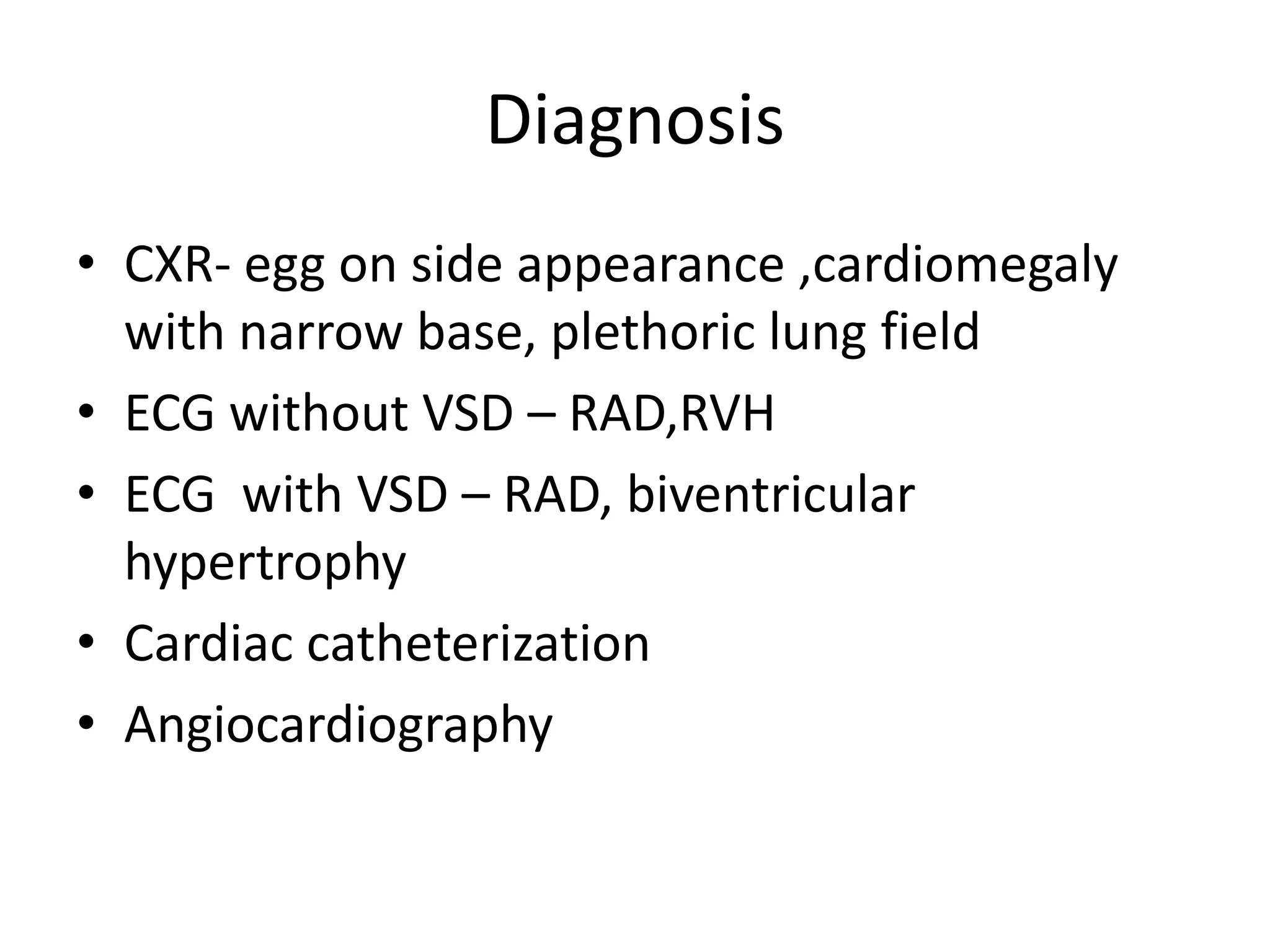
Diagnosis
• CXR- egg on side appearance ,cardiomegaly
  with narrow base, plethoric lung field
• ECG without VSD – RAD,RVH
• ECG with VSD – RAD, biventricular
  hypertrophy
• Cardiac catheterization
• Angiocardiography
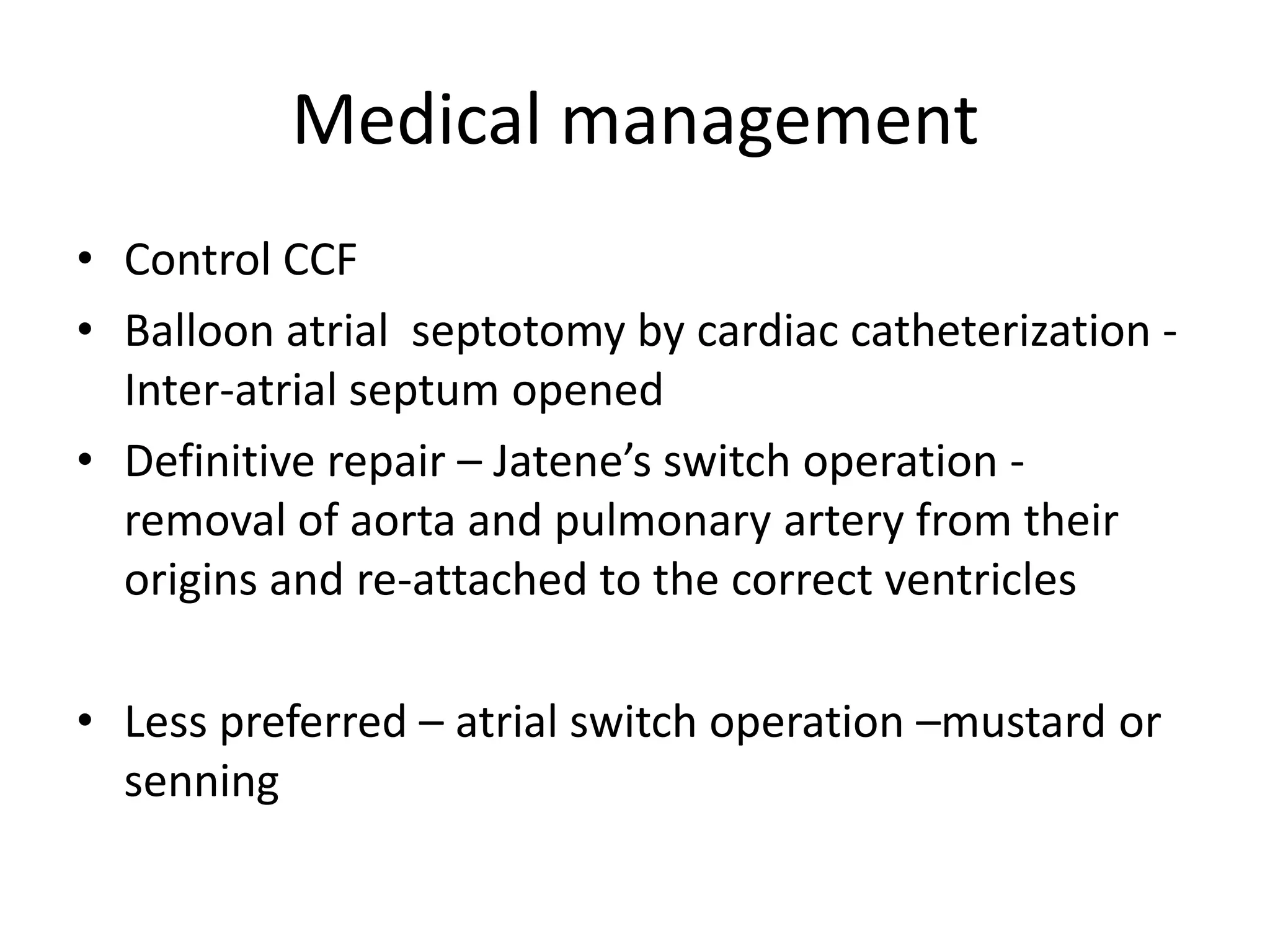
Medical management
• Control CCF
• Balloon atrial septotomy by cardiac catheterization -
  Inter-atrial septum opened
• Definitive repair – Jatene’s switch operation -
  removal of aorta and pulmonary artery from their
  origins and re-attached to the correct ventricles

• Less preferred – atrial switch operation –mustard or
  senning
Corrected TGA
• Normal route of blood flow
• Commonly associated with other anomalies
  98% - symtoms are due associated anomalies:
1.VSD with/without PS
2.Lt sided Ebstein’s anomaly of tricuspid valve
3.Atrioventricular conduction abnormalities
Truncus Arteriosus
• Truncus fails to divide completely during fetal life,
  leaving a connection between the aorta and
  pulmonary arteries
• Mixed oxygenated and de-oxygenated blood exits the
  heart and enters the systemic circulation
Truncus Arteriosus
• Single artery arises from the heart, supplying both aorta
  and pulmonary artery.
• VSD below the truncal valve allows mixing of right and left
  ventricular blood
• Degree of cyanosis is variable
• Presents with progressive heart failure
Truncus Arteriosus
• Medical Management
  – Digoxin and Diuretics
• Surgical Repair
  – Usually required by 2-3 months of age
  – VSD is closed
  – PA trunk is separated from truncus
  – Conduit created between RV and PA using a
    valved graft
TAPVR
• The pulmonary veins, instead of being connected to
  the left atrium , are connected to the right atrium
  or superior vena cava, and return oxygenated blood
  to the right side of the heart.
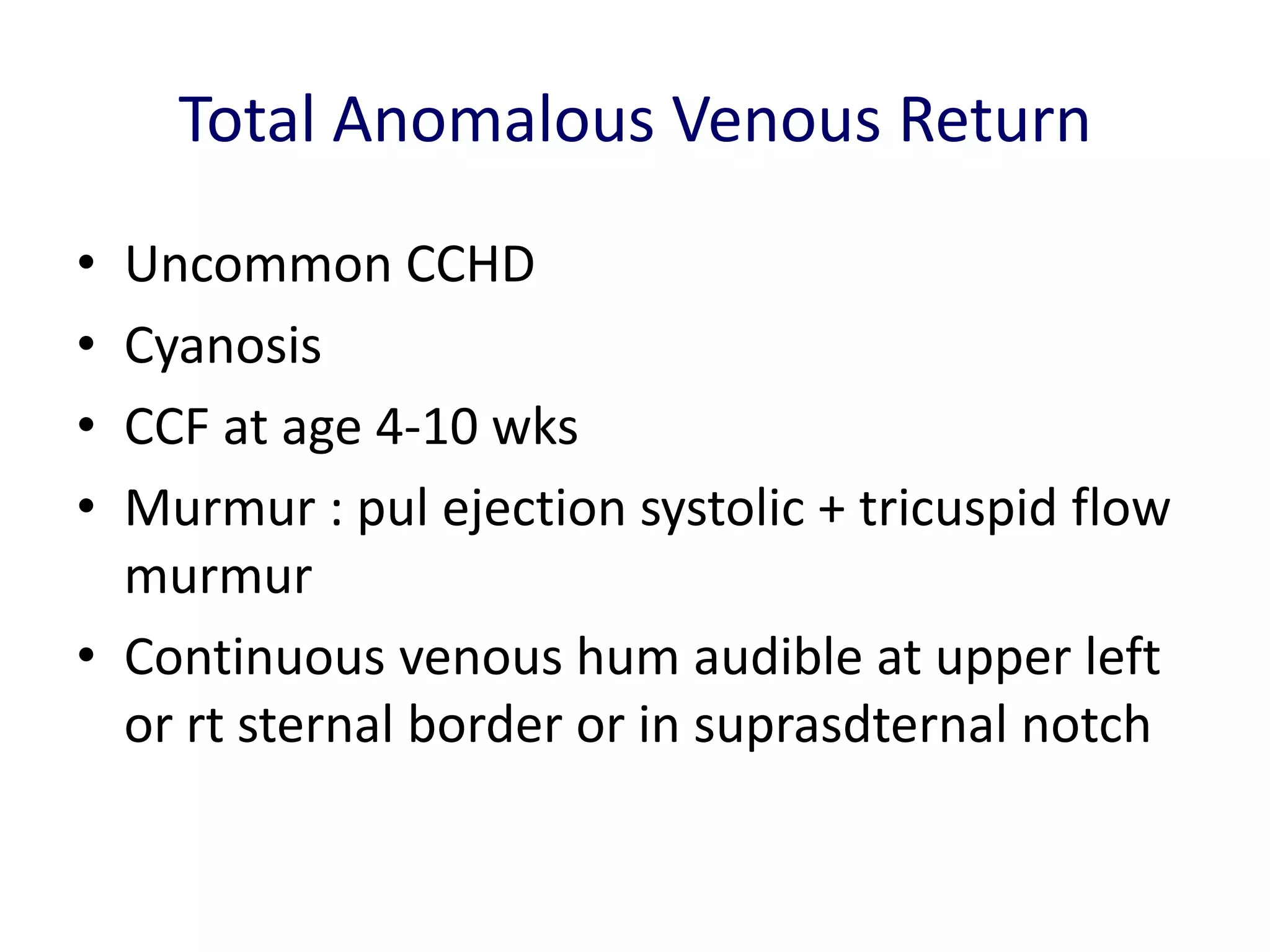
Total Anomalous Venous Return
• Uncommon CCHD
• Cyanosis
• CCF at age 4-10 wks
• Murmur : pul ejection systolic + tricuspid flow
  murmur
• Continuous venous hum audible at upper left
  or rt sternal border or in suprasdternal notch
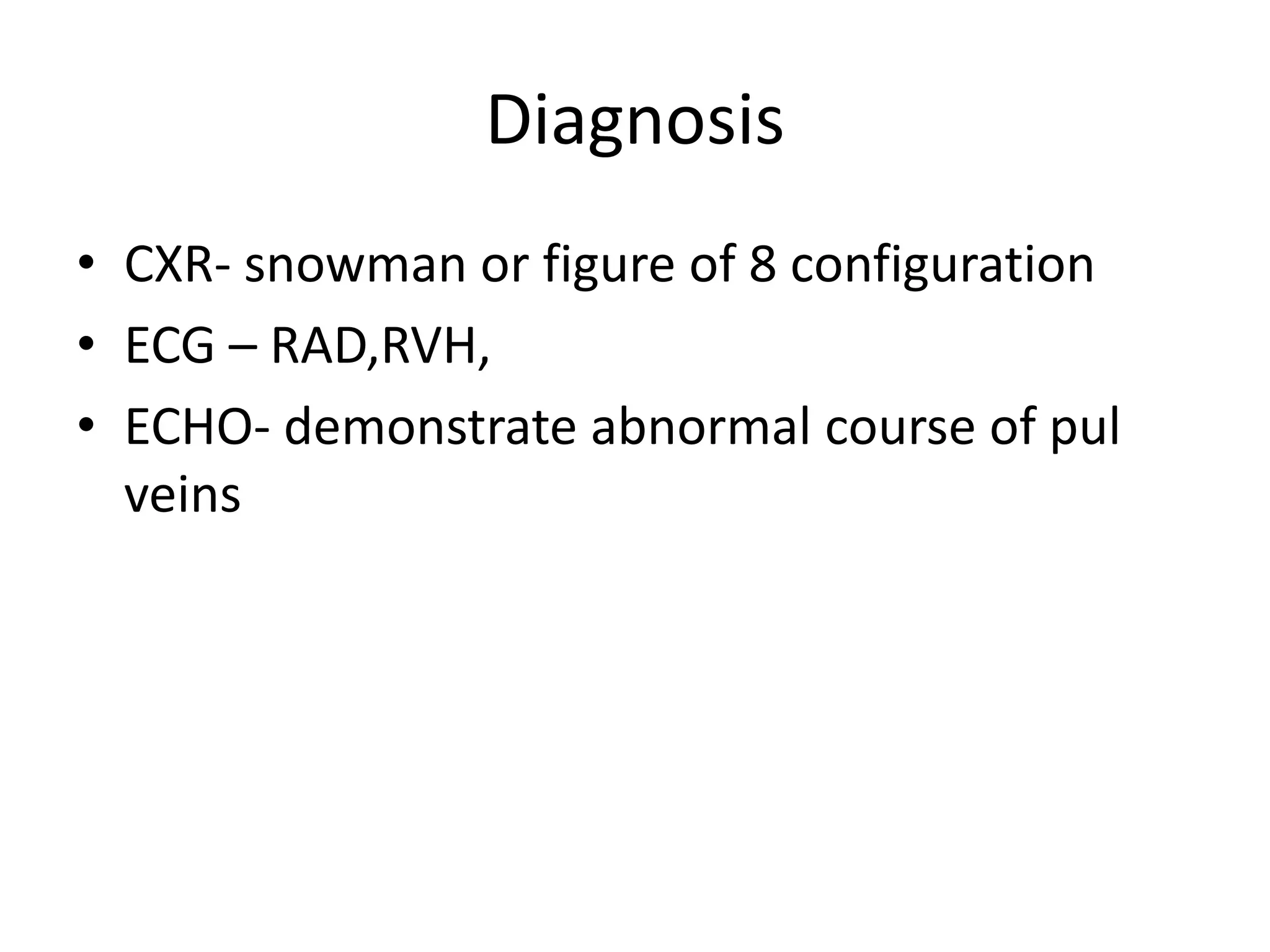
Diagnosis
• CXR- snowman or figure of 8 configuration
• ECG – RAD,RVH,
• ECHO- demonstrate abnormal course of pul
  veins
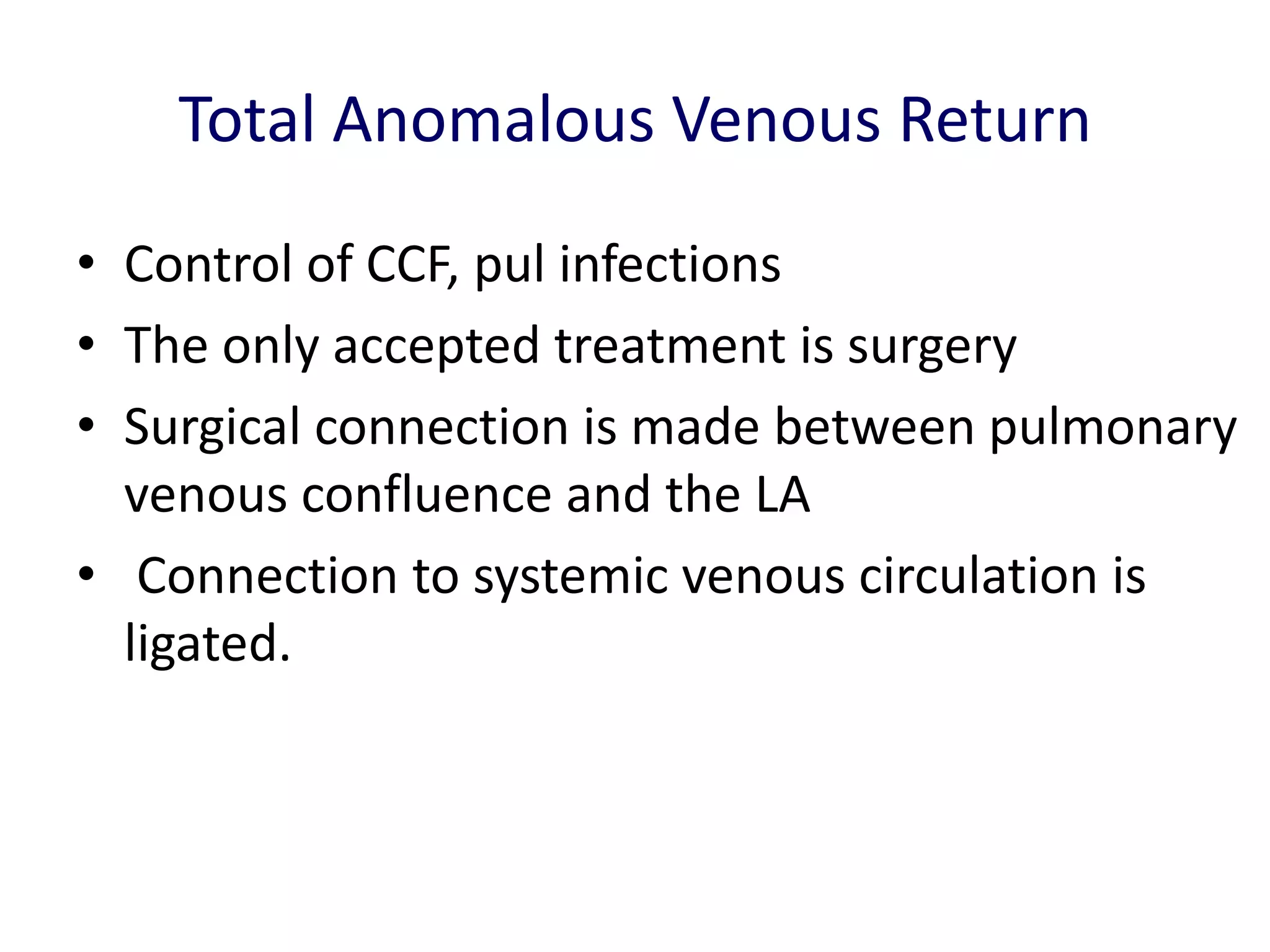
Total Anomalous Venous Return
• Control of CCF, pul infections
• The only accepted treatment is surgery
• Surgical connection is made between pulmonary
  venous confluence and the LA
• Connection to systemic venous circulation is
  ligated.
Hypoplastic Left Heart


• Fatal without early surgical
  intervention
Treatment- continued
• General procedure for cyanotic heart lesions
  involves a systemic to PA shunt.
• Procedure known as the Blalock-Taussig shunt
  – Uses a small Gore-Tex® shunt to connect either
    left or right subclavian to left or right branch PA.
  – Allows partially desaturated blood to enter PA,
    increasing pulmonary blood flow and oxygenation
CCHD with PA HTN
• This group is named – Eisenmenger syndrome
  – severe PA HTN resulting in R→L shunt at
  atrial, ventricular or pulmonary arterial level
• Eisenmenger complex – severe PA HTN with
  VSD resulting in R→L shunt
• Eisenmenger's syndrome named by Dr. Paul
  Wood after Dr. Victor Eisenmenger, who first
  described the condition in 1897.
Hemodynamics
• L→R shunt in the heart causes:-
            - increased flow through PA
            - High O2 saturation in PA
            - Hyperreactive pul vasculature → Pul
  vascular obstructive Ds →PA HTN
• PA HTN → causes increased pressures in the right
  side of the heart and reversal of the shunt into R → L
  shunt
• R → L shunt with VSD & PDA → decompresses rt
  ventricle →RV has only concentric hypertrophy with
  no increase in size ( no heave)
• R → L shunt with ASD → RVH +dilatation →rt
  ven failure
• R → L with ASD or VSD →mixing of blood
  reaches ascending aorta → distributed to
  whole systemic circulation → equal cyanosis
• R → L with PDA → mixed blood directed
  downwards to descending aorta (junction is
  distal to lt Subclavian artery → cyanosis +
  clubbing of toes only (differential cyanosis)
Examination
•   Cyanosis
•   Clubbing
•   Fatigue
•   Effort intolerance
•   Dyspnea
•    h/o recurrent chest infection
Sounds
• S1- normal
• S2- ASD- wide fixed split
    VSD- single
• PDA- normally split
• Murmurs
• Pulmonary regurgitation ( graham steel)
• Ejection systolic
Investigations
• CXR- prominance of pul artery,heart size –
           normal to large
• ECG – RVH
• ECHO-
• Cardiac catherization-bi-directional shunt
Treatment
• Heart-lung transplant is required to fully treat
  the syndrome
• If this option is not available - treatment is
  palliative-
• Anticoagulants
• Pulmonary vasodilators
• Antibiotic prophylaxis to prevent endocarditis
• Phlebotomy to treat polycythemia
• Maintaining proper fluid balance
Thank you
Download more documents and slide shows on The Medical Post
               [ www.themedicalpost.net ]

Cyanotic Heart Diseases

  • 1.
    Cyanotic Heart Lesions Dr. Kalpana Malla MBBS MD (Pediatrics) Manipal Teaching Hospital Download more documents and slide shows on The Medical Post [ www.themedicalpost.net ]
  • 2.
    Cyanotic Heart Lesions •The 5 Ts – Tetralogy of Fallot – Transposition of the Great Arteries – Truncus Arteriosus (Persistent) – Tricuspid Atresia – Total Anomalous Pulmonary Venous Return (TAPVR)
  • 3.
    Cyanotic Heart Lesions • Hypoplastic left heart syndrome (HLH) • Pulmonary atresia (PA) / critical PS • Double outlet right ventricle (DORV) • Ebstein anomaly • Single ventricle
  • 4.
    R L R L with pulmonary stenosis • TOF • Tricuspid atresia • Ebstein’s anomaly
  • 5.
    Evaluation possible congenitalheart Exam: rate, rhythm, impulse, murmur, pulses (brachial and femoral) • Oxygen saturation - Hyperoxia test • ABG • Chest X- ray • Echocardiogram • Cardiac catheterization
  • 6.
    Tetralogy of Fallot(TOF): • Most common (75% )cyanotic CHD in >2yrs • ~ 10% of all CHD
  • 7.
    Tetralogy of Fallot •TOF = consists – Ventricular septal defect – Rt ventricular outflow obstruction – infundibular or infundibular + pulmonary valve stenosis – Aorta position is shifted to the right and over-rides the VSD – Hypertrophy of the right ventricle
  • 8.
    Essential components: VSD Pulmonary stenosis Other components : overriding of Aorta RVH Pentalogy of Fallot: all above + ASD
  • 9.
    Hemodynamics: • Large, non-restrictiveVSD, perimembranous type, extending upto right ventricular outlet allows equalisation of pressures in two ventricles VSD is silent • Pulmonary stenosis Shunting of blood from R L ventricle mixing of oxygenated & deoxygenated blood in left ventricle circulated to whole body
  • 10.
    • Severity dependsupon degree of pulmonary stenosis • Pulmonary stenosis causes concentric rt ventricular hypertrophy without cardiac enlargement & ↑rt vent pressure • Flow from Rt vent to pul artery  across pul stenosis  produce ejection systolic murmur • If obstruction small, RL shunt minimal or absent (pink or acyanotic TOF)
  • 11.
    • P2 Delayed & reduced in intensity due to rt vent outflow obstruction reduced PA pressure • S2 single and A2 audible • Severity of cyanosis  directly proportional to severity of pul stenosis but intensity of systolic murmur inversely related to severity of pulmonic stenosis
  • 12.
    Clinical features: • Maybecome symptomatic any time after birth – usually 2nd half of 1st yr • Anoxic spells (synonyms- hypoxic, hypercyanotic, blue, tet ) – paroxysmal attack of dyspnea • Common symptoms – dyspnea on exertion,exercise intolerance • Cyanosis • H/O squatting during dyspneaic episodes
  • 13.
    Anoxic spells • Occurpredominantly after waking up or following exertion • Most commonly start around 4 to 6 months of age and are charcterized by 1.Sudden crying 2.Sudden onset or deepening of cyanosis 3.Sudden onset of dyspnea
  • 14.
    Anoxic spells 4. Alterationsof consciousness 5. Convulsions 6.Decrease in intensity of systolic murmur Frequency varies from once in a few days to numerous attacks every day
  • 15.
    • Mild outflowobstruction: cyanosis in later part of 1st year • Severe outflow obstruction: cyanosis immediately after birth (as ductus starts to close) CCF unusual in children with TOF except in: Severe anemia Valvular regurgitation Infective endocarditis Systemic hypertension Coincidental myocardial diseases
  • 16.
    Physical examination: • Cyanosis • Clubbing • Polycythemia • Normal sized heart • Mild parastrnal impulse
  • 17.
    Auscultation • S1 –normal • S2 – Single, (A2 heard,P2 soft &delayed • Murmur – • Shunt – absent • Flow - Loud short pulmonary ejection systolic murmur grade 3-5/6 at 3rd ICS in left side
  • 18.
    Diagnosis: • Blood: polycythemia •CXR: 1. Upturned apex (RVH)- Small boot shaped heart 2. Oligemic lung fields 3. Absence or concavity of pulmonary artery segment gives the shape described as cor- en sabot 4. Right aortic arch ~25 -30%
  • 19.
    • Diagnosis: • ECG: RAD, RVH with tall peaked p waves • Echo: overriding aorta,RVH,outflow obstruction • Cardiac catheterisation
  • 20.
    Complications: • Cerebral thrombosis •Brain abscess • Bleeding diathesis • Infective endocarditis • CCF-in acyanotic or pink TOF
  • 21.
    Complications: • CNS -Embolism to CNS - sluggish circulation from polycythemia • Hemiplegia - infarction in CNS during anoxic spell
  • 22.
    Management: • Management ofTet spells: - knee-chest position - humidified O2 inhalation - morphine 0.1 mg/kg s/c/ iv
  • 23.
    Management of Tetspells: - IV fluids - Correct metabolic acidosis- Na-bicarbonate - Propanolol – 0.1mg/kg/iv during spell (0.5-1 mg/kg PO 6 hrly
  • 24.
    Management: • Vasopressors- methoxamineIM or IV drip penylephrine • Correct anemia • Consider surgery
  • 25.
    • General measures: - Correction of iron deficiency anemia - Adequate hydration - Antibiotics for infection - Prophylaxis with propranolol
  • 26.
    Surgery • Palliative surgery: - Blalock-Taussig shunt – subclavian artery to pulm artery - Pott’s shunt-descending aorta to PA - Waterson operation – ascending aorta to Rt pulm artery -Modified Blalock-Taussig shunt
  • 27.
    • Corrective surgery:open heart surgery for – closer of VSD - resecting the infundibular obstruction PS Surgery can be performed at any age Success – 85-90%
  • 28.
    Complications of surgery • Complete heart block • RBBB • Residual VSD & Pulm stenosis • Pulm regurgitation
  • 29.
    Tricuspid atresia • Cong absence of Tricuspid valve • Rt ven hypoplastic • Absent inflow portion • 2% of CHD
  • 30.
    Hemodynamics • No communicationbetween Rt atrium rt ventricle (hypoplastic) • Blood from Rt atrium lt atrium through patent foramen ovale or ASD.mixing of oxygenated + deoxygenated blood to lt ventricle aorta • Lt vent rt vent there is VSD pul artery ( lt .ventricle maintains both systemic & pulmonary circulation saturation of blood is identicle in pulm artery and aorta
  • 31.
    Clinical features • Dependson state of pulmonary flow • 90 % are with diminished blood flow • Features :As TOF • Differentiating points : 1.Cyanosis from birth 2.More sicker than TOF 3.Lt ventricular type of apical impulse 4.Enlarged liver with presystolic pulsations 5.ECG- LAD,LVH
  • 32.
    Diagnosis • Blood: polycythemia •CXR: 1.Oligemic lung fields 2.Left ventricular configuration 3.Prominent SVC shadow • ECG: Rt & Lt atrial hypertrophy, LAD,LVH • Echo: large single ventricular cavity
  • 33.
    Tricuspid Atresia Repair notusually performed in neonatal period- over a series of procedures – Systemic to PA shunt – SVC to PA shunt (followed by ligation of first shunt)– Glenn Shunt – IVC to PA shunt– completion Fontan
  • 34.
    Ebsteins Anomaly • RareCCHD • Post and septal leaflet of TV – displaced downwards – • The upper part of the right ventricle is part of the right atrium - atrialized rt ventricle • Rt ventricle is too small and Rt. atrium is too large. • Leaflets – malformed and fused – obstruction of flow to rt ventricle
  • 35.
    Ebsteins Anomaly • OftenAssociated with other heart lesions – ASD – Pulmonary Stenosis – Pulmonary Atresia
  • 36.
    Hemodynamics : Abnormal leafletsobstruction to forward flow & regurgitation from Rt ven to Rt atrium atrium dilates Patent FO / ASD allows R L shunt( cyanosis) Lt atrium (enlarged) Lt ventricle (enlarged & hypertrophied)
  • 37.
    Clinical picture • Cyanosis • Effort intolerance • Fatigue • Paroxysmal attack of tachycardia • Clubbing • Lt ventricular apical impulse • Systolic thrill may be palpable LSB
  • 38.
    Auscultation • S1- normal •S2 – widely split but variable • Rt ventricular 3rd soundor rt atrial 4th sound audible – triple/quadruple sound usually heard • Murmur-midsystolic ejection or pansystolic • Short tricuspid delayed diastolic M
  • 39.
    Investigations • CXR cardiomegaly–square shaped Lung – oligemic ECG- ‘p’ pulmonale ‘p’mitrale,RBBB Wolff Parkinson white type conducton defect maybe seen ECHO- displaced tricuspid valve
  • 40.
    Treatment • Surgical –obliteration of atrialised portion of rt.ventricle and repairof tricuspid valve
  • 41.
    Fallot’s physiology • Presenceof large VSD with PS • Useful for bedside identification of group of condition with similar clinical findings • Defects with Fallot’s physiology: 1. Complete TGA with VSD & PS 2. DORV with PS & large VSD (subaortic) 3. Tricuspid atresia with diminished pul flow 4.Single ventricle with PS 5. corrected TGA with VSD & PS
  • 42.
    Transposition of theGreat Arteries • Most common cyanotic condition that requires hospitalization in first 2 weeks of life • Aorta arises from RV • Pulmonary artery originates in the left ventricle
  • 43.
    • Oxygenated pulmonaryvenous blood recirculates in lungs and systemic venous blood recirculates in systemic circulation
  • 44.
    Transposition of theGreat Vessels • A PDA,ASD,VSD, is necessary for these infants to survive until they can have corrective surgery • More common in infants of diabetic mothers
  • 45.
    Classification 1. Complete variety 2.Physiologically corrected type
  • 46.
    Complete variety • Rtatrium →Rt ventricle →aorta • Lt atrium →Lt ventricle →pulmonary artery • Systemic & pulmonary circulation separate →survival possible only if there is ASD,VSD,PDA Classification A) With intact ventricular septum – mixing site is atrial communication PFO B) with VSD with/without pul stenosis
  • 47.
    Physiologically corrected type •Rt atrium → morphologically inverted left ventricle →pulmonary artery • Lt atrium → morphologically inverted Rt ventricle →aorta • Route of blood flow is normal
  • 48.
    C /F withintact VS • Cyanotic at birth • Interatrial mixing poor (PFO) – rapid breathing ,congestive failure due to hypoxia within 1st wk of life • CCF • S1 –normal • S2- single • Ejection systolic murmur grade 1-2/6 • CXR – egg on side appearance,plethoric lung field
  • 49.
    With VSD • Goodmixing at ventricular level, large pulmonary blood flow – cyanosis milder • CCF at 4-10 wks • Exam –cyanosis,CCF • S1- Normal • S2 – single • Murmur – ejection systolic grade 2-4/6
  • 50.
    Diagnosis • CXR- eggon side appearance ,cardiomegaly with narrow base, plethoric lung field • ECG without VSD – RAD,RVH • ECG with VSD – RAD, biventricular hypertrophy • Cardiac catheterization • Angiocardiography
  • 51.
    Medical management • ControlCCF • Balloon atrial septotomy by cardiac catheterization - Inter-atrial septum opened • Definitive repair – Jatene’s switch operation - removal of aorta and pulmonary artery from their origins and re-attached to the correct ventricles • Less preferred – atrial switch operation –mustard or senning
  • 52.
    Corrected TGA • Normalroute of blood flow • Commonly associated with other anomalies 98% - symtoms are due associated anomalies: 1.VSD with/without PS 2.Lt sided Ebstein’s anomaly of tricuspid valve 3.Atrioventricular conduction abnormalities
  • 53.
    Truncus Arteriosus • Truncusfails to divide completely during fetal life, leaving a connection between the aorta and pulmonary arteries • Mixed oxygenated and de-oxygenated blood exits the heart and enters the systemic circulation
  • 54.
    Truncus Arteriosus • Singleartery arises from the heart, supplying both aorta and pulmonary artery. • VSD below the truncal valve allows mixing of right and left ventricular blood • Degree of cyanosis is variable • Presents with progressive heart failure
  • 55.
    Truncus Arteriosus • MedicalManagement – Digoxin and Diuretics • Surgical Repair – Usually required by 2-3 months of age – VSD is closed – PA trunk is separated from truncus – Conduit created between RV and PA using a valved graft
  • 56.
    TAPVR • The pulmonaryveins, instead of being connected to the left atrium , are connected to the right atrium or superior vena cava, and return oxygenated blood to the right side of the heart.
  • 57.
    Total Anomalous VenousReturn • Uncommon CCHD • Cyanosis • CCF at age 4-10 wks • Murmur : pul ejection systolic + tricuspid flow murmur • Continuous venous hum audible at upper left or rt sternal border or in suprasdternal notch
  • 58.
    Diagnosis • CXR- snowmanor figure of 8 configuration • ECG – RAD,RVH, • ECHO- demonstrate abnormal course of pul veins
  • 59.
    Total Anomalous VenousReturn • Control of CCF, pul infections • The only accepted treatment is surgery • Surgical connection is made between pulmonary venous confluence and the LA • Connection to systemic venous circulation is ligated.
  • 60.
    Hypoplastic Left Heart •Fatal without early surgical intervention
  • 61.
    Treatment- continued • Generalprocedure for cyanotic heart lesions involves a systemic to PA shunt. • Procedure known as the Blalock-Taussig shunt – Uses a small Gore-Tex® shunt to connect either left or right subclavian to left or right branch PA. – Allows partially desaturated blood to enter PA, increasing pulmonary blood flow and oxygenation
  • 62.
    CCHD with PAHTN • This group is named – Eisenmenger syndrome – severe PA HTN resulting in R→L shunt at atrial, ventricular or pulmonary arterial level • Eisenmenger complex – severe PA HTN with VSD resulting in R→L shunt
  • 63.
    • Eisenmenger's syndromenamed by Dr. Paul Wood after Dr. Victor Eisenmenger, who first described the condition in 1897.
  • 64.
    Hemodynamics • L→R shuntin the heart causes:- - increased flow through PA - High O2 saturation in PA - Hyperreactive pul vasculature → Pul vascular obstructive Ds →PA HTN • PA HTN → causes increased pressures in the right side of the heart and reversal of the shunt into R → L shunt • R → L shunt with VSD & PDA → decompresses rt ventricle →RV has only concentric hypertrophy with no increase in size ( no heave)
  • 65.
    • R →L shunt with ASD → RVH +dilatation →rt ven failure • R → L with ASD or VSD →mixing of blood reaches ascending aorta → distributed to whole systemic circulation → equal cyanosis • R → L with PDA → mixed blood directed downwards to descending aorta (junction is distal to lt Subclavian artery → cyanosis + clubbing of toes only (differential cyanosis)
  • 66.
    Examination • Cyanosis • Clubbing • Fatigue • Effort intolerance • Dyspnea • h/o recurrent chest infection
  • 67.
    Sounds • S1- normal •S2- ASD- wide fixed split VSD- single • PDA- normally split • Murmurs • Pulmonary regurgitation ( graham steel) • Ejection systolic
  • 68.
    Investigations • CXR- prominanceof pul artery,heart size – normal to large • ECG – RVH • ECHO- • Cardiac catherization-bi-directional shunt
  • 69.
    Treatment • Heart-lung transplantis required to fully treat the syndrome • If this option is not available - treatment is palliative- • Anticoagulants • Pulmonary vasodilators • Antibiotic prophylaxis to prevent endocarditis • Phlebotomy to treat polycythemia • Maintaining proper fluid balance
  • 70.
    Thank you Download moredocuments and slide shows on The Medical Post [ www.themedicalpost.net ]