UNDER THE GUIDANCE OF
PROF. R. R. KATWATE
PRESENTED BY
Mr. B. A. WADEKAR (11291)
A SEMINAR-I ON
“AUTOMOBILE AIR-CONDITIONING BASED
ON VAC USING EXHAUST HEAT”
• Conventional Car A/C System
• Important Points Regarding VCC
• Introduction to Vapour Absorption System
• Literature Review
• Methodology
• Methods of Implementation
• Components of VAS
• Working of The System
• Feasibility Approach
• Testing of the Prototype over Nissan1400
• Comparison Between VCRS and VARS
CONTENTS
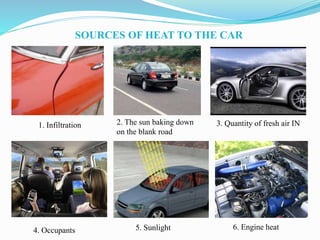
SOURCES OF HEAT TO THE CAR
1. Infiltration 2. The sun baking down
on the blank road
3. Quantity of fresh air IN
4. Occupants 6. Engine heat5. Sunlight
NEED OF A/C SYSTEM
 Heating of Cabin
 Cooling of Cabin
 Circulation of Air
 Cleaning and Filtering
 Humidity Control
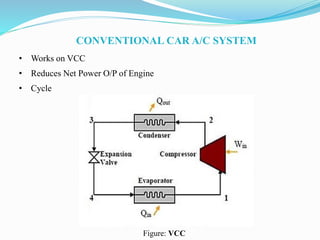
CURRENT TRENDS IN COOLING SYSTEM
 Minimum Energy Consumption
 Efficient Utilization of Non-renewable Natural Resources
 Minimal Negative Impacts on Environment & Ecosystems
 Montreal Protocol and Kyoto Protocol
 Maximum Quality of Indoor Environment
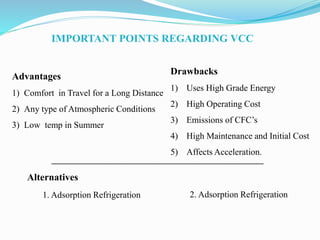
CONVENTIONAL CAR A/C SYSTEM
• Works on VCC
• Reduces Net Power O/P of Engine
• Cycle
Figure: VCC
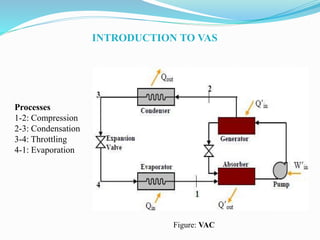
IMPORTANT POINTS REGARDING VCC
Advantages
1) Comfort in Travel for a Long Distance
2) Any type of Atmospheric Conditions
3) Low temp in Summer
Drawbacks
1) Uses High Grade Energy
2) High Operating Cost
3) Emissions of CFC’s
4) High Maintenance and Initial Cost
5) Affects Acceleration.
Alternatives
_____________________________________________________
1. Adsorption Refrigeration 2. Adsorption Refrigeration
INTRODUCTION TO VAS
Figure: VAC
Processes
1-2: Compression
2-3: Condensation
3-4: Throttling
4-1: Evaporation
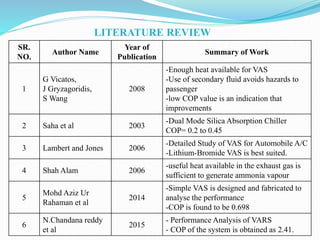
LITERATURE REVIEW
SR.
NO.
Author Name
Year of
Publication
Summary of Work
1
G Vicatos,
J Gryzagoridis,
S Wang
2008
-Enough heat available for VAS
-Use of secondary fluid avoids hazards to
passenger
-low COP value is an indication that
improvements
2 Saha et al 2003
-Dual Mode Silica Absorption Chiller
COP= 0.2 to 0.45
3 Lambert and Jones 2006
-Detailed Study of VAS for Automobile A/C
-Lithium-Bromide VAS is best suited.
4 Shah Alam 2006
-useful heat available in the exhaust gas is
sufficient to generate ammonia vapour
5
Mohd Aziz Ur
Rahaman et al
2014
-Simple VAS is designed and fabricated to
analyse the performance
-COP is found to be 0.698
6
N.Chandana reddy
et al
2015
- Performance Analysis of VARS
- COP of the system is obtained as 2.41.
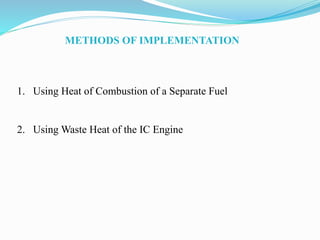
METHODS OF IMPLEMENTATION
1. Using Heat of Combustion of a Separate Fuel
2. Using Waste Heat of the IC Engine
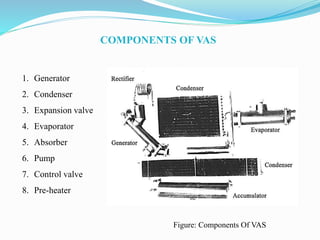
COMPONENTS OF VAS
1. Generator
2. Condenser
3. Expansion valve
4. Evaporator
5. Absorber
6. Pump
7. Control valve
8. Pre-heater
Figure: Components Of VAS
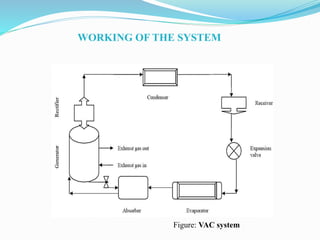
WORKING OF THE SYSTEM
Figure: VAC system
FEASIBILITY APPROACH
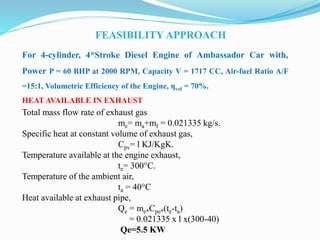
For 4-cylinder, 4*Stroke Diesel Engine of Ambassador Car with,
Power P = 60 BHP at 2000 RPM, Capacity V = 1717 CC, Air-fuel Ratio A/F
=15:1, Volumetric Efficiency of the Engine, ηvol = 70%.
HEAT AVAILABLE IN EXHAUST
Total mass flow rate of exhaust gas
me= ma+mf = 0.021335 kg/s.
Specific heat at constant volume of exhaust gas,
Cpv= l KJ/KgK.
Temperature available at the engine exhaust,
te= 300°C.
Temperature of the ambient air,
ta = 40°C
Heat available at exhaust pipe,
Qe = me*Cpe*(te-ta)
= 0.021335 x l x(300-40)
Qe=5.5 KW
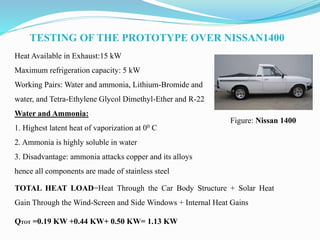
TESTING OF THE PROTOTYPE OVER NISSAN1400
Heat Available in Exhaust:15 kW
Maximum refrigeration capacity: 5 kW
Working Pairs: Water and ammonia, Lithium-Bromide and
water, and Tetra-Ethylene Glycol Dimethyl-Ether and R-22
Water and Ammonia:
1. Highest latent heat of vaporization at 00 C
2. Ammonia is highly soluble in water
3. Disadvantage: ammonia attacks copper and its alloys
hence all components are made of stainless steel
TOTAL HEAT LOAD=Heat Through the Car Body Structure + Solar Heat
Gain Through the Wind-Screen and Side Windows + Internal Heat Gains
QTOT =0.19 KW +0.44 KW+ 0.50 KW= 1.13 KW
Figure: Nissan 1400
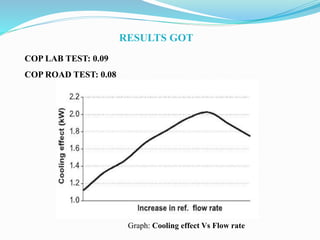
RESULTS GOT
COP LAB TEST: 0.09
COP ROAD TEST: 0.08
Graph: Cooling effect Vs Flow rate
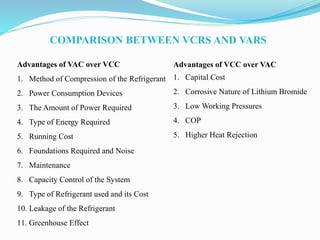
COMPARISON BETWEEN VCRS AND VARS
Advantages of VAC over VCC
1. Method of Compression of the Refrigerant
2. Power Consumption Devices
3. The Amount of Power Required
4. Type of Energy Required
5. Running Cost
6. Foundations Required and Noise
7. Maintenance
8. Capacity Control of the System
9. Type of Refrigerant used and its Cost
10. Leakage of the Refrigerant
11. Greenhouse Effect
Advantages of VCC over VAC
1. Capital Cost
2. Corrosive Nature of Lithium Bromide
3. Low Working Pressures
4. COP
5. Higher Heat Rejection
REFERENCES
1. Journal of Energy in Southern Africa, G Vicatos,J Gryzagoridis, A car airconditioning system based on an absorption
refrigeration cycle using energy from exhaust gas of an internal combustion engine, 2008
2. International Journal of Modern Engineering Research (IJMER) Manu.S, T.K.Chandrashekar, Theoritical Model of Absorber
for Miniature LiBr-H2o Vapor Absorption Refrigeration System , 2012
3. Energy procedi, aKhaled AlQdah , Sameh Alsaqoor , Assem Al-Jarrah, Design and Fabrication of Auto Air Conditioner
Generator Utilizing Exhaust Waste Energy from a Diesel Engine ,2011
4. Second International Conference on Emerging Trends in Engineering and Technology, ICETET-09, A C Deshpande, R M Pillai,
Adsorption Air Conditioning (AdAC) for Automobiles Using Waste Heat Recovered from Exhaust Gases ,2009
5. Z hong Ji-Xiang, Research on A Novel Air-condition System driven by combination of Exhaust Heat of Engine and Solar
Energy,2009
6. The 2nd Joint International Conference on “Sustainable Energy and Environment (SEE 2006)”, 21-23 November 2006,
Bangkok, Thailand, Shah Alam, A Proposed Model for Utilizing Exhaust Heat to run Automobile Air-conditioner, The 2nd Joint
International Conference on SEE,2006
7. Khaled S. AlQdah Tafila Technical University Tafila, Jordan, Performance and Evaluation of Aqua Ammonia Auto Air
Conditioner System using Exhaust Waste Energy,2011
8. Nahla Bouaziz, Ridha Ben Iffa and Lakhdar kairouani, Performance of a water ammonia absorption system operating at three
pressure levels, 2011
9. R.H.L. Eichhorn - Eindhoven University of Technology, Waste Energy Driven Air Conditioning System (WEDACS), 2009.
10. ASHARE Hand book, 2008
THANK YOU...!

Automobile air conditioning based on VAC using exhaust heat

  • 1.
    UNDER THE GUIDANCEOF PROF. R. R. KATWATE PRESENTED BY Mr. B. A. WADEKAR (11291) A SEMINAR-I ON “AUTOMOBILE AIR-CONDITIONING BASED ON VAC USING EXHAUST HEAT”
  • 2.
    • Conventional CarA/C System • Important Points Regarding VCC • Introduction to Vapour Absorption System • Literature Review • Methodology • Methods of Implementation • Components of VAS • Working of The System • Feasibility Approach • Testing of the Prototype over Nissan1400 • Comparison Between VCRS and VARS CONTENTS
  • 3.
    SOURCES OF HEATTO THE CAR 1. Infiltration 2. The sun baking down on the blank road 3. Quantity of fresh air IN 4. Occupants 6. Engine heat5. Sunlight
  • 4.
    NEED OF A/CSYSTEM  Heating of Cabin  Cooling of Cabin  Circulation of Air  Cleaning and Filtering  Humidity Control
  • 5.
    CURRENT TRENDS INCOOLING SYSTEM  Minimum Energy Consumption  Efficient Utilization of Non-renewable Natural Resources  Minimal Negative Impacts on Environment & Ecosystems  Montreal Protocol and Kyoto Protocol  Maximum Quality of Indoor Environment
  • 6.
    CONVENTIONAL CAR A/CSYSTEM • Works on VCC • Reduces Net Power O/P of Engine • Cycle Figure: VCC
  • 7.
    IMPORTANT POINTS REGARDINGVCC Advantages 1) Comfort in Travel for a Long Distance 2) Any type of Atmospheric Conditions 3) Low temp in Summer Drawbacks 1) Uses High Grade Energy 2) High Operating Cost 3) Emissions of CFC’s 4) High Maintenance and Initial Cost 5) Affects Acceleration. Alternatives _____________________________________________________ 1. Adsorption Refrigeration 2. Adsorption Refrigeration
  • 8.
    INTRODUCTION TO VAS Figure:VAC Processes 1-2: Compression 2-3: Condensation 3-4: Throttling 4-1: Evaporation
  • 9.
    LITERATURE REVIEW SR. NO. Author Name Yearof Publication Summary of Work 1 G Vicatos, J Gryzagoridis, S Wang 2008 -Enough heat available for VAS -Use of secondary fluid avoids hazards to passenger -low COP value is an indication that improvements 2 Saha et al 2003 -Dual Mode Silica Absorption Chiller COP= 0.2 to 0.45 3 Lambert and Jones 2006 -Detailed Study of VAS for Automobile A/C -Lithium-Bromide VAS is best suited. 4 Shah Alam 2006 -useful heat available in the exhaust gas is sufficient to generate ammonia vapour 5 Mohd Aziz Ur Rahaman et al 2014 -Simple VAS is designed and fabricated to analyse the performance -COP is found to be 0.698 6 N.Chandana reddy et al 2015 - Performance Analysis of VARS - COP of the system is obtained as 2.41.
  • 10.
    METHODS OF IMPLEMENTATION 1.Using Heat of Combustion of a Separate Fuel 2. Using Waste Heat of the IC Engine
  • 11.
    COMPONENTS OF VAS 1.Generator 2. Condenser 3. Expansion valve 4. Evaporator 5. Absorber 6. Pump 7. Control valve 8. Pre-heater Figure: Components Of VAS
  • 12.
    WORKING OF THESYSTEM Figure: VAC system
  • 13.
    FEASIBILITY APPROACH For 4-cylinder,4*Stroke Diesel Engine of Ambassador Car with, Power P = 60 BHP at 2000 RPM, Capacity V = 1717 CC, Air-fuel Ratio A/F =15:1, Volumetric Efficiency of the Engine, ηvol = 70%. HEAT AVAILABLE IN EXHAUST Total mass flow rate of exhaust gas me= ma+mf = 0.021335 kg/s. Specific heat at constant volume of exhaust gas, Cpv= l KJ/KgK. Temperature available at the engine exhaust, te= 300°C. Temperature of the ambient air, ta = 40°C Heat available at exhaust pipe, Qe = me*Cpe*(te-ta) = 0.021335 x l x(300-40) Qe=5.5 KW
  • 14.
    TESTING OF THEPROTOTYPE OVER NISSAN1400 Heat Available in Exhaust:15 kW Maximum refrigeration capacity: 5 kW Working Pairs: Water and ammonia, Lithium-Bromide and water, and Tetra-Ethylene Glycol Dimethyl-Ether and R-22 Water and Ammonia: 1. Highest latent heat of vaporization at 00 C 2. Ammonia is highly soluble in water 3. Disadvantage: ammonia attacks copper and its alloys hence all components are made of stainless steel TOTAL HEAT LOAD=Heat Through the Car Body Structure + Solar Heat Gain Through the Wind-Screen and Side Windows + Internal Heat Gains QTOT =0.19 KW +0.44 KW+ 0.50 KW= 1.13 KW Figure: Nissan 1400
  • 15.
    RESULTS GOT COP LABTEST: 0.09 COP ROAD TEST: 0.08 Graph: Cooling effect Vs Flow rate
  • 16.
    COMPARISON BETWEEN VCRSAND VARS Advantages of VAC over VCC 1. Method of Compression of the Refrigerant 2. Power Consumption Devices 3. The Amount of Power Required 4. Type of Energy Required 5. Running Cost 6. Foundations Required and Noise 7. Maintenance 8. Capacity Control of the System 9. Type of Refrigerant used and its Cost 10. Leakage of the Refrigerant 11. Greenhouse Effect Advantages of VCC over VAC 1. Capital Cost 2. Corrosive Nature of Lithium Bromide 3. Low Working Pressures 4. COP 5. Higher Heat Rejection
  • 18.
    REFERENCES 1. Journal ofEnergy in Southern Africa, G Vicatos,J Gryzagoridis, A car airconditioning system based on an absorption refrigeration cycle using energy from exhaust gas of an internal combustion engine, 2008 2. International Journal of Modern Engineering Research (IJMER) Manu.S, T.K.Chandrashekar, Theoritical Model of Absorber for Miniature LiBr-H2o Vapor Absorption Refrigeration System , 2012 3. Energy procedi, aKhaled AlQdah , Sameh Alsaqoor , Assem Al-Jarrah, Design and Fabrication of Auto Air Conditioner Generator Utilizing Exhaust Waste Energy from a Diesel Engine ,2011 4. Second International Conference on Emerging Trends in Engineering and Technology, ICETET-09, A C Deshpande, R M Pillai, Adsorption Air Conditioning (AdAC) for Automobiles Using Waste Heat Recovered from Exhaust Gases ,2009 5. Z hong Ji-Xiang, Research on A Novel Air-condition System driven by combination of Exhaust Heat of Engine and Solar Energy,2009 6. The 2nd Joint International Conference on “Sustainable Energy and Environment (SEE 2006)”, 21-23 November 2006, Bangkok, Thailand, Shah Alam, A Proposed Model for Utilizing Exhaust Heat to run Automobile Air-conditioner, The 2nd Joint International Conference on SEE,2006 7. Khaled S. AlQdah Tafila Technical University Tafila, Jordan, Performance and Evaluation of Aqua Ammonia Auto Air Conditioner System using Exhaust Waste Energy,2011 8. Nahla Bouaziz, Ridha Ben Iffa and Lakhdar kairouani, Performance of a water ammonia absorption system operating at three pressure levels, 2011 9. R.H.L. Eichhorn - Eindhoven University of Technology, Waste Energy Driven Air Conditioning System (WEDACS), 2009. 10. ASHARE Hand book, 2008
  • 19.