What crucial conversation 
have you been avoiding? 
0 At each table, take 1 minute to identify a crucial 
conversation that you have been avoiding. 
0 Without breaking confidences, please share very 
briefly what conversation you have been dodging. 
0 Timer
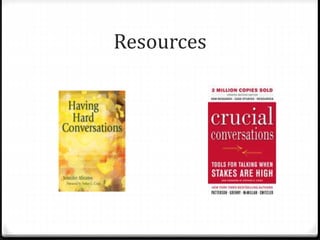
Resources
20 years of research on over 
100,000 people reveals: 
0 THE key skill of effective leaders, parents, loved 
ones… is… 
0…the capacity to skillfully address 
emotionally and politically risky 
issues. PERIOD!!!!!!
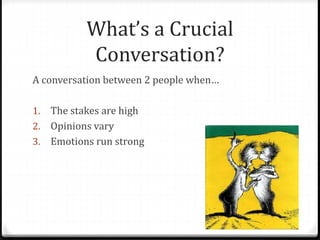
What’s a Crucial 
Conversation? 
A conversation between 2 people when… 
1. The stakes are high 
2. Opinions vary 
3. Emotions run strong
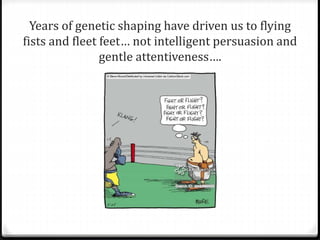
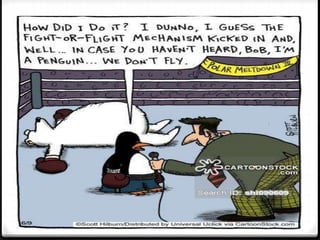
Years of genetic shaping have driven us to flying 
fists and fleet feet… not intelligent persuasion and 
gentle attentiveness….
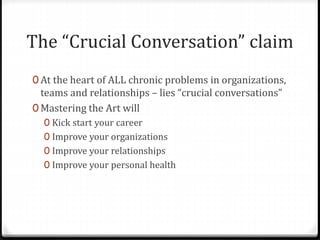
The “Crucial Conversation” claim 
0 At the heart of ALL chronic problems in organizations, 
teams and relationships – lies “crucial conversations” 
0 Mastering the Art will 
0 Kick start your career 
0 Improve your organizations 
0 Improve your relationships 
0 Improve your personal health
Research cited… by authors 
0 Companies who have mastered the art of crucial 
conversations… 
0 Respond 5 times faster to financial downturns 
0 2/3rds more likely to avoid injury or death due to 
unsafe conditions 
0 Save $1,500 AND an 8 hour workday for every crucial 
conversation held rather than avoided 
0 Substantially increase trust and reduce costs in virtual 
work teams 
0 Influence changes in colleagues who bullying, conniving, 
dishonest, or incompetent
It is NOT simply… 
0 Policies 
0 Procedures 
0 Structures 
0 Systems
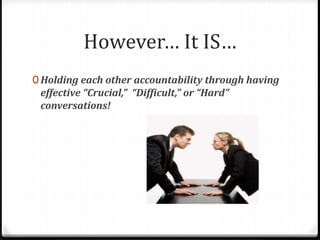
However… It IS… 
0 Holding each other accountability through having 
effective “Crucial,” “Difficult,” or “Hard” 
conversations!
The great news? 
0 These skills are learnable….
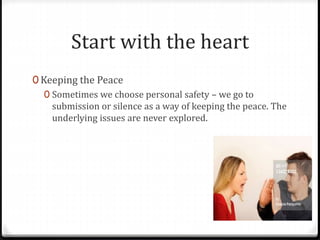
Start with the heart 
0 Keeping the Peace 
0 Sometimes we choose personal safety – we go to 
submission or silence as a way of keeping the peace. The 
underlying issues are never explored.
What do I really want? 
0 For myself 
0 For others? 
0 For the relationship? 
0 Refuse the “fools choice” 
0 We sometimes assume that we must choose between 
getting results and keeping the relationship 
0 How can we achieve BOTH?
Watch for conditions… 
0 Silence – any act to withhold meaning from the 
conversations 
0 Masking (sugarcoating, sarcasm, couching…) 
0 Avoiding (changing the subject…) 
0 Withdrawing (leaving the conversation or the room…) 
0 Violence 
0 Controlling (coercion, cutting them off, overstating…) 
0 Labeling (dismissing someone’s ideas from a 
stereotype…) 
0 Attacking (threatening, name calling…)
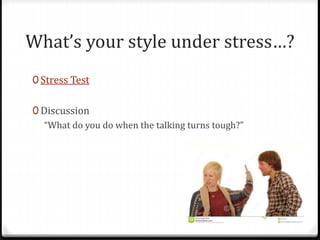
What’s your style under stress…? 
0 Stress Test 
0 Discussion 
“What do you do when the talking turns tough?”
Styles 
0 Silence 
0 Masking 
0 Avoiding 
0 Withdrawing 
0 Violence 
0 Controlling 
0 Labeling 
0 Attacking
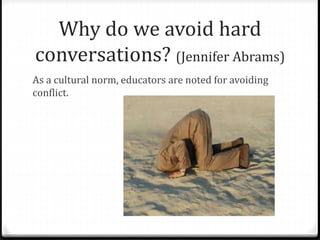
Why do we avoid hard 
conversations? (Jennifer Abrams) 
As a cultural norm, educators are noted for avoiding 
conflict.
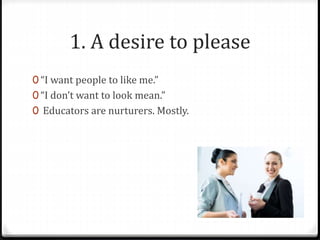
1. A desire to please 
0 “I want people to like me.” 
0 “I don’t want to look mean.” 
0 Educators are nurturers. Mostly.
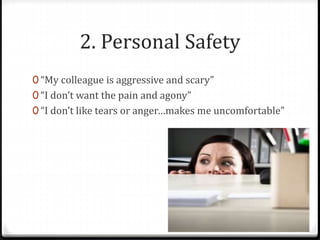
2. Personal Safety 
0 “My colleague is aggressive and scary” 
0 “I don’t want the pain and agony” 
0 “I don’t like tears or anger…makes me uncomfortable”
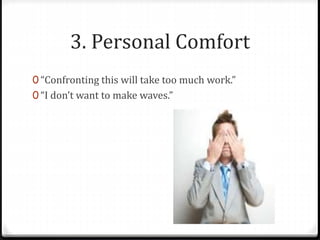
3. Personal Comfort 
0 “Confronting this will take too much work.” 
0 “I don’t want to make waves.”
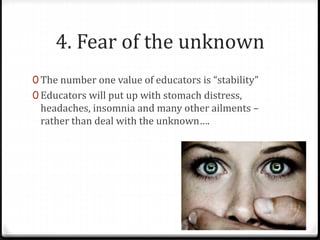
4. Fear of the unknown 
0 The number one value of educators is “stability” 
0 Educators will put up with stomach distress, 
headaches, insomnia and many other ailments – 
rather than deal with the unknown….
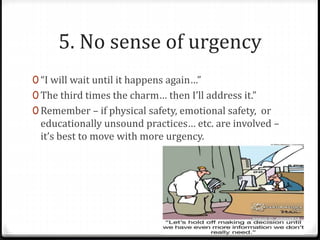
5. No sense of urgency 
0 “I will wait until it happens again…” 
0 The third times the charm… then I’ll address it.” 
0 Remember – if physical safety, emotional safety, or 
educationally unsound practices… etc. are involved – 
it’s best to move with more urgency.
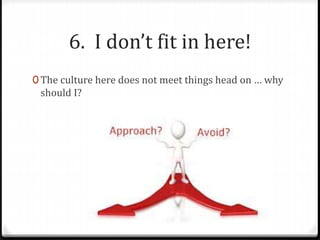
6. I don’t fit in here! 
0 The culture here does not meet things head on … why 
should I?
7. Waiting for the perfect 
moment. 
0 “I cant talk to her until I know more about it…”
8. Perfectionism 
0 “I can’t talk to him until I have the perfect words”
9. Distrust on oneself or 
others 
0 “I don’t trust my gut instinct” 
0 “ I might be too sensitive”
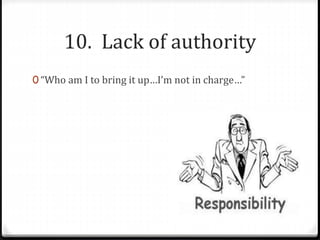
10. Lack of authority 
0 “Who am I to bring it up…I’m not in charge…”
11. Distrusting our own 
judgment 
0 “Who am I to tell someone else how they ought to do 
their job?”
12. Fear of kicking someone 
else when they are down 
0 “This will overwhelm him and he’s got enough 
problems as it is.”
13. Too big a shift in role 
expectations 
0 Instructional coaches or new supervisors may find the 
role change to be uncomfortable. Confronting peers 
or employees without training or experience may be 
overwhelming.
14. This wasn’t in my job 
description 
0 “I just assumed most people knew the right thing to 
do. I didn’t know I had to deal with all these things.”
15. Too close to home 
0 “This is a small town. Everyone knows each other. I 
need to keep this relationship as it is.”
16. Conflict with beliefs or 
values 
0 “I don’t agree with the decision on this anyway, why 
should I confront someone over it!”
17. Fatigue 
0 “I don’t have the energy to take this on!”
18. Personality or intent 
0 “She is really a nice person – I hate to confront her on 
this.” 
0 “I am sure she didn’t mean it that way!”
The Toll… 
0 We feel personally guilty for not addressing it…. 
0 We feel fraudulent…as if we are not in the world as we really are” 
0 We give control or power to the other person… 
0 “It looks to others like we condone their behavior” 
0 We don’t live up to our principles… 
0 “We feel like a hypocrite” 
0We allow the organization (students, staff, parents, 
employees…) to experience negative consequences. 
0 “Kids and adults get hurt, or don’t receive benefits they should”
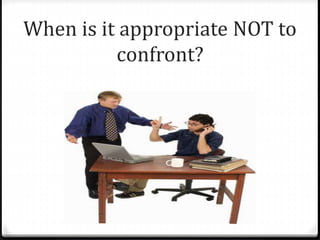
When is it appropriate NOT to 
confront?
Timing Issues 
1. Will the problem fix itself? 
2. Does it need to be addressed now? 
3. Am I in the right frame of mind now? 
4. Is this the right time for the other person? 
5. Do I have enough information now? 
6. Do I prioritize this over other conversations?
Stakes 
1. What’s the best and worst that could happen? 
2. What is the ripple effect? 
3. Do negatives out weigh the positives? 
4. Who might need to know before I talk to the person?
Likelihood of Success 
1. If I bring this up do I have an action plan? A 
solution? 
2. How promising are the hoped-for results?
Options 
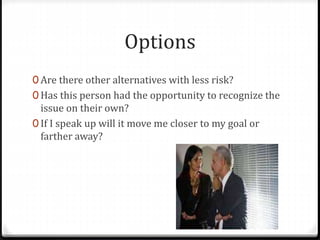
0 Are there other alternatives with less risk? 
0 Has this person had the opportunity to recognize the 
issue on their own? 
0 If I speak up will it move me closer to my goal or 
farther away?
Consequences for failure 
0What is the worst that could happen and how likely is 
that?
Personal perspective 
0 Will this be seen as only my issue? 
0 Do I model the behavior I am looking for? 
0 How do my beliefs guide me to think this way and 
would other beliefs alter my thinking?
Feasibility 
0 Is the solution I am proposing possible for this 
individual to accomplish or learn? 
0 If I bring up the concern is there time to deal with it?
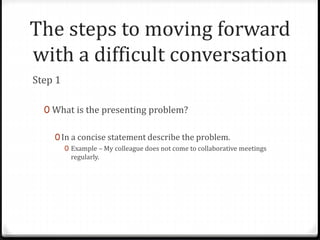
The steps to moving forward 
with a difficult conversation 
Step 1 
0 What is the presenting problem? 
0In a concise statement describe the problem. 
0 Example – My colleague does not come to collaborative meetings 
regularly.
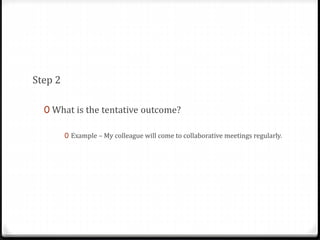
Step 2 
0 What is the tentative outcome? 
0 Example – My colleague will come to collaborative meetings regularly.
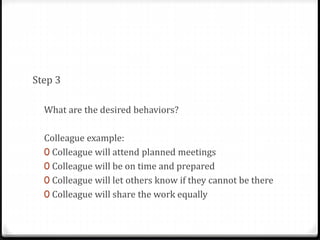
Step 3 
What are the desired behaviors? 
Colleague example: 
0 Colleague will attend planned meetings 
0 Colleague will be on time and prepared 
0 Colleague will let others know if they cannot be there 
0 Colleague will share the work equally
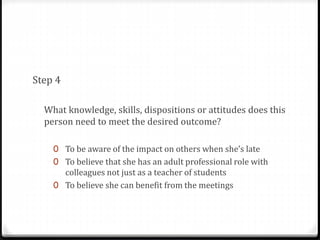
Step 4 
What knowledge, skills, dispositions or attitudes does this 
person need to meet the desired outcome? 
0 To be aware of the impact on others when she’s late 
0 To believe that she has an adult professional role with 
colleagues not just as a teacher of students 
0 To believe she can benefit from the meetings
Step 5 
What strategies can you use to promote this person’s 
growth? 
0Be sure she knows her job description includes attending 
meetings 
0Plan ways to make the meetings more relevant for her 
0Makes sure minutes of the meetings reflect everyone’s 
responsibilities
Step 6 
What resources do you need for a successful outcome? 
External - Do you need books, funds, schedules or approval 
from someone else? 
Internal – Be able to verbalize the impact on the team and 
speak without crying, chickening out or getting overly 
emotional.
Scripting the conversation 
0 Step 1: Setting the tone: and purpose 
0 You must scale your tone and your non-verbals in 
relation to the seriousness of the conversation. 
0 The other person must understand the level of intensity 
the conversation requires YET you don’t want to show 
more emotion than is necessary.
Scripting… 
0 Step 2: Get to the point and name it professionally: 
0 As you name the issue “present the problem” from your 
outcome map. 
0 Avoid trigger words (“lazy, chaotic, …) 
0 Use professional language that is not judgmental
Scripting… 
0 Step 3: Give specific examples: 
0 Use the most current examples first 
0 Don’t give too many at once
Scripting… 
0 Step 4: Describe the effect on the school, students, 
parents, colleagues, etc. 
0 Explain the impact…
Scripting… 
0 Step 5: State your desire to resolve the issue and open 
the discussion 
0 End your opening statements by stating the change you 
would like to see take place and then open by asking 
questions: 
0How do you see it? 
0How do you feel? 
0What are your thoughts? 
0DO you see this differently?
Post script 
0 One method is to write a draft summary of the 
meeting in post tense BEFORE the meeting takes 
place. 
0 Place it in a drawer 
0 Conduct the meeting following your script 
0 After the meeting, revise the summary to reflect what 
actually happened
Preparing the logistics 
0 Initiating contact 
0 No cryptic voice messages or emails 
0 Find a private place and time (remember – the more serious 
the discussion the more formal the setting) 
0 Think about timing. (Do they have to teach after this 
conversation?) 
0 Body Language 
0 Voice: “credible voice” of authority goes down, “approachable 
voice” goes up at the end of sentences 
0 Hands: palms down is business, palms up gives listener an 
opening 
0 Eyes: Not looking means hesitation, too much looking may be 
too imposing. Consider culture and context.
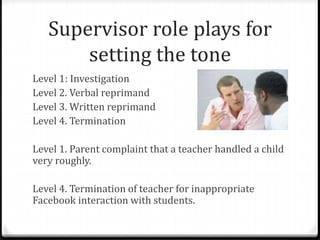
Supervisor role plays for 
setting the tone 
Level 1: Investigation 
Level 2. Verbal reprimand 
Level 3. Written reprimand 
Level 4. Termination 
Level 1. Parent complaint that a teacher handled a child 
very roughly. 
Level 4. Termination of teacher for inappropriate 
Facebook interaction with students.
Resources
MJS Consulting LLC 
0 Dr. Mark J. Stock 
0 64 Arrowhead Drive 
0 Laramie, WY, 82070 
0 Work # 307-766-6825 
0 Cell # 307-399-1711 
0 mstock1@uwyo.edu 
0 University of Wyoming 
0 Assistant Professor Educational Leadership

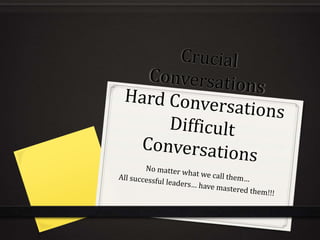
Crucial conversations deadwood presentation

  • 2.
    What crucial conversation have you been avoiding? 0 At each table, take 1 minute to identify a crucial conversation that you have been avoiding. 0 Without breaking confidences, please share very briefly what conversation you have been dodging. 0 Timer
  • 3.
  • 4.
    20 years ofresearch on over 100,000 people reveals: 0 THE key skill of effective leaders, parents, loved ones… is… 0…the capacity to skillfully address emotionally and politically risky issues. PERIOD!!!!!!
  • 5.
    What’s a Crucial Conversation? A conversation between 2 people when… 1. The stakes are high 2. Opinions vary 3. Emotions run strong
  • 6.
    Years of geneticshaping have driven us to flying fists and fleet feet… not intelligent persuasion and gentle attentiveness….
  • 8.
    The “Crucial Conversation”claim 0 At the heart of ALL chronic problems in organizations, teams and relationships – lies “crucial conversations” 0 Mastering the Art will 0 Kick start your career 0 Improve your organizations 0 Improve your relationships 0 Improve your personal health
  • 9.
    Research cited… byauthors 0 Companies who have mastered the art of crucial conversations… 0 Respond 5 times faster to financial downturns 0 2/3rds more likely to avoid injury or death due to unsafe conditions 0 Save $1,500 AND an 8 hour workday for every crucial conversation held rather than avoided 0 Substantially increase trust and reduce costs in virtual work teams 0 Influence changes in colleagues who bullying, conniving, dishonest, or incompetent
  • 10.
    It is NOTsimply… 0 Policies 0 Procedures 0 Structures 0 Systems
  • 11.
    However… It IS… 0 Holding each other accountability through having effective “Crucial,” “Difficult,” or “Hard” conversations!
  • 12.
    The great news? 0 These skills are learnable….
  • 13.
    Start with theheart 0 Keeping the Peace 0 Sometimes we choose personal safety – we go to submission or silence as a way of keeping the peace. The underlying issues are never explored.
  • 14.
    What do Ireally want? 0 For myself 0 For others? 0 For the relationship? 0 Refuse the “fools choice” 0 We sometimes assume that we must choose between getting results and keeping the relationship 0 How can we achieve BOTH?
  • 15.
    Watch for conditions… 0 Silence – any act to withhold meaning from the conversations 0 Masking (sugarcoating, sarcasm, couching…) 0 Avoiding (changing the subject…) 0 Withdrawing (leaving the conversation or the room…) 0 Violence 0 Controlling (coercion, cutting them off, overstating…) 0 Labeling (dismissing someone’s ideas from a stereotype…) 0 Attacking (threatening, name calling…)
  • 16.
    What’s your styleunder stress…? 0 Stress Test 0 Discussion “What do you do when the talking turns tough?”
  • 17.
    Styles 0 Silence 0 Masking 0 Avoiding 0 Withdrawing 0 Violence 0 Controlling 0 Labeling 0 Attacking
  • 19.
    Why do weavoid hard conversations? (Jennifer Abrams) As a cultural norm, educators are noted for avoiding conflict.
  • 20.
    1. A desireto please 0 “I want people to like me.” 0 “I don’t want to look mean.” 0 Educators are nurturers. Mostly.
  • 21.
    2. Personal Safety 0 “My colleague is aggressive and scary” 0 “I don’t want the pain and agony” 0 “I don’t like tears or anger…makes me uncomfortable”
  • 22.
    3. Personal Comfort 0 “Confronting this will take too much work.” 0 “I don’t want to make waves.”
  • 23.
    4. Fear ofthe unknown 0 The number one value of educators is “stability” 0 Educators will put up with stomach distress, headaches, insomnia and many other ailments – rather than deal with the unknown….
  • 24.
    5. No senseof urgency 0 “I will wait until it happens again…” 0 The third times the charm… then I’ll address it.” 0 Remember – if physical safety, emotional safety, or educationally unsound practices… etc. are involved – it’s best to move with more urgency.
  • 25.
    6. I don’tfit in here! 0 The culture here does not meet things head on … why should I?
  • 26.
    7. Waiting forthe perfect moment. 0 “I cant talk to her until I know more about it…”
  • 27.
    8. Perfectionism 0“I can’t talk to him until I have the perfect words”
  • 28.
    9. Distrust ononeself or others 0 “I don’t trust my gut instinct” 0 “ I might be too sensitive”
  • 29.
    10. Lack ofauthority 0 “Who am I to bring it up…I’m not in charge…”
  • 30.
    11. Distrusting ourown judgment 0 “Who am I to tell someone else how they ought to do their job?”
  • 31.
    12. Fear ofkicking someone else when they are down 0 “This will overwhelm him and he’s got enough problems as it is.”
  • 32.
    13. Too biga shift in role expectations 0 Instructional coaches or new supervisors may find the role change to be uncomfortable. Confronting peers or employees without training or experience may be overwhelming.
  • 33.
    14. This wasn’tin my job description 0 “I just assumed most people knew the right thing to do. I didn’t know I had to deal with all these things.”
  • 34.
    15. Too closeto home 0 “This is a small town. Everyone knows each other. I need to keep this relationship as it is.”
  • 35.
    16. Conflict withbeliefs or values 0 “I don’t agree with the decision on this anyway, why should I confront someone over it!”
  • 36.
    17. Fatigue 0“I don’t have the energy to take this on!”
  • 37.
    18. Personality orintent 0 “She is really a nice person – I hate to confront her on this.” 0 “I am sure she didn’t mean it that way!”
  • 38.
    The Toll… 0We feel personally guilty for not addressing it…. 0 We feel fraudulent…as if we are not in the world as we really are” 0 We give control or power to the other person… 0 “It looks to others like we condone their behavior” 0 We don’t live up to our principles… 0 “We feel like a hypocrite” 0We allow the organization (students, staff, parents, employees…) to experience negative consequences. 0 “Kids and adults get hurt, or don’t receive benefits they should”
  • 39.
    When is itappropriate NOT to confront?
  • 40.
    Timing Issues 1.Will the problem fix itself? 2. Does it need to be addressed now? 3. Am I in the right frame of mind now? 4. Is this the right time for the other person? 5. Do I have enough information now? 6. Do I prioritize this over other conversations?
  • 41.
    Stakes 1. What’sthe best and worst that could happen? 2. What is the ripple effect? 3. Do negatives out weigh the positives? 4. Who might need to know before I talk to the person?
  • 42.
    Likelihood of Success 1. If I bring this up do I have an action plan? A solution? 2. How promising are the hoped-for results?
  • 43.
    Options 0 Arethere other alternatives with less risk? 0 Has this person had the opportunity to recognize the issue on their own? 0 If I speak up will it move me closer to my goal or farther away?
  • 44.
    Consequences for failure 0What is the worst that could happen and how likely is that?
  • 45.
    Personal perspective 0Will this be seen as only my issue? 0 Do I model the behavior I am looking for? 0 How do my beliefs guide me to think this way and would other beliefs alter my thinking?
  • 46.
    Feasibility 0 Isthe solution I am proposing possible for this individual to accomplish or learn? 0 If I bring up the concern is there time to deal with it?
  • 47.
    The steps tomoving forward with a difficult conversation Step 1 0 What is the presenting problem? 0In a concise statement describe the problem. 0 Example – My colleague does not come to collaborative meetings regularly.
  • 48.
    Step 2 0What is the tentative outcome? 0 Example – My colleague will come to collaborative meetings regularly.
  • 49.
    Step 3 Whatare the desired behaviors? Colleague example: 0 Colleague will attend planned meetings 0 Colleague will be on time and prepared 0 Colleague will let others know if they cannot be there 0 Colleague will share the work equally
  • 50.
    Step 4 Whatknowledge, skills, dispositions or attitudes does this person need to meet the desired outcome? 0 To be aware of the impact on others when she’s late 0 To believe that she has an adult professional role with colleagues not just as a teacher of students 0 To believe she can benefit from the meetings
  • 51.
    Step 5 Whatstrategies can you use to promote this person’s growth? 0Be sure she knows her job description includes attending meetings 0Plan ways to make the meetings more relevant for her 0Makes sure minutes of the meetings reflect everyone’s responsibilities
  • 52.
    Step 6 Whatresources do you need for a successful outcome? External - Do you need books, funds, schedules or approval from someone else? Internal – Be able to verbalize the impact on the team and speak without crying, chickening out or getting overly emotional.
  • 53.
    Scripting the conversation 0 Step 1: Setting the tone: and purpose 0 You must scale your tone and your non-verbals in relation to the seriousness of the conversation. 0 The other person must understand the level of intensity the conversation requires YET you don’t want to show more emotion than is necessary.
  • 54.
    Scripting… 0 Step2: Get to the point and name it professionally: 0 As you name the issue “present the problem” from your outcome map. 0 Avoid trigger words (“lazy, chaotic, …) 0 Use professional language that is not judgmental
  • 55.
    Scripting… 0 Step3: Give specific examples: 0 Use the most current examples first 0 Don’t give too many at once
  • 56.
    Scripting… 0 Step4: Describe the effect on the school, students, parents, colleagues, etc. 0 Explain the impact…
  • 57.
    Scripting… 0 Step5: State your desire to resolve the issue and open the discussion 0 End your opening statements by stating the change you would like to see take place and then open by asking questions: 0How do you see it? 0How do you feel? 0What are your thoughts? 0DO you see this differently?
  • 58.
    Post script 0One method is to write a draft summary of the meeting in post tense BEFORE the meeting takes place. 0 Place it in a drawer 0 Conduct the meeting following your script 0 After the meeting, revise the summary to reflect what actually happened
  • 59.
    Preparing the logistics 0 Initiating contact 0 No cryptic voice messages or emails 0 Find a private place and time (remember – the more serious the discussion the more formal the setting) 0 Think about timing. (Do they have to teach after this conversation?) 0 Body Language 0 Voice: “credible voice” of authority goes down, “approachable voice” goes up at the end of sentences 0 Hands: palms down is business, palms up gives listener an opening 0 Eyes: Not looking means hesitation, too much looking may be too imposing. Consider culture and context.
  • 60.
    Supervisor role playsfor setting the tone Level 1: Investigation Level 2. Verbal reprimand Level 3. Written reprimand Level 4. Termination Level 1. Parent complaint that a teacher handled a child very roughly. Level 4. Termination of teacher for inappropriate Facebook interaction with students.
  • 61.
  • 62.
    MJS Consulting LLC 0 Dr. Mark J. Stock 0 64 Arrowhead Drive 0 Laramie, WY, 82070 0 Work # 307-766-6825 0 Cell # 307-399-1711 0 mstock1@uwyo.edu 0 University of Wyoming 0 Assistant Professor Educational Leadership