How to make difficult work
conversations less difficult
Helping organisations bring out the best in their talent
Helping individuals make positive and rewarding career choices
www.pinpoint.ie
Prepared by John Deely BA MSc
Occupational Psychologist with Pinpoint.
ABOUT PINPOINT
 Pinpoint – occupational psychologists and career
management specialists
 Key Services:
ď‚— Coaching talent in organisations especially new
managers and teams working under pressure
ď‚— Career direction and development for individuals off
their own bat or as part of a redundancy programme
 Profiling – psychometric testing of talent
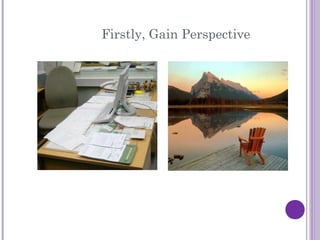
Firstly, Gain Perspective
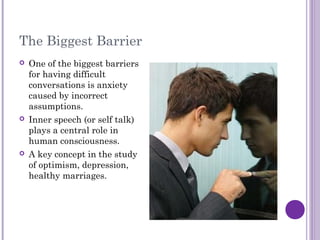
The Biggest Barrier
 One of the biggest barriers
for having difficult
conversations is anxiety
caused by incorrect
assumptions.
 Inner speech (or self talk)
plays a central role in
human consciousness.
 A key concept in the study
of optimism, depression,
healthy marriages.
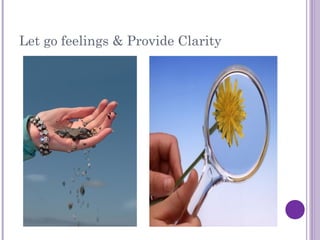
Let go feelings & Provide Clarity
Avoid Avoidance
 “Can’t do it today, too
busy”
 “I’ll catch it at the
performance review”
 “Maybe someone else will
tell them”
 “Their work was good
today, so maybe it is ok”
 “I don’t want to upset the
apple cart”
 “I can’t believe they could
not be aware they are
doing a bad job”
Questions to challenge yourself
 How will I be helping
them?
 Why am I delaying this?
 Will delaying telling them
about this problem make it
go away?
 Would I like to know how I
was doing?
 What am I assuming their
reaction will be?
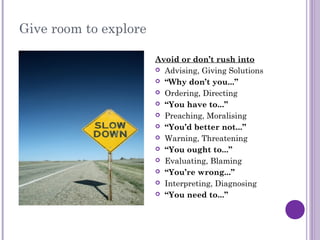
Give room to explore
Avoid or don’t rush into
 Advising, Giving Solutions
 “Why don’t you...”
 Ordering, Directing
 “You have to...”
 Preaching, Moralising
 “You’d better not...”
 Warning, Threatening
 “You ought to...”
 Evaluating, Blaming
 “You’re wrong...”
 Interpreting, Diagnosing
 “You need to...”
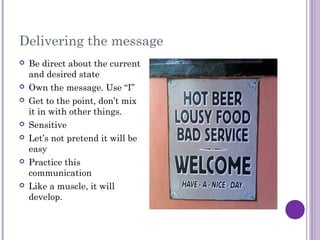
Delivering the message
 Be direct about the current
and desired state
 Own the message. Use “I”
 Get to the point, don’t mix
it in with other things.
 Sensitive
 Let’s not pretend it will be
easy
 Practice this
communication
 Like a muscle, it will
develop.
Questions & Handouts

How to make difficult conversations less difficult

  • 1.
    How to makedifficult work conversations less difficult Helping organisations bring out the best in their talent Helping individuals make positive and rewarding career choices www.pinpoint.ie Prepared by John Deely BA MSc Occupational Psychologist with Pinpoint.
  • 2.
    ABOUT PINPOINT  Pinpoint– occupational psychologists and career management specialists  Key Services:  Coaching talent in organisations especially new managers and teams working under pressure  Career direction and development for individuals off their own bat or as part of a redundancy programme  Profiling – psychometric testing of talent
  • 3.
  • 4.
    The Biggest Barrier One of the biggest barriers for having difficult conversations is anxiety caused by incorrect assumptions.  Inner speech (or self talk) plays a central role in human consciousness.  A key concept in the study of optimism, depression, healthy marriages.
  • 5.
    Let go feelings& Provide Clarity
  • 6.
    Avoid Avoidance  “Can’tdo it today, too busy”  “I’ll catch it at the performance review”  “Maybe someone else will tell them”  “Their work was good today, so maybe it is ok”  “I don’t want to upset the apple cart”  “I can’t believe they could not be aware they are doing a bad job”
  • 7.
    Questions to challengeyourself  How will I be helping them?  Why am I delaying this?  Will delaying telling them about this problem make it go away?  Would I like to know how I was doing?  What am I assuming their reaction will be?
  • 8.
    Give room toexplore Avoid or don’t rush into  Advising, Giving Solutions  “Why don’t you...”  Ordering, Directing  “You have to...”  Preaching, Moralising  “You’d better not...”  Warning, Threatening  “You ought to...”  Evaluating, Blaming  “You’re wrong...”  Interpreting, Diagnosing  “You need to...”
  • 9.
    Delivering the message Be direct about the current and desired state  Own the message. Use “I”  Get to the point, don’t mix it in with other things.  Sensitive  Let’s not pretend it will be easy  Practice this communication  Like a muscle, it will develop.
  • 10.

Editor's Notes

  • #2 Contact details. www.pinpoint.ie, John.Deely@pinpoint.ie, (01) 6425 721 Handout accompanied this presentation, let me know if you are interested in them.
  • #5 Attribution theory helps us understand human motivation. It reminds us that people who experience frequent success / positive outcomes often attribute their success to their own effort or ability, and their failure to their own lack of effort or ability. People who experience repeated failure / negative experience, however, often attribute their failure to bad luck or to task difficulty, and their success to good luck or the ease of the task (Weiner, 1990).
  • #11 Q and A Thank you