BUILDING AND
SUSTAINING TRUST2014 NH/VT NSH Spring Meeting
Kris Mailepors; MBA, CODP
Director of Organizational Development & Training
Catholic Medical Center
kmailepo@cmc-nh.org
@krismailepors
©Kris Mailepors; 2014
HOW DO I BUILD TRUST?
What do I do? What should I do? What might I do wrong?
What about my Boss??
What does s/he do? What should s/he do more?
What does s/he do wrong?
©Kris Mailepors; 2014
NOW WAIT… WHAT ARE THE RULES?
TRUST:
Choosing to risk making something you value subject to another person’s actions.
…Such as?
opinions about policy
work habits
things we need
“tricks of the trade”
Money, goals, promotions, your “good name,” your sense of happiness…..
Yes, somewhat vague…
©Kris Mailepors; 2014
TRUST & DISTRUST…
DIStrust
When you choose to NOT make yourself open to another’s actions.
General assessment: What is important to me is not safe with this person in this
situation.
When we DIStrust, we look for ways to PROTECT what we value
©Kris Mailepors; 2014
TRUST & DISTRUST…
When we DIStrust, we look for ways to PROTECT what we value
THE DISASTER OF DISTRUST:
The strategies we use to protect ourselves get in the way of our ability to
effectively work with others.
©Kris Mailepors; 2014
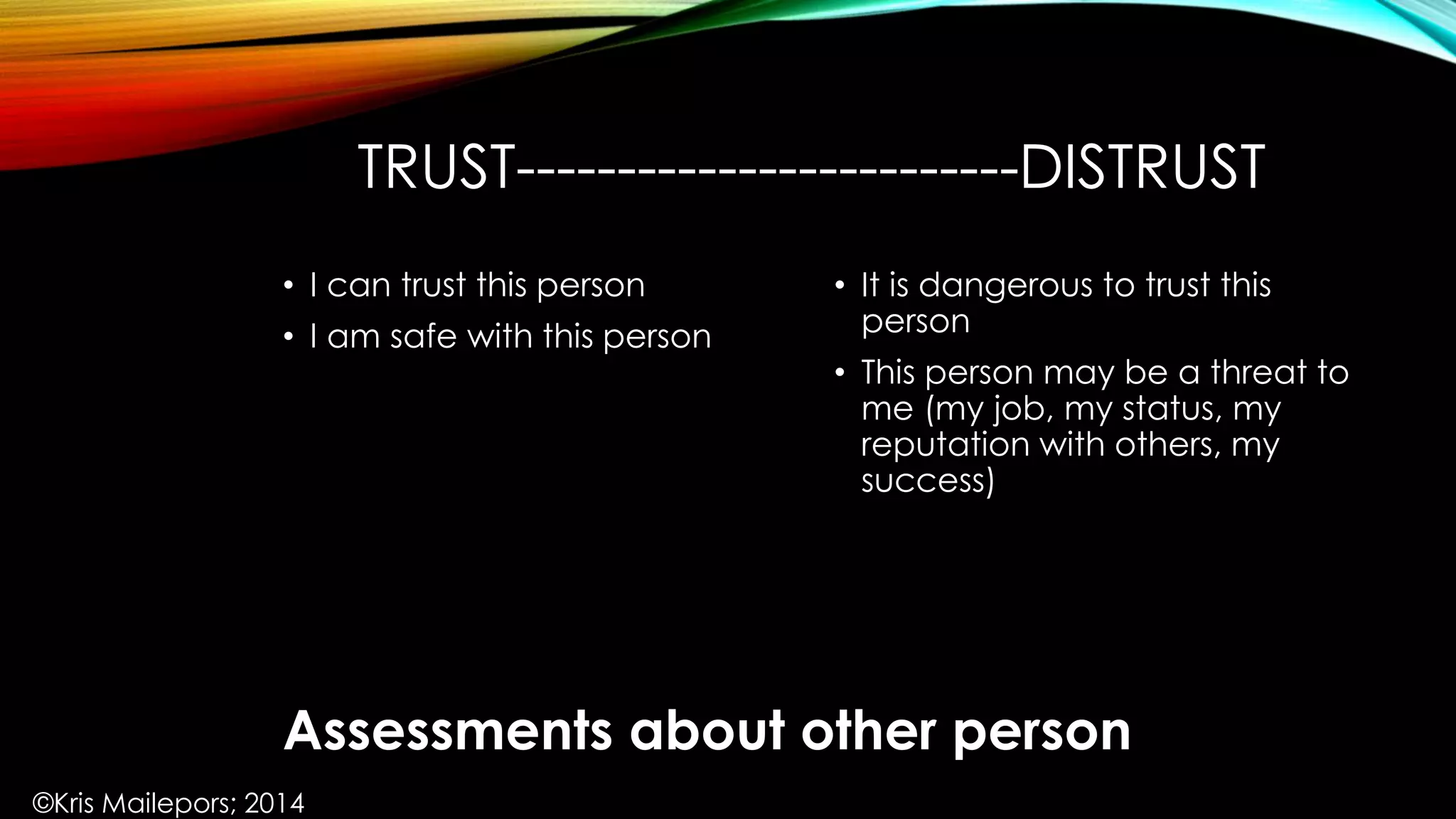
TRUST-------------------------DISTRUST
• It is dangerous to trust this
person
• This person may be a threat to
me (my job, my status, my
reputation with others, my
success)
• I can trust this person
• I am safe with this person
Assessments about other person
©Kris Mailepors; 2014
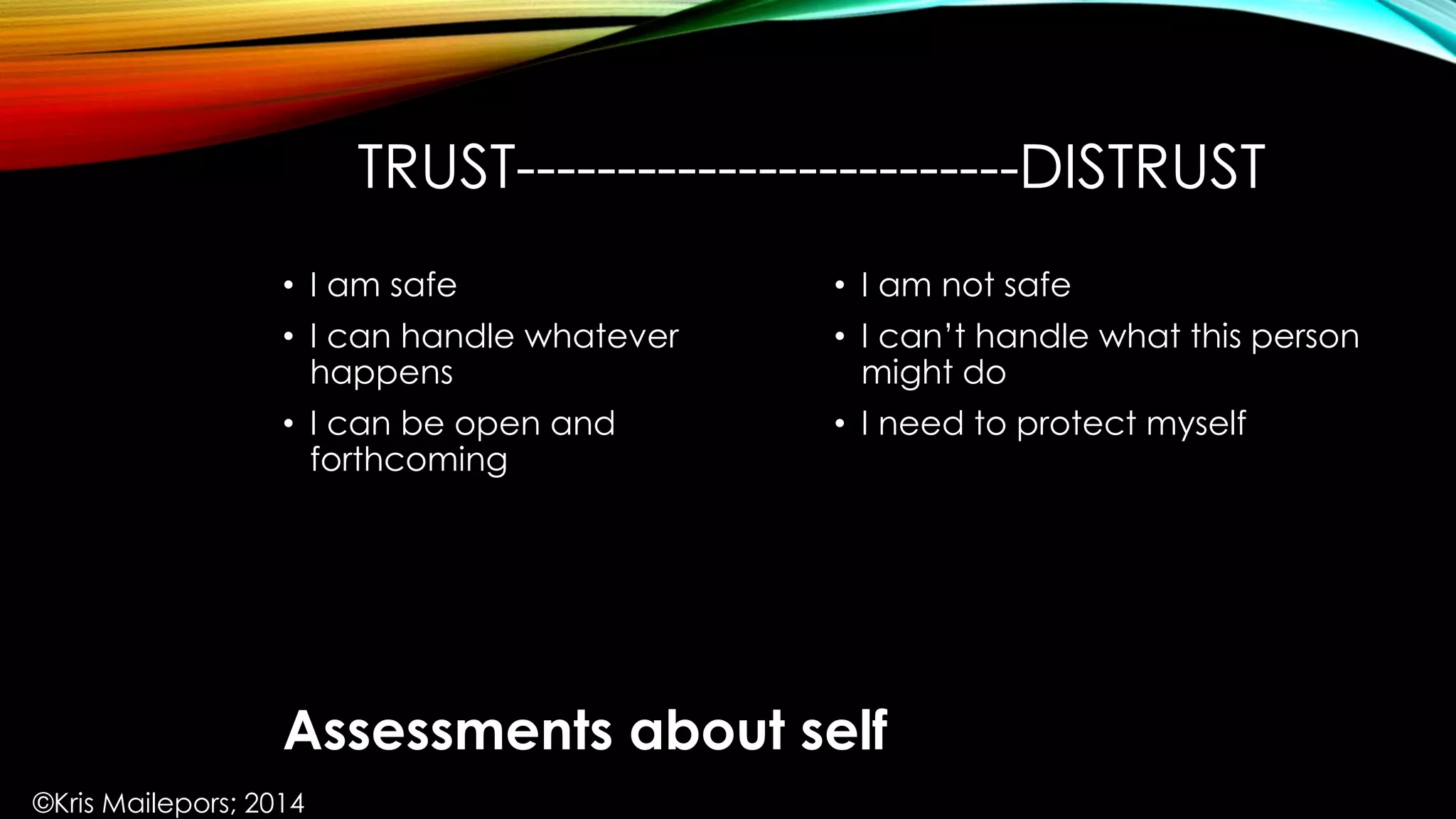
TRUST-------------------------DISTRUST
• I am not safe
• I can’t handle what this person
might do
• I need to protect myself
• I am safe
• I can handle whatever
happens
• I can be open and
forthcoming
Assessments about self
©Kris Mailepors; 2014
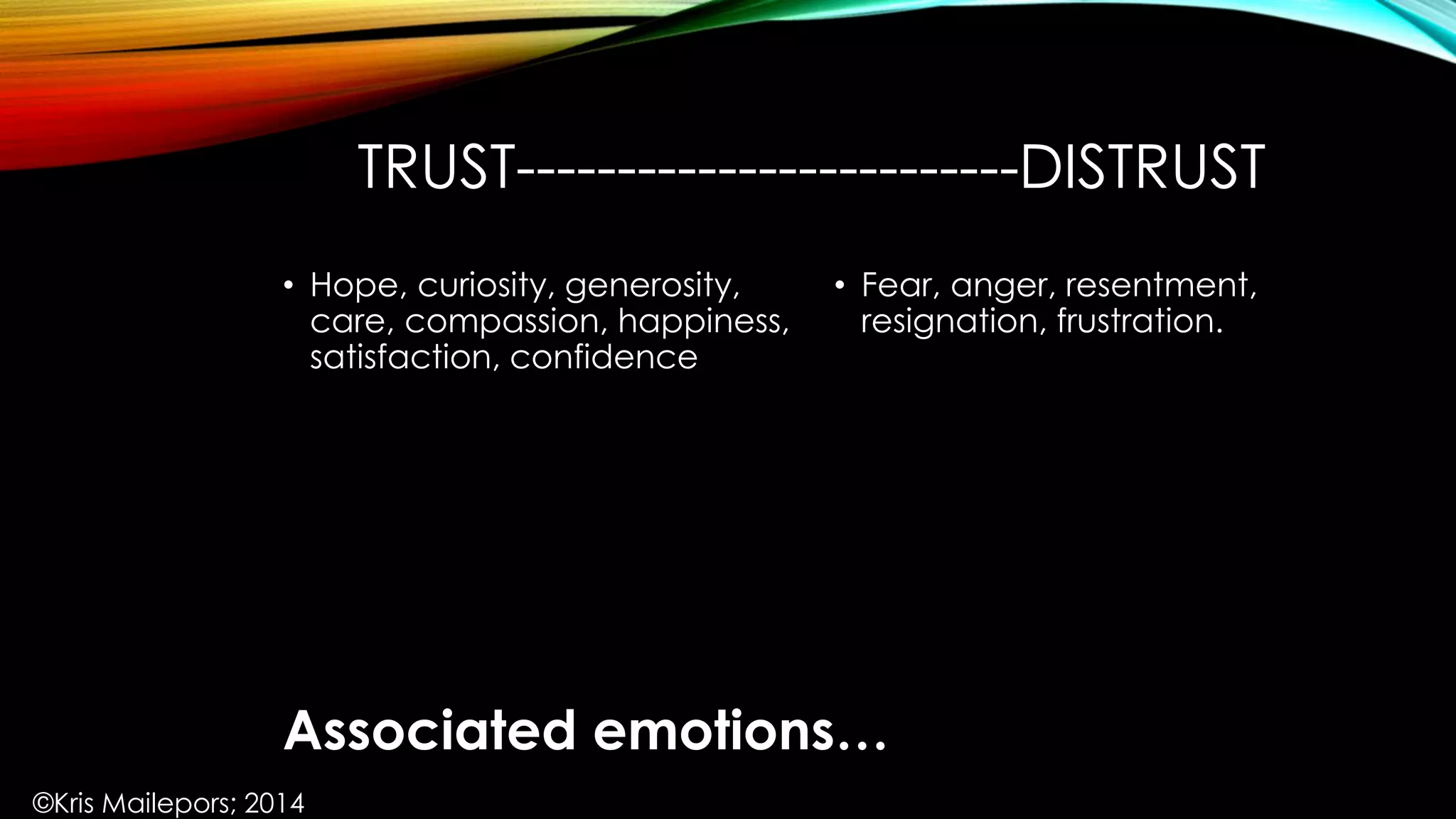
TRUST-------------------------DISTRUST
• Fear, anger, resentment,
resignation, frustration.
• Hope, curiosity, generosity,
care, compassion, happiness,
satisfaction, confidence
Associated emotions…
©Kris Mailepors; 2014
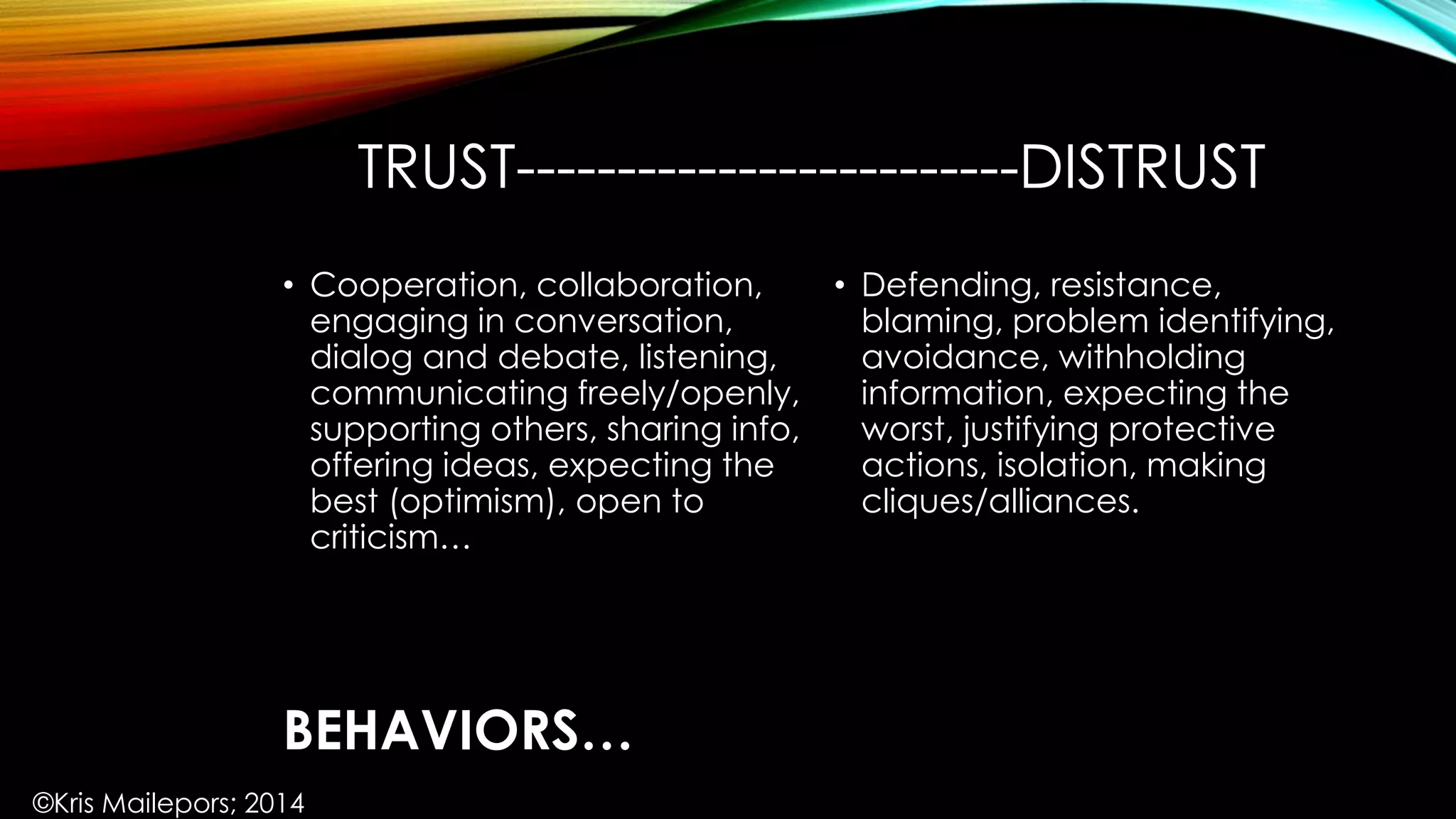
TRUST-------------------------DISTRUST
• Defending, resistance,
blaming, problem identifying,
avoidance, withholding
information, expecting the
worst, justifying protective
actions, isolation, making
cliques/alliances.
• Cooperation, collaboration,
engaging in conversation,
dialog and debate, listening,
communicating freely/openly,
supporting others, sharing info,
offering ideas, expecting the
best (optimism), open to
criticism…
BEHAVIORS…
©Kris Mailepors; 2014
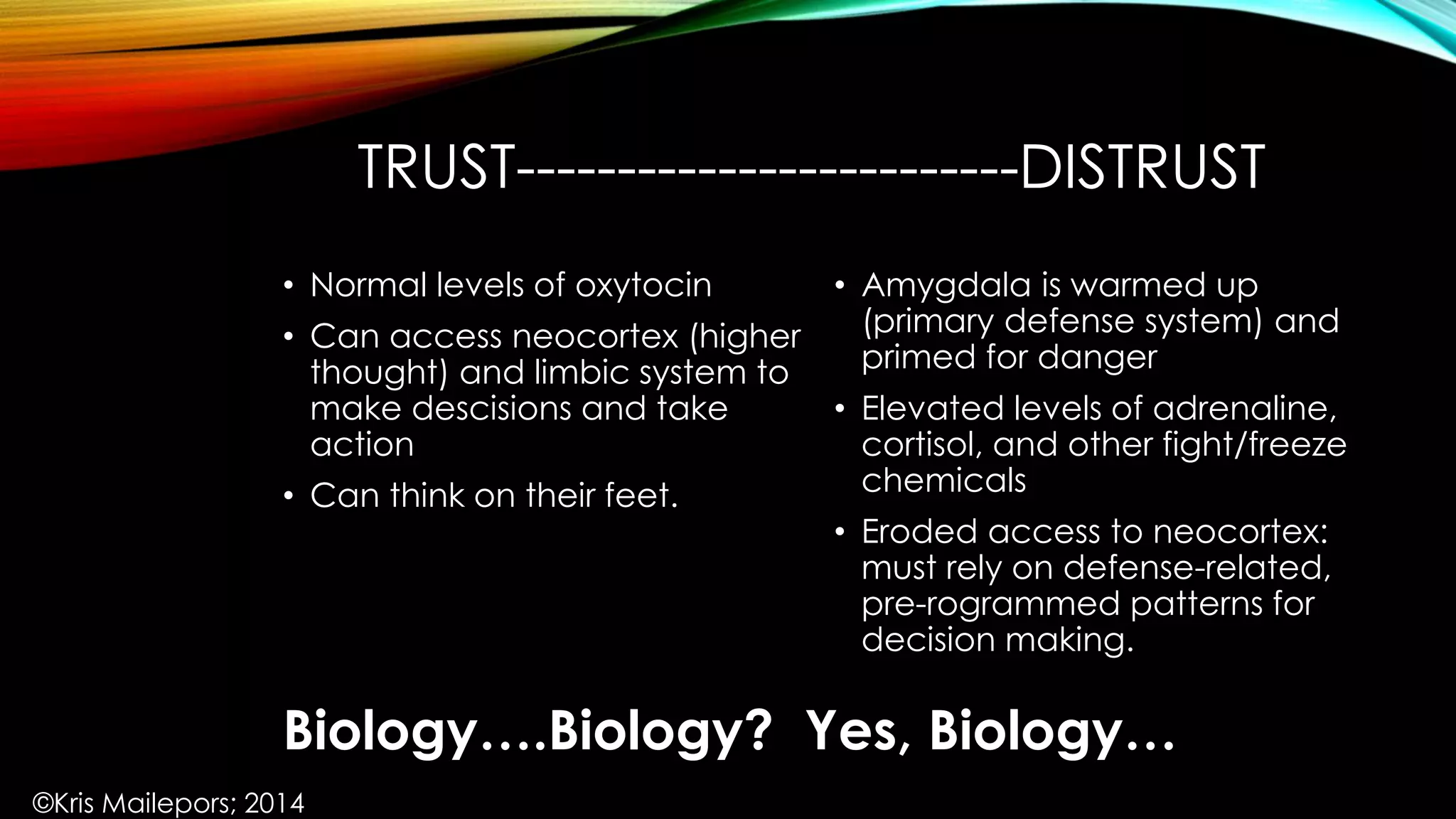
TRUST-------------------------DISTRUST
• Amygdala is warmed up
(primary defense system) and
primed for danger
• Elevated levels of adrenaline,
cortisol, and other fight/freeze
chemicals
• Eroded access to neocortex:
must rely on defense-related,
pre-rogrammed patterns for
decision making.
• Normal levels of oxytocin
• Can access neocortex (higher
thought) and limbic system to
make descisions and take
action
• Can think on their feet.
Biology….Biology? Yes, Biology…
©Kris Mailepors; 2014
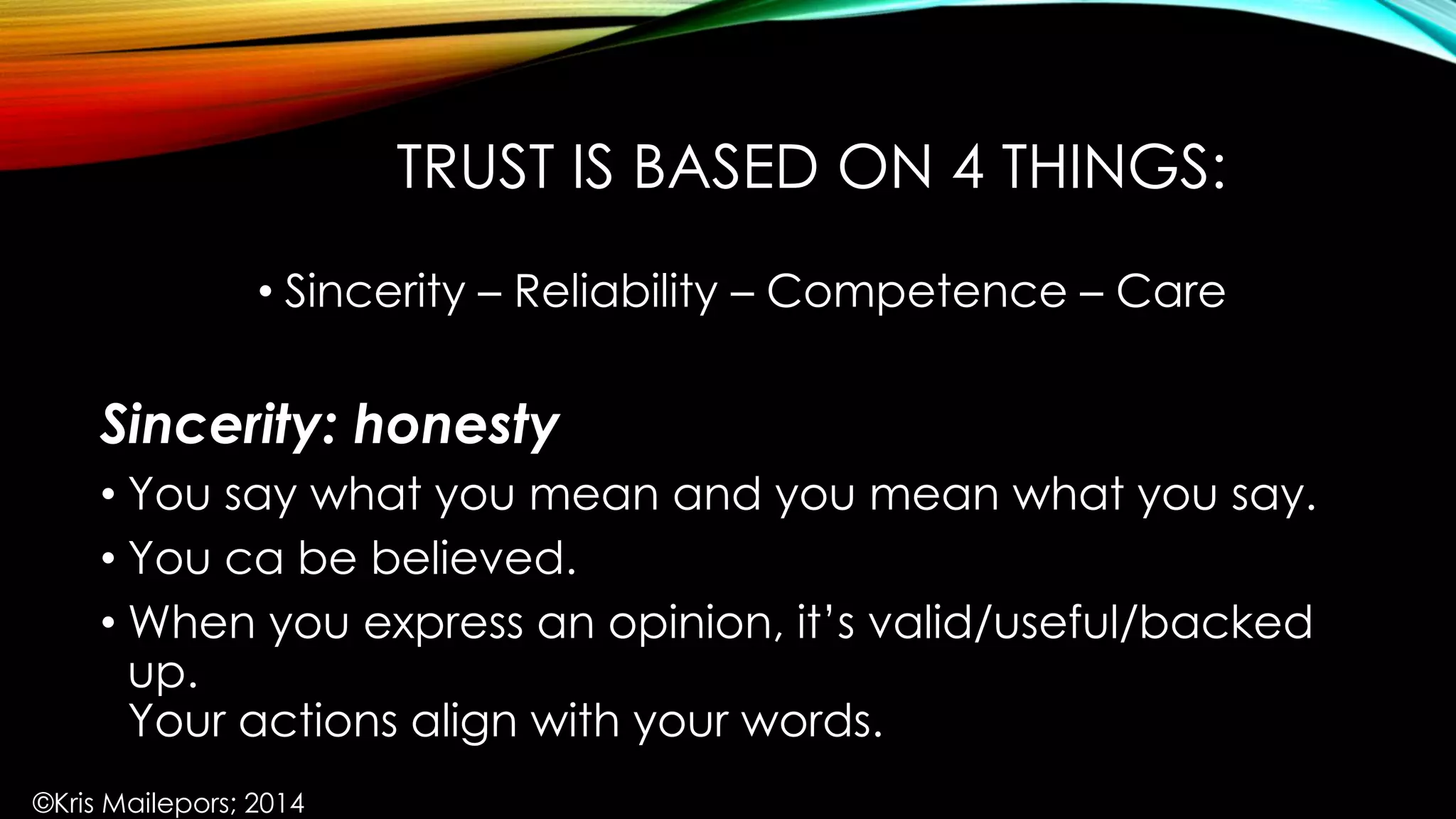
TRUST IS BASED ON 4 THINGS:
• Sincerity – Reliability – Competence – Care
Sincerity: honesty
• You say what you mean and you mean what you say.
• You ca be believed.
• When you express an opinion, it’s valid/useful/backed
up.
Your actions align with your words.
©Kris Mailepors; 2014
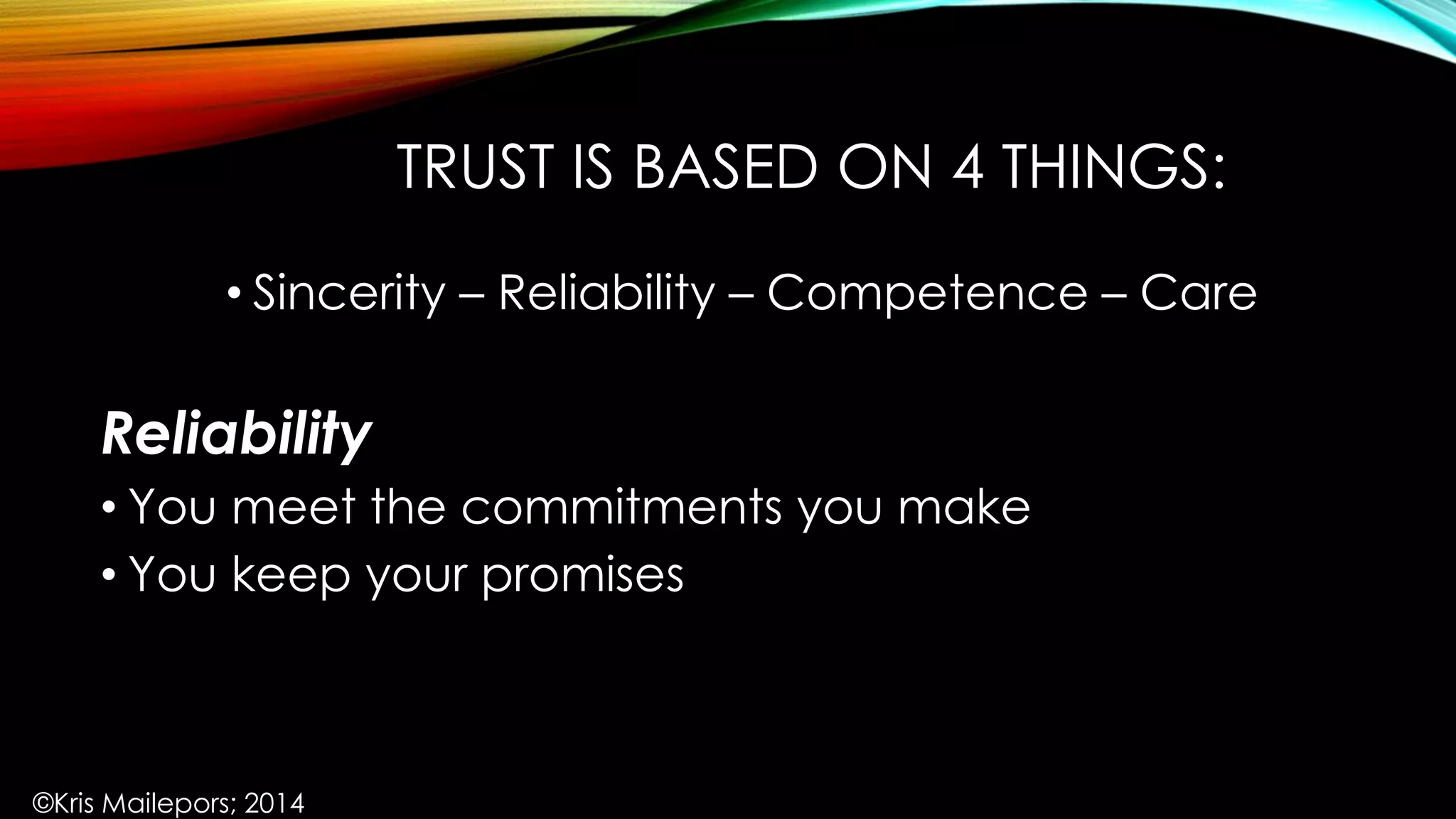
TRUST IS BASED ON 4 THINGS:
• Sincerity – Reliability – Competence – Care
Reliability
• You meet the commitments you make
• You keep your promises
©Kris Mailepors; 2014
TRUST IS BASED ON 4 THINGS:
• Sincerity – Reliability – Competence – Care
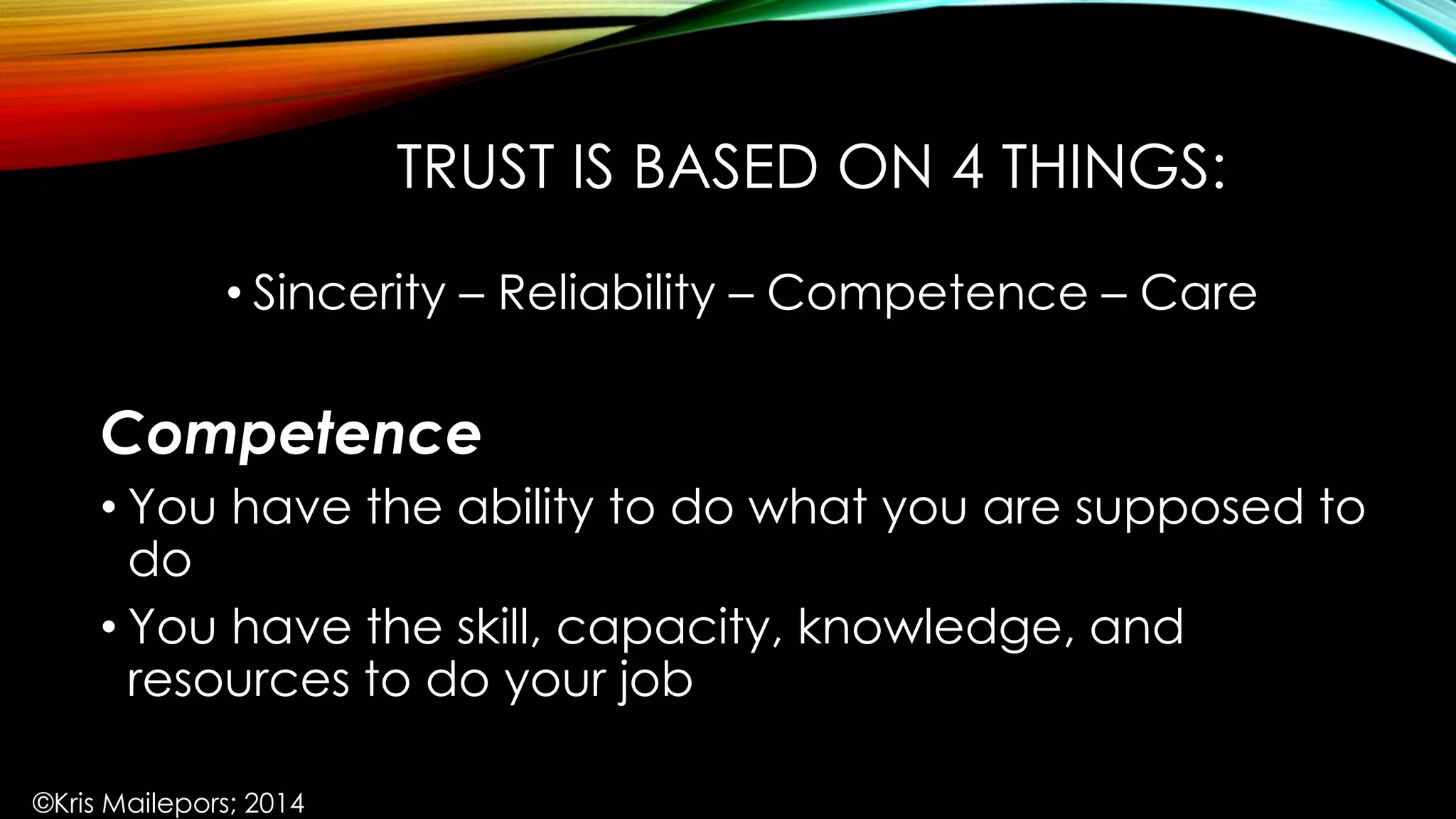
Competence
• You have the ability to do what you are supposed to
do
• You have the skill, capacity, knowledge, and
resources to do your job
©Kris Mailepors; 2014
TRUST IS BASED ON 4 THINGS:
• Sincerity – Reliability – Competence – Care
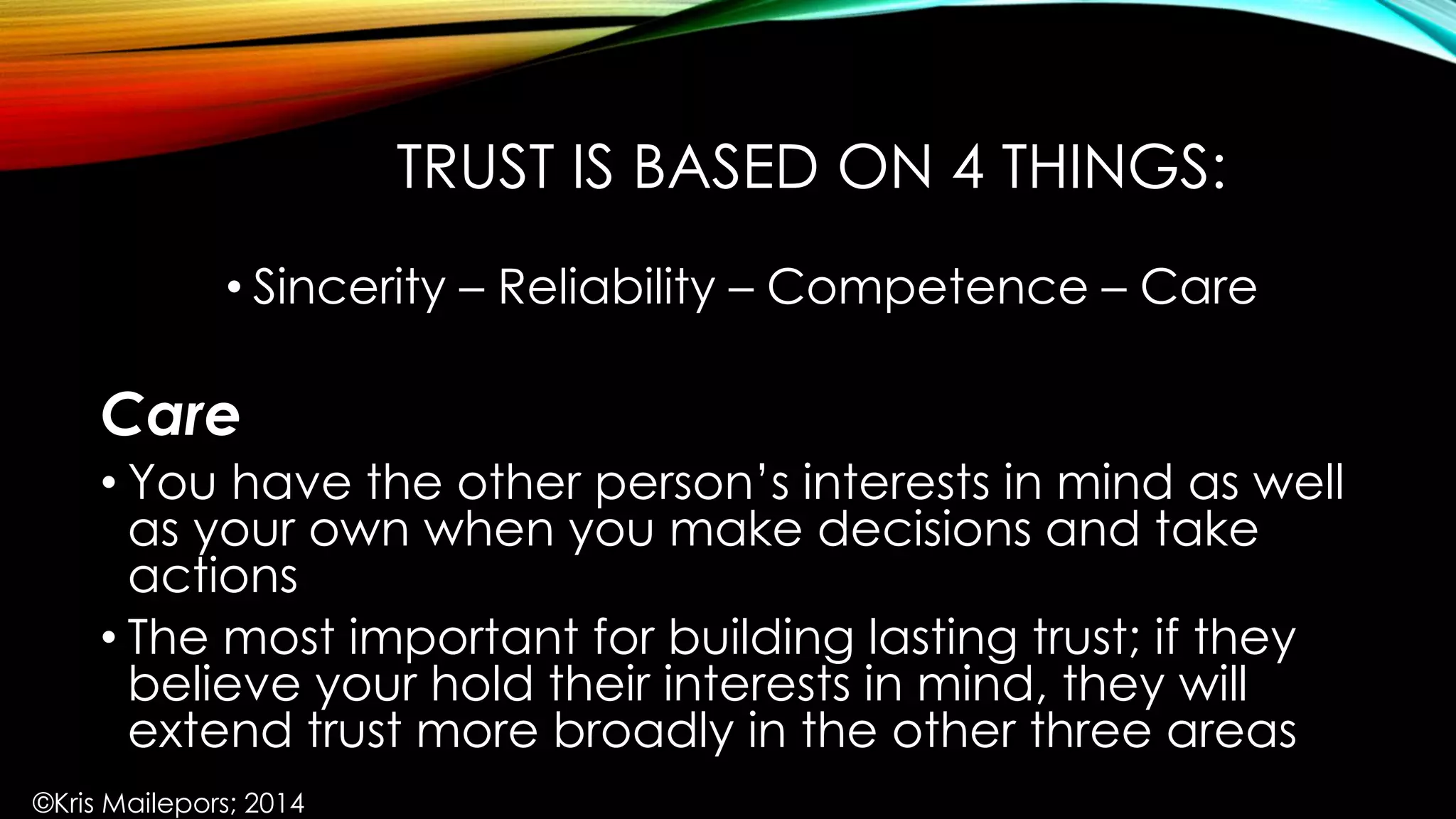
Care
• You have the other person’s interests in mind as well
as your own when you make decisions and take
actions
• The most important for building lasting trust; if they
believe your hold their interests in mind, they will
extend trust more broadly in the other three areas
©Kris Mailepors; 2014
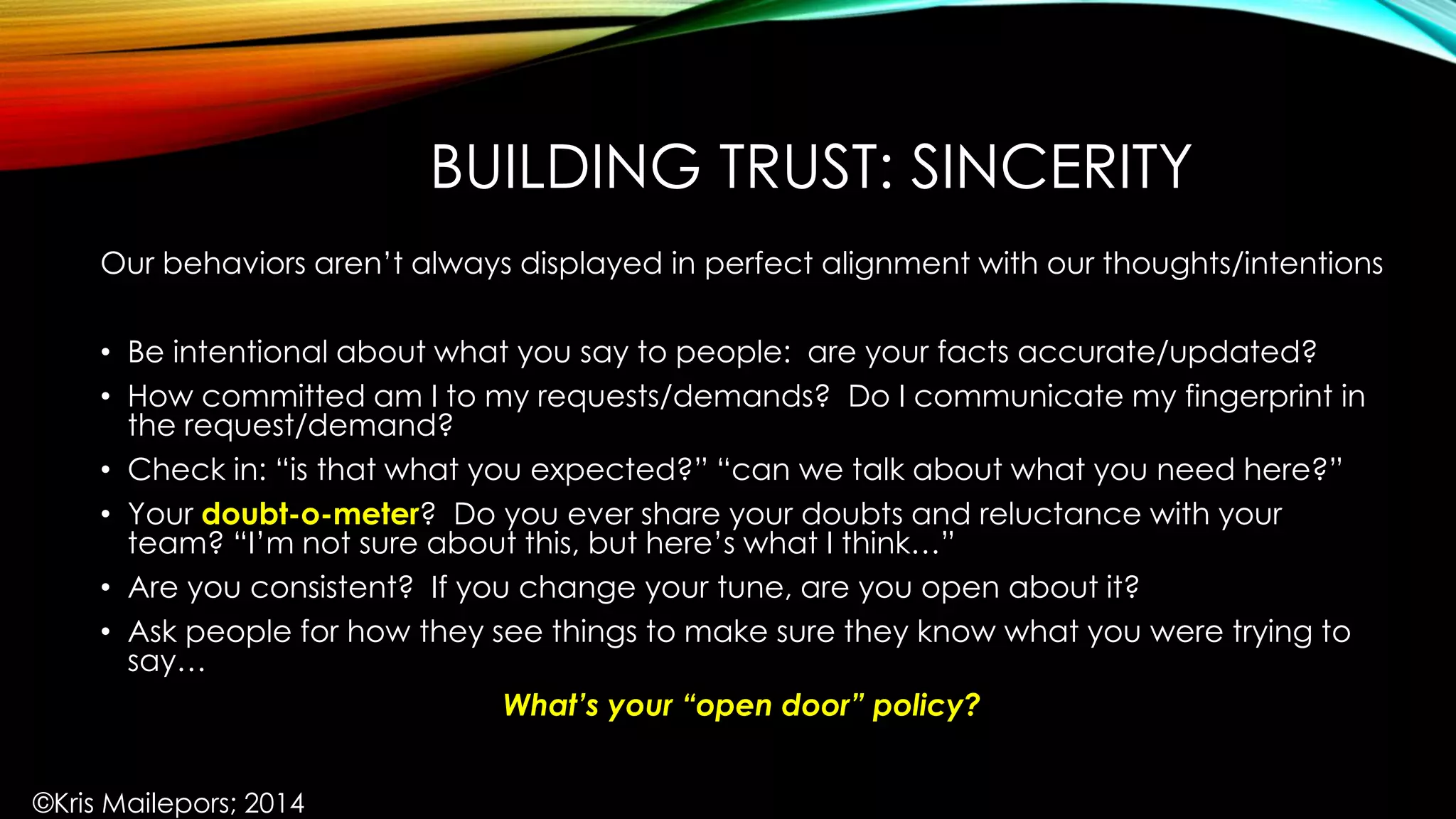
BUILDING TRUST: SINCERITY
Our behaviors aren’t always displayed in perfect alignment with our thoughts/intentions
• Be intentional about what you say to people: are your facts accurate/updated?
• How committed am I to my requests/demands? Do I communicate my fingerprint in
the request/demand?
• Check in: “is that what you expected?” “can we talk about what you need here?”
• Your doubt-o-meter? Do you ever share your doubts and reluctance with your
team? “I’m not sure about this, but here’s what I think…”
• Are you consistent? If you change your tune, are you open about it?
• Ask people for how they see things to make sure they know what you were trying to
say…
What’s your “open door” policy?
©Kris Mailepors; 2014
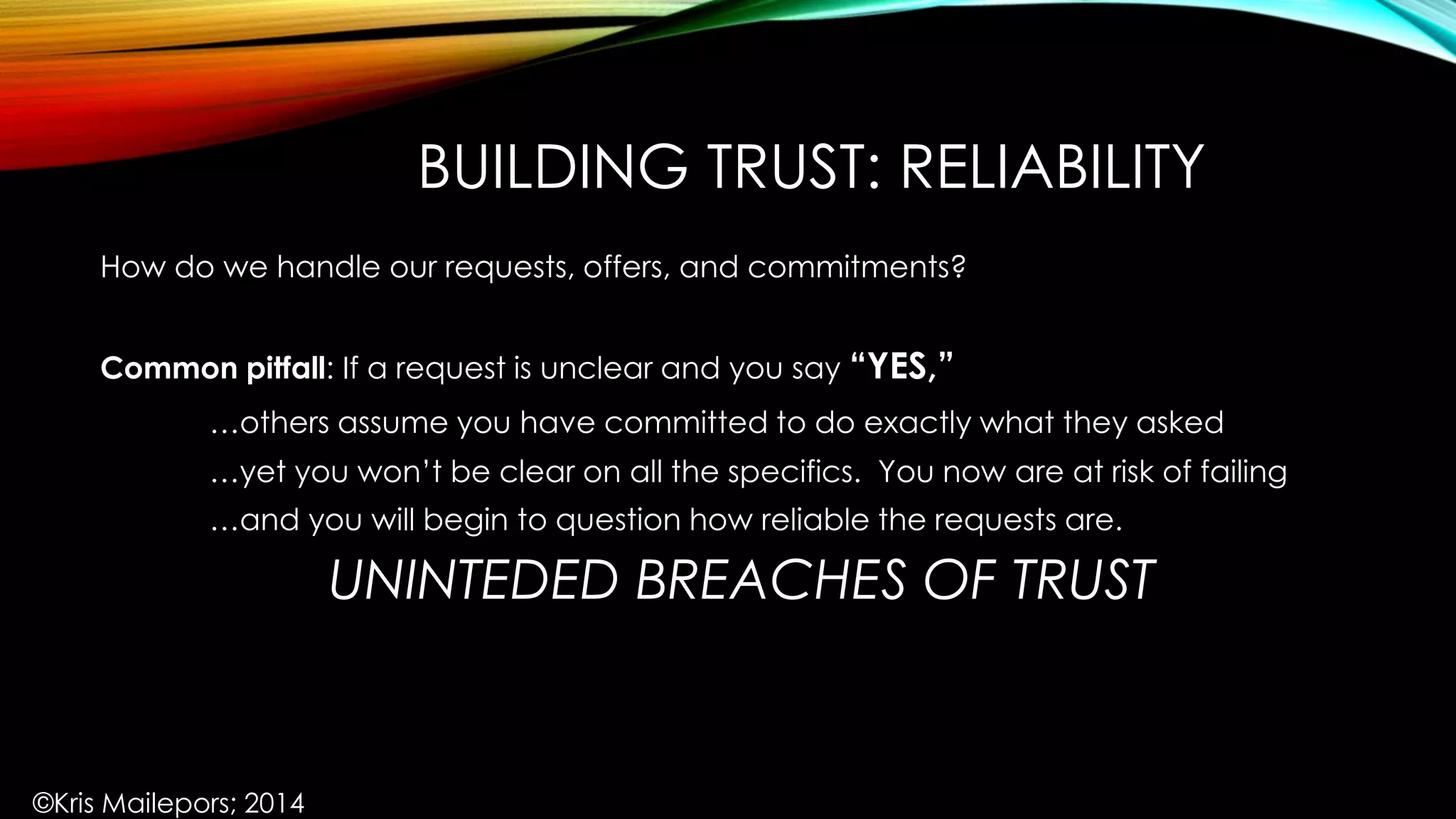
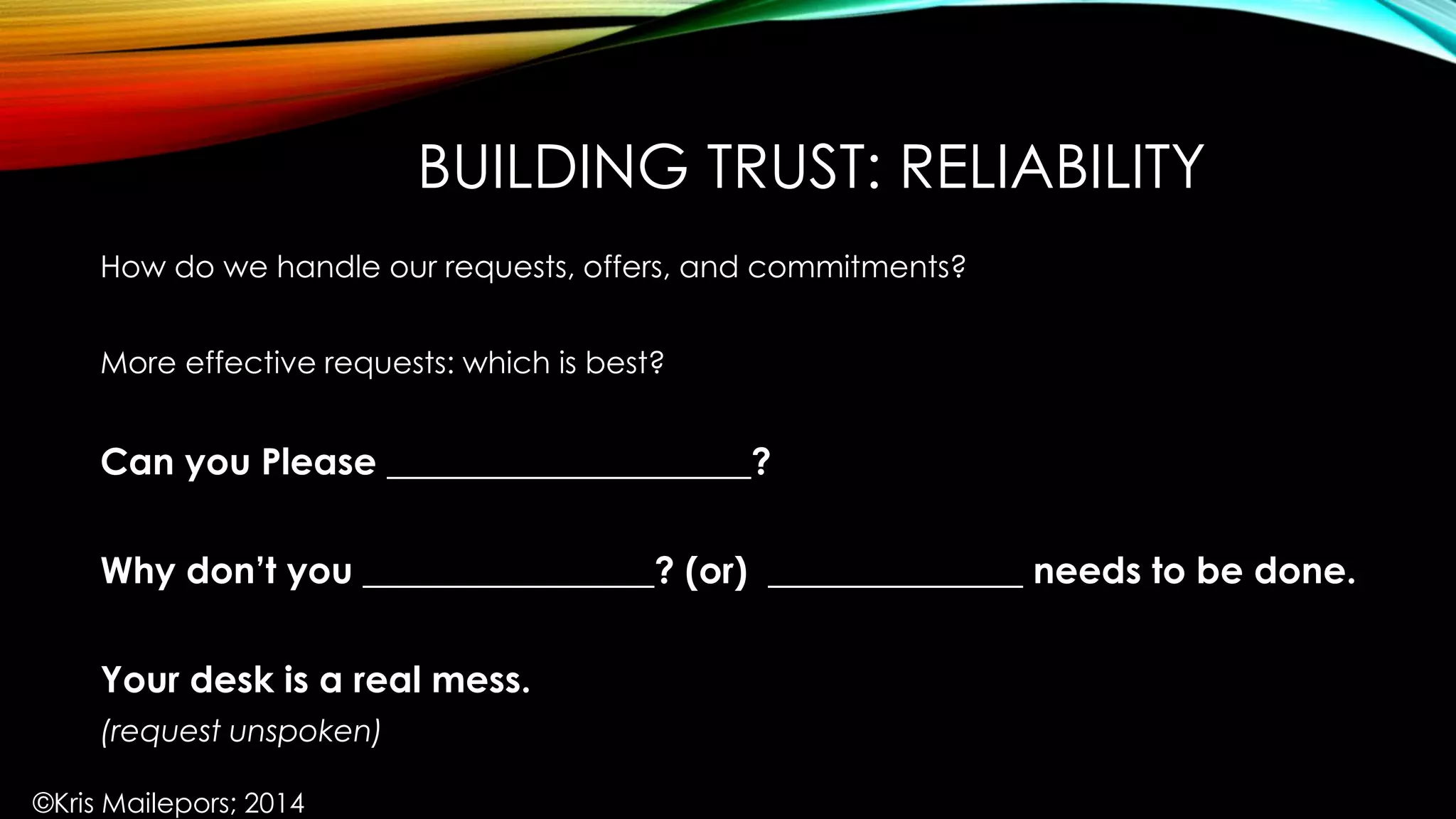
BUILDING TRUST: RELIABILITY
How do we handle our requests, offers, and commitments?
Common pitfall: If a request is unclear and you say “YES,”
…others assume you have committed to do exactly what they asked
…yet you won’t be clear on all the specifics. You now are at risk of failing
…and you will begin to question how reliable the requests are.
UNINTEDED BREACHES OF TRUST
©Kris Mailepors; 2014
BUILDING TRUST: RELIABILITY
How do we handle our requests, offers, and commitments?
More effective requests: which is best?
Can you Please ____________________?
Why don’t you ________________? (or) ______________ needs to be done.
Your desk is a real mess.
(request unspoken)
©Kris Mailepors; 2014
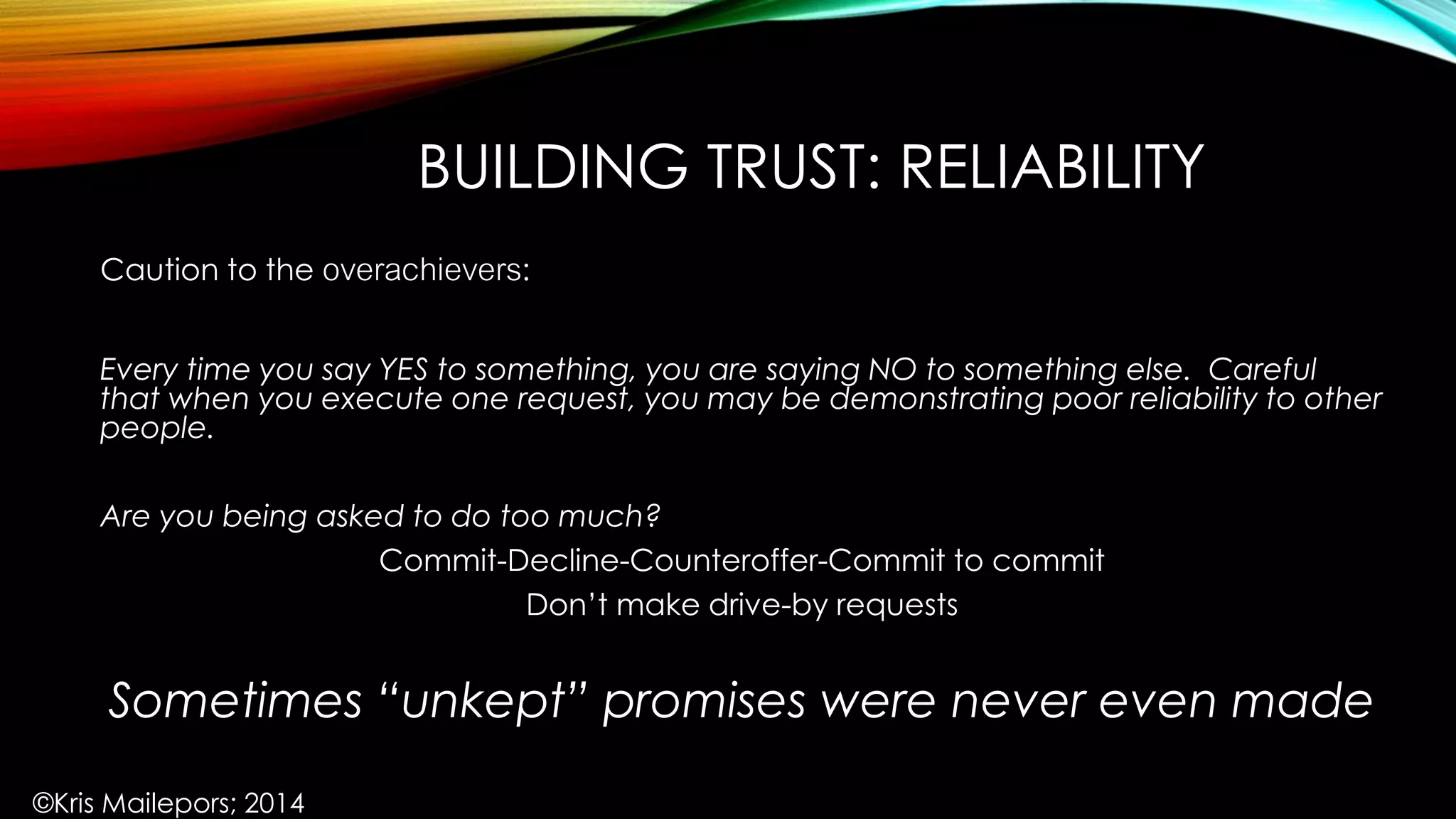
BUILDING TRUST: RELIABILITY
Caution to the overachievers:
Every time you say YES to something, you are saying NO to something else. Careful
that when you execute one request, you may be demonstrating poor reliability to other
people.
Are you being asked to do too much?
Commit-Decline-Counteroffer-Commit to commit
Don’t make drive-by requests
Sometimes “unkept” promises were never even made
©Kris Mailepors; 2014
BUILDING TRUST: RELIABILITY
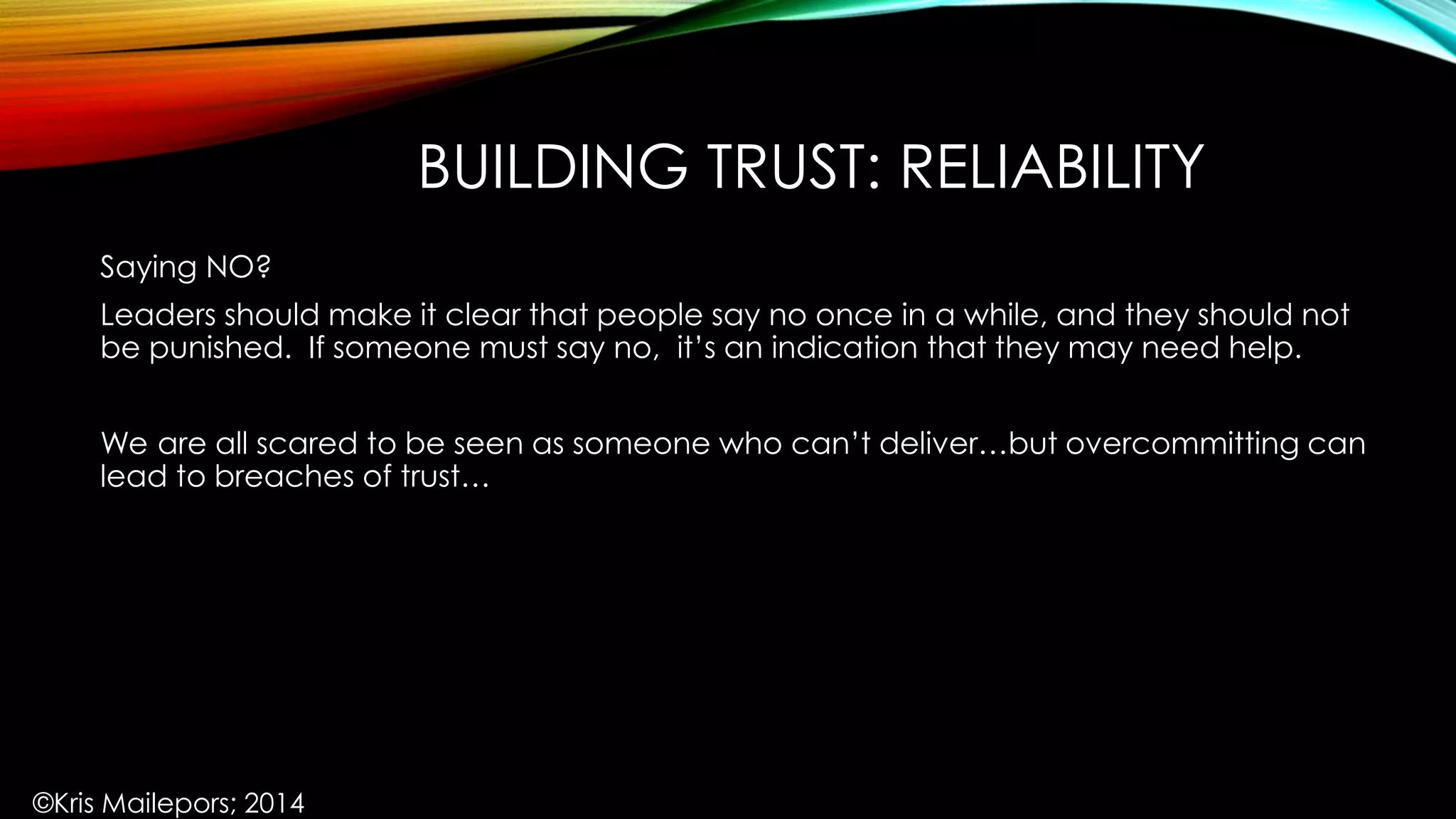
Saying NO?
Leaders should make it clear that people say no once in a while, and they should not
be punished. If someone must say no, it’s an indication that they may need help.
We are all scared to be seen as someone who can’t deliver…but overcommitting can
lead to breaches of trust…
©Kris Mailepors; 2014
BUILDING TRUST: RELIABILITY
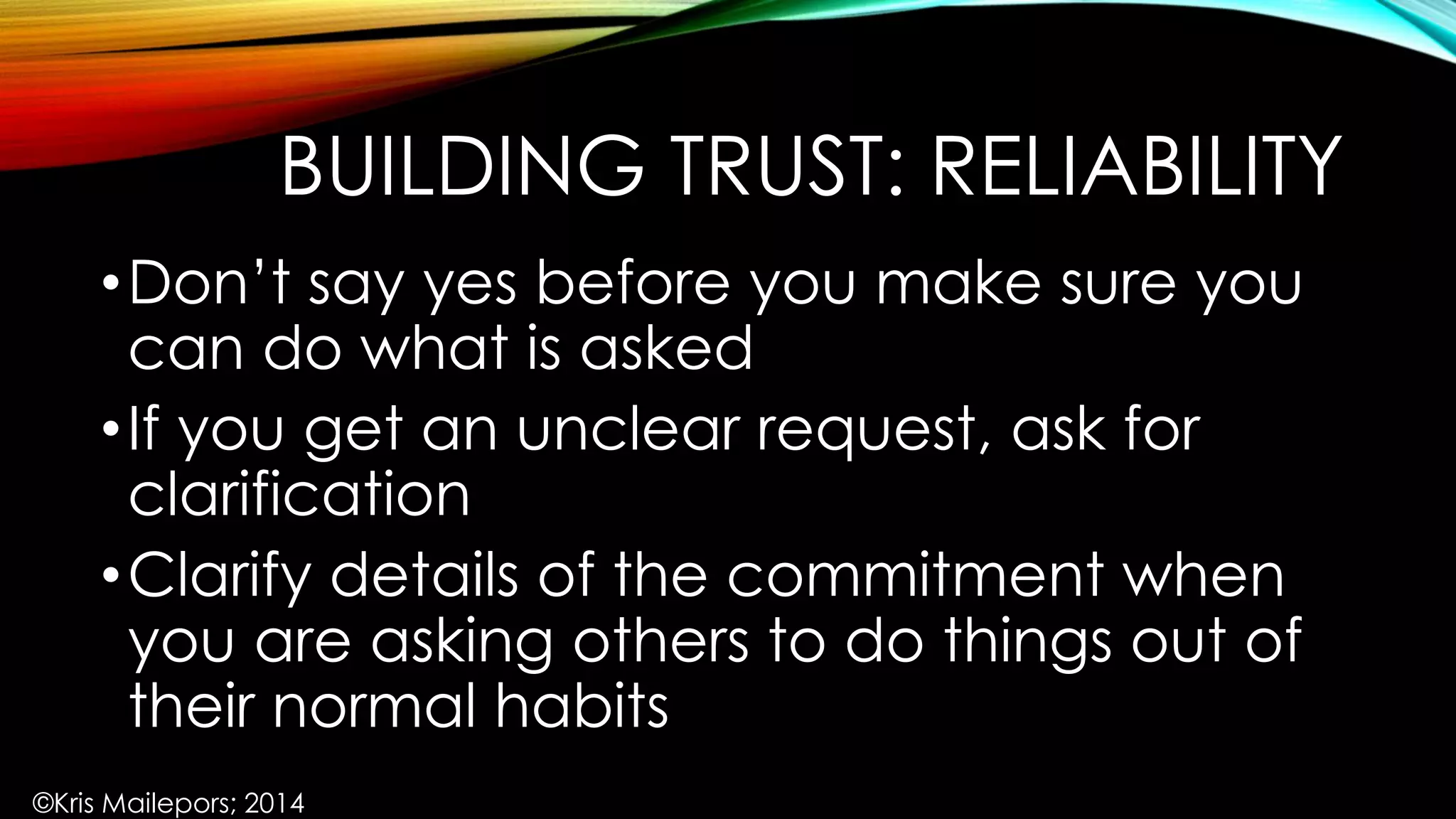
•Don’t say yes before you make sure you
can do what is asked
•If you get an unclear request, ask for
clarification
•Clarify details of the commitment when
you are asking others to do things out of
their normal habits
©Kris Mailepors; 2014
BUILDING TRUST: COMPETENCE
The desire to appear competent gets in the way of our ability
to become competent
Have you ever worked with someone—and you thought s/he
wasn’t competent to do their job?
How do you manage them? What do/don’t you TRUST them
with?
©Kris Mailepors; 2014
BUILDING TRUST: COMPETENCE
• Make a list to clarify to yourself the areas in which you are
competent
• …would you share this with others? Why not?
• Define the STANDARD by which your competence is assessed
(may need to collaborate). This is an exercise in CLARITY
• When you don’t know something, do you ask? If you are the
highest ranking in the room, do you still ask?
• Do you ask OTHERS for direct feedback (not fishing for
compliments)
©Kris Mailepors; 2014
BUILDING TRUST: CARE
“We’re in this together”
When people believe you have their best interests in mind as
well as your own (or at least some shared interest like patient
care, team advancement), they will generally extend their
trust in many circumstances (even if reliability, sincerity, and
competence are incomplete or imperfect)
©Kris Mailepors; 2014
BUILDING TRUST: CARE
Without care:
• I may believe what he says,
• He may keep promises
• He may be competent…. BUT…
• I won’t trust him to do (anything past this one thing)
• I won’t let him know what I am really thinking…
• I won’t let him know what I really care about.
©Kris Mailepors; 2014
BUILDING TRUST: CARE
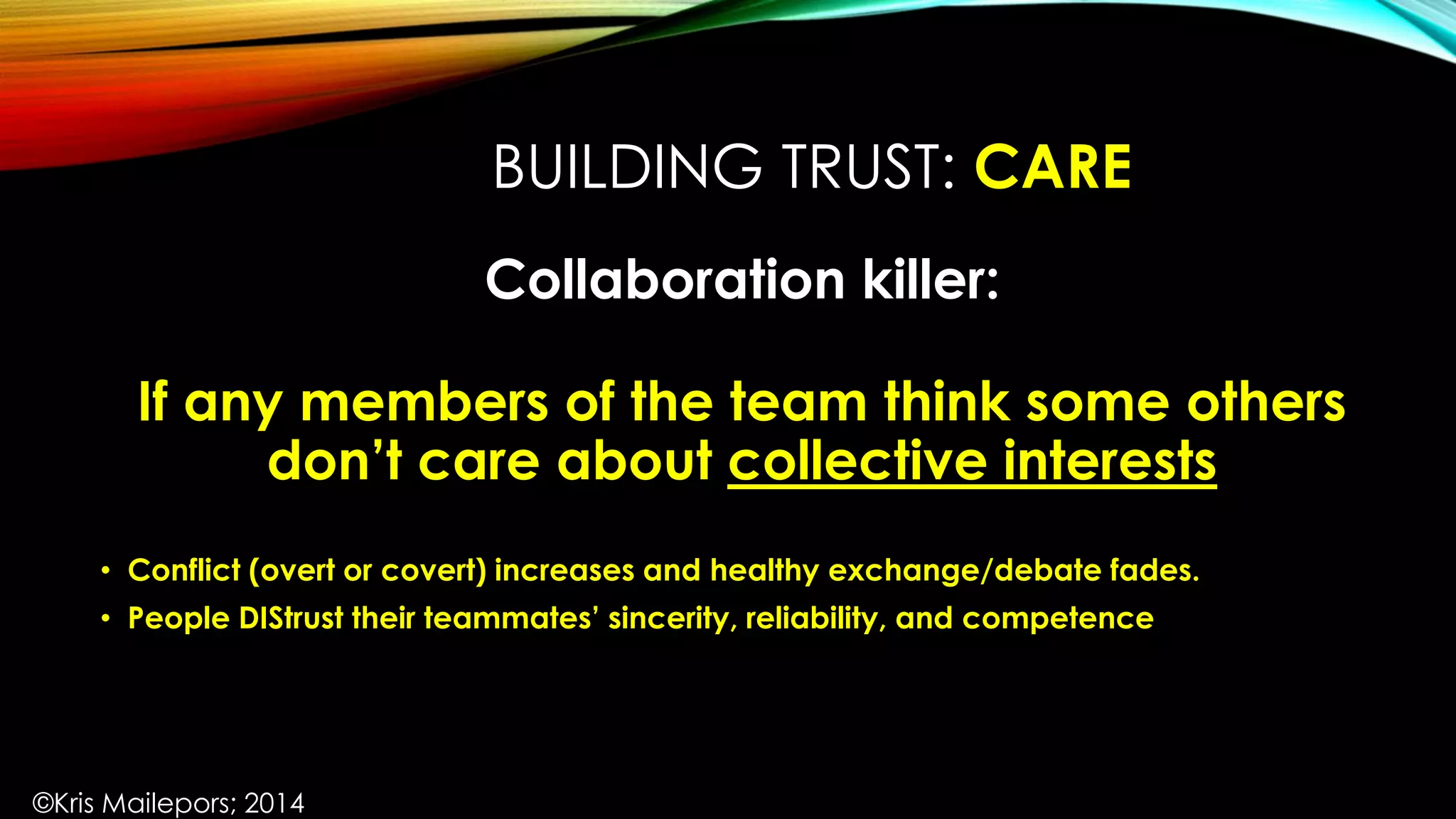
Collaboration killer:
If any members of the team think some others
don’t care about collective interests
• Conflict (overt or covert) increases and healthy exchange/debate fades.
• People DIStrust their teammates’ sincerity, reliability, and competence
©Kris Mailepors; 2014
BUILDING TRUST: CARE
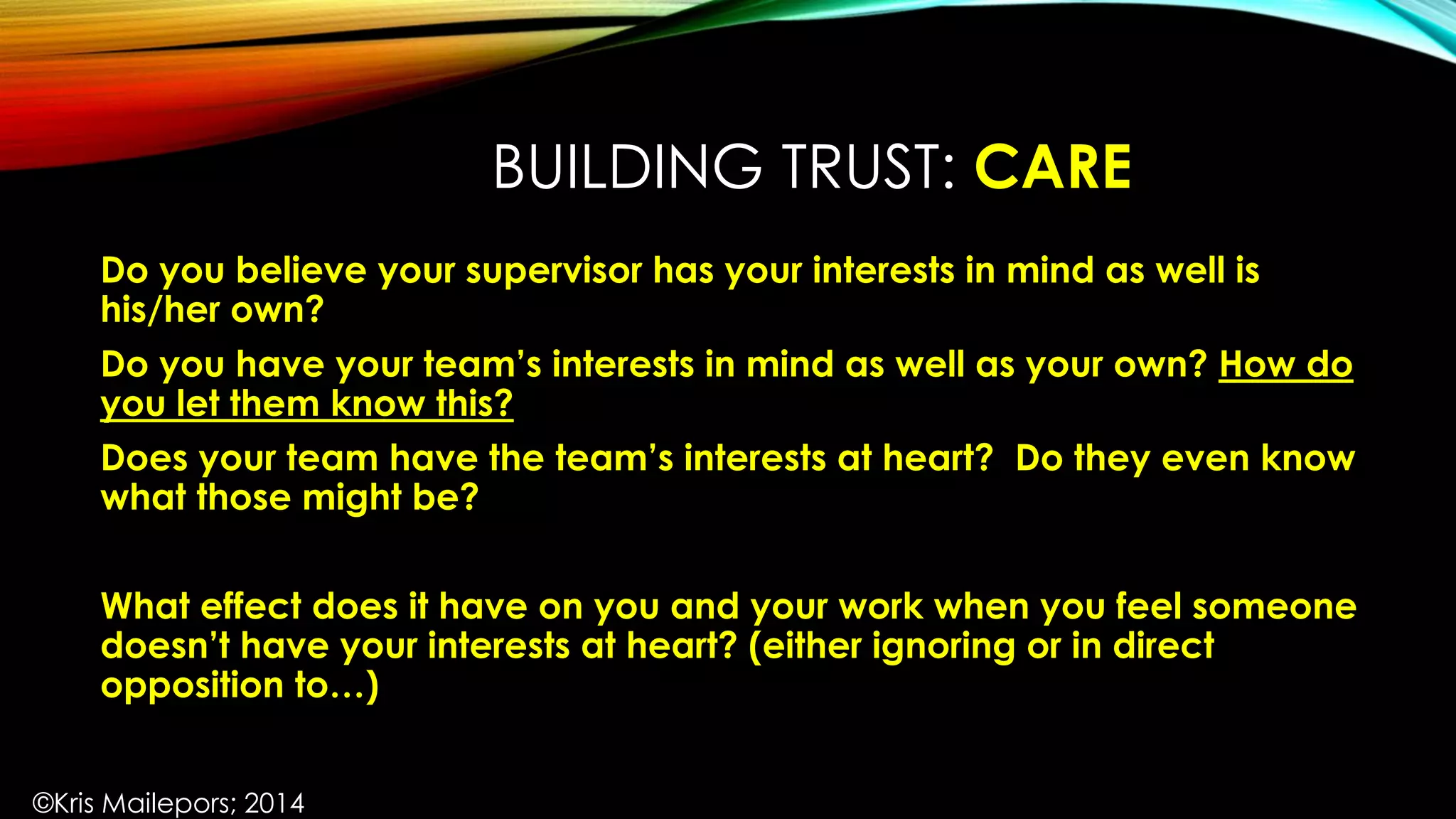
Do you believe your supervisor has your interests in mind as well is
his/her own?
Do you have your team’s interests in mind as well as your own? How do
you let them know this?
Does your team have the team’s interests at heart? Do they even know
what those might be?
What effect does it have on you and your work when you feel someone
doesn’t have your interests at heart? (either ignoring or in direct
opposition to…)
©Kris Mailepors; 2014
BUILDING TRUST: CARE
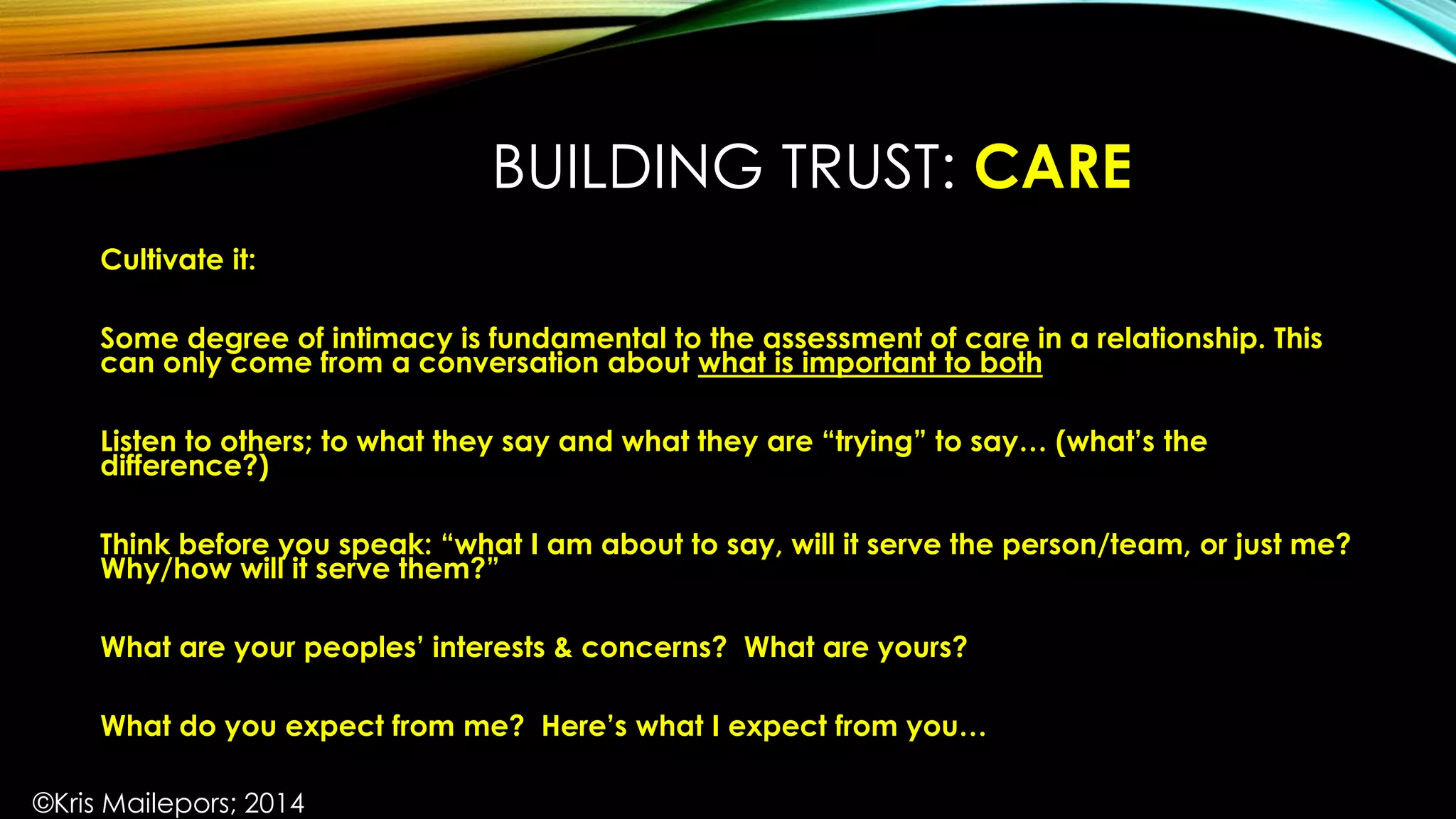
Cultivate it:
Some degree of intimacy is fundamental to the assessment of care in a relationship. This
can only come from a conversation about what is important to both
Listen to others; to what they say and what they are “trying” to say… (what’s the
difference?)
Think before you speak: “what I am about to say, will it serve the person/team, or just me?
Why/how will it serve them?”
What are your peoples’ interests & concerns? What are yours?
What do you expect from me? Here’s what I expect from you…
©Kris Mailepors; 2014
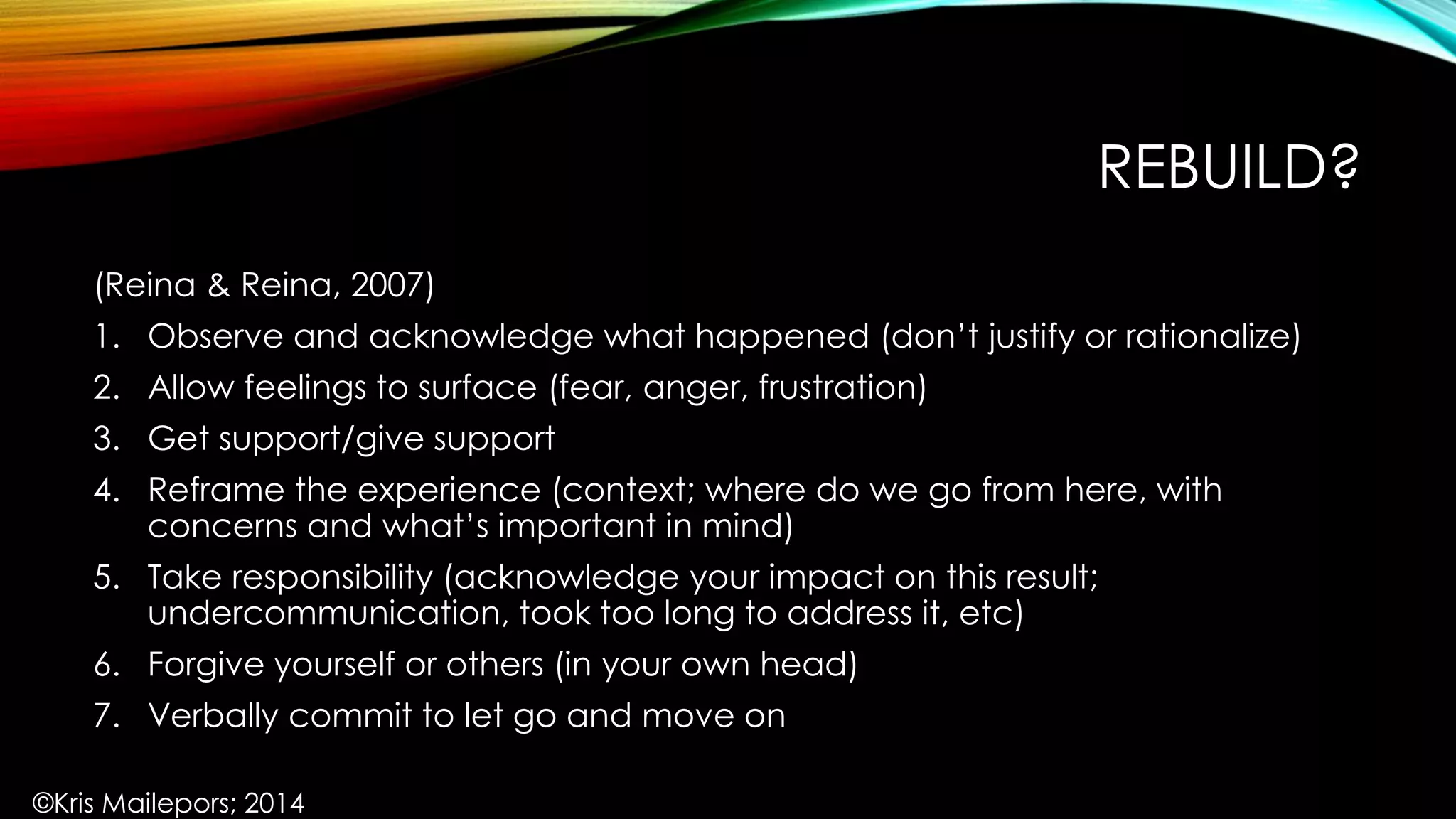
REBUILD?
(Reina & Reina, 2007)
1. Observe and acknowledge what happened (don’t justify or rationalize)
2. Allow feelings to surface (fear, anger, frustration)
3. Get support/give support
4. Reframe the experience (context; where do we go from here, with
concerns and what’s important in mind)
5. Take responsibility (acknowledge your impact on this result;
undercommunication, took too long to address it, etc)
6. Forgive yourself or others (in your own head)
7. Verbally commit to let go and move on
©Kris Mailepors; 2014
WHOM DO WE TRUST?
Transparent: open, easily readable, vulnerable. What you see is what you get
Responsive: give timely and honest feedback openly so to help others
Use caring: whatever I say/do comes from my heart, but “sees” you, so my
behavior is compassionate
Sincere: be consistent, accountable, congruent.
Trustworthy: honest, honor your word/commitments, manage your agreements
Do I need or want a trusting relationship with this person?
(it can be no…then what)
©Kris Mailepors; 2014
TRUST
In order to practice Sincerity, I should:
In order to practice Reliability, I should:
In order to demonstrate Competence, I should:
In order to practice Care, I should:
©Kris Mailepors; 2014
REFERENCES
Feltman, Charles. 2009. The Thin Book of Trust. Bend OR
Reina, Dennis; Reina Michelle. 2007. “Building Sustainable Trust.” OD
PRACTITIONER Vol.9 No.1.
©Kris Mailepors; 2014

Building and Sustaining Trust for Leaders

  • 1.
    BUILDING AND SUSTAINING TRUST2014NH/VT NSH Spring Meeting Kris Mailepors; MBA, CODP Director of Organizational Development & Training Catholic Medical Center kmailepo@cmc-nh.org @krismailepors ©Kris Mailepors; 2014
  • 2.
    HOW DO IBUILD TRUST? What do I do? What should I do? What might I do wrong? What about my Boss?? What does s/he do? What should s/he do more? What does s/he do wrong? ©Kris Mailepors; 2014
  • 3.
    NOW WAIT… WHATARE THE RULES? TRUST: Choosing to risk making something you value subject to another person’s actions. …Such as? opinions about policy work habits things we need “tricks of the trade” Money, goals, promotions, your “good name,” your sense of happiness….. Yes, somewhat vague… ©Kris Mailepors; 2014
  • 4.
    TRUST & DISTRUST… DIStrust Whenyou choose to NOT make yourself open to another’s actions. General assessment: What is important to me is not safe with this person in this situation. When we DIStrust, we look for ways to PROTECT what we value ©Kris Mailepors; 2014
  • 5.
    TRUST & DISTRUST… Whenwe DIStrust, we look for ways to PROTECT what we value THE DISASTER OF DISTRUST: The strategies we use to protect ourselves get in the way of our ability to effectively work with others. ©Kris Mailepors; 2014
  • 6.
    TRUST-------------------------DISTRUST • It isdangerous to trust this person • This person may be a threat to me (my job, my status, my reputation with others, my success) • I can trust this person • I am safe with this person Assessments about other person ©Kris Mailepors; 2014
  • 7.
    TRUST-------------------------DISTRUST • I amnot safe • I can’t handle what this person might do • I need to protect myself • I am safe • I can handle whatever happens • I can be open and forthcoming Assessments about self ©Kris Mailepors; 2014
  • 8.
    TRUST-------------------------DISTRUST • Fear, anger,resentment, resignation, frustration. • Hope, curiosity, generosity, care, compassion, happiness, satisfaction, confidence Associated emotions… ©Kris Mailepors; 2014
  • 9.
    TRUST-------------------------DISTRUST • Defending, resistance, blaming,problem identifying, avoidance, withholding information, expecting the worst, justifying protective actions, isolation, making cliques/alliances. • Cooperation, collaboration, engaging in conversation, dialog and debate, listening, communicating freely/openly, supporting others, sharing info, offering ideas, expecting the best (optimism), open to criticism… BEHAVIORS… ©Kris Mailepors; 2014
  • 10.
    TRUST-------------------------DISTRUST • Amygdala iswarmed up (primary defense system) and primed for danger • Elevated levels of adrenaline, cortisol, and other fight/freeze chemicals • Eroded access to neocortex: must rely on defense-related, pre-rogrammed patterns for decision making. • Normal levels of oxytocin • Can access neocortex (higher thought) and limbic system to make descisions and take action • Can think on their feet. Biology….Biology? Yes, Biology… ©Kris Mailepors; 2014
  • 11.
    TRUST IS BASEDON 4 THINGS: • Sincerity – Reliability – Competence – Care Sincerity: honesty • You say what you mean and you mean what you say. • You ca be believed. • When you express an opinion, it’s valid/useful/backed up. Your actions align with your words. ©Kris Mailepors; 2014
  • 12.
    TRUST IS BASEDON 4 THINGS: • Sincerity – Reliability – Competence – Care Reliability • You meet the commitments you make • You keep your promises ©Kris Mailepors; 2014
  • 13.
    TRUST IS BASEDON 4 THINGS: • Sincerity – Reliability – Competence – Care Competence • You have the ability to do what you are supposed to do • You have the skill, capacity, knowledge, and resources to do your job ©Kris Mailepors; 2014
  • 14.
    TRUST IS BASEDON 4 THINGS: • Sincerity – Reliability – Competence – Care Care • You have the other person’s interests in mind as well as your own when you make decisions and take actions • The most important for building lasting trust; if they believe your hold their interests in mind, they will extend trust more broadly in the other three areas ©Kris Mailepors; 2014
  • 15.
    BUILDING TRUST: SINCERITY Ourbehaviors aren’t always displayed in perfect alignment with our thoughts/intentions • Be intentional about what you say to people: are your facts accurate/updated? • How committed am I to my requests/demands? Do I communicate my fingerprint in the request/demand? • Check in: “is that what you expected?” “can we talk about what you need here?” • Your doubt-o-meter? Do you ever share your doubts and reluctance with your team? “I’m not sure about this, but here’s what I think…” • Are you consistent? If you change your tune, are you open about it? • Ask people for how they see things to make sure they know what you were trying to say… What’s your “open door” policy? ©Kris Mailepors; 2014
  • 16.
    BUILDING TRUST: RELIABILITY Howdo we handle our requests, offers, and commitments? Common pitfall: If a request is unclear and you say “YES,” …others assume you have committed to do exactly what they asked …yet you won’t be clear on all the specifics. You now are at risk of failing …and you will begin to question how reliable the requests are. UNINTEDED BREACHES OF TRUST ©Kris Mailepors; 2014
  • 17.
    BUILDING TRUST: RELIABILITY Howdo we handle our requests, offers, and commitments? More effective requests: which is best? Can you Please ____________________? Why don’t you ________________? (or) ______________ needs to be done. Your desk is a real mess. (request unspoken) ©Kris Mailepors; 2014
  • 18.
    BUILDING TRUST: RELIABILITY Cautionto the overachievers: Every time you say YES to something, you are saying NO to something else. Careful that when you execute one request, you may be demonstrating poor reliability to other people. Are you being asked to do too much? Commit-Decline-Counteroffer-Commit to commit Don’t make drive-by requests Sometimes “unkept” promises were never even made ©Kris Mailepors; 2014
  • 19.
    BUILDING TRUST: RELIABILITY SayingNO? Leaders should make it clear that people say no once in a while, and they should not be punished. If someone must say no, it’s an indication that they may need help. We are all scared to be seen as someone who can’t deliver…but overcommitting can lead to breaches of trust… ©Kris Mailepors; 2014
  • 20.
    BUILDING TRUST: RELIABILITY •Don’tsay yes before you make sure you can do what is asked •If you get an unclear request, ask for clarification •Clarify details of the commitment when you are asking others to do things out of their normal habits ©Kris Mailepors; 2014
  • 21.
    BUILDING TRUST: COMPETENCE Thedesire to appear competent gets in the way of our ability to become competent Have you ever worked with someone—and you thought s/he wasn’t competent to do their job? How do you manage them? What do/don’t you TRUST them with? ©Kris Mailepors; 2014
  • 22.
    BUILDING TRUST: COMPETENCE •Make a list to clarify to yourself the areas in which you are competent • …would you share this with others? Why not? • Define the STANDARD by which your competence is assessed (may need to collaborate). This is an exercise in CLARITY • When you don’t know something, do you ask? If you are the highest ranking in the room, do you still ask? • Do you ask OTHERS for direct feedback (not fishing for compliments) ©Kris Mailepors; 2014
  • 23.
    BUILDING TRUST: CARE “We’rein this together” When people believe you have their best interests in mind as well as your own (or at least some shared interest like patient care, team advancement), they will generally extend their trust in many circumstances (even if reliability, sincerity, and competence are incomplete or imperfect) ©Kris Mailepors; 2014
  • 24.
    BUILDING TRUST: CARE Withoutcare: • I may believe what he says, • He may keep promises • He may be competent…. BUT… • I won’t trust him to do (anything past this one thing) • I won’t let him know what I am really thinking… • I won’t let him know what I really care about. ©Kris Mailepors; 2014
  • 25.
    BUILDING TRUST: CARE Collaborationkiller: If any members of the team think some others don’t care about collective interests • Conflict (overt or covert) increases and healthy exchange/debate fades. • People DIStrust their teammates’ sincerity, reliability, and competence ©Kris Mailepors; 2014
  • 26.
    BUILDING TRUST: CARE Doyou believe your supervisor has your interests in mind as well is his/her own? Do you have your team’s interests in mind as well as your own? How do you let them know this? Does your team have the team’s interests at heart? Do they even know what those might be? What effect does it have on you and your work when you feel someone doesn’t have your interests at heart? (either ignoring or in direct opposition to…) ©Kris Mailepors; 2014
  • 27.
    BUILDING TRUST: CARE Cultivateit: Some degree of intimacy is fundamental to the assessment of care in a relationship. This can only come from a conversation about what is important to both Listen to others; to what they say and what they are “trying” to say… (what’s the difference?) Think before you speak: “what I am about to say, will it serve the person/team, or just me? Why/how will it serve them?” What are your peoples’ interests & concerns? What are yours? What do you expect from me? Here’s what I expect from you… ©Kris Mailepors; 2014
  • 28.
    REBUILD? (Reina & Reina,2007) 1. Observe and acknowledge what happened (don’t justify or rationalize) 2. Allow feelings to surface (fear, anger, frustration) 3. Get support/give support 4. Reframe the experience (context; where do we go from here, with concerns and what’s important in mind) 5. Take responsibility (acknowledge your impact on this result; undercommunication, took too long to address it, etc) 6. Forgive yourself or others (in your own head) 7. Verbally commit to let go and move on ©Kris Mailepors; 2014
  • 29.
    WHOM DO WETRUST? Transparent: open, easily readable, vulnerable. What you see is what you get Responsive: give timely and honest feedback openly so to help others Use caring: whatever I say/do comes from my heart, but “sees” you, so my behavior is compassionate Sincere: be consistent, accountable, congruent. Trustworthy: honest, honor your word/commitments, manage your agreements Do I need or want a trusting relationship with this person? (it can be no…then what) ©Kris Mailepors; 2014
  • 30.
    TRUST In order topractice Sincerity, I should: In order to practice Reliability, I should: In order to demonstrate Competence, I should: In order to practice Care, I should: ©Kris Mailepors; 2014
  • 31.
    REFERENCES Feltman, Charles. 2009.The Thin Book of Trust. Bend OR Reina, Dennis; Reina Michelle. 2007. “Building Sustainable Trust.” OD PRACTITIONER Vol.9 No.1. ©Kris Mailepors; 2014