Playing Nice in the Sandbox Project Phoenix Dan Wiseman Wiseman Consulting and Training [email_address]
Why can’t people play nice? People disagree about values and beliefs. We are having a bad day (situational problems). We are having a bad life-mental or physical illness. Anxiety and Stress in the situation Personality differences are not acknowledged or accepted. People are being treated unfairly or unequally and they feel powerless We never learned how or never had any good models
Why aren’t we nice continued Major change is occurring and we don’t know what to do Roles and responsibilities are unclear and a source of disagreement People feel incompetent or don’t have the skills to be successful People have wrong information or made faulty assumptions We have been rewarded for bad behavior or punished for good behavior. The organization has a culture of dealing with conflict in unproductive ways
Goals of Conflict Engagement Interest based decision processes  Improve commitment to the outcome  Clearly identifying the specific issues, concerns, and needs of each party Producing sustainable solutions Increasing acceptance and appreciation differences Reducing aggression during conflict Reducing passive behavior or whining Reducing covert or manipulative behavior
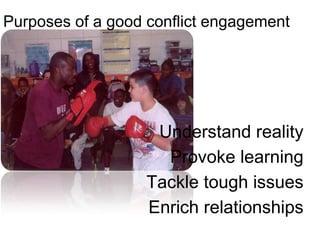
Purposes of a good conflict engagement Understand reality Provoke learning Tackle tough issues Enrich relationships
  We Can’t Change Without Conflict All Change Is Uncomfortable Three Ways to Change Aggression, Anger, Violence Apathy, avoidance, withdraw Engagement (principled, effective conflict management)
THINK MORE THAN YOU TALK & TALK LESS THAN YOU LISTEN THINK > TALK  TALK < LISTEN Think >   listen >   talk
 
Levels of Conflict Issue based conflicts-people can articulate what their needs and interests are Personality based conflicts-focus is on person, trust, and not the issue Factional conflict-focus is on winning and defeating the “enemy or opposing side” Winning at all costs-humiliating or harming the opposition is only concern Intractable conflict-long term warfare.
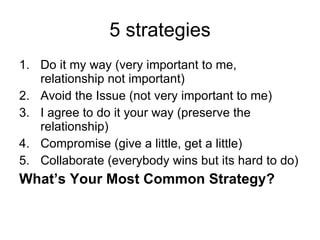
5 strategies Do it my way (very important to me, relationship not important) Avoid the Issue (not very important to me) I agree to do it your way (preserve the relationship) Compromise (give a little, get a little) Collaborate (everybody wins but its hard to do) What’s Your Most Common Strategy?
“ The shortest distance between two people is a laugh. ”   Victor Borge
Shift Perspective
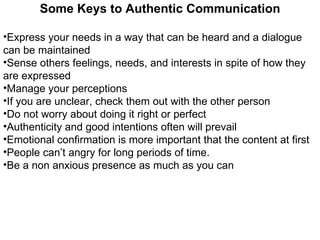
Some Keys to Authentic Communication Express your needs in a way that can be heard and a dialogue can be maintained Sense others feelings, needs, and interests in spite of how they are expressed Manage your perceptions  If you are unclear, check them out with the other person Do not worry about doing it right or perfect  Authenticity and good intentions often will prevail Emotional confirmation is more important that the content at first  People can’t angry for long periods of time.  Be a non anxious presence as much as you can
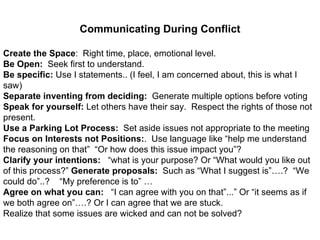
Communicating During Conflict Create the Space :  Right time, place, emotional level. Be Open:  Seek first to understand.  Be specific:  Use I statements.. (I feel, I am concerned about, this is what I saw) Separate inventing from deciding:   Generate multiple options before voting  Speak for yourself:  Let others have their say.  Respect the rights of those not present. Use a Parking Lot Process:   Set aside issues not appropriate to the meeting  Focus on Interests not Positions: .  Use language like “help me understand the reasoning on that”  “Or how does this issue impact you”?  Clarify your intentions:   “what is your purpose? Or “What would you like out of this process?”  Generate proposals:   Such as “What I suggest is”….?  “We could do”..?  “My preference is to” … Agree on what you can:   “I can agree with you on that”...” Or “it seems as if we both agree on”….? Or I can agree that we are stuck. Realize that some issues are wicked and can not be solved?
How to make things worse in conflict situations Advising:  Why don’t you just Don’t be upset Judging: Don’t’ be so uptight You are so wrong on this issue Analyzing I think what’s really bothering you is Your personality type makes that difficult for you Questioning: Why are you doing that Why didn’t you fix it before now Supporting: Don’t worry about this This is no problem
Sometimes Pigs Can Fly
Being Unconditionally Constructive Adapted from Getting Together by Roger Fisher by Dan Wiseman I will be rational even if others are acting emotionally. (Try to balance emotion with reason but remember until people are heard reason is of little use) I will seek first to understand even if I am misunderstood (Try to find out what’s their concern) I will consult with others before deciding on things that impact them even if they are not listening (Take the high road, model democratic processes) I will be consistent with my principles and behavior even if others try to be deceptive or are untrustworthy (Practice what you preach but don’t be naive) I will be firm but not violent or coercive in the way I influence others and will not yield to coercion. (Keep trying to persuade while paying attention to what’s important to others) I will not reject others as unworthy even if they reject me and my ideas as worthy of consideration.  (Maintain the relationship if possible and keep the lines of communication open)
Conflict Resources Never Call Them Jerks-Healthy Responses to Difficult Behavior  by Arthur Paul Boers (Alban Institute) Conflicts, A Better Way to Resolve Them  by Edward de Bono Getting Together and Getting to Yes  by Roger Fisher, Scott Brown, And William Ury) Peace Is Every Step  by Thich Nhat Hanh with foreword by Dalai Lama The Third Way  by William Ury Managing Transitions  by William Bridges Turning to One Another  by Margaret Wheatly Is There No Other Way  by Michael Nagel Gifts Differing Understanding Personality Type  by Isabel Briggs Myers The Anxious Organization-Why Smart Companies Do Dumb Things  by Jeffery A. Miller (Facts on Demand Press) Dealing with People You Can’t Strand (How to bring out the best in people at their worst)  by Dr. Rick Brinkman and Dr. Rick Kirschner).  McGraw-Hill. Non Violent Communication a Language of Life  by Dr. Marshall Rosenberg Fierce Conversations-Achieving Success at Work &In Life-One Conversation at a Time  by Susan Scott
More Resources Emotional Leadership (Why it can matter more than IQ)  by  Daniel Goleman. 1995 Working with Emotional Intelligence by Daniel Goleman. 2000. Test Your EQ (Find out how emotionally intelligent you really are)  by Mark Davis, Ph.D. 2004 Websites:  http://eqi.org  (practical advice for increasing social skills and self control) and  http://eiconsortium.org . (research components and finding on EQ).  www.selfgrowth.com  (advice on EQ, communications skills, and goal setting.) Coping with difficult bosses  by Nicholos R. Bramson. 1993 (Why bosses bully, stall and complain.) Difficult conversations: how to discuss what matters most  by D.Stone, B. Patton, and R. Fisher. 2000. Crucial Conversations  by Kerry Patterson, Joseph Grenny, Ron McMillan, and Al Switzler.2002. Choosing Civility  by P.M. Forni (25 rules of Considerate Conduct). 2002 Toxic People:10 ways of dealing with people who make your life miserable  by L. Glass. 1995 Emotional Intelligence, Imagination, and Personality  by P.Salovey, J.D. Mayer. 1990. Now, Discover your Strengths   ( A revolutionary program based on the Gallup study of 2 million people) by Marcus Buckingham and Donald O. Clifton. 2001.

Playing Nice In The Sandbox (Project Phoenix)

  • 1.
    Playing Nice inthe Sandbox Project Phoenix Dan Wiseman Wiseman Consulting and Training [email_address]
  • 2.
    Why can’t peopleplay nice? People disagree about values and beliefs. We are having a bad day (situational problems). We are having a bad life-mental or physical illness. Anxiety and Stress in the situation Personality differences are not acknowledged or accepted. People are being treated unfairly or unequally and they feel powerless We never learned how or never had any good models
  • 3.
    Why aren’t wenice continued Major change is occurring and we don’t know what to do Roles and responsibilities are unclear and a source of disagreement People feel incompetent or don’t have the skills to be successful People have wrong information or made faulty assumptions We have been rewarded for bad behavior or punished for good behavior. The organization has a culture of dealing with conflict in unproductive ways
  • 4.
    Goals of ConflictEngagement Interest based decision processes Improve commitment to the outcome Clearly identifying the specific issues, concerns, and needs of each party Producing sustainable solutions Increasing acceptance and appreciation differences Reducing aggression during conflict Reducing passive behavior or whining Reducing covert or manipulative behavior
  • 5.
    Purposes of agood conflict engagement Understand reality Provoke learning Tackle tough issues Enrich relationships
  • 6.
    WeCan’t Change Without Conflict All Change Is Uncomfortable Three Ways to Change Aggression, Anger, Violence Apathy, avoidance, withdraw Engagement (principled, effective conflict management)
  • 7.
    THINK MORE THANYOU TALK & TALK LESS THAN YOU LISTEN THINK > TALK TALK < LISTEN Think > listen > talk
  • 8.
  • 9.
    Levels of ConflictIssue based conflicts-people can articulate what their needs and interests are Personality based conflicts-focus is on person, trust, and not the issue Factional conflict-focus is on winning and defeating the “enemy or opposing side” Winning at all costs-humiliating or harming the opposition is only concern Intractable conflict-long term warfare.
  • 10.
    5 strategies Doit my way (very important to me, relationship not important) Avoid the Issue (not very important to me) I agree to do it your way (preserve the relationship) Compromise (give a little, get a little) Collaborate (everybody wins but its hard to do) What’s Your Most Common Strategy?
  • 11.
    “ The shortestdistance between two people is a laugh. ” Victor Borge
  • 12.
  • 13.
    Some Keys toAuthentic Communication Express your needs in a way that can be heard and a dialogue can be maintained Sense others feelings, needs, and interests in spite of how they are expressed Manage your perceptions If you are unclear, check them out with the other person Do not worry about doing it right or perfect Authenticity and good intentions often will prevail Emotional confirmation is more important that the content at first People can’t angry for long periods of time. Be a non anxious presence as much as you can
  • 14.
    Communicating During ConflictCreate the Space : Right time, place, emotional level. Be Open: Seek first to understand. Be specific: Use I statements.. (I feel, I am concerned about, this is what I saw) Separate inventing from deciding: Generate multiple options before voting Speak for yourself: Let others have their say. Respect the rights of those not present. Use a Parking Lot Process: Set aside issues not appropriate to the meeting Focus on Interests not Positions: . Use language like “help me understand the reasoning on that” “Or how does this issue impact you”? Clarify your intentions: “what is your purpose? Or “What would you like out of this process?” Generate proposals: Such as “What I suggest is”….? “We could do”..? “My preference is to” … Agree on what you can: “I can agree with you on that”...” Or “it seems as if we both agree on”….? Or I can agree that we are stuck. Realize that some issues are wicked and can not be solved?
  • 15.
    How to makethings worse in conflict situations Advising: Why don’t you just Don’t be upset Judging: Don’t’ be so uptight You are so wrong on this issue Analyzing I think what’s really bothering you is Your personality type makes that difficult for you Questioning: Why are you doing that Why didn’t you fix it before now Supporting: Don’t worry about this This is no problem
  • 16.
  • 17.
    Being Unconditionally ConstructiveAdapted from Getting Together by Roger Fisher by Dan Wiseman I will be rational even if others are acting emotionally. (Try to balance emotion with reason but remember until people are heard reason is of little use) I will seek first to understand even if I am misunderstood (Try to find out what’s their concern) I will consult with others before deciding on things that impact them even if they are not listening (Take the high road, model democratic processes) I will be consistent with my principles and behavior even if others try to be deceptive or are untrustworthy (Practice what you preach but don’t be naive) I will be firm but not violent or coercive in the way I influence others and will not yield to coercion. (Keep trying to persuade while paying attention to what’s important to others) I will not reject others as unworthy even if they reject me and my ideas as worthy of consideration. (Maintain the relationship if possible and keep the lines of communication open)
  • 18.
    Conflict Resources NeverCall Them Jerks-Healthy Responses to Difficult Behavior by Arthur Paul Boers (Alban Institute) Conflicts, A Better Way to Resolve Them by Edward de Bono Getting Together and Getting to Yes by Roger Fisher, Scott Brown, And William Ury) Peace Is Every Step by Thich Nhat Hanh with foreword by Dalai Lama The Third Way by William Ury Managing Transitions by William Bridges Turning to One Another by Margaret Wheatly Is There No Other Way by Michael Nagel Gifts Differing Understanding Personality Type by Isabel Briggs Myers The Anxious Organization-Why Smart Companies Do Dumb Things by Jeffery A. Miller (Facts on Demand Press) Dealing with People You Can’t Strand (How to bring out the best in people at their worst) by Dr. Rick Brinkman and Dr. Rick Kirschner). McGraw-Hill. Non Violent Communication a Language of Life by Dr. Marshall Rosenberg Fierce Conversations-Achieving Success at Work &In Life-One Conversation at a Time by Susan Scott
  • 19.
    More Resources EmotionalLeadership (Why it can matter more than IQ) by Daniel Goleman. 1995 Working with Emotional Intelligence by Daniel Goleman. 2000. Test Your EQ (Find out how emotionally intelligent you really are) by Mark Davis, Ph.D. 2004 Websites: http://eqi.org (practical advice for increasing social skills and self control) and http://eiconsortium.org . (research components and finding on EQ). www.selfgrowth.com (advice on EQ, communications skills, and goal setting.) Coping with difficult bosses by Nicholos R. Bramson. 1993 (Why bosses bully, stall and complain.) Difficult conversations: how to discuss what matters most by D.Stone, B. Patton, and R. Fisher. 2000. Crucial Conversations by Kerry Patterson, Joseph Grenny, Ron McMillan, and Al Switzler.2002. Choosing Civility by P.M. Forni (25 rules of Considerate Conduct). 2002 Toxic People:10 ways of dealing with people who make your life miserable by L. Glass. 1995 Emotional Intelligence, Imagination, and Personality by P.Salovey, J.D. Mayer. 1990. Now, Discover your Strengths ( A revolutionary program based on the Gallup study of 2 million people) by Marcus Buckingham and Donald O. Clifton. 2001.

Editor's Notes

  • #6 http://www.flickr.com/photos/michael_newman/153214300/ All rights reserved Permission was granted to use picture. Reality changes—market, economies, strategies, our spouses , children, and ourselves. As we drill down by interrogating changes, we learn. Mineral rights. Dig deep in one place rather than digging shallow in lots of places. Purpose is to tackle tough issues. If you are successful at asking, learning, and tackling tough issues, then the relationships will be better.
  • #12 Honest laugh - snap out - pos state Happiness leads to more success - Shaun Achor - Harvard studies avge preschooler laughs or smiles 400 x day vs. 15 x day by 35.
  • #13 Freeze frame game 2 sets 2 players