



CREATING & NURTURING
KNOWLEDGE COMMUNITIES
Marc Jadoul


              COPYRIGHT © 2011 ALCATEL-LUCENT. ALL RIGHTS RESERVED.
WHAT IS “KNOWLEDGE” ?


                                 Knowledge is of
                          two kinds: we know
                          a subject ourselves,
                           or we know where
                              we can find
                          information upon it.
                                                                    Samuel Johnson. 1709-1784


            COPYRIGHT © 2011 ALCATEL-LUCENT. ALL RIGHTS RESERVED.
KNOWLEDGE IS PART OF OUR
DAY-TO-DAY BUSINESS

           Knowledge is information,
         applied and re-used,
              not just collected …


          Capture “knowledge work” as
       daily work, instead of capturing
             knowledge separately…


               COPYRIGHT © 2011 ALCATEL-LUCENT. ALL RIGHTS RESERVED.
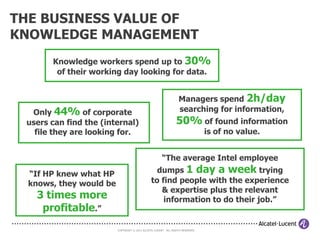
THE BUSINESS VALUE OF
KNOWLEDGE MANAGEMENT
       Knowledge workers spend up to 30%
        of their working day looking for data.


                                                                  Managers spend 2h/day
  Only 44% of corporate                                           searching for information,
 users can find the (internal)                                   50% of found information
   file they are looking for.                                                    is of no value.


                                                       “The average Intel employee

  “If HP knew what HP                            dumps 1 day a week trying
  knows, they would be                         to find people with the experience
                                                  & expertise plus the relevant
   3 times more                                    information to do their job.”
    profitable.”
                         COPYRIGHT © 2011 ALCATEL-LUCENT. ALL RIGHTS RESERVED.
THE KNOWLEDGE CREATING COMPANY


            “                   In an economy where the only certainty is
                                uncertainty, the one sure source of lasting
                                competitive advantage is knowledge.
                                When markets shift, technologies
                                proliferate, competitors multiply, and
                                products become obsolete almost
                                overnight, successful companies are those
                                that consistently create new knowledge,
                                disseminate it widely throughout the
                                organization, and quickly embody it in
                                new technologies and products.
                                These activities define the “knowledge-
                                creating” company, whose sole business is
                                continuous innovation.


            COPYRIGHT © 2011 ALCATEL-LUCENT. ALL RIGHTS RESERVED.
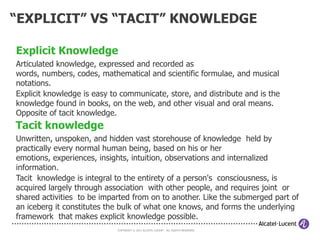
“EXPLICIT” VS “TACIT” KNOWLEDGE

Explicit Knowledge
Articulated knowledge, expressed and recorded as words, numbers, codes,
mathematical and scientific formulae, and musical notations.
Explicit knowledge is easy to communicate, store, and distribute and is the
knowledge found in books, on the web, and other visual and oral means.
Opposite of tacit knowledge.

Tacit knowledge
Unwritten, unspoken, and hidden vast storehouse of knowledge held by
practically every normal human being, based on his or her emotions, experiences,
insights, intuition, observations and internalized information.
Tacit knowledge is integral to the entirety of a person's consciousness, is
acquired largely through association with other people, and requires joint or
shared activities to be imparted from on to another. Like the submerged part of
an iceberg it constitutes the bulk of what one knows, and forms the underlying
framework that makes explicit knowledge possible.

                            COPYRIGHT © 2011 ALCATEL-LUCENT. ALL RIGHTS RESERVED.
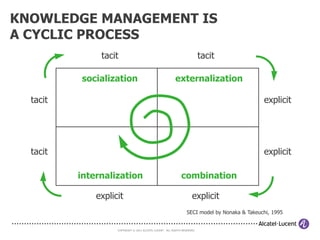
KNOWLEDGE MANAGEMENT IS
A CYCLIC PROCESS
               tacit                                                        tacit

          socialization                                    externalization

  tacit                                                                                         explicit


  tacit                                                                                         explicit

          internalization                                      combination

              explicit                                                explicit
                                                                   SECI model by Nonaka & Takeuchi, 1995


                    COPYRIGHT © 2011 ALCATEL-LUCENT. ALL RIGHTS RESERVED.
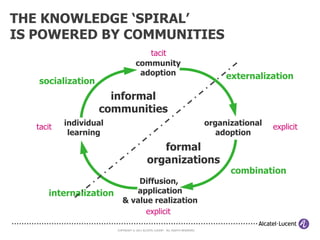
THE KNOWLEDGE ‘SPIRAL’
IS POWERED BY COMMUNITIES
                                        tacit
                                     community
                                      adoption                                        externalization
   socialization
                     informal
                   communities
   tacit   individual                                                            organizational   explicit
            learning                                                                adoption
                                                formal
                                             organizations
                                                                                       combination
                                Diffusion,
       internalization         application
                            & value realization
                                  explicit

                         COPYRIGHT © 2011 ALCATEL-LUCENT. ALL RIGHTS RESERVED.
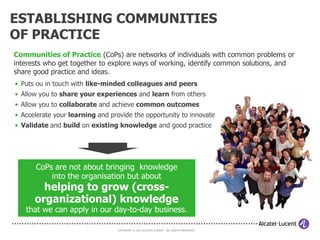
ESTABLISHING COMMUNITIES
OF PRACTICE
Communities of Practice (CoPs) are networks of individuals with common problems or
interests who get together to explore ways of working, identify common solutions, and
share good practice and ideas.
• Puts ou in touch with like-minded colleagues and peers
• Allow you to share your experiences and learn from others
• Allow you to collaborate and achieve common outcomes
• Accelerate your learning and provide the opportunity to innovate
• Validate and build on existing knowledge and good practice


      CoPs are not about bringing knowledge
          into the organisation but about
        helping to grow (cross-
      organizational) knowledge
   that we can apply in our day-to-day business.

                                 COPYRIGHT © 2011 ALCATEL-LUCENT. ALL RIGHTS RESERVED.
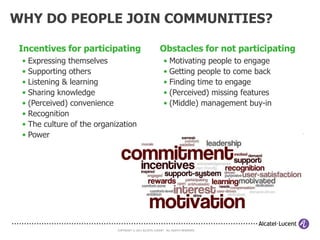
WHY DO PEOPLE JOIN COMMUNITIES?

 Incentives for participating                           Obstacles for not participating
 • Expressing themselves                                   • Motivating people to engage
 • Supporting others                                       • Getting people to come back
 • Listening & learning                                    • Finding time to engage
 • Sharing knowledge                                       • (Perceived) missing features
 • (Perceived) convenience                                 • (Middle) management buy-in
 • Recognition
 • The culture of the organization
 • Power


                            COPYRIGHT © 2011 ALCATEL-LUCENT. ALL RIGHTS RESERVED.
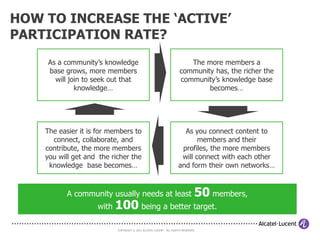
HOW TO INCREASE THE ‘ACTIVE’
PARTICIPATION RATE?
    As a community’s knowledge                                          The more members a
    base grows, more members                                         community has, the richer the
      will join to seek out that                                     community’s knowledge base
             knowledge…                                                      becomes…


    The easier it is for members to                                     As you connect content to
      connect, collaborate, and                                        members and their profiles,
    contribute, the more members                                          the more members will
    you will get and the richer the                                    connect with each other and
     knowledge base becomes…                                            form their own networks…


           A community usually needs at least                                  50 members,
                    with   100 being a better target.
                           COPYRIGHT © 2011 ALCATEL-LUCENT. ALL RIGHTS RESERVED.
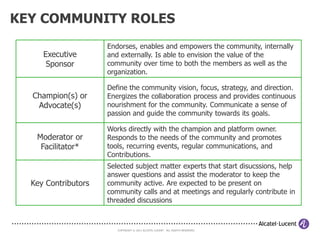
KEY COMMUNITY ROLES
                     Endorses, enables and empowers the community, internally
     Executive       and externally. Is able to envision the value of the
      Sponsor        community over time to both the members as well as the
                     organization.

                     Define the community vision, focus, strategy, and direction.
  Champion(s) or     Energizes the collaboration process and provides continuous
   Advocate(s)       nourishment for the community. Communicate a sense of
                     passion and guide the community towards its goals.

                     Works directly with the champion and platform owner.
   Moderator or      Responds to the needs of the community and promotes
    Facilitator*     tools, recurring events, regular communications, and
                     Contributions.
                     Selected subject matter experts that start disucssions, help
                     answer questions and assist the moderator to keep the
  Key Contributors   community active. Are expected to be present on
                     community calls and at meetings and regularly contribute in
                     threaded discussions


                        COPYRIGHT © 2011 ALCATEL-LUCENT. ALL RIGHTS RESERVED.
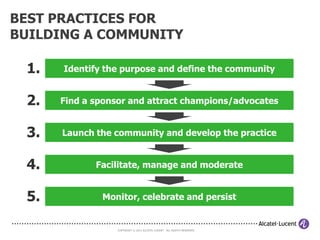
BEST PRACTICES FOR
BUILDING A COMMUNITY

 1.   Identify the purpose and define the community


 2.   Find a sponsor and attract champions/advocates


 3.   Launch the community and develop the practice


 4.          Facilitate, manage and moderate


 5.           Monitor, celebrate and persist


                  COPYRIGHT © 2011 ALCATEL-LUCENT. ALL RIGHTS RESERVED.
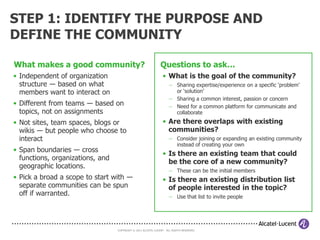
STEP 1: IDENTIFY THE PURPOSE AND
DEFINE THE COMMUNITY

What makes a good community?                                  Questions to ask…
• Independent of organization                                  • What is the goal of the community?
  structure ― based on what                                        — Sharing expertise/experience on a specific ‘problem’
  members want to interact on                                        or ‘solution’
                                                                   — Sharing a common interest, passion or concern
• Different from teams ― based on                                  — Need for a common platform for communicate and
  topics, not on assignments                                         collaborate
• Not sites, team spaces, blogs or                             • Are there overlaps with existing
  wikis ― but people who choose to                               communities?
  interact                                                         — Consider joining or expanding an existing community
                                                                     instead of creating your own
• Span boundaries ― cross functions,
                                                               • Is there an existing team that could
  organizations, and geographic
                                                                 be the core of a new community?
  locations.
                                                                   — These can be the initial members
• Pick a broad a scope to start with ―                         • Is there an existing distribution list
  separate communities can be spun                               of people interested in the topic?
  off if warranted.                                                — Use that list to invite people


                                 COPYRIGHT © 2011 ALCATEL-LUCENT. ALL RIGHTS RESERVED.
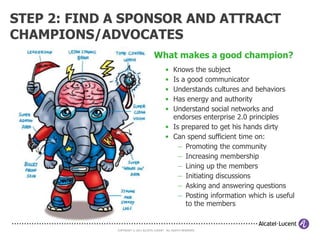
STEP 2: FIND A SPONSOR AND ATTRACT
CHAMPIONS/ADVOCATES
                                     What makes a good champion?
                                             • Knows the subject
                                             • Is a good communicator
                                             • Understands cultures and behaviors
                                             • Has energy and authority
                                             • Understand social networks and
                                               endorses enterprise 2.0 principles
                                             • Is prepared to get his hands dirty
                                             • Can spend sufficient time on:
                                                ― Promoting the community
                                                ― Increasing membership
                                                ― Lining up the members
                                                ― Initiating discussions
                                                ― Asking and answering questions
                                                ― Posting information which is useful
                                                   to the members


             COPYRIGHT © 2011 ALCATEL-LUCENT. ALL RIGHTS RESERVED.
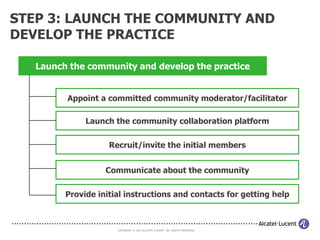
STEP 3: LAUNCH THE COMMUNITY AND
DEVELOP THE PRACTICE

   Launch the community and develop the practice


         Appoint a committed community moderator/facilitator

              Launch the community collaboration platform


                    Recruit/invite the initial members


                   Communicate about the community


         Provide initial instructions and contacts for getting help


                      COPYRIGHT © 2011 ALCATEL-LUCENT. ALL RIGHTS RESERVED.
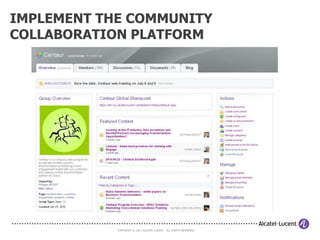
IMPLEMENT THE COMMUNITY
COLLABORATION PLATFORM


            COPYRIGHT © 2011 ALCATEL-LUCENT. ALL RIGHTS RESERVED.
PROMOTE THE COLLABORATION PLATFORM
TOWARDS COMMUNITY MEMBERS
1. Make yourself visible as an expert and finding your peers and
   complements across the organization
2. Share information about innovation, technology, markets, challenges,
   customers, competitors, solutions, best practices, business cases, etc.
3. A state-of-the art and easy-to-use Enterprise 2.0 collaboration platform,
   already adopted by almost (number of users) of your colleagues...
4. (CoI specific value propositions, incentives and benefits)


                           COPYRIGHT © 2011 ALCATEL-LUCENT. ALL RIGHTS RESERVED.
RECRUIT COMMUNITY MEMBERS

• How to attract and recruit community members
- Frequent executive reach out by the sponsor and advocate(s)
- Post/submit articles on existing webpages, newsletters, blogs, etc.
  that reach your target audience
- Use existing networks to inform possible members about your community
- Send a one-time broadcast message to the entire population containing
  your target audience
- Suggest to those with questions or interest in your topic that they join
  your community
- Participate to discussions in other communities, to promote you community
- Request that links to your community be added on all relevant web sites


                              COPYRIGHT © 2011 ALCATEL-LUCENT. ALL RIGHTS RESERVED.
“GETTING STARTED” INSTRUCTIONS

      Make yourself searchable
      Create a profile that contains basic information about yourself. It will
      enable people to find you when they need an expert in your field. Be sure
      to fill the fields related to your interests, your expertise and tags.
         Manage your information flows
         Personalize your Engage home page by adding “widgets” to filter and
         follow activity in the groups you belong to, on specific keywords/tags,
         certain people's blogs, discussions in groups you follow, etc.

                Reduce email notification overload
                By default, the Engage platform will send you an email message
                when content you care about is added or changed. Engage
                provides you with some easy to use tools to help you manage
                Engage email notifications.
                  Connect – Collaborate - Contribute
                  Visit the “Getting Started” pages or contact (community
                  manager)


                      COPYRIGHT © 2011 ALCATEL-LUCENT. ALL RIGHTS RESERVED.
MORE RECOMMENDATIONS
FOR COMMUNITY MEMBERS…
     Use Projects
     Identify a formal activity launched within the community about a given topic. Projects
     should have clear deliverables and milestones and must be used for tracking
     associated activities, …

        Use Discussions and Mark them as Questions
        For very quick response and decision to a group of close questions: when a
        Discussion appears, it should become the priority for community members to
        come up with answers

            Use Blogs
            Share fresh information, news and updates e.g. markets and competition

                 Global groups Architecture
                  The Engage platform is not :
                  • Aiming to replace Sharepoint
                  • A document repository
                  • Our "New Intranet"
                  • A Project Management Platform
                  A group should have a flat architecture. The best tool for a structured
                  repository remains Sharepoint.


                        COPYRIGHT © 2011 ALCATEL-LUCENT. ALL RIGHTS RESERVED.
STEP 4: FACILITATE, MANAGE AND
MODERATE
• Keep the community active
- Regular community call with a scheduled speaker
- Face-to-face meetings of ‘local chapters’
- Training sessions on community subjects of interest

• Keep the collaboration platform alive
- Create sponsor and advocate blogs
- Sponsor and advocate replies and reactions to community posts
- Post thought-provoking documents and polls to stimulate discussion
- Publish a weekly summary of a community event
- Republish useful links & interesting content from other communities

• Increase content relevance and searchability
- Categorize and add relevant content tags
- ‘Move’ too old, irrelevant or obsolete information (don’t remove!)
- One2one discussion of irrelevant/inapropriate content with the authors

                                      COPYRIGHT © 2011 ALCATEL-LUCENT. ALL RIGHTS RESERVED.
STEP 5: MONITOR, CELEBRATE AND
PERSIST
• Monitor and measure the success of the community
- Define and measure relevant and appropriate KPIs
- Adjust/intervene when necessary

• Recognize and celebrate
- Focus on people and culture, not on content
- Recognize key community members or contributions
- Extend community recognition to organization recognition
- Celebrate successes made possible by the CoI or the collaboration platform

• Don’t give up
- Recognize it will take time and resources, and that communities
  are not established ‘overnight’
- Make sure the key stakeholders understanding social media and
  get their hands dirty
- Advocates play a key role in promoting and growing the community


                                    COPYRIGHT © 2011 ALCATEL-LUCENT. ALL RIGHTS RESERVED.
STOP REINVENTING
THE WHEEL!


            COPYRIGHT © 2011 ALCATEL-LUCENT. ALL RIGHTS RESERVED.
25
COPYRIGHT © 2011 ALCATEL-LUCENT. ALL RIGHTS RESERVED.
26
COPYRIGHT © 2011 ALCATEL-LUCENT. ALL RIGHTS RESERVED.

Creating Knowledge Communities (2011)

  • 1.
    CREATING & NURTURING KNOWLEDGECOMMUNITIES Marc Jadoul COPYRIGHT © 2011 ALCATEL-LUCENT. ALL RIGHTS RESERVED.
  • 2.
    WHAT IS “KNOWLEDGE”? Knowledge is of two kinds: we know a subject ourselves, or we know where we can find information upon it. Samuel Johnson. 1709-1784 COPYRIGHT © 2011 ALCATEL-LUCENT. ALL RIGHTS RESERVED.
  • 3.
    KNOWLEDGE IS PARTOF OUR DAY-TO-DAY BUSINESS Knowledge is information, applied and re-used, not just collected … Capture “knowledge work” as daily work, instead of capturing knowledge separately… COPYRIGHT © 2011 ALCATEL-LUCENT. ALL RIGHTS RESERVED.
  • 4.
    THE BUSINESS VALUEOF KNOWLEDGE MANAGEMENT Knowledge workers spend up to 30% of their working day looking for data. Managers spend 2h/day Only 44% of corporate searching for information, users can find the (internal) 50% of found information file they are looking for. is of no value. “The average Intel employee “If HP knew what HP dumps 1 day a week trying knows, they would be to find people with the experience & expertise plus the relevant 3 times more information to do their job.” profitable.” COPYRIGHT © 2011 ALCATEL-LUCENT. ALL RIGHTS RESERVED.
  • 5.
    THE KNOWLEDGE CREATINGCOMPANY “ In an economy where the only certainty is uncertainty, the one sure source of lasting competitive advantage is knowledge. When markets shift, technologies proliferate, competitors multiply, and products become obsolete almost overnight, successful companies are those that consistently create new knowledge, disseminate it widely throughout the organization, and quickly embody it in new technologies and products. These activities define the “knowledge- creating” company, whose sole business is continuous innovation. COPYRIGHT © 2011 ALCATEL-LUCENT. ALL RIGHTS RESERVED.
  • 6.
    “EXPLICIT” VS “TACIT”KNOWLEDGE Explicit Knowledge Articulated knowledge, expressed and recorded as words, numbers, codes, mathematical and scientific formulae, and musical notations. Explicit knowledge is easy to communicate, store, and distribute and is the knowledge found in books, on the web, and other visual and oral means. Opposite of tacit knowledge. Tacit knowledge Unwritten, unspoken, and hidden vast storehouse of knowledge held by practically every normal human being, based on his or her emotions, experiences, insights, intuition, observations and internalized information. Tacit knowledge is integral to the entirety of a person's consciousness, is acquired largely through association with other people, and requires joint or shared activities to be imparted from on to another. Like the submerged part of an iceberg it constitutes the bulk of what one knows, and forms the underlying framework that makes explicit knowledge possible. COPYRIGHT © 2011 ALCATEL-LUCENT. ALL RIGHTS RESERVED.
  • 7.
    KNOWLEDGE MANAGEMENT IS ACYCLIC PROCESS tacit tacit socialization externalization tacit explicit tacit explicit internalization combination explicit explicit SECI model by Nonaka & Takeuchi, 1995 COPYRIGHT © 2011 ALCATEL-LUCENT. ALL RIGHTS RESERVED.
  • 8.
    THE KNOWLEDGE ‘SPIRAL’ ISPOWERED BY COMMUNITIES tacit community adoption externalization socialization informal communities tacit individual organizational explicit learning adoption formal organizations combination Diffusion, internalization application & value realization explicit COPYRIGHT © 2011 ALCATEL-LUCENT. ALL RIGHTS RESERVED.
  • 9.
    ESTABLISHING COMMUNITIES OF PRACTICE Communitiesof Practice (CoPs) are networks of individuals with common problems or interests who get together to explore ways of working, identify common solutions, and share good practice and ideas. • Puts ou in touch with like-minded colleagues and peers • Allow you to share your experiences and learn from others • Allow you to collaborate and achieve common outcomes • Accelerate your learning and provide the opportunity to innovate • Validate and build on existing knowledge and good practice CoPs are not about bringing knowledge into the organisation but about helping to grow (cross- organizational) knowledge that we can apply in our day-to-day business. COPYRIGHT © 2011 ALCATEL-LUCENT. ALL RIGHTS RESERVED.
  • 10.
    WHY DO PEOPLEJOIN COMMUNITIES? Incentives for participating Obstacles for not participating • Expressing themselves • Motivating people to engage • Supporting others • Getting people to come back • Listening & learning • Finding time to engage • Sharing knowledge • (Perceived) missing features • (Perceived) convenience • (Middle) management buy-in • Recognition • The culture of the organization • Power COPYRIGHT © 2011 ALCATEL-LUCENT. ALL RIGHTS RESERVED.
  • 11.
    HOW TO INCREASETHE ‘ACTIVE’ PARTICIPATION RATE? As a community’s knowledge The more members a base grows, more members community has, the richer the will join to seek out that community’s knowledge base knowledge… becomes… The easier it is for members to As you connect content to connect, collaborate, and members and their profiles, contribute, the more members the more members will you will get and the richer the connect with each other and knowledge base becomes… form their own networks… A community usually needs at least 50 members, with 100 being a better target. COPYRIGHT © 2011 ALCATEL-LUCENT. ALL RIGHTS RESERVED.
  • 12.
    KEY COMMUNITY ROLES Endorses, enables and empowers the community, internally Executive and externally. Is able to envision the value of the Sponsor community over time to both the members as well as the organization. Define the community vision, focus, strategy, and direction. Champion(s) or Energizes the collaboration process and provides continuous Advocate(s) nourishment for the community. Communicate a sense of passion and guide the community towards its goals. Works directly with the champion and platform owner. Moderator or Responds to the needs of the community and promotes Facilitator* tools, recurring events, regular communications, and Contributions. Selected subject matter experts that start disucssions, help answer questions and assist the moderator to keep the Key Contributors community active. Are expected to be present on community calls and at meetings and regularly contribute in threaded discussions COPYRIGHT © 2011 ALCATEL-LUCENT. ALL RIGHTS RESERVED.
  • 13.
    BEST PRACTICES FOR BUILDINGA COMMUNITY 1. Identify the purpose and define the community 2. Find a sponsor and attract champions/advocates 3. Launch the community and develop the practice 4. Facilitate, manage and moderate 5. Monitor, celebrate and persist COPYRIGHT © 2011 ALCATEL-LUCENT. ALL RIGHTS RESERVED.
  • 14.
    STEP 1: IDENTIFYTHE PURPOSE AND DEFINE THE COMMUNITY What makes a good community? Questions to ask… • Independent of organization • What is the goal of the community? structure ― based on what — Sharing expertise/experience on a specific ‘problem’ members want to interact on or ‘solution’ — Sharing a common interest, passion or concern • Different from teams ― based on — Need for a common platform for communicate and topics, not on assignments collaborate • Not sites, team spaces, blogs or • Are there overlaps with existing wikis ― but people who choose to communities? interact — Consider joining or expanding an existing community instead of creating your own • Span boundaries ― cross functions, • Is there an existing team that could organizations, and geographic be the core of a new community? locations. — These can be the initial members • Pick a broad a scope to start with ― • Is there an existing distribution list separate communities can be spun of people interested in the topic? off if warranted. — Use that list to invite people COPYRIGHT © 2011 ALCATEL-LUCENT. ALL RIGHTS RESERVED.
  • 15.
    STEP 2: FINDA SPONSOR AND ATTRACT CHAMPIONS/ADVOCATES What makes a good champion? • Knows the subject • Is a good communicator • Understands cultures and behaviors • Has energy and authority • Understand social networks and endorses enterprise 2.0 principles • Is prepared to get his hands dirty • Can spend sufficient time on: ― Promoting the community ― Increasing membership ― Lining up the members ― Initiating discussions ― Asking and answering questions ― Posting information which is useful to the members COPYRIGHT © 2011 ALCATEL-LUCENT. ALL RIGHTS RESERVED.
  • 16.
    STEP 3: LAUNCHTHE COMMUNITY AND DEVELOP THE PRACTICE Launch the community and develop the practice Appoint a committed community moderator/facilitator Launch the community collaboration platform Recruit/invite the initial members Communicate about the community Provide initial instructions and contacts for getting help COPYRIGHT © 2011 ALCATEL-LUCENT. ALL RIGHTS RESERVED.
  • 17.
    IMPLEMENT THE COMMUNITY COLLABORATIONPLATFORM COPYRIGHT © 2011 ALCATEL-LUCENT. ALL RIGHTS RESERVED.
  • 18.
    PROMOTE THE COLLABORATIONPLATFORM TOWARDS COMMUNITY MEMBERS 1. Make yourself visible as an expert and finding your peers and complements across the organization 2. Share information about innovation, technology, markets, challenges, customers, competitors, solutions, best practices, business cases, etc. 3. A state-of-the art and easy-to-use Enterprise 2.0 collaboration platform, already adopted by almost (number of users) of your colleagues... 4. (CoI specific value propositions, incentives and benefits) COPYRIGHT © 2011 ALCATEL-LUCENT. ALL RIGHTS RESERVED.
  • 19.
    RECRUIT COMMUNITY MEMBERS •How to attract and recruit community members - Frequent executive reach out by the sponsor and advocate(s) - Post/submit articles on existing webpages, newsletters, blogs, etc. that reach your target audience - Use existing networks to inform possible members about your community - Send a one-time broadcast message to the entire population containing your target audience - Suggest to those with questions or interest in your topic that they join your community - Participate to discussions in other communities, to promote you community - Request that links to your community be added on all relevant web sites COPYRIGHT © 2011 ALCATEL-LUCENT. ALL RIGHTS RESERVED.
  • 20.
    “GETTING STARTED” INSTRUCTIONS Make yourself searchable Create a profile that contains basic information about yourself. It will enable people to find you when they need an expert in your field. Be sure to fill the fields related to your interests, your expertise and tags. Manage your information flows Personalize your Engage home page by adding “widgets” to filter and follow activity in the groups you belong to, on specific keywords/tags, certain people's blogs, discussions in groups you follow, etc. Reduce email notification overload By default, the Engage platform will send you an email message when content you care about is added or changed. Engage provides you with some easy to use tools to help you manage Engage email notifications. Connect – Collaborate - Contribute Visit the “Getting Started” pages or contact (community manager) COPYRIGHT © 2011 ALCATEL-LUCENT. ALL RIGHTS RESERVED.
  • 21.
    MORE RECOMMENDATIONS FOR COMMUNITYMEMBERS… Use Projects Identify a formal activity launched within the community about a given topic. Projects should have clear deliverables and milestones and must be used for tracking associated activities, … Use Discussions and Mark them as Questions For very quick response and decision to a group of close questions: when a Discussion appears, it should become the priority for community members to come up with answers Use Blogs Share fresh information, news and updates e.g. markets and competition Global groups Architecture The Engage platform is not : • Aiming to replace Sharepoint • A document repository • Our "New Intranet" • A Project Management Platform A group should have a flat architecture. The best tool for a structured repository remains Sharepoint. COPYRIGHT © 2011 ALCATEL-LUCENT. ALL RIGHTS RESERVED.
  • 22.
    STEP 4: FACILITATE,MANAGE AND MODERATE • Keep the community active - Regular community call with a scheduled speaker - Face-to-face meetings of ‘local chapters’ - Training sessions on community subjects of interest • Keep the collaboration platform alive - Create sponsor and advocate blogs - Sponsor and advocate replies and reactions to community posts - Post thought-provoking documents and polls to stimulate discussion - Publish a weekly summary of a community event - Republish useful links & interesting content from other communities • Increase content relevance and searchability - Categorize and add relevant content tags - ‘Move’ too old, irrelevant or obsolete information (don’t remove!) - One2one discussion of irrelevant/inapropriate content with the authors COPYRIGHT © 2011 ALCATEL-LUCENT. ALL RIGHTS RESERVED.
  • 23.
    STEP 5: MONITOR,CELEBRATE AND PERSIST • Monitor and measure the success of the community - Define and measure relevant and appropriate KPIs - Adjust/intervene when necessary • Recognize and celebrate - Focus on people and culture, not on content - Recognize key community members or contributions - Extend community recognition to organization recognition - Celebrate successes made possible by the CoI or the collaboration platform • Don’t give up - Recognize it will take time and resources, and that communities are not established ‘overnight’ - Make sure the key stakeholders understanding social media and get their hands dirty - Advocates play a key role in promoting and growing the community COPYRIGHT © 2011 ALCATEL-LUCENT. ALL RIGHTS RESERVED.
  • 24.
    STOP REINVENTING THE WHEEL! COPYRIGHT © 2011 ALCATEL-LUCENT. ALL RIGHTS RESERVED.
  • 25.
    25 COPYRIGHT © 2011ALCATEL-LUCENT. ALL RIGHTS RESERVED.
  • 26.
    26 COPYRIGHT © 2011ALCATEL-LUCENT. ALL RIGHTS RESERVED.