1 © Nokia 2016© Nokia 2016
How big is the
Internet of Things?
Marc Jadoul ( @mjadoul)
ETSI IoT/M2M Workshop
Sophia Antipolis, 17 November 2016
1 © Nokia 2016
2 © Nokia 2016
About this presentation
https://en.wikipedia.org/wiki/Nabaztag
3 © Nokia 2016
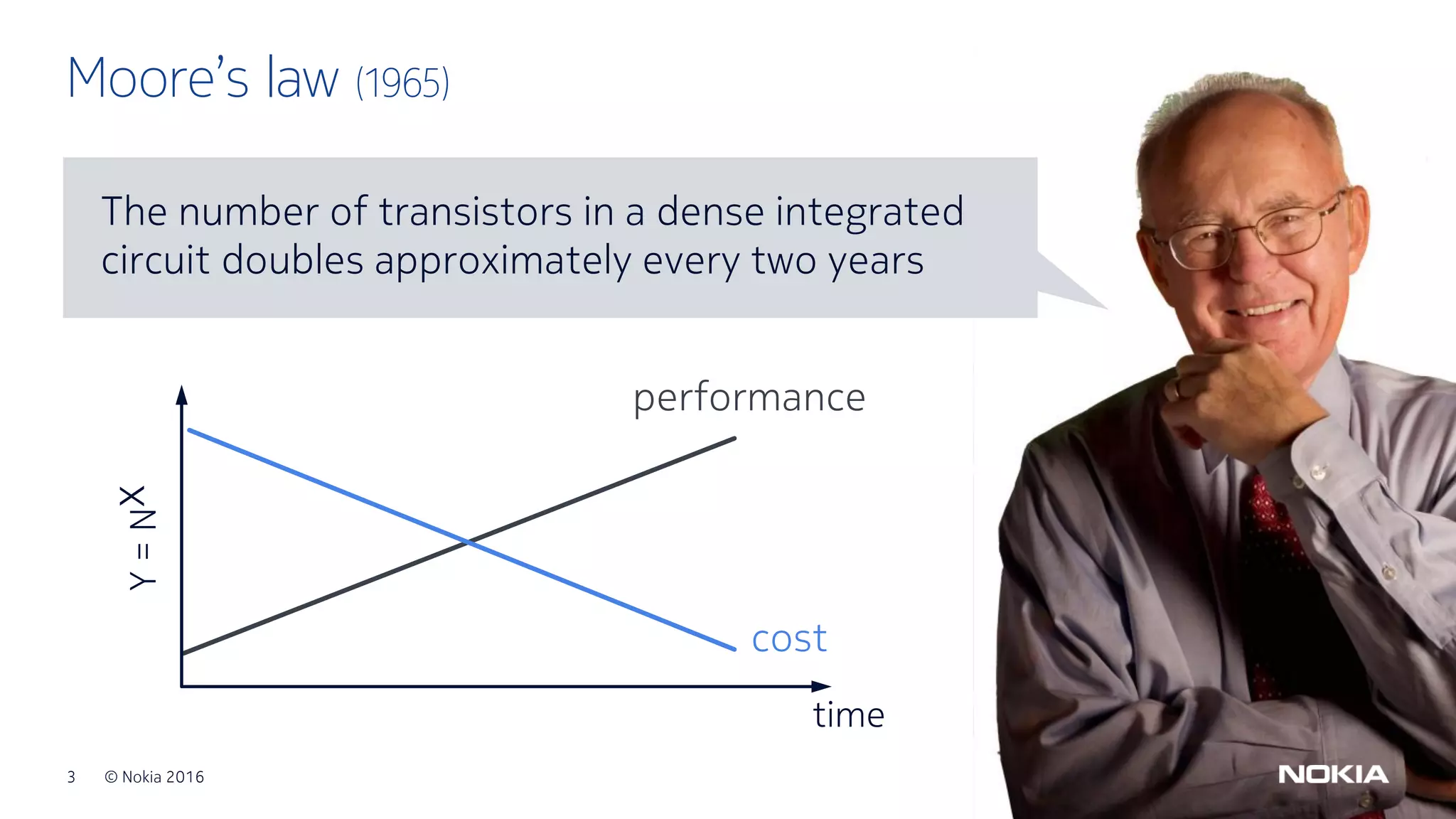
Moore’s law (1965)
The number of transistors in a dense integrated
circuit doubles approximately every two years
time
performance
cost
Y=Nx
4 © Nokia 2016
Micro-processor evolution has followed Moore’s law
1965
Numberoftransistors
100
1980 1990 2000 2010 20161970
1k
10k
0
1M
10M
100M
1G
10G
TTL CMOS
4100
4004
8008
8080
6800
8085
8086
68000
1802
6502
Z80
6809
8088
ARM2
68020
80286
80386
80486
68040
PowerPC 601
AMD K5
AMD K6
AMD K7
Pentium I
Pentium II
POWER 1 Pentium III
Pentium 4 Atom
AMD K8
Core 2 Duo
Core i7
15 Core Xeon
SPARC 64X
8 Core Xeon
16 Core SPARC T3
6 Core i7
8 Core POWER 7
POWER 6
22 Core Xeon
Sparc M7
5 © Nokia 2016
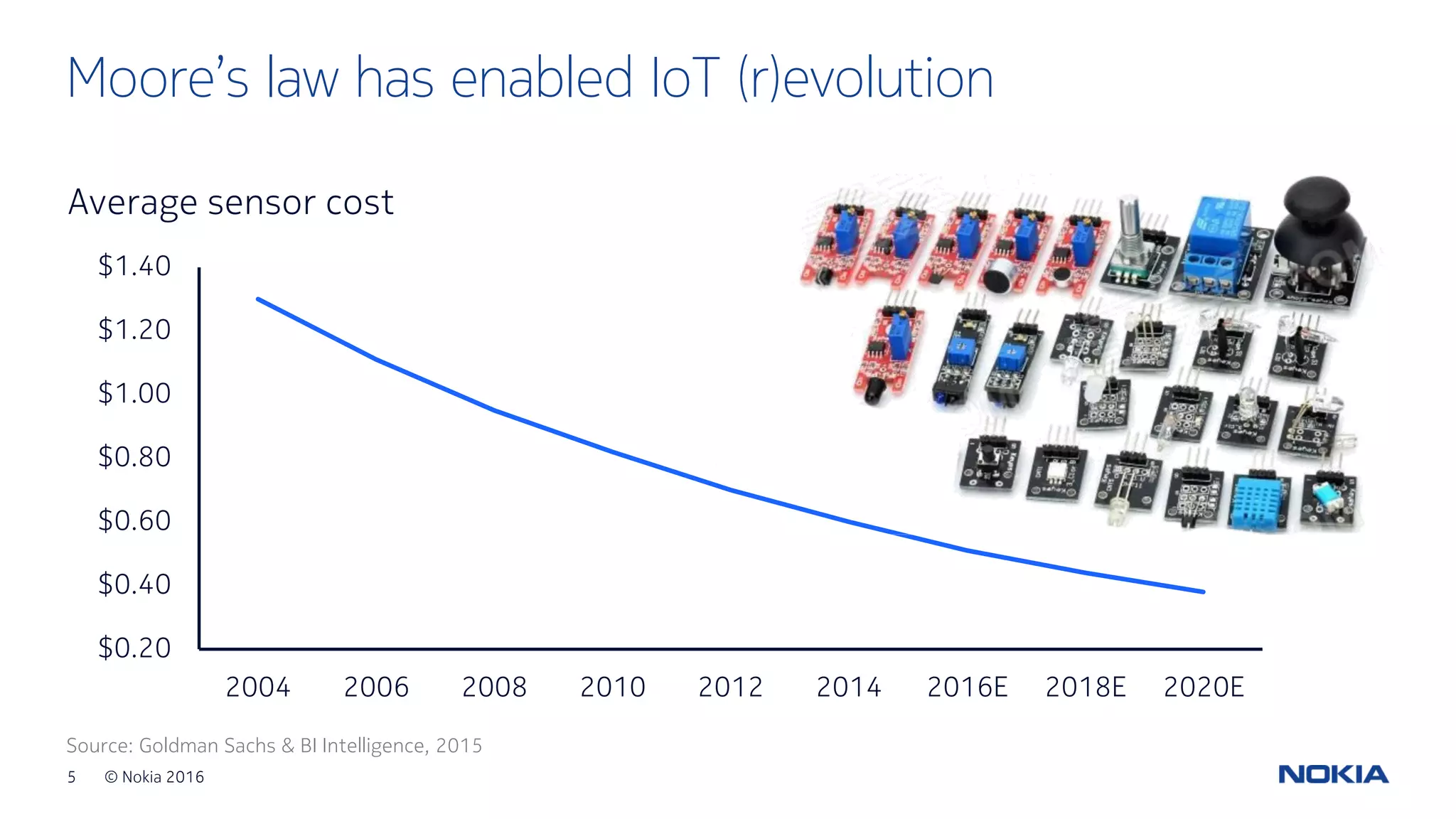
$0.20
$0.40
$0.60
$0.80
$1.00
$1.20
$1.40
2004 2006 2008 2010 2012 2014 2016E 2018E 2020E
Moore’s law has enabled IoT (r)evolution
Source: Goldman Sachs & BI Intelligence, 2015
Average sensor cost
6 © Nokia 2016
Metcalfe’s law (1993)
The value of a network is proportional to the
square of the number of its nodes – while the
cost follows a more or less linear function
value
cost
#
€
7 © Nokia 2016
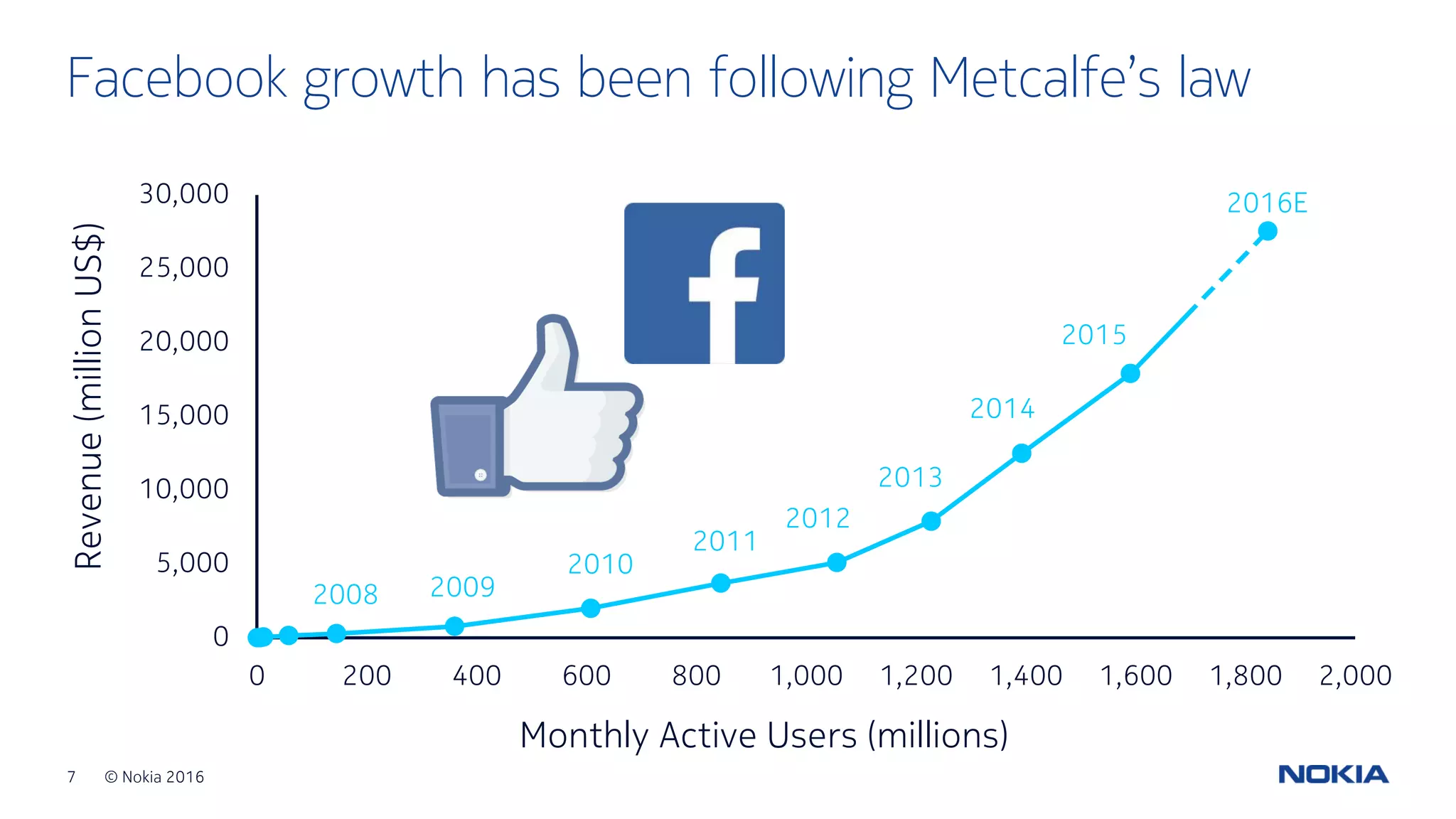
Facebook growth has been following Metcalfe’s law
0
5,000
10,000
15,000
20,000
25,000
30,000
0 200 400 600 800 1,000 1,200 1,400 1,600 1,800 2,000
Revenue(millionUS$)
Monthly Active Users (millions)
2016E
2015
2014
2013
2012
2011
2010
20092008
8 © Nokia 2016
Source: BI Intelligence, 2015
0
5
10
15
20
25
2011 2012 2013 2014 2015E 2016E 2017E 2018E 2019E
IoT value will come through Metcalfe’s law
Estimated number of installed IoT devices (billions)
9 © Nokia 2016
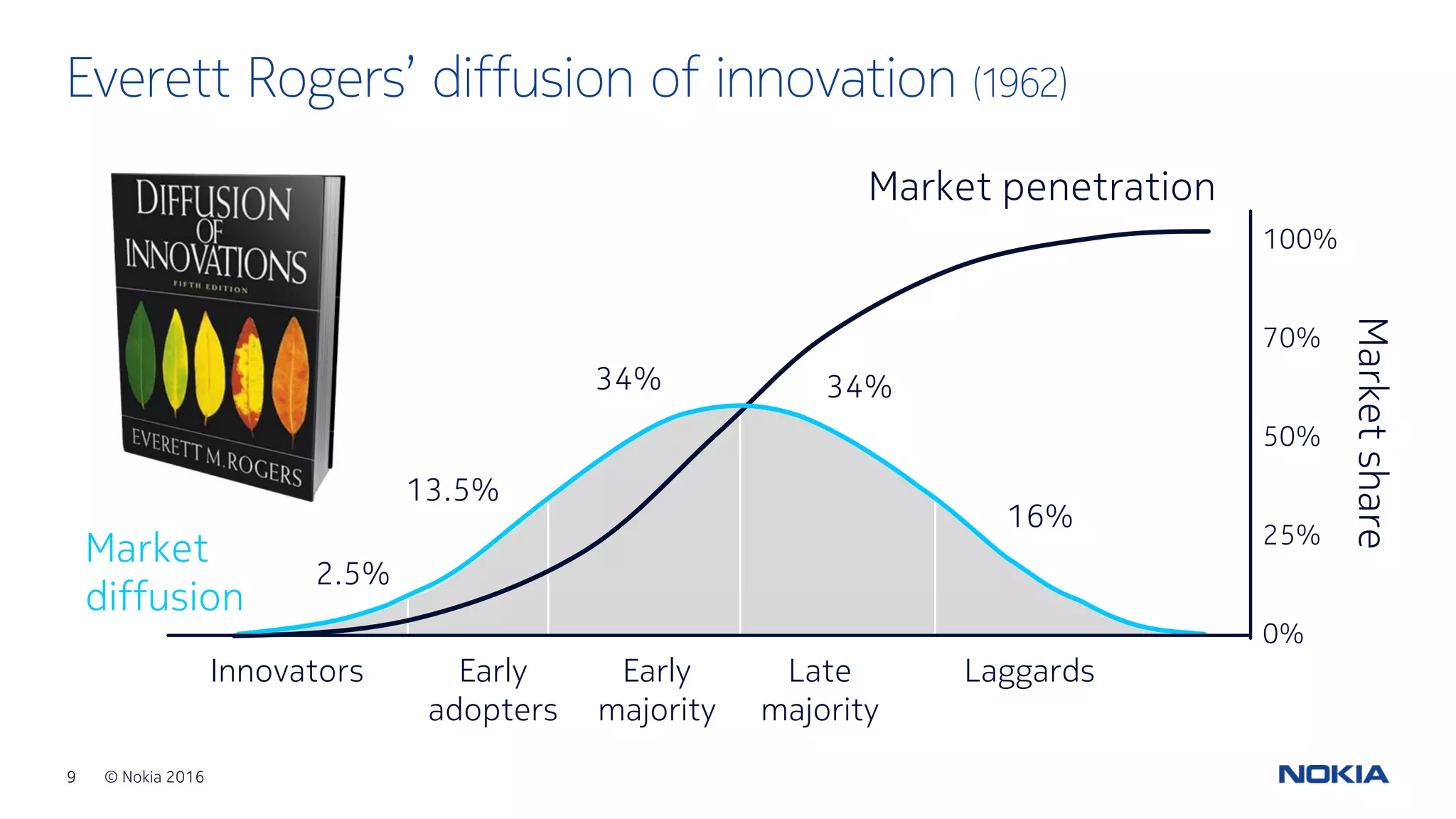
Everett Rogers’ diffusion of innovation (1962)
Innovators Early
adopters
Early
majority
Late
majority
Laggards
0%
25%
50%
70%
100%
Marketshare
13.5%
2.5%
34% 34%
16%
Market penetration
Market
diffusion
10 © Nokia 2016
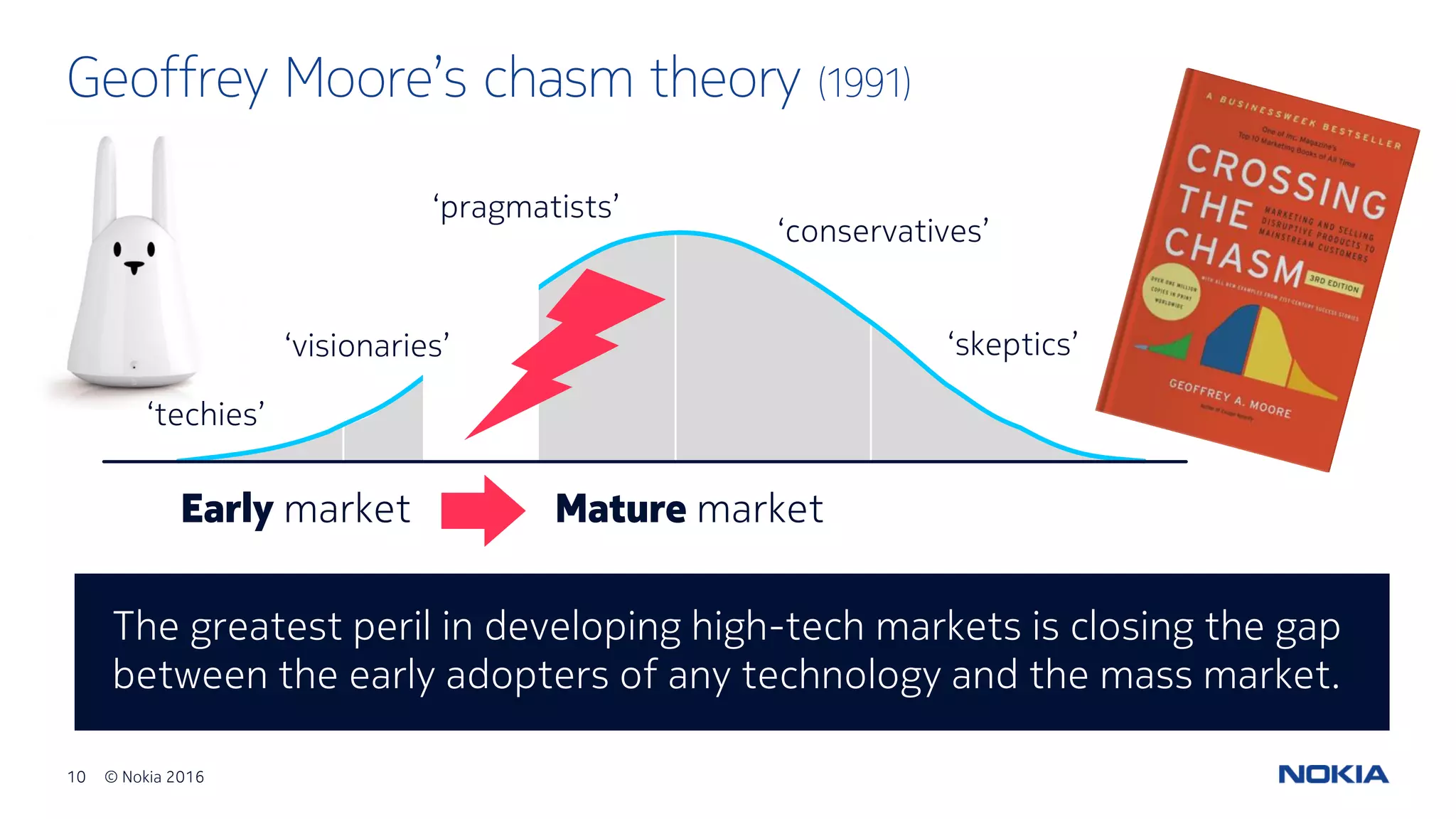
Geoffrey Moore’s chasm theory (1991)
The greatest peril in developing high-tech markets is closing the gap
between the early adopters of any technology and the mass market.
Early market Mature market
‘techies’
‘visionaries’
‘pragmatists’
‘conservatives’
‘skeptics’
11 © Nokia 2016
Many IoT devices and apps are still stuck in the chasm
3.9
2.8
0.7
4.4
3.1
3.6
0.7
4.7
3.7 3.9
0.9
8.1
2.7
4.1
1.0
4.8
3.7
1.5
0.9
5.7
3.1
1.6 1.6
Fitbit Xiaomi Apple Garmin
1Q2015 2Q2015 3Q2015 4Q2015 1Q2016 2Q2016
Source: IDC Worldwide Quarterly Wearables Tracker
Worldwide wearable device shipments (million units)
12 © Nokia 2016
Clayton Christensen's innovator's dilemma (1997)
It is in disruptive innovations, where we know least
about the market, that there are such strong first-
mover advantages. This is the innovator’s
dilemma.
Disruptive technology should be framed as a
marketing challenge, not a technological one.
13 © Nokia 2016
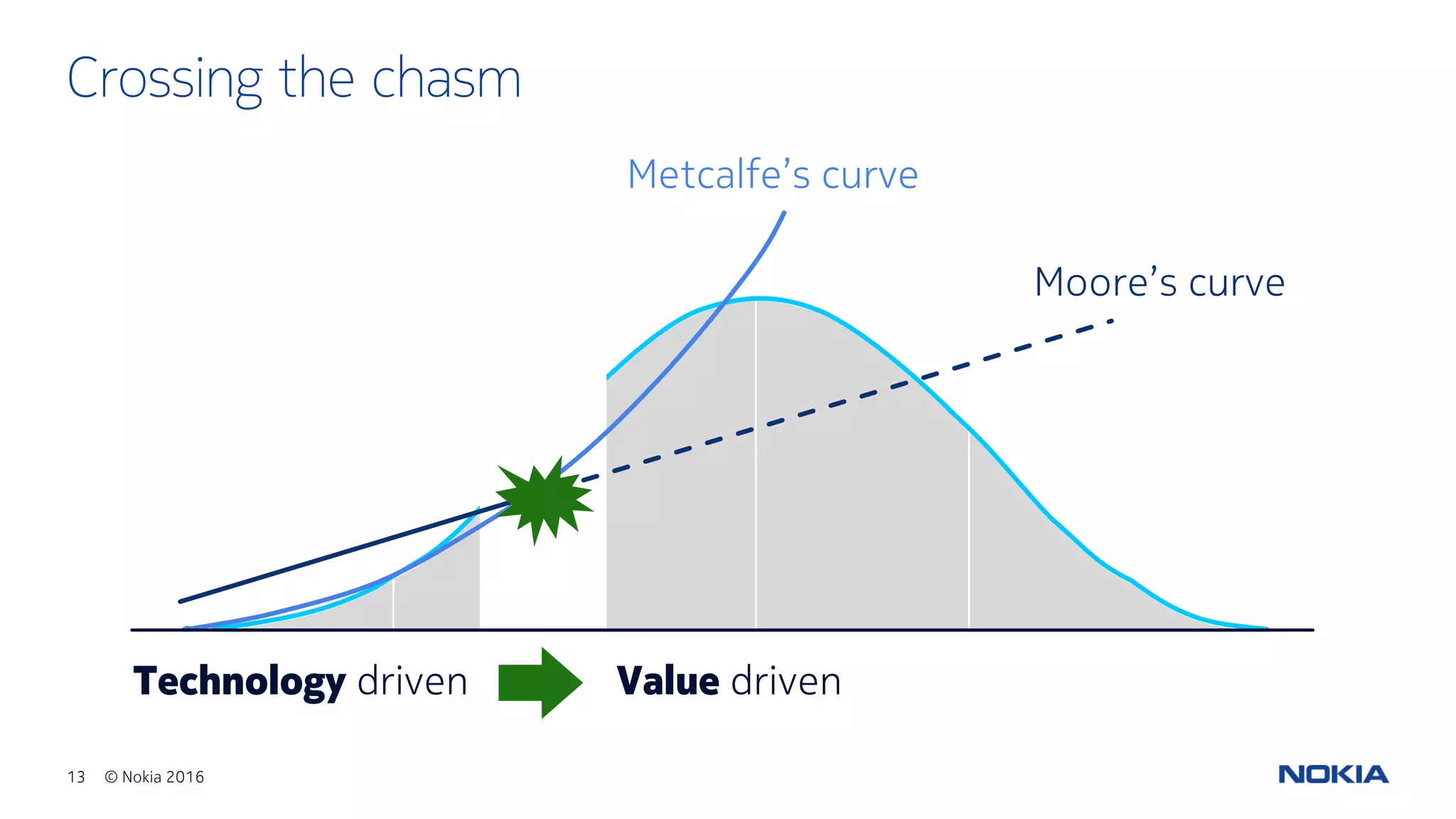
Crossing the chasm
Technology driven Value driven
Moore’s curve
Metcalfe’s curve
14 © Nokia 2016
Jeremy Rifkin’s zero marginal cost society (2014)
The IoT is emerging with the potential of pushing
large segments of economic life to near zero
marginal cost in the years ahead.
Prosumers can connect to the network and use
big data, analytics, and algorithms to accelerate
efficiency, dramatically increase productivity, and
lower the marginal cost of producing and sharing a
wide range of products and services to near zero,
just like they now do with information goods.
15 © Nokia 2016
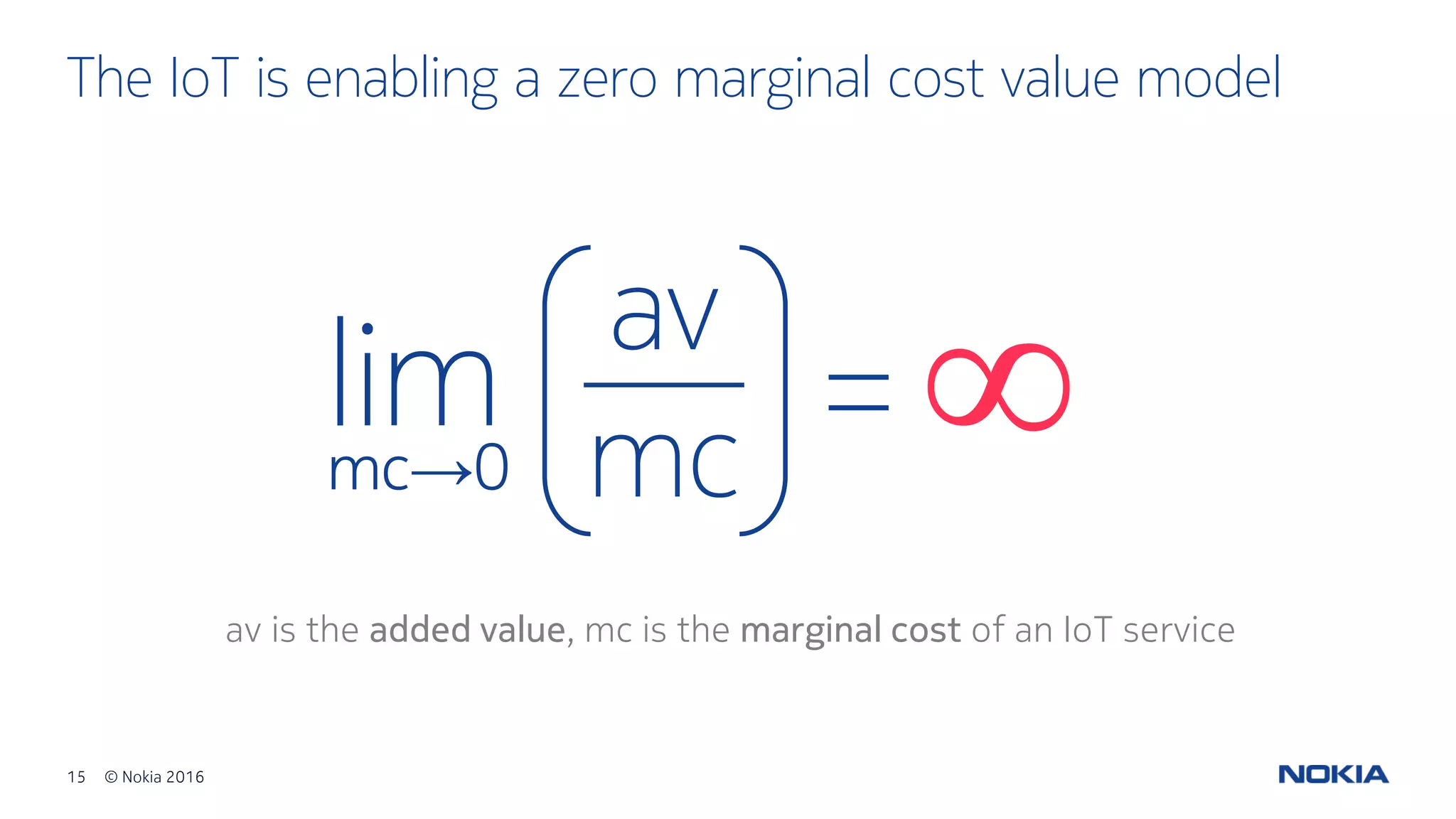
The IoT is enabling a zero marginal cost value model
av is the added value, mc is the marginal cost of an IoT service
lim
av
mcmc→0
= ∞
16 © Nokia 2016© Nokia 2016
So, how big is the
IoT’s (potential) value?
16 © Nokia 2016
17 © Nokia 2016
Moore’s Law applied to the IoT
1
10
100
2013 2014 2015 2016 2017 2018 2019 2020 2021
Componentdensity
(Billionsperarea)
8X increase in performance or
8X drop in price for a given performance
18 © Nokia 2016
Metcalfe’s Law applied to the IoTConnectedUsers/Devices(Billions)
Connectionssquared(Billions)
2.7 3.0 3.2 3.4
7.6
3.0
3.8
4.9
6.4
20.8
1.0
1.2
1.4
1.6
7.8
1.2
1.9
3.2
5.5
58.1
1
10
100
2013 2014 2015 2016 2017 2018 2019 2020 2021
Internet users IoT connections Internet value IoT value
7.5X
the value
of the
Internet
In 2020
36X the value of
the Internet in 2016
19 © Nokia 2016
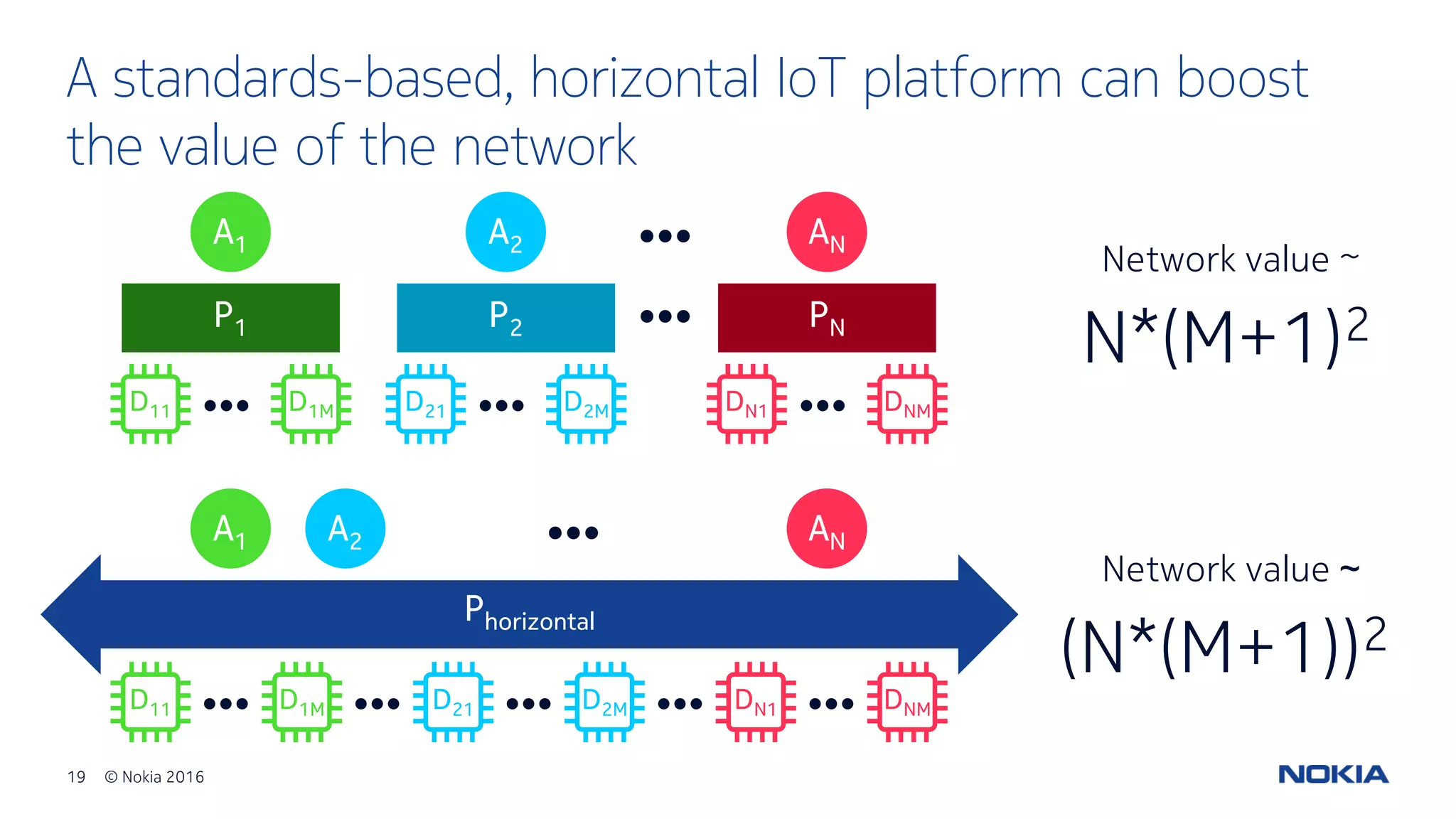
A standards-based, horizontal IoT platform can boost
the value of the network
A1
•••
D11 D1M•••
P2
A2
D21 D2M•••
P1 PN
AN
DN1 DNM•••
Network value ~
Network value ~
•••
A1
D11 D1M••• D21 D2M•••
Phorizontal
AN
DN1 DNM•••••• •••
•••A2
N*(M+1)2
(N*(M+1))2
20 © Nokia 2016
Summary
Moore’s
law
Metcalfe’s
law
Innovation
& user
adoption
Crossing
the chasm
Standards-
based,
horizontal
platform
Marginal
cost
Network
value
zero
7.5X
36X
IoT technology
IoT value
21 © Nokia 2016
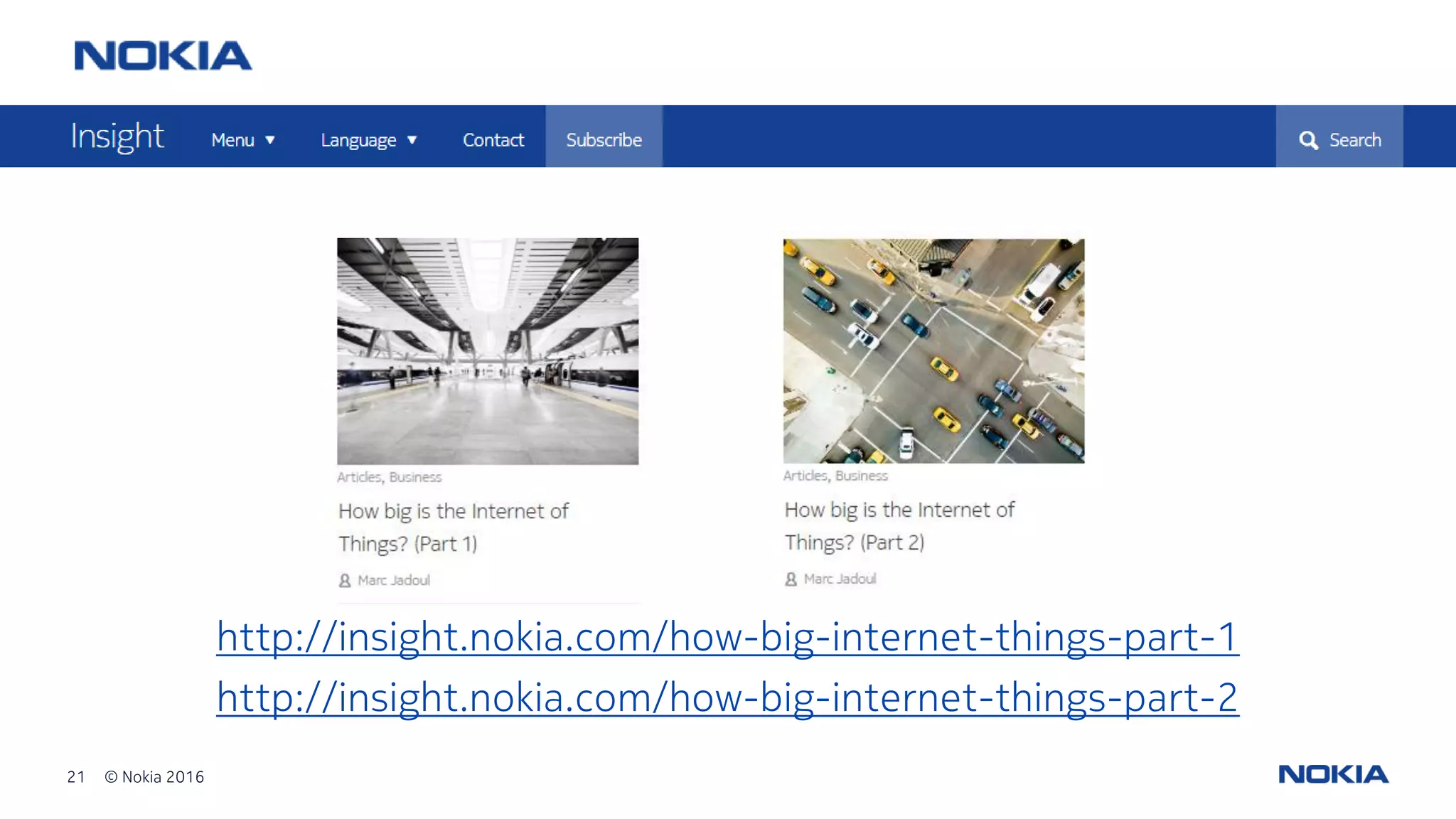
http://insight.nokia.com/how-big-internet-things-part-1
http://insight.nokia.com/how-big-internet-things-part-2
ETSI IoT keynote (2016)

ETSI IoT keynote (2016)

  • 1.
    1 © Nokia2016© Nokia 2016 How big is the Internet of Things? Marc Jadoul ( @mjadoul) ETSI IoT/M2M Workshop Sophia Antipolis, 17 November 2016 1 © Nokia 2016
  • 2.
    2 © Nokia2016 About this presentation https://en.wikipedia.org/wiki/Nabaztag
  • 3.
    3 © Nokia2016 Moore’s law (1965) The number of transistors in a dense integrated circuit doubles approximately every two years time performance cost Y=Nx
  • 4.
    4 © Nokia2016 Micro-processor evolution has followed Moore’s law 1965 Numberoftransistors 100 1980 1990 2000 2010 20161970 1k 10k 0 1M 10M 100M 1G 10G TTL CMOS 4100 4004 8008 8080 6800 8085 8086 68000 1802 6502 Z80 6809 8088 ARM2 68020 80286 80386 80486 68040 PowerPC 601 AMD K5 AMD K6 AMD K7 Pentium I Pentium II POWER 1 Pentium III Pentium 4 Atom AMD K8 Core 2 Duo Core i7 15 Core Xeon SPARC 64X 8 Core Xeon 16 Core SPARC T3 6 Core i7 8 Core POWER 7 POWER 6 22 Core Xeon Sparc M7
  • 5.
    5 © Nokia2016 $0.20 $0.40 $0.60 $0.80 $1.00 $1.20 $1.40 2004 2006 2008 2010 2012 2014 2016E 2018E 2020E Moore’s law has enabled IoT (r)evolution Source: Goldman Sachs & BI Intelligence, 2015 Average sensor cost
  • 6.
    6 © Nokia2016 Metcalfe’s law (1993) The value of a network is proportional to the square of the number of its nodes – while the cost follows a more or less linear function value cost # €
  • 7.
    7 © Nokia2016 Facebook growth has been following Metcalfe’s law 0 5,000 10,000 15,000 20,000 25,000 30,000 0 200 400 600 800 1,000 1,200 1,400 1,600 1,800 2,000 Revenue(millionUS$) Monthly Active Users (millions) 2016E 2015 2014 2013 2012 2011 2010 20092008
  • 8.
    8 © Nokia2016 Source: BI Intelligence, 2015 0 5 10 15 20 25 2011 2012 2013 2014 2015E 2016E 2017E 2018E 2019E IoT value will come through Metcalfe’s law Estimated number of installed IoT devices (billions)
  • 9.
    9 © Nokia2016 Everett Rogers’ diffusion of innovation (1962) Innovators Early adopters Early majority Late majority Laggards 0% 25% 50% 70% 100% Marketshare 13.5% 2.5% 34% 34% 16% Market penetration Market diffusion
  • 10.
    10 © Nokia2016 Geoffrey Moore’s chasm theory (1991) The greatest peril in developing high-tech markets is closing the gap between the early adopters of any technology and the mass market. Early market Mature market ‘techies’ ‘visionaries’ ‘pragmatists’ ‘conservatives’ ‘skeptics’
  • 11.
    11 © Nokia2016 Many IoT devices and apps are still stuck in the chasm 3.9 2.8 0.7 4.4 3.1 3.6 0.7 4.7 3.7 3.9 0.9 8.1 2.7 4.1 1.0 4.8 3.7 1.5 0.9 5.7 3.1 1.6 1.6 Fitbit Xiaomi Apple Garmin 1Q2015 2Q2015 3Q2015 4Q2015 1Q2016 2Q2016 Source: IDC Worldwide Quarterly Wearables Tracker Worldwide wearable device shipments (million units)
  • 12.
    12 © Nokia2016 Clayton Christensen's innovator's dilemma (1997) It is in disruptive innovations, where we know least about the market, that there are such strong first- mover advantages. This is the innovator’s dilemma. Disruptive technology should be framed as a marketing challenge, not a technological one.
  • 13.
    13 © Nokia2016 Crossing the chasm Technology driven Value driven Moore’s curve Metcalfe’s curve
  • 14.
    14 © Nokia2016 Jeremy Rifkin’s zero marginal cost society (2014) The IoT is emerging with the potential of pushing large segments of economic life to near zero marginal cost in the years ahead. Prosumers can connect to the network and use big data, analytics, and algorithms to accelerate efficiency, dramatically increase productivity, and lower the marginal cost of producing and sharing a wide range of products and services to near zero, just like they now do with information goods.
  • 15.
    15 © Nokia2016 The IoT is enabling a zero marginal cost value model av is the added value, mc is the marginal cost of an IoT service lim av mcmc→0 = ∞
  • 16.
    16 © Nokia2016© Nokia 2016 So, how big is the IoT’s (potential) value? 16 © Nokia 2016
  • 17.
    17 © Nokia2016 Moore’s Law applied to the IoT 1 10 100 2013 2014 2015 2016 2017 2018 2019 2020 2021 Componentdensity (Billionsperarea) 8X increase in performance or 8X drop in price for a given performance
  • 18.
    18 © Nokia2016 Metcalfe’s Law applied to the IoTConnectedUsers/Devices(Billions) Connectionssquared(Billions) 2.7 3.0 3.2 3.4 7.6 3.0 3.8 4.9 6.4 20.8 1.0 1.2 1.4 1.6 7.8 1.2 1.9 3.2 5.5 58.1 1 10 100 2013 2014 2015 2016 2017 2018 2019 2020 2021 Internet users IoT connections Internet value IoT value 7.5X the value of the Internet In 2020 36X the value of the Internet in 2016
  • 19.
    19 © Nokia2016 A standards-based, horizontal IoT platform can boost the value of the network A1 ••• D11 D1M••• P2 A2 D21 D2M••• P1 PN AN DN1 DNM••• Network value ~ Network value ~ ••• A1 D11 D1M••• D21 D2M••• Phorizontal AN DN1 DNM•••••• ••• •••A2 N*(M+1)2 (N*(M+1))2
  • 20.
    20 © Nokia2016 Summary Moore’s law Metcalfe’s law Innovation & user adoption Crossing the chasm Standards- based, horizontal platform Marginal cost Network value zero 7.5X 36X IoT technology IoT value
  • 21.
    21 © Nokia2016 http://insight.nokia.com/how-big-internet-things-part-1 http://insight.nokia.com/how-big-internet-things-part-2