Unit 3: Organizational Design & Strategy
Lesson 8: Learning & Organization Strategy
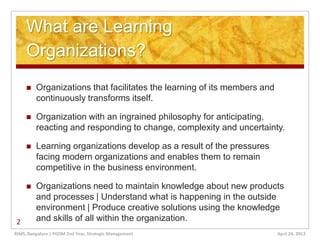
What are Learning
     Organizations?
        Organizations that facilitates the learning of its members and
         continuously transforms itself.

        Organization with an ingrained philosophy for anticipating,
         reacting and responding to change, complexity and uncertainty.

        Learning organizations develop as a result of the pressures
         facing modern organizations and enables them to remain
         competitive in the business environment.

        Organizations need to maintain knowledge about new products
         and processes | Understand what is happening in the outside
         environment | Produce creative solutions using the knowledge
2        and skills of all within the organization.
RIMS, Bangalore | PGDM 2nd Year, Strategic Management                     April 24, 2012
3
RIMS, Bangalore | PGDM 2nd Year, Strategic Management   April 24, 2012
Characteristics of Learning
     Organizations
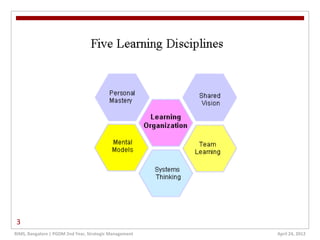
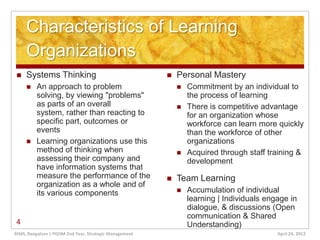
    Systems Thinking                                      Personal Mastery
        An approach to problem                                Commitment by an individual to
         solving, by viewing "problems"                         the process of learning
         as parts of an overall                                There is competitive advantage
         system, rather than reacting to                        for an organization whose
         specific part, outcomes or                             workforce can learn more quickly
         events                                                 than the workforce of other
        Learning organizations use this                        organizations
         method of thinking when                               Acquired through staff training &
         assessing their company and                            development
         have information systems that
         measure the performance of the                    Team Learning
         organization as a whole and of
         its various components                                Accumulation of individual
                                                                learning | Individuals engage in
                                                                dialogue, & discussions (Open
                                                                communication & Shared
4                                                               Understanding)
RIMS, Bangalore | PGDM 2nd Year, Strategic Management                                     April 24, 2012
Characteristics of Learning
     Organizations
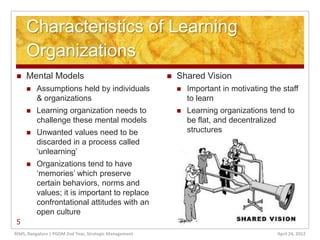
    Mental Models                                         Shared Vision
        Assumptions held by individuals                       Important in motivating the staff
         & organizations                                        to learn
        Learning organization needs to                        Learning organizations tend to
         challenge these mental models                          be flat, and decentralized
        Unwanted values need to be                             structures
         discarded in a process called
         ‘unlearning’
        Organizations tend to have
         ‘memories’ which preserve
         certain behaviors, norms and
         values; it is important to replace
         confrontational attitudes with an
         open culture
5
RIMS, Bangalore | PGDM 2nd Year, Strategic Management                                     April 24, 2012
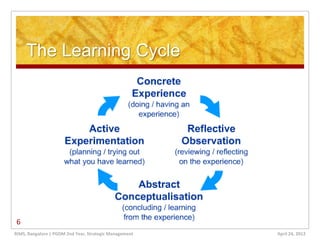
The Learning Cycle


6
RIMS, Bangalore | PGDM 2nd Year, Strategic Management   April 24, 2012
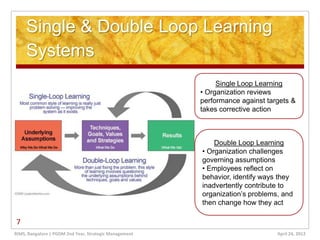
Single & Double Loop Learning
     Systems
                                                             Single Loop Learning
                                                        • Organization reviews
                                                        performance against targets &
                                                        takes corrective action


                                                            Double Loop Learning
                                                        • Organization challenges
                                                        governing assumptions
                                                        • Employees reflect on
                                                        behavior, identify ways they
                                                        inadvertently contribute to
                                                        organization’s problems, and
                                                        then change how they act

7
RIMS, Bangalore | PGDM 2nd Year, Strategic Management                          April 24, 2012
What is Knowledge
     Management?
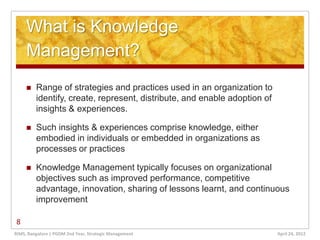
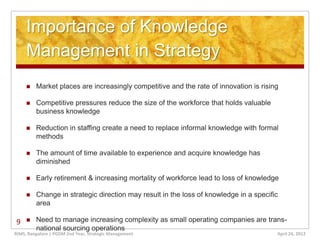
        Range of strategies and practices used in an organization to
         identify, create, represent, distribute, and enable adoption of
         insights & experiences.

        Such insights & experiences comprise knowledge, either
         embodied in individuals or embedded in organizations as
         processes or practices

        Knowledge Management typically focuses on organizational
         objectives such as improved performance, competitive
         advantage, innovation, sharing of lessons learnt, and continuous
         improvement

8
RIMS, Bangalore | PGDM 2nd Year, Strategic Management                      April 24, 2012
Importance of Knowledge
     Management in Strategy
        Market places are increasingly competitive and the rate of innovation is rising

        Competitive pressures reduce the size of the workforce that holds valuable
         business knowledge

        Reduction in staffing create a need to replace informal knowledge with formal
         methods

        The amount of time available to experience and acquire knowledge has
         diminished

        Early retirement & increasing mortality of workforce lead to loss of knowledge

        Change in strategic direction may result in the loss of knowledge in a specific
         area

9       Need to manage increasing complexity as small operating companies are trans-
         national sourcing operations
RIMS, Bangalore | PGDM 2nd Year, Strategic Management                                  April 24, 2012
Knowledge Management Spiral
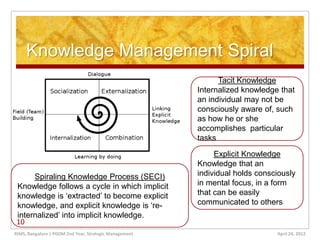
                                                              Tacit Knowledge
                                                        Internalized knowledge that
                                                        an individual may not be
                                                        consciously aware of, such
                                                        as how he or she
                                                        accomplishes particular
                                                        tasks

                                                             Explicit Knowledge
                                                        Knowledge that an
     Spiraling Knowledge Process (SECI)                 individual holds consciously
Knowledge follows a cycle in which implicit             in mental focus, in a form
knowledge is ‘extracted’ to become explicit             that can be easily
knowledge, and explicit knowledge is ‘re-               communicated to others
internalized’ into implicit knowledge.
10
RIMS, Bangalore | PGDM 2nd Year, Strategic Management                         April 24, 2012
Knowledge Management Spiral
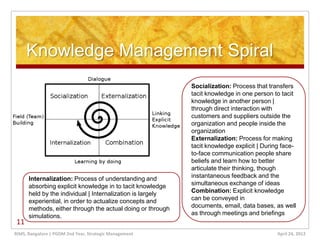
                                                            Socialization: Process that transfers
                                                            tacit knowledge in one person to tacit
                                                            knowledge in another person |
                                                            through direct interaction with
                                                            customers and suppliers outside the
                                                            organization and people inside the
                                                            organization
                                                            Externalization: Process for making
                                                            tacit knowledge explicit | During face-
                                                            to-face communication people share
                                                            beliefs and learn how to better
                                                            articulate their thinking, though
      Internalization: Process of understanding and         instantaneous feedback and the
      absorbing explicit knowledge in to tacit knowledge    simultaneous exchange of ideas
      held by the individual | Internalization is largely   Combination: Explicit knowledge
      experiential, in order to actualize concepts and      can be conveyed in
      methods, either through the actual doing or through   documents, email, data bases, as well
      simulations.                                          as through meetings and briefings
11
RIMS, Bangalore | PGDM 2nd Year, Strategic Management                                       April 24, 2012
Challenges of Creating Learning
     Organizations
        Problems of Leadership
             Leaders in the organization may already have mental models that are
              entrenched and must be overcome in order to foster the openness
              and confidence required
             Learning Organizations require leaders to be open to challenges
              about their vision and behavior, and to be prepared to change when
              necessary
             Learning Organizations require a questioning approach that is
              contradictory to the cultural expectations of both leaders and the
              majority of organizations
             Most leaders are promoted to their level because of their expertise at
              the previous level, they then fall into the ‘Expert Trap’, telling people
              what to do
12
RIMS, Bangalore | PGDM 2nd Year, Strategic Management                              April 24, 2012
Challenges of Creating Learning
     Organizations
        Long-Term Vision
             Learning Organizations must have a long-term vision, and be focused
              on the learning and development of their workers in order to achieve
              development of the whole.
             This requires many to make large changes and in a results driven,
              time pressured, business environment, the decision to look long-term
              is a hard one to take.

        Training and Development required to move towards being a
         Learning Organization takes a lot of time that companies may not
         be able or willing to spend at the moment.


13
RIMS, Bangalore | PGDM 2nd Year, Strategic Management                         April 24, 2012
Hardy Alexander
Founder & Director | Triune Global
Bangalore – 560077
Contact: +91 96864 48698
Email: halexander@triuneglobal.com
My Blog: dayscore.wordpress.com


                                      Thank you
RIMS, Bangalore | PGDM 2nd Year, Strategic Management   14   April 24, 2012

Learning Organizations: Strategic Management

  • 1.
    Unit 3: OrganizationalDesign & Strategy Lesson 8: Learning & Organization Strategy
  • 2.
    What are Learning Organizations?  Organizations that facilitates the learning of its members and continuously transforms itself.  Organization with an ingrained philosophy for anticipating, reacting and responding to change, complexity and uncertainty.  Learning organizations develop as a result of the pressures facing modern organizations and enables them to remain competitive in the business environment.  Organizations need to maintain knowledge about new products and processes | Understand what is happening in the outside environment | Produce creative solutions using the knowledge 2 and skills of all within the organization. RIMS, Bangalore | PGDM 2nd Year, Strategic Management April 24, 2012
  • 3.
    3 RIMS, Bangalore |PGDM 2nd Year, Strategic Management April 24, 2012
  • 4.
    Characteristics of Learning Organizations  Systems Thinking  Personal Mastery  An approach to problem  Commitment by an individual to solving, by viewing "problems" the process of learning as parts of an overall  There is competitive advantage system, rather than reacting to for an organization whose specific part, outcomes or workforce can learn more quickly events than the workforce of other  Learning organizations use this organizations method of thinking when  Acquired through staff training & assessing their company and development have information systems that measure the performance of the  Team Learning organization as a whole and of its various components  Accumulation of individual learning | Individuals engage in dialogue, & discussions (Open communication & Shared 4 Understanding) RIMS, Bangalore | PGDM 2nd Year, Strategic Management April 24, 2012
  • 5.
    Characteristics of Learning Organizations  Mental Models  Shared Vision  Assumptions held by individuals  Important in motivating the staff & organizations to learn  Learning organization needs to  Learning organizations tend to challenge these mental models be flat, and decentralized  Unwanted values need to be structures discarded in a process called ‘unlearning’  Organizations tend to have ‘memories’ which preserve certain behaviors, norms and values; it is important to replace confrontational attitudes with an open culture 5 RIMS, Bangalore | PGDM 2nd Year, Strategic Management April 24, 2012
  • 6.
    The Learning Cycle 6 RIMS,Bangalore | PGDM 2nd Year, Strategic Management April 24, 2012
  • 7.
    Single & DoubleLoop Learning Systems Single Loop Learning • Organization reviews performance against targets & takes corrective action Double Loop Learning • Organization challenges governing assumptions • Employees reflect on behavior, identify ways they inadvertently contribute to organization’s problems, and then change how they act 7 RIMS, Bangalore | PGDM 2nd Year, Strategic Management April 24, 2012
  • 8.
    What is Knowledge Management?  Range of strategies and practices used in an organization to identify, create, represent, distribute, and enable adoption of insights & experiences.  Such insights & experiences comprise knowledge, either embodied in individuals or embedded in organizations as processes or practices  Knowledge Management typically focuses on organizational objectives such as improved performance, competitive advantage, innovation, sharing of lessons learnt, and continuous improvement 8 RIMS, Bangalore | PGDM 2nd Year, Strategic Management April 24, 2012
  • 9.
    Importance of Knowledge Management in Strategy  Market places are increasingly competitive and the rate of innovation is rising  Competitive pressures reduce the size of the workforce that holds valuable business knowledge  Reduction in staffing create a need to replace informal knowledge with formal methods  The amount of time available to experience and acquire knowledge has diminished  Early retirement & increasing mortality of workforce lead to loss of knowledge  Change in strategic direction may result in the loss of knowledge in a specific area 9  Need to manage increasing complexity as small operating companies are trans- national sourcing operations RIMS, Bangalore | PGDM 2nd Year, Strategic Management April 24, 2012
  • 10.
    Knowledge Management Spiral Tacit Knowledge Internalized knowledge that an individual may not be consciously aware of, such as how he or she accomplishes particular tasks Explicit Knowledge Knowledge that an Spiraling Knowledge Process (SECI) individual holds consciously Knowledge follows a cycle in which implicit in mental focus, in a form knowledge is ‘extracted’ to become explicit that can be easily knowledge, and explicit knowledge is ‘re- communicated to others internalized’ into implicit knowledge. 10 RIMS, Bangalore | PGDM 2nd Year, Strategic Management April 24, 2012
  • 11.
    Knowledge Management Spiral Socialization: Process that transfers tacit knowledge in one person to tacit knowledge in another person | through direct interaction with customers and suppliers outside the organization and people inside the organization Externalization: Process for making tacit knowledge explicit | During face- to-face communication people share beliefs and learn how to better articulate their thinking, though Internalization: Process of understanding and instantaneous feedback and the absorbing explicit knowledge in to tacit knowledge simultaneous exchange of ideas held by the individual | Internalization is largely Combination: Explicit knowledge experiential, in order to actualize concepts and can be conveyed in methods, either through the actual doing or through documents, email, data bases, as well simulations. as through meetings and briefings 11 RIMS, Bangalore | PGDM 2nd Year, Strategic Management April 24, 2012
  • 12.
    Challenges of CreatingLearning Organizations  Problems of Leadership  Leaders in the organization may already have mental models that are entrenched and must be overcome in order to foster the openness and confidence required  Learning Organizations require leaders to be open to challenges about their vision and behavior, and to be prepared to change when necessary  Learning Organizations require a questioning approach that is contradictory to the cultural expectations of both leaders and the majority of organizations  Most leaders are promoted to their level because of their expertise at the previous level, they then fall into the ‘Expert Trap’, telling people what to do 12 RIMS, Bangalore | PGDM 2nd Year, Strategic Management April 24, 2012
  • 13.
    Challenges of CreatingLearning Organizations  Long-Term Vision  Learning Organizations must have a long-term vision, and be focused on the learning and development of their workers in order to achieve development of the whole.  This requires many to make large changes and in a results driven, time pressured, business environment, the decision to look long-term is a hard one to take.  Training and Development required to move towards being a Learning Organization takes a lot of time that companies may not be able or willing to spend at the moment. 13 RIMS, Bangalore | PGDM 2nd Year, Strategic Management April 24, 2012
  • 14.
    Hardy Alexander Founder &Director | Triune Global Bangalore – 560077 Contact: +91 96864 48698 Email: halexander@triuneglobal.com My Blog: dayscore.wordpress.com Thank you RIMS, Bangalore | PGDM 2nd Year, Strategic Management 14 April 24, 2012