Manifesto for a Standard on Meaningful
Representations of Knowledge in Social
Knowledge Management Environments
        Bick, M., Hetmank, L., Kruse, P., Maier, R., Pawlowski, J.M.,
                      Peinl, R., Schoop, E., Seeber, I., Thalmann, S


                                                                        1
Licensing: Creative Commons
You are free:
       to Share — to copy, distribute and transmit the work
       to Remix — to adapt the work


Under the following conditions:
       Attribution. You must attribute the work in the manner specified by
        the author or licensor (but not in any way that suggests that they
        endorse you or your use of the work).
       Noncommercial. You may not use this work for commercial purposes.
       Share Alike. If you alter, transform, or build upon this work, you may
        distribute the resulting work only under the same or similar license to
        this one.
http://creativecommons.org/licenses/by-nc-sa/3.0/

                                                                              2
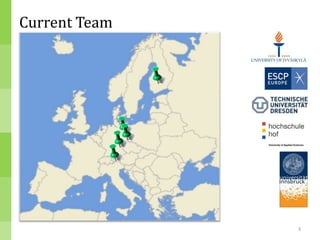
Current Team


               3
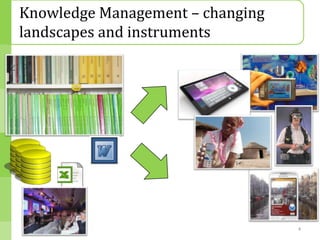
Knowledge Management – changing
landscapes and instruments


                                  4
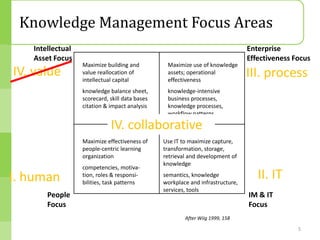
Knowledge Management Focus Areas
   Intellectual                                                                 Enterprise
   Asset Focus                                                                  Effectiveness Focus
                  Maximize building and          Maximize use of knowledge
IV. value         value reallocation of
                  intellectual capital
                                                 assets; operational
                                                 effectiveness
                                                                                III. process
                  knowledge balance sheet,       knowledge-intensive
                  scorecard, skill data bases    business processes,
                  citation & impact analysis     knowledge processes,
                                                 workflow patterns

                             IV. collaborative
                  Maximize effectiveness of     Use IT to maximize capture,
                  people-centric learning       transformation, storage,
                  organization                  retrieval and development of
                                                knowledge
                  competencies, motiva-
I. human          tion, roles & responsi-
                  bilities, task patterns
                                                semantics, knowledge
                                                workplace and infrastructure,
                                                                                   II. IT
                                                services, tools
       People                                                                   IM & IT
       Focus                                                                    Focus
                                                        After Wiig 1999, 158

                                                                                               5
Source: B.D. Solis: http://www.sortingthoughts.de/blog/wp-
                                                                                                  6


                                     content/uploads/2008/12/2735401175_fcdcd0da03.jpg
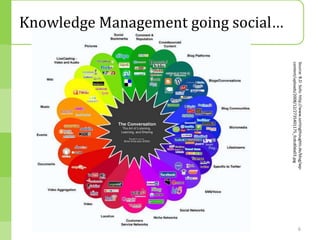
Knowledge Management going social…
The challenges
 Knowledge management trends
   Connecting human and technology orientation
   From document/repository orientation to
    distributed resources and activities
   Social software as a central concept for
    connecting resources and activities

 How do we represent knowledge and connect
  activities, resources and people?

                                                  7
The role of social software in knowledge
activities
 Knowledge cannot completely be codified and shared
 Knowledge transfer can be improved by capturing information
  about the current and historical context and the underlying
  activity.
 Social media (SM) and social software (SSW) support knowledge
  transfer and construction of knowledge through social
  interactions between people.
 Contextual information of interactions can be tracked by using
  existing SM and SSW functionalities such as activity streams,
  tagging and commenting
 SM and SSW are mostly limited to personal and content metadata
 Standardization remains a key task for improving the handling of
  large and complex information
                                                                  8
Current standardization efforts
 Technical standards (document formats,
  metadata)
     Dublin Core
     Learning Object Metadata (LOM)
     Business Process Model Notation (BPMN)
     IMS Learning Design Specification
     Contextualized attention metadata (CAM)
     RDF, OWL
     OOXML, PDF, ODF
 Human-oriented standards (guidelines and good
  practices)
                                                  9
Knowledge activities
 To deal with the (automatic ) detection of the users’ task and activities based on collected contextual data a
 better understanding of potential knowledge activities and their connection and traceability is necessary.
Author           Knowledge (Management) Activity          Author      Knowledge (Management) Activity
Aurum et al.,    knowledge creation, knowledge            Alavi 2001 Creation, storage/retrieve, transfer, apply,
2008             acquisition, knowledge identification,
                 knowledge adaptation, knowledge
                 organization
                 knowledge distribution, knowledge
                 application
Newell et al.,   create knowledge, integrate              Fong and Acquisition, creation, storage, distribution, use,
2009             knowledge, share knowledge               Choi, 2009 maintaining
                 codify knowledge
Hädrich, 2008 Identification, acquisition                 Holsapple, acquisition (identifying appropriate knowledge,
              Codification, combination                   Singh,       capturing identified knowledge, organizing
              Distribution, search & retrieval            2001         captured knowledge, transferring the organized
              application, development                                 knowledge
              archiving & deleting, learning                         selection (identifying appropriate knowledge,
              networking                                               capturing identified knowledge, organizing
Nonaka &     Socialization, externalization,                           captured knowledge, transferring organized
Takeuchi,    combination, internalization                              knowledge)
1995; Nonaka                                                         generate (monitor, evaluate, produce, transfer)
& Toyama,                                                            assimilation (assessing, targeting, structuring,
2003                                                                   delivering)
                                                                     emission (targeting, producing, transferring)
                                                                                                                        10
Activity Stream
Activity Streams allow applications to publish a live stream of a persons’
working, learning (or social) activities by aggregators that serialize items into
a sequence of posts, making actions visible to other users of the service.
Motivation
 participants better understand boundaries
  of their actions
 groups better manage & coordinate activities
 people decide with whom to collaborate
 attracts attention and signals
 enhances knowledge sharing, asking &
  answering questions, solving problems
 enhances mechanisms to demonstrate
  competences
(Olson et al., 2006)
                                                                                    11
Active Documents
  An electronic document which includes data as well as metadata and
   application logic. Alternatively, an active document can be directly
   connected with the application logic.
  Metadata and application logic will be transferred with the active
   document and be able to activate, control and execute functionalities.
   [Trög07]

                            Integration of               Ability to react                  Ability to initiate and                 Ability to take
 Transformation               metadata                    on an event                       control functions                 decisions autonomously
   characteristic

                     Passive           Enriched                           Reactive                          Active                                Proactive
                    Document           Document                          Document                          Document                               Document
Sort of document
                                             <creator>Muster</creator>       <creator>Muster</creator>         <creator>Muster</creator>             <creator>Muster</creator>
                                             <date>11-01-2006</date>         <date>11-01-2006</date>           <date>11-01-2006</date>               <date>11-01-2006</date>


   Requirements
regarding system                                                                                                                                Specific system
                                                                         Specific system environment interpreting
    environment      Standard system enviroment                                                                                                   environment
                                                                             metadata and application logic
                                                                                                                                           using autoactivation mode


                                                                                                                                                [Trög07]
                                                                                                                                                                     12
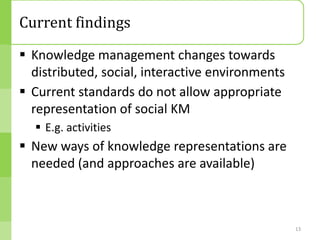
Current findings
 Knowledge management changes towards
  distributed, social, interactive environments
 Current standards do not allow appropriate
  representation of social KM
   E.g. activities
 New ways of knowledge representations are
  needed (and approaches are available)


                                                  13
The Manifesto
 New ways of knowledge representation
 Key aspects
   Represent activities and interactions
   Represent context: in which environment do
    knowledge activities happen?
   Allow bundling, merging and connecting resources,
    activities and people
 Develop a standard for KM (systems) to enable
  interoperability and re-use
 A basis for discussion, discourse, community
  building!
                                                        14
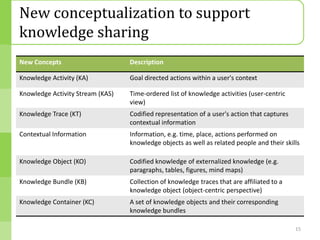
New conceptualization to support
knowledge sharing
New Concepts                      Description

Knowledge Activity (KA)           Goal directed actions within a user's context

Knowledge Activity Stream (KAS)   Time-ordered list of knowledge activities (user-centric
                                  view)
Knowledge Trace (KT)              Codified representation of a user's action that captures
                                  contextual information
Contextual Information            Information, e.g. time, place, actions performed on
                                  knowledge objects as well as related people and their skills

Knowledge Object (KO)             Codified knowledge of externalized knowledge (e.g.
                                  paragraphs, tables, figures, mind maps)
Knowledge Bundle (KB)             Collection of knowledge traces that are affiliated to a
                                  knowledge object (object-centric perspective)
Knowledge Container (KC)          A set of knowledge objects and their corresponding
                                  knowledge bundles

                                                                                             15
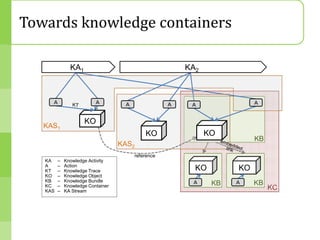
Towards knowledge containers

               KA1                                      KA2


     A                    A         A               A    A               A


                     KO
   KAS1
                                            KO                KO
                                                                         KB
                                   KAS2
                                        reference
   KA    –   Knowledge Activity
   A     –   Action
   KT    –   Knowledge Trace                              KO        KO
   KO    –   Knowledge Object
   KB    –   Knowledge Bundle
   KC    –   Knowledge Container
                                                         A     KB   A    KB
   KAS   –   KA Stream
                                                                              KC
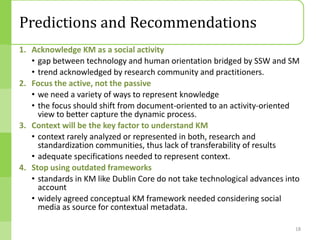
Aspects of contextual information
enriched knowledge containers


                                    17
Predictions and Recommendations
1. Acknowledge KM as a social activity
   • gap between technology and human orientation bridged by SSW and SM
   • trend acknowledged by research community and practitioners.
2. Focus the active, not the passive
   • we need a variety of ways to represent knowledge
   • the focus should shift from document-oriented to an activity-oriented
     view to better capture the dynamic process.
3. Context will be the key factor to understand KM
   • context rarely analyzed or represented in both, research and
     standardization communities, thus lack of transferability of results
   • adequate specifications needed to represent context.
4. Stop using outdated frameworks
   • standards in KM like Dublin Core do not take technological advances into
     account
   • widely agreed conceptual KM framework needed considering social
     media as source for contextual metadata.

                                                                           18
Predictions and Recommendations (2)
5.  Focus on specifications and standards
  • KM community has ignored standards for decades.
  • specifications and standards are important when designing and
    experimenting with innovative systems.
6. Form an enterprise-research alliance for standards
  • consensus of all stakeholders needed, in particular researchers and
    enterprises.
  • a balanced community needs to be formed from the very beginning.
7. Stand on the shoulders of giants
  • KM community has specific characteristics, but standards do not need to
    be created from scratch.
  • build on existing base and similar standards already successful in use.
8. Create standards now
  • KM and SSW are mature enough that we understand the key success
    factors.
  • KM community needs to create standards as an agreement in the
    community for competitive innovative and interoperable solutions
                                                                         19
Summary
 We need new ways of representing knowledge
  management in standards
 Key aspect: adding context and activities

 Steps
    Find (further) appropriate
     approaches, standards and alternatives
    Collaborate with standardization bodies
    Discuss, test, improve!
                                               20
Contact Information JYU
Prof. Dr. Markus Bick
mbick@escpeurope.eu


Prof. Dr. Ronald Maier
ronald.maier@uibk.ac.at


Prof. Dr. Jan M. Pawlowski
jan.pawlowski@jyu.fi


Prof. Dr. Rene Peinl
rene.peinl@hof-university.de


Prof. Dr. Eric Schoop
eric.schoop@tu-dresden.de
                               21

Knowledge management manifesto_mkwi2012_20120301

  • 1.
    Manifesto for aStandard on Meaningful Representations of Knowledge in Social Knowledge Management Environments Bick, M., Hetmank, L., Kruse, P., Maier, R., Pawlowski, J.M., Peinl, R., Schoop, E., Seeber, I., Thalmann, S 1
  • 2.
    Licensing: Creative Commons Youare free:  to Share — to copy, distribute and transmit the work  to Remix — to adapt the work Under the following conditions:  Attribution. You must attribute the work in the manner specified by the author or licensor (but not in any way that suggests that they endorse you or your use of the work).  Noncommercial. You may not use this work for commercial purposes.  Share Alike. If you alter, transform, or build upon this work, you may distribute the resulting work only under the same or similar license to this one. http://creativecommons.org/licenses/by-nc-sa/3.0/ 2
  • 3.
  • 4.
    Knowledge Management –changing landscapes and instruments 4
  • 5.
    Knowledge Management FocusAreas Intellectual Enterprise Asset Focus Effectiveness Focus Maximize building and Maximize use of knowledge IV. value value reallocation of intellectual capital assets; operational effectiveness III. process knowledge balance sheet, knowledge-intensive scorecard, skill data bases business processes, citation & impact analysis knowledge processes, workflow patterns IV. collaborative Maximize effectiveness of Use IT to maximize capture, people-centric learning transformation, storage, organization retrieval and development of knowledge competencies, motiva- I. human tion, roles & responsi- bilities, task patterns semantics, knowledge workplace and infrastructure, II. IT services, tools People IM & IT Focus Focus After Wiig 1999, 158 5
  • 6.
    Source: B.D. Solis:http://www.sortingthoughts.de/blog/wp- 6 content/uploads/2008/12/2735401175_fcdcd0da03.jpg Knowledge Management going social…
  • 7.
    The challenges  Knowledgemanagement trends  Connecting human and technology orientation  From document/repository orientation to distributed resources and activities  Social software as a central concept for connecting resources and activities  How do we represent knowledge and connect activities, resources and people? 7
  • 8.
    The role ofsocial software in knowledge activities  Knowledge cannot completely be codified and shared  Knowledge transfer can be improved by capturing information about the current and historical context and the underlying activity.  Social media (SM) and social software (SSW) support knowledge transfer and construction of knowledge through social interactions between people.  Contextual information of interactions can be tracked by using existing SM and SSW functionalities such as activity streams, tagging and commenting  SM and SSW are mostly limited to personal and content metadata  Standardization remains a key task for improving the handling of large and complex information 8
  • 9.
    Current standardization efforts Technical standards (document formats, metadata)  Dublin Core  Learning Object Metadata (LOM)  Business Process Model Notation (BPMN)  IMS Learning Design Specification  Contextualized attention metadata (CAM)  RDF, OWL  OOXML, PDF, ODF  Human-oriented standards (guidelines and good practices) 9
  • 10.
    Knowledge activities Todeal with the (automatic ) detection of the users’ task and activities based on collected contextual data a better understanding of potential knowledge activities and their connection and traceability is necessary. Author Knowledge (Management) Activity Author Knowledge (Management) Activity Aurum et al., knowledge creation, knowledge Alavi 2001 Creation, storage/retrieve, transfer, apply, 2008 acquisition, knowledge identification, knowledge adaptation, knowledge organization knowledge distribution, knowledge application Newell et al., create knowledge, integrate Fong and Acquisition, creation, storage, distribution, use, 2009 knowledge, share knowledge Choi, 2009 maintaining codify knowledge Hädrich, 2008 Identification, acquisition Holsapple, acquisition (identifying appropriate knowledge, Codification, combination Singh, capturing identified knowledge, organizing Distribution, search & retrieval 2001 captured knowledge, transferring the organized application, development knowledge archiving & deleting, learning selection (identifying appropriate knowledge, networking capturing identified knowledge, organizing Nonaka & Socialization, externalization, captured knowledge, transferring organized Takeuchi, combination, internalization knowledge) 1995; Nonaka generate (monitor, evaluate, produce, transfer) & Toyama, assimilation (assessing, targeting, structuring, 2003 delivering) emission (targeting, producing, transferring) 10
  • 11.
    Activity Stream Activity Streamsallow applications to publish a live stream of a persons’ working, learning (or social) activities by aggregators that serialize items into a sequence of posts, making actions visible to other users of the service. Motivation  participants better understand boundaries of their actions  groups better manage & coordinate activities  people decide with whom to collaborate  attracts attention and signals  enhances knowledge sharing, asking & answering questions, solving problems  enhances mechanisms to demonstrate competences (Olson et al., 2006) 11
  • 12.
    Active Documents An electronic document which includes data as well as metadata and application logic. Alternatively, an active document can be directly connected with the application logic.  Metadata and application logic will be transferred with the active document and be able to activate, control and execute functionalities. [Trög07] Integration of Ability to react Ability to initiate and Ability to take Transformation metadata on an event control functions decisions autonomously characteristic Passive Enriched Reactive Active Proactive Document Document Document Document Document Sort of document <creator>Muster</creator> <creator>Muster</creator> <creator>Muster</creator> <creator>Muster</creator> <date>11-01-2006</date> <date>11-01-2006</date> <date>11-01-2006</date> <date>11-01-2006</date> Requirements regarding system Specific system Specific system environment interpreting environment Standard system enviroment environment metadata and application logic using autoactivation mode [Trög07] 12
  • 13.
    Current findings  Knowledgemanagement changes towards distributed, social, interactive environments  Current standards do not allow appropriate representation of social KM  E.g. activities  New ways of knowledge representations are needed (and approaches are available) 13
  • 14.
    The Manifesto  Newways of knowledge representation  Key aspects  Represent activities and interactions  Represent context: in which environment do knowledge activities happen?  Allow bundling, merging and connecting resources, activities and people  Develop a standard for KM (systems) to enable interoperability and re-use  A basis for discussion, discourse, community building! 14
  • 15.
    New conceptualization tosupport knowledge sharing New Concepts Description Knowledge Activity (KA) Goal directed actions within a user's context Knowledge Activity Stream (KAS) Time-ordered list of knowledge activities (user-centric view) Knowledge Trace (KT) Codified representation of a user's action that captures contextual information Contextual Information Information, e.g. time, place, actions performed on knowledge objects as well as related people and their skills Knowledge Object (KO) Codified knowledge of externalized knowledge (e.g. paragraphs, tables, figures, mind maps) Knowledge Bundle (KB) Collection of knowledge traces that are affiliated to a knowledge object (object-centric perspective) Knowledge Container (KC) A set of knowledge objects and their corresponding knowledge bundles 15
  • 16.
    Towards knowledge containers KA1 KA2 A A A A A A KO KAS1 KO KO KB KAS2 reference KA – Knowledge Activity A – Action KT – Knowledge Trace KO KO KO – Knowledge Object KB – Knowledge Bundle KC – Knowledge Container A KB A KB KAS – KA Stream KC
  • 17.
    Aspects of contextualinformation enriched knowledge containers 17
  • 18.
    Predictions and Recommendations 1.Acknowledge KM as a social activity • gap between technology and human orientation bridged by SSW and SM • trend acknowledged by research community and practitioners. 2. Focus the active, not the passive • we need a variety of ways to represent knowledge • the focus should shift from document-oriented to an activity-oriented view to better capture the dynamic process. 3. Context will be the key factor to understand KM • context rarely analyzed or represented in both, research and standardization communities, thus lack of transferability of results • adequate specifications needed to represent context. 4. Stop using outdated frameworks • standards in KM like Dublin Core do not take technological advances into account • widely agreed conceptual KM framework needed considering social media as source for contextual metadata. 18
  • 19.
    Predictions and Recommendations(2) 5. Focus on specifications and standards • KM community has ignored standards for decades. • specifications and standards are important when designing and experimenting with innovative systems. 6. Form an enterprise-research alliance for standards • consensus of all stakeholders needed, in particular researchers and enterprises. • a balanced community needs to be formed from the very beginning. 7. Stand on the shoulders of giants • KM community has specific characteristics, but standards do not need to be created from scratch. • build on existing base and similar standards already successful in use. 8. Create standards now • KM and SSW are mature enough that we understand the key success factors. • KM community needs to create standards as an agreement in the community for competitive innovative and interoperable solutions 19
  • 20.
    Summary  We neednew ways of representing knowledge management in standards  Key aspect: adding context and activities  Steps  Find (further) appropriate approaches, standards and alternatives  Collaborate with standardization bodies  Discuss, test, improve! 20
  • 21.
    Contact Information JYU Prof.Dr. Markus Bick mbick@escpeurope.eu Prof. Dr. Ronald Maier ronald.maier@uibk.ac.at Prof. Dr. Jan M. Pawlowski jan.pawlowski@jyu.fi Prof. Dr. Rene Peinl rene.peinl@hof-university.de Prof. Dr. Eric Schoop eric.schoop@tu-dresden.de 21

Editor's Notes

  • #8 TODO Stefan: Frageüberarbeiteneventl.
  • #13 TODO Stefan: eventl. kombinieren mit slideActivity Streams
  • #17 Szenario:(1) In einem typischen Projekt erstellen mehrere Personen kollaborativ eine PPT-Präsentation für ein kommende Konferenz. Diese Präsentation wird für die bestmögliche Teilung auf LiveLink gestellt (Dokumentenmanagementsystem)(2) Stefan führt eine letzte Änderung an dem Artefakt durch und stellt die PPT anschließend auf eine andere Plattform und zwar MSSharepoint um vor allem weitere Diskussionen im Team direkt am Artefakt zu haben – darauf hin ändern auch andere Personen die Präsentation innerhalb und außerhalb der Projektgruppe(3) Bevor das gesamte Projektteam sich face-to-face trifft wird noch eine skype-conferenz durchgeführt bei welcher weitere Informationen zum Thema gesammelt und in anderen Dokumenten gesammelt wird. (4) In Vorbereitung auf die Konferenz wird sie auf slideshare gestellt, um auch durch andere Wissenschaftler in einen breiten Diskurs einzuladen welcher über diese web2.0 platform unterstützt wird. (5) Während der Präsentation teilen viele Personen Einstellungen, Meinungen etc zu dem Thema über Twitter(6) All diese weiteren wertvollen Informationen werden weiter in die PPT aufgenommen nach der Konferenz(7) In einem ähnlichen Projekt benötigt Lars ebenfalls einen Teil der bereits vorgestellten Präsentation und entnimmt daher einen Teil dieser Präsentation in eine andere – dort wird die übernommene Information weiterbearbeitetAll dies ist ein komplexer Kollaborationsprozess welcher derzeit nicht leicht nachvollziehbar ist – allerdings besteht hier ein Reifungsprozess von Wissen welcher im Grunde genommen sehr relevant für alle Beteiligten wäre zu wissenTODO: Lars: eventl. die Folie animieren und Texte anpassen