
KMS


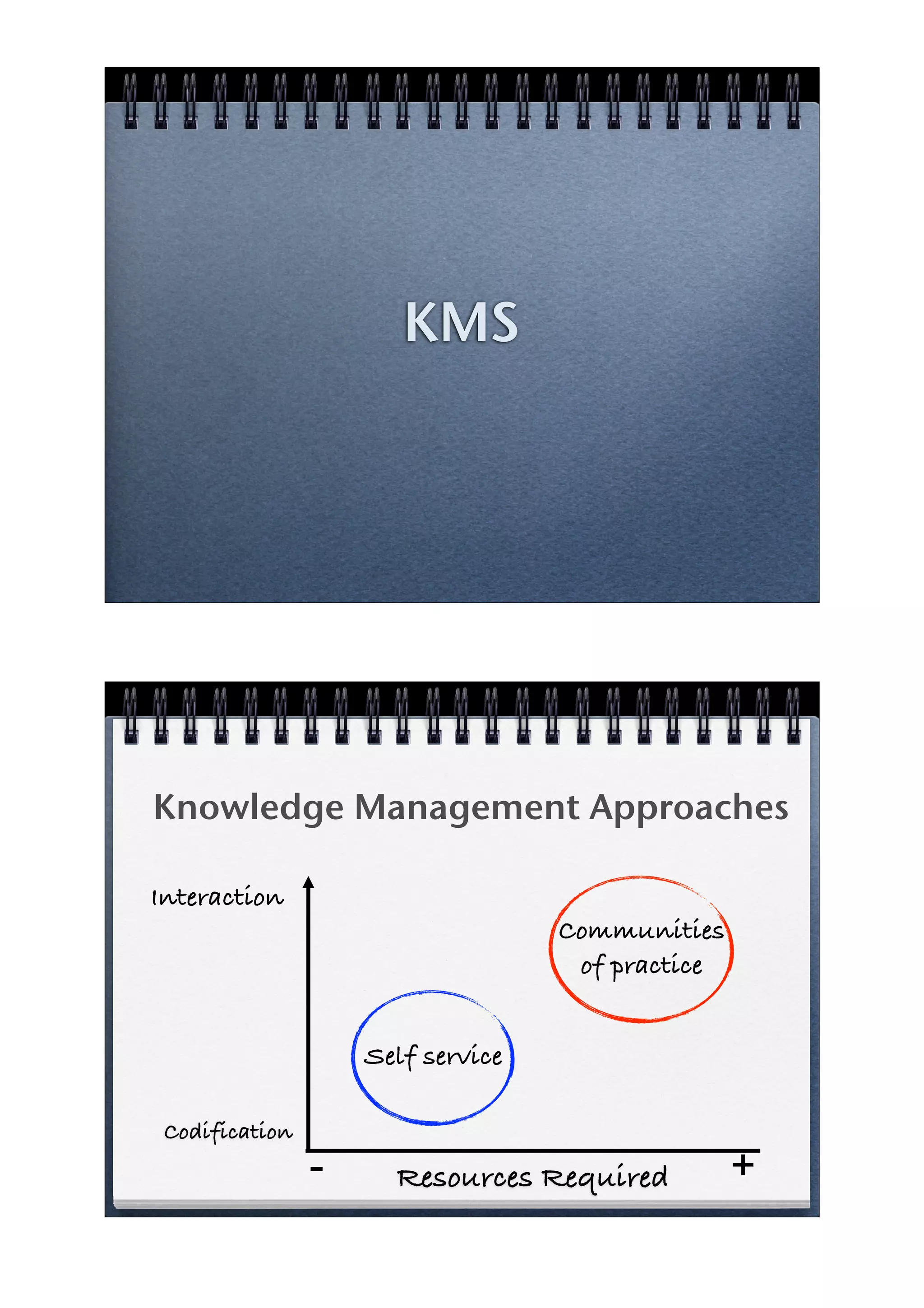
Knowledge Management Approaches

Interaction
                                   Communities
                                    of practice


                    Self service

 Codification
                -     Resources Required          +
“My KM is
 spelled with 6
 letters, and they
 are...”
The problem of Google as a KMS
        You lead a consulting company
        You find out that your employees do not
        use your internal KMS
            Instead they go to Google to find
            presentations


        What do you do?


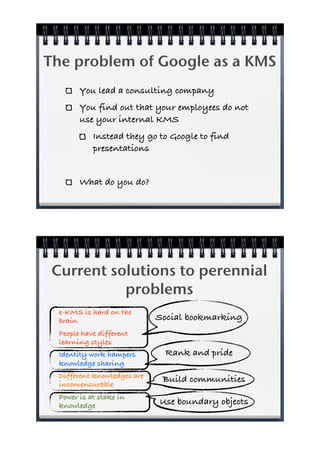
 Current solutions to perennial
           problems
  e-KMS is hard on the
  brain                      Social bookmarking
  People have different
  learning styles
  Identity work hampers        Rank and pride
  knowledge sharing
  Different knowledges are    Build communities
  incomensurable
  Power is at stake in
  knowledge                  Use boundary objects
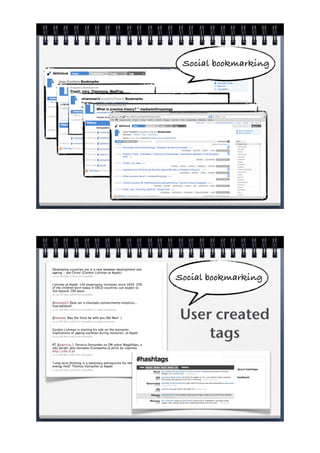
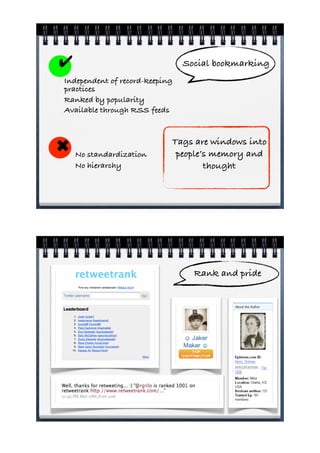
Social bookmarking


Social bookmarking


User created
    tags
!                               Social bookmarking
Independent of record-keeping
practices
Ranked by popularity
Available through RSS feeds


                            Tags are windows into
"   No standardization       people’s memory and
    No hierarchy                    thought


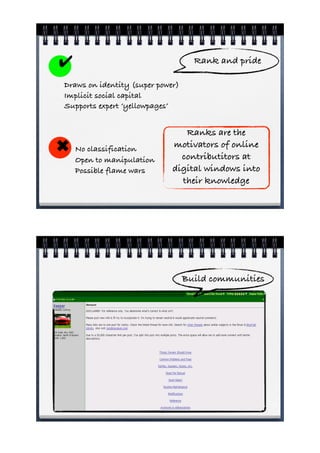
                                  Rank and pride
!                                   Rank and pride

Draws on identity (super power)
Implicit social capital
Supports expert ‘yellowpages’


                                Ranks are the
"   No classification
                             motivators of online
                               contributitors at
    Open to manipulation
    Possible flame wars      digital windows into
                               their knowledge


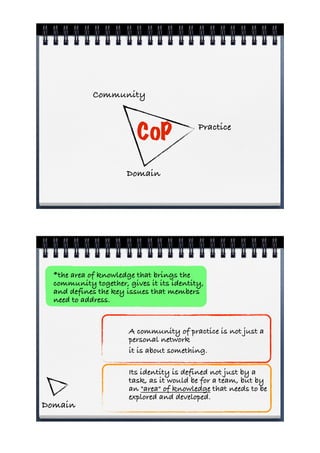
                                  Build communities
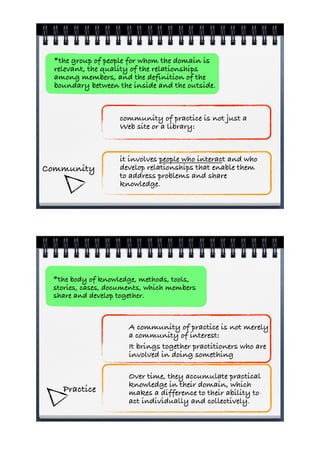
Community


                         CoP              Practice


                      Domain


  *the area of knowledge that brings the
  community together, gives it its identity,
  and defines the key issues that members
  need to address.


                       A community of practice is not just a
                       personal network
                       it is about something.

                       Its identity is defined not just by a
                       task, as it would be for a team, but by
                       an "area" of knowledge that needs to be
                       explored and developed.
Domain
*the group of people for whom the domain is
  relevant, the quality of the relationships
  among members, and the definition of the
  boundary between the inside and the outside.


                   community of practice is not just a
                   Web site or a library:


                   it involves people who interact and who
Community          develop relationships that enable them
                   to address problems and share
                   knowledge.


 *the body of knowledge, methods, tools,
 stories, cases, documents, which members
 share and develop together.


                      A community of practice is not merely
                      a community of interest:
                      It brings together practitioners who are
                      involved in doing something

                      Over time, they accumulate practical
                      knowledge in their domain, which
    Practice          makes a difference to their ability to
                      act individually and collectively.
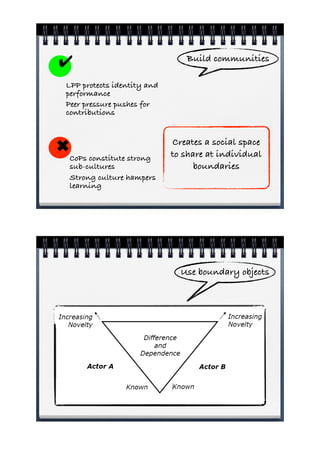
Build communities
!
LPP protects identity and
performance
Peer pressure pushes for
contributions


                             Creates a social space
"                            to share at individual
    CoPs constitute strong
    sub-cultures                   boundaries
    Strong culture hampers
    learning


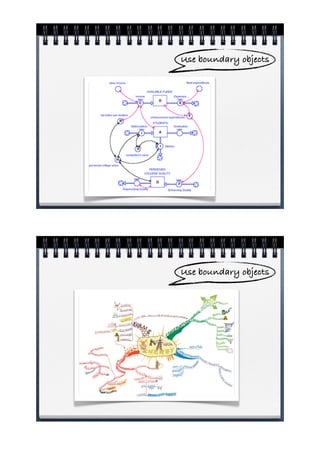
                               Use boundary objects
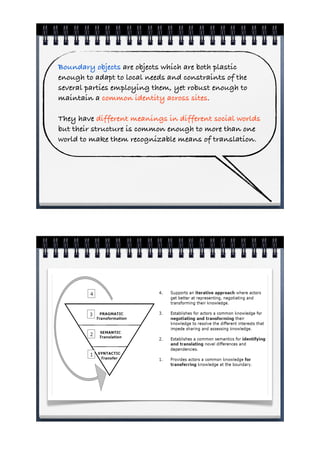
Use boundary objects


Use boundary objects
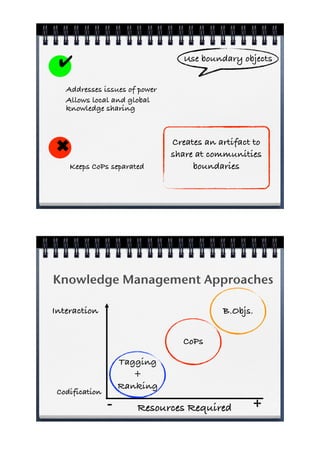
Boundary objects are objects which are both plastic
enough to adapt to local needs and constraints of the
several parties employing them, yet robust enough to
maintain a common identity across sites.

They have different meanings in different social worlds
but their structure is common enough to more than one
world to make them recognizable means of translation.
Use boundary objects
 !
   Addresses issues of power
   Allows local and global
   knowledge sharing


                               Creates an artifact to
 "                             share at communities
     Keeps CoPs separated           boundaries


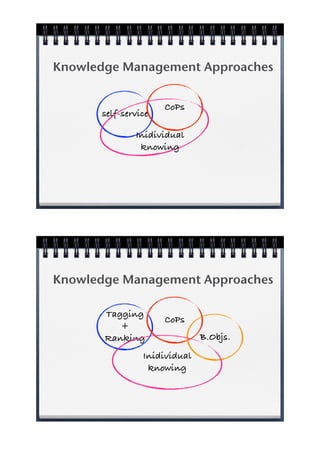
Knowledge Management Approaches

Interaction                                B.Objs.


                                  CoPs

                    Tagging
                       +
                    Ranking
 Codification
                -      Resources Required         +
Knowledge Management Approaches


                     CoPs
      self-service

              Inidividual
               knowing


Knowledge Management Approaches

       Tagging
                     CoPs
          +
       Ranking                B.Objs.
                Inidividual
                 knowing
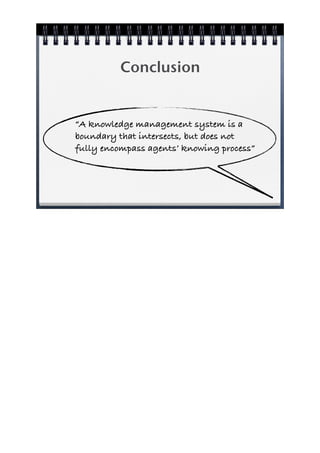
Conclusion


“A knowledge management system is a
boundary that intersects, but does not
fully encompass agents’ knowing process”

IS Undergrads Class 17

  • 1.
    KMS Knowledge Management Approaches Interaction Communities of practice Self service Codification - Resources Required +
  • 2.
    “My KM is spelled with 6 letters, and they are...”
  • 3.
    The problem ofGoogle as a KMS You lead a consulting company You find out that your employees do not use your internal KMS Instead they go to Google to find presentations What do you do? Current solutions to perennial problems e-KMS is hard on the brain Social bookmarking People have different learning styles Identity work hampers Rank and pride knowledge sharing Different knowledges are Build communities incomensurable Power is at stake in knowledge Use boundary objects
  • 4.
  • 5.
    ! Social bookmarking Independent of record-keeping practices Ranked by popularity Available through RSS feeds Tags are windows into " No standardization people’s memory and No hierarchy thought Rank and pride
  • 6.
    ! Rank and pride Draws on identity (super power) Implicit social capital Supports expert ‘yellowpages’ Ranks are the " No classification motivators of online contributitors at Open to manipulation Possible flame wars digital windows into their knowledge Build communities
  • 7.
    Community CoP Practice Domain *the area of knowledge that brings the community together, gives it its identity, and defines the key issues that members need to address. A community of practice is not just a personal network it is about something. Its identity is defined not just by a task, as it would be for a team, but by an "area" of knowledge that needs to be explored and developed. Domain
  • 8.
    *the group ofpeople for whom the domain is relevant, the quality of the relationships among members, and the definition of the boundary between the inside and the outside. community of practice is not just a Web site or a library: it involves people who interact and who Community develop relationships that enable them to address problems and share knowledge. *the body of knowledge, methods, tools, stories, cases, documents, which members share and develop together. A community of practice is not merely a community of interest: It brings together practitioners who are involved in doing something Over time, they accumulate practical knowledge in their domain, which Practice makes a difference to their ability to act individually and collectively.
  • 9.
    Build communities ! LPP protectsidentity and performance Peer pressure pushes for contributions Creates a social space " to share at individual CoPs constitute strong sub-cultures boundaries Strong culture hampers learning Use boundary objects
  • 10.
    Use boundary objects Useboundary objects
  • 11.
    Boundary objects areobjects which are both plastic enough to adapt to local needs and constraints of the several parties employing them, yet robust enough to maintain a common identity across sites. They have different meanings in different social worlds but their structure is common enough to more than one world to make them recognizable means of translation.
  • 12.
    Use boundary objects ! Addresses issues of power Allows local and global knowledge sharing Creates an artifact to " share at communities Keeps CoPs separated boundaries Knowledge Management Approaches Interaction B.Objs. CoPs Tagging + Ranking Codification - Resources Required +
  • 13.
    Knowledge Management Approaches CoPs self-service Inidividual knowing Knowledge Management Approaches Tagging CoPs + Ranking B.Objs. Inidividual knowing
  • 14.
    Conclusion “A knowledge managementsystem is a boundary that intersects, but does not fully encompass agents’ knowing process”